Results by title
1761 books match the query 'Public Policy' and 70 start with e

Early Start
Preschool Politics in the United StatesAndrew Karch
University of Michigan Press, 2014
In the United States, preschool education is characterized by the dominance of a variegated private sector and patchy, uncoordinated oversight of the public sector. Tracing the history of the American debate over preschool education, Andrew Karch argues that the current state of decentralization and fragmentation is the consequence of a chain of reactions and counterreactions to policy decisions dating from the late 1960s and early 1970s, when preschool advocates did not achieve their vision for a comprehensive national program but did manage to foster initiatives at both the state and national levels. Over time, beneficiaries of these initiatives and officials with jurisdiction over preschool education have become ardent defenders of the status quo. Today, advocates of greater government involvement must take on a diverse and entrenched set of constituencies resistant to policy change.
In his close analysis of the politics of preschool education, Karch demonstrates how to apply the concepts of policy feedback, critical junctures, and venue shopping to the study of social policy.
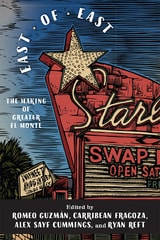
East of East
The Making of Greater El MonteRomeo Guzmán
Rutgers University Press, 2020

Eating Grasshoppers
Chapulines and the Women Who Sell ThemJeffrey H. Cohen
University of Texas Press, 2025
An approachable ethnography of how grasshoppers are harvested, sold, and consumed in Oaxaca.
Chapulines (toasted grasshoppers) are not a delicacy in Oaxaca. They are just food—good food—and a protein-rich seasonal snack that is the product of a long-standing industry based overwhelmingly on the labor of women. Jeffrey Cohen has interviewed dozens of these chapulineras, who harvest insects from corn and alfalfa fields, prepare them, and sell them in urban and rural marketplaces. An accessible ethnography, Eating Grasshoppers tells their story alongside the broader history of chapulines.
For tourists, chapulines are an experience—a gateway to the “real” Oaxaca. For locals, they are ordinary fare, but also a reminder of Indigenous stability and rural survival. In a sense, eating chapulines is a declaration of independence from a government that has condemned eating insects as backward. Yet, while chapulines are a generations-old favorite, eating them is not an act of preservation. Cohen shows that the business of this traditional food is thoroughly modern and ever evolving, with entrepreneurial chapulineras responding nimbly to complex and dynamic markets. From alfalfa fields to online markets, Eating Grasshoppers takes readers inside one of the world’s most fascinating food cultures.

Eating Her Curries and Kway
A Cultural History of Food in SingaporeNicole Tarulevicz
University of Illinois Press, 2013
Discovering Singaporean identity through cooking and cuisine
While eating is a universal experience, for Singaporeans it carries strong national connotations. The popular Singaporean-English phrase "Die die must try" is not so much hyperbole as it is a reflection of the lengths that Singaporeans will go to find great dishes.
In Eating Her Curries and Kway: A Cultural History of Food in Singapore, Nicole Tarulevicz argues that in a society that has undergone substantial change in a relatively short amount of time, food serves Singaporeans as a poignant connection to the past. Eating has provided a unifying practice for a diverse society, a metaphor for multiracialism and recognizable national symbols for a fledgling state. Covering the period from British settlement in 1819 to the present and focusing on the post–1965 postcolonial era, Tarulevicz tells the story of Singapore through the production and consumption of food.
Analyzing a variety of sources that range from cookbooks to architectural and city plans, Tarulevicz offer a thematic history of this unusual country, which was colonized by the British and operated as a port within Malaya. Connecting food culture to the larger history of Singapore, she discusses various topics including domesticity and home economics, housing and architecture, advertising, and the regulation of food-related manners and public behavior such as hawking, littering, and chewing gum. Moving away from the predominantly political and economic focus of other histories of Singapore, Eating Her Curries and Kway provides an important alternative reading of Singaporean society.

Eating Is an English Word
Annemarie Mol
Duke University Press, 2024

Eating Our Way through the Anthropocene
Jessica Fanzo
University of Utah Press, 2022
Originally delivered as the Stegner Lecture at the 2020 annual symposium of the Wallace Stegner Center for Land, Resources and the Environment, this book explores how, in the context of the broad global trends of population growth, climate crisis, and inequitable food availability, food systems need to be re-oriented to ensure they can produce enough food to nourish the world. Fanzo discusses moving toward on-farm sustainable food production practices, decreasing food loss and waste, addressing poverty by creating jobs and decent livelihoods, and providing safe, affordable, and healthy diets for everyone. At the same time, food systems must decrease the pressure on biodiversity loss, conserve land and water resources, minimize air and water pollution, and lower greenhouse gas emissions.

Eating Together
Food, Friendship and InequalityAlice P. Julier
University of Illinois Press, 2013

Eating and Being
A History of Ideas about Our Food and OurselvesSteven Shapin
University of Chicago Press, 2024
Eating and Being is a history of Western thinking about food, eating, knowledge, and ourselves. In modern thought, eating is about what is good for you, not about what is good. Eating is about health, not about virtue. Yet this has not always been the case. For a great span of the past—from antiquity through about the middle of the eighteenth century—one of the most pervasive branches of medicine was known as dietetics, prescribing not only what people should eat but also how they should order many aspects of their lives, including sleep, exercise, and emotional management. Dietetics did not distinguish between the medical and the moral, nor did it acknowledge the difference between what was good for you and what was good. Dietetics counseled moderation in all things, where moderation was counted as a virtue as well as the way to health. But during the nineteenth century, nutrition science began to replace the language of traditional dietetics with the vocabulary of proteins, fats, carbohydrates, and calories, and the medical and the moral went their separate ways. Steven Shapin shows how much depended upon that shift, and he also explores the extent to which the sensibilities of dietetics have been lost.
Throughout this rich history, he evokes what it felt like to eat during another historical period and invites us to reflect on what it means to feel about food as we now do. Shapin shows how the change from dietetics to nutrition science fundamentally altered how we think about our food and its powers, our bodies, and our minds.
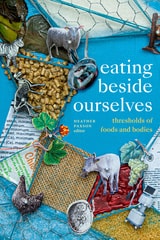
Eating beside Ourselves
Thresholds of Foods and BodiesHeather Paxson, editor
Duke University Press, 2023
Contributors. Alex Blanchette, Deborah Heath, Hannah Landecker, Marianne Elisabeth Lien, Amy Moran-Thomas, Heather Paxson, Harris Solomon, Emily Yates-Doerr, Wim Van Daele

Eating in Theory
Annemarie Mol
Duke University Press, 2021
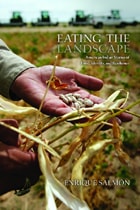
Eating the Landscape
American Indian Stories of Food, Identity, and ResilienceEnrique Salmón
University of Arizona Press, 2012
"Eating is not only a political act, it is also a cultural act that reaffirms one’s identity and worldview," Enrique Salmón writes in Eating the Landscape. Traversing a range of cultures, including the Tohono O’odham of the Sonoran Desert and the Rarámuri of the Sierra Tarahumara, the book is an illuminating journey through the southwest United States and northern Mexico. Salmón weaves his historical and cultural knowledge as a renowned indigenous ethnobotanist with stories American Indian farmers have shared with him to illustrate how traditional indigenous foodways—from the cultivation of crops to the preparation of meals—are rooted in a time-honored understanding of environmental stewardship.
In this fascinating personal narrative, Salmón focuses on an array of indigenous farmers who uphold traditional agricultural practices in the face of modern changes to food systems such as extensive industrialization and the genetic modification of food crops. Despite the vast cultural and geographic diversity of the region he explores, Salmón reveals common themes: the importance of participation in a reciprocal relationship with the land, the connection between each group’s cultural identity and their ecosystems, and the indispensable correlation of land consciousness and food consciousness. Salmón shows that these collective philosophies provide the foundation for indigenous resilience as the farmers contend with global climate change and other disruptions to long-established foodways. This resilience, along with the rich stores of traditional ecological knowledge maintained by indigenous agriculturalists, Salmón explains, may be the key to sustaining food sources for humans in years to come.
As many of us begin to question the origins and collateral costs of the food we consume, Salmón’s call for a return to more traditional food practices in this wide-ranging and insightful book is especially timely. Eating the Landscape is an essential resource for ethnobotanists, food sovereignty proponents, and advocates of the local food and slow food movements.

Eating to Learn, Learning to Eat
The Origins of School Lunch in the United StatesA. R. Ruis
Rutgers University Press, 2017

Eco-Sufficiency and Global Justice
Women Write Political EcologyEdited by Ariel Salleh
Pluto Press, 2009
As the twenty-first century faces a crisis of democracy and sustainability, this book attempts to bring academics and alternative globalisation activists into conversation.
Through studies of global neoliberalism, ecological debt, climate change, and the ongoing devaluation of reproductive and subsistence labour, these uncompromising essays by internationally distinguished women thinkers expose the limits of current scholarship in political economy, ecological economics, and sustainability science.
The book introduces groundbreaking theoretical concepts for talking about humanity-nature links and will be a challenging read for activists and for students of political economy, environmental ethics, global studies, sociology, women's studies, and critical geography.
Ecocide
A Short History of the Mass Extinction of SpeciesFranz Broswimmer
Pluto Press, 2002
Ecological Governance
Toward a New Social Contract with the EarthBruce Jennings
West Virginia University Press, 2016
As our economic and natural systems continue on their collision course, Bruce Jennings asks whether we have the political capacity to avoid large-scale environmental disaster. Can liberal democracy, he wonders, respond in time to ecological challenges that require dramatic changes in the way we approach the natural world? Must a more effective governance be less democratic and more autocratic? Or can a new form of grassroots ecological democracy save us from ourselves and the false promises of material consumption run amok?
Ecological Governance is an ethicist’s reckoning with how our political culture, broadly construed, must change in response to climate change. Jennings argues that during the Anthropocene era a social contract of consumption has been forged. Under it people have given political and economic control to elites in exchange for the promise of economic growth. In a new political economy of the future, the terms of the consumptive contract cannot be met without severe ecological damage. We will need a new guiding vision and collective aim, a new social contract of ecological trusteeship and responsibility.
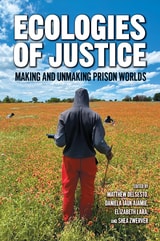
Ecologies of Justice
Making and Unmaking Prison WorldsMatthew DelSesto
Rutgers University Press, 2027
What is the role of multi-species ecologies in creating spaces that counteract the violence in carceral systems and environmental destruction? This book brings together, for the first time, contributions on issues related to prison, jail, and reentry programs, community-based interventions, environmental justice, and sustainability. Through rigorous analysis, detailed case studies, poetry, and personal reflections, the book offers ways of thinking and acting at the intersection of environmental issues and the carceral system. It gathers hard-earned wisdom and insight of researchers, activists, practitioners, and community leaders from within and beyond prison walls who have taken up their projects despite profound institutional constraints.
Approaches in the book range from reform to abolition, as authors detail both practical interventions and imaginative courses of action. More than a contribution to academic knowledge, the book also uniquely highlights voices of those who are incarcerated, survivors of crime, and institutional stakeholders. In addition to writing about the carceral system based on research and personal experience, authors describe practices that are creating transformative spaces of environmental education, building effective pipelines for green workforce development, and sustaining reciprocal relationships for eco-social healing.
Visit for more information: ecologiesofjustice.net
Economic Inequality and Higher Education
Access, Persistence, and SuccessStacy Dickert-Conlin
Russell Sage Foundation, 2007
Economic Interdependence and International Conflict
New Perspectives on an Enduring DebateEdward D. Mansfield and Brian M. Pollins, Editors
University of Michigan Press, 2003
Edward D. Mansfield is Hum Rosen Professor of Political Science and Co-Director of the Christopher H. Browne Center for International Politics at the University of Pennsylvania.
Brian M. Pollins is Associate Professor of Political Science at Ohio State University and a Research Fellow at the Mershon Center.
Economic Performance in the Nordic World
Torben M. Andersen
University of Wisconsin Press, 2021
Economist Torben M. Andersen shows how the Nordic model rests on two pillars: the social safety net, which offers income compensation to the majority of those unable to support themselves, and the provision of services like education, childcare, and healthcare to all. The Nordic model can be characterized as one of employment, since its financial viability rests on a high labor participation rate with few working poor.
Andersen lays out the structure of the model and highlights factors important for understanding its economic performance. He then looks into specific policy areas based on Denmark's experiences regarding labor market policies (flexicurity), pension systems, and preparation for an aging population; and addresses the challenges arising from new technologies and globalization.
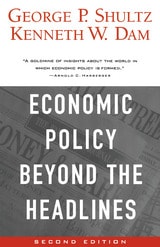
Economic Policy Beyond the Headlines
George P. Shultz and Kenneth W. Dam
University of Chicago Press, 1998
"A model of brevity and lucidity . . . [Economic Policy Beyond the Headlines] incorporates a unique and rewarding blend of economic reasoning with a high level of political awareness . . . enriched by the wide personal experience in government of the authors."—Albert T. Sommers, Across the Board
"[Shultz and Dam] help foreign readers to understand why the world looks so different from Washington. . . . This book should provide the model."—The Economist
"A wise and valuable book showing great insight into the realities of economic policy making."—Henry A. Kissinger
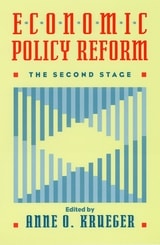
Economic Policy Reform
The Second StageEdited by Anne O. Krueger
University of Chicago Press, 2000
Economic Policy Reform: The Second Stage provides an incisive overview of the context of these crucial second-stage reforms with a thorough examination of the issues confronting the policymakers involved. Edited by Anne O. Krueger, it features studies from distinguished experts in various fields of economics. Each chapter of this book addresses a key issue in economic policy, examines the progress of reforms in the markets considered, and then explores what research might further aid leaders as they embark on fundamental changes.
Both a handbook for economists and practitioners and a theoretical exploration of the most significant challenges currently facing the economic world, this new book will be indispensable to anyone involved in the global economic scene.
Contributors:
Vittorio Corbo
Cimon Cowan
Sebastian Edwards
Stephan Haggard
Michael Kremer
Steven Matusz
Frederic S. Mishkin
Jonathan Morduch
Roger G. Noll
Miguel A. Savastano
T. Paul Shultz
Mary M. Shirley
T.N. Srinivasan
Joseph E. Stiglitz
Vito Tanzi
David Tarr
Aaron Tornell
Economic Policy, Exchange Rates, and the International System
W. Max Corden
University of Chicago Press, 1994
Exchange Rates, and the World Economy, this book addresses topics in
international macroeconomics that have come to the forefront of economic
policy debates in recent years. Covering exchange rate policy, the
European Monetary System, protection and competition, and the
international "non-system" since the collapse of Bretton Woods, Corden
provides a probing analysis of significant economic trends associated
with the increasing integration of the world capital market.
Beginning with essays on exchange rate policy, the current account, and
external effects of fiscal policy, Corden lays out the foundations of
balance-of-payments theory in relation to wage rates, income
distribution, and inflation. Chapters on the European Monetary System
focus on monetary integration and look skeptically at European proposals
to move toward monetary union. Other topical essays discuss the
"competitiveness" problem and the relation between protection and
macroeconomic policy.
Corden summarizes and clarifies a vast range of work on the coordination
of macroeconomic policies and critically reviews various proposals for
reforming the international monetary system.
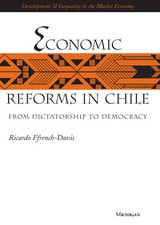
Economic Reforms in Chile
From Dictatorship to DemocracyRicardo Ffrench-Davis
University of Michigan Press, 2002
Written in accessible and readable prose, Economic Reforms in Chile begins with an overview of the Chilean economy during the last fifty years. This historical time frame is divided into three periods of economic reform. The first period covers the Pinochet regime, during which the more orthodox neoliberalism was implemented. The second period includes the Pinochet dictatorship, during which economic policy shifted toward pragmatism, particularly in the areas of trade and finance; it also includes the crisis of 1982 and its effects. The third period begins in 1990 with the return to democratic elections and the significant reforms to prior reforms. This section also examines the search for growth-with-equity, success in investment and growth performance, macroeconomic sustainability, and the reduction of poverty. Ffrench-Davis addresses several "paradoxes," or results that defy the expectations of policymakers, in order to analyze the significance of comprehensive macroeconomic equilibrium and its implications for sustainable stability, growth, and equity.
Economic Reforms in Chile will be of interest to economists, political scientists, and policymakers involved with the economies of emerging and developing countries.
Ricardo Ffrench-Davis is Principal Regional Advisor, ECLAC, Santiago, and Professor of Economics, University of Chile.
Economics and Elections
The Major Western DemocraciesMichael S. Lewis-Beck
University of Michigan Press, 1990
Economics and Politics
The Calculus of SupportHelmut Norpoth, Michael S. Lewis-Beck, and Jean-Dominique Lafay, Editors
University of Michigan Press, 1991
Educating the Enemy
Teaching Nazis and Mexicans in the Cold War BorderlandsJonna Perrillo
University of Chicago Press, 2022
Educating the Enemy begins with the 144 children of Nazi scientists who moved to El Paso, Texas, in 1946 as part of the military program called Operation Paperclip. These German children were bused daily from a military outpost to four El Paso public schools. Though born into a fascist enemy nation, the German children were quickly integrated into the schools and, by proxy, American society. Their rapid assimilation offered evidence that American public schools played a vital role in ensuring the victory of democracy over fascism.
Jonna Perrillo not only tells this fascinating story of Cold War educational policy, but she draws an important contrast with another, much more numerous population of children in the El Paso public schools: Mexican Americans. Like everywhere else in the Southwest, Mexican American children in El Paso were segregated into “Mexican” schools, where the children received a vastly different educational experience. Not only were they penalized for speaking Spanish—the only language all but a few spoke due to segregation—they were tracked for low-wage and low-prestige careers, with limited opportunities for economic success. Educating the Enemy charts what two groups of children—one that might have been considered the enemy, the other that was treated as such—reveal about the ways political assimilation has been treated by schools as an easier, more viable project than racial or ethnic assimilation.
Listen to an interview with the author here and read an interview in Time and a piece based on the book in the Boston Review.
El Paso
Local Frontiers At A Global CrossroadsVictor M. Ortiz-Gonzalez
University of Minnesota Press, 2004
A grounded and instructive analysis of the ways globalization affects a border city
Every marker of social difference can be easily interpreted in the fashionable language of “borderlands”—and if so, as Victor M. Ortiz-Gonzalez reveals, the practical reality of the border region is often grossly misrepresented and its people woefully served. He argues that amid the tantalizing abstractions generated by the sweeping reconfigurations of globalization, people in cities like El Paso and Ciudad Juárez, on the U.S.–Mexican border, are actually living the gritty realities of a new world order.
With descriptions of grassroots initiatives to confront the challenges and opportunities that NAFTA represents for the city, El Paso challenges us to acknowledge and address the conceptual and sociopolitical tasks of a world in which abstract representations and non-local interests override concrete situations. Ortiz-Gonzalez also provides an in-depth analysis of groups such as La Mujer Obrera, Unite El Paso, and the Hispanic Chamber of Commerce and their attempts to give local residents and workers more autonomy and power.Balancing ethnographic detail with precise theoretical insights, El Paso offers a compelling case study and a stirring call to understand both the conceptual challenge and the social urgency of the effects of globalization in local settings.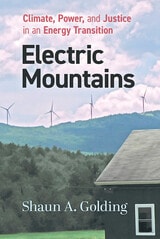
Electric Mountains
Climate, Power, and Justice in an Energy TransitionShaun A. Golding
Rutgers University Press, 2021
Committed environmentalists in one of North America’s most progressive regions desperately wanted energy policies that address the climate crisis. For many of them, wind turbines on Northern New England’s iconic ridgelines symbolize the energy transition that they have long hoped to see. For others, however, ridgeline wind takes on a very different meaning. When weighing its costs and benefits locally and globally, some wind opponents now see the graceful structures as symbols of corrupted energy politics.
This book derives from several years of research to make sense of how wind turbines have so starkly split a community of environmentalists, as well as several communities. In doing so, it casts a critical light on the roadmap for energy transition that Northern New England’s ridgeline wind projects demarcate. It outlines how ridgeline wind conforms to antiquated social structures propping up corporate energy interests, to the detriment of the swift de-carbonizing and equitable transformation that climate predictions warrant. It suggests, therefore, that the energy transition of which most of us are a part, is probably not the transition we would have designed ourselves, if we had been asked.
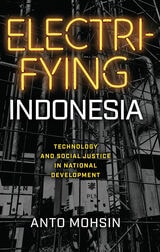
Electrifying Indonesia
Technology and Social Justice in National DevelopmentAnto Mohsin
University of Wisconsin Press, 2023
Elements of Econometrics
Second EditionJan Kmenta
University of Michigan Press, 1997
Throughout the book the emphasis is on simplification whenever possible, assuming the readers know college algebra and basic calculus. Jan Kmenta explains all methods within the simplest framework, and generalizations are presented as logical extensions of simple cases. And while a relatively high degree of rigor is preserved, every conflict between rigor and clarity is resolved in favor of the latter. Apart from its clear exposition, the book's strength lies in emphasizing the basic ideas rather than just presenting formulas to learn and rules to apply.
The book consists of two parts, which could be considered jointly or separately. Part one covers the basic elements of the theory of statistics and provides readers with a good understanding of the process of scientific generalization from incomplete information. Part two contains a thorough exposition of all basic econometric methods and includes some of the more recent developments in several areas.
As a textbook, Elements of Econometrics is intended for upper-level undergraduate and master's degree courses and may usefully serve as a supplement for traditional Ph.D. courses in econometrics. Researchers in the social sciences will find it an invaluable reference tool.
A solutions manual is also available for teachers who adopt the text for coursework.
Jan Kmenta is Professor Emeritus of Economics and Statistics, University of Michigan.

Ellen Johnson Sirleaf
Pamela Scully
Ohio University Press, 2016
In this timely addition to the Ohio Short Histories of Africa series, Pamela Scully takes us from the 1938 birth of Nobel Peace Prize winner and two-time Liberian president Ellen Johnson through the Ebola epidemic of 2014–15. Charting her childhood and adolescence, the book covers Sirleaf’s relationship with her indigenous grandmother and urban parents, her early marriage, her years studying in the United States, and her career in international development and finance, where she developed her skill as a technocrat. The later chapters cover her years in and out of formal Liberian politics, her support for women’s rights, and the Ebola outbreak.
Sirleaf’s story speaks to many of the key themes of the twenty-first century. Among these are the growing power of women in the arenas of international politics and human rights; the ravaging civil wars in which sexual violence is used as a weapon; and the challenges of transitional justice in building postconflict societies. Ellen Johnson Sirleaf is an astute examination of the life of a pioneering feminist politician.

Elsewhere
How the US Food System Cultivates, Consumes, and Conceals Its ViolenceStian Rice
West Virginia University Press, 2026
Elsewhere argues that you can make all of the “smart” food choices you want and follow Michael Pollan to the letter, but that won’t end the violence in the food system. Eating is an act of violence. With every life-sustaining meal and food purchase, we shorten the lives of farmers, laborers, animals, the planet, and ourselves. This isn’t a symptom of a broken food system, but a feature of a working one: our capitalist food system doesn’t cause harm accidentally, it does so because it has to. To keep generating wealth, the system moves its violence around, away from privileged producers and consumers and into forgettable elsewheres: reservations, prisons, distant islands, killing floors, inner cities, rural hinterlands, and war-torn countries.
This shell-game is not new. Elsewhere examines the 250-year history of the US food system to uncover how the country used abundance to enrich some and exploit others; how it captured, colonized, and reorganized territory to conceal its harms; and why decades of technological innovation, environmental awareness, and consumer consciousness haven’t staunched these self-inflicted wounds. Elsewhere invites us to ask different questions about the food system: where does its violence come from, where does it go, and how can we nurture a food system that first does no harm.
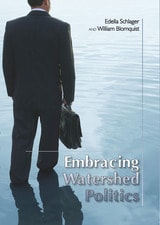
Embracing Watershed Politics
Edella Schlager
University Press of Colorado, 2008
Enriched by case studies of the organizations and decision making processes in several major U.S. watersheds (the Delaware River Basin, San Gabriel River, Platte River, and the Columbia River Basin), Embracing Watershed Politics presents a reasoned explanation of why there are so few watershed-scale integrated management agencies and how the more diverse multi-organizational arrangements found in the vast majorities of watersheds work. Although the presence of multiple organizations representing a multitude of communities of interest complicates watershed management, these institutional arrangements can-under certain conditions-suit the complexity and uncertainty associated with watershed management in the twenty-first century.
Empowering Exporters
Reciprocity, Delegation, and Collective Action in American Trade PolicyMichael J. Gilligan
University of Michigan Press, 1997
Empowering Smart Cities through Community-Centred Public Private Partnerships and Innovations
Debra Lam
The Institution of Engineering and Technology, 2024
Empowering the Public-Private Partnership
The Future of America’s Local GovernmentGeorge V. Voinovich
Ohio University Press, 2017
America’s cities are increasingly acknowledged as sites of renewal and economic opportunity—but how can city leaders facing physical and financial constraints harness this positive energy to create sustainable development? The story of Cleveland in the early 1980s provides the necessary roadmap. Mayor George V. Voinovich, by drawing on the combined strengths of the public and private sectors, took Cleveland from financial default to becoming “America’s Comeback City,” and he later used the best practices he developed there to tackle state-level challenges as governor of Ohio. The public-private partnership model that Voinovich pioneered has since become the gold standard for cities seeking to maximize resources.
Using lessons from Cleveland, Voinovich developed this handbook for governments and private entities seeking a mutually enriching partnership. It is his legacy to those who will guide America’s cities to new growth and vitality.

Ending Ageism, or How Not to Shoot Old People
Gullette, Margaret Morganroth
Rutgers University Press, 2017
When the term “ageism” was coined in 1969, many problems of exclusion seemed resolved by government programs like Social Security and Medicare. As people live longer lives, today’s great demotions of older people cut deeper into their self-worth and human relations, beyond the reach of law or public policy. In Ending Ageism, or How Not to Shoot Old People, award-winning writer and cultural critic Margaret Morganroth Gullette confronts the offenders: the ways people aging past midlife are portrayed in the media, by adult offspring; the esthetics and politics of representation in photography, film, and theater; and the incitement to commit suicide for those with early signs of “dementia.”
In this original and important book, Gullette presents evidence of pervasive age-related assaults in contemporary societies and their chronic affects. The sudden onset of age-related shaming can occur anywhere—the shove in the street, the cold shoulder at the party, the deaf ear at the meeting, the shut-out by the personnel office or the obtuseness of a government. Turning intimate suffering into public grievances, Ending Ageism, Or How Not to Shoot Old People effectively and beautifully argues that overcoming ageism is the next imperative social movement of our time.
About the cover image:
This elegant, dignified figure--Leda Machado, a Cuban old enough to have seen the Revolution--once the center of a vast photo mural, is now a fragment on a ruined wall. Ageism tears down the structures that all humans need to age well; to end it, a symbol of resilience offers us all brisk blue-sky energy.
“Leda Antonia Machado” from “Wrinkles of the City, 2012.”
Piotr Trybalski / Trybalski.com. Courtesy of the artist.
A Declaration of Grievances
"A Declaration of Grievances" was written by Margaret Morganroth Gullette and is excerpted from her book Ending Ageism, or How Not to Shoot Old People (2017, Rutgers University Press). The poster was designed by Carolyn Kerchof.
- A Declaration of Grievances (in English): https://d3tto5i5w9ogdd.cloudfront.net/wp-content/uploads/2023/01/15175130/A-Declaration-of-Grievances_Eng.pdf
- A Declaration of Grievances (in Spanish): https://d3tto5i5w9ogdd.cloudfront.net/wp-content/uploads/2023/01/15175131/A-Declaration-of-Grievances_Spanish.pdf
- A Declaration of Grievances (in French): https://d3tto5i5w9ogdd.cloudfront.net/wp-content/uploads/2023/01/15175130/A-Declaration-of-Grievances_French.pdf
- A Declaration of Grievances (in German): https://d3tto5i5w9ogdd.cloudfront.net/wp-content/uploads/2023/01/15175131/A-Declaration-of-Grievances_German.pdf
Print the PDF (make sure to click "fit to page") and hang the Declaration up in your home or place of work. Please share this link with other people you know who care about the rights of older persons. Share on social media with the hashtags #ADeclarationOfGrievances and #EndingAgeismGullette.
For more information, an excerpt, links to reviews, and special offers on this book, go to: https://www.rutgersuniversitypress.org/ending-ageism
Related website: (https://www.brandeis.edu/wsrc/scholars/profiles/gullette.html)

Endless Empire
Spain's Retreat, Europe's Eclipse, America's DeclineEdited by Alfred W. McCoy, Josep M. Fradera, and Stephen Jacobson
University of Wisconsin Press, 2012
- erosion of economic and fiscal strength needed for military power on a global scale
- misuse of military power through micro-military misadventures
- breakdown of alliances among major powers
- weakened controls over the subordinate elites critical for any empire’s exercise of global power
- insufficient technological innovation to sustain global force projection.

Energy in the Nordic World
Mogens Rüdiger and Anna Åberg
University of Wisconsin Press, 2023
Norway and Sweden are among the biggest consumers of energy per capita, yet the Nordic nations also lead the world in clean power production and have ambitious goals of decarbonizing their energy systems by 2050. Denmark, Norway, Sweden, Finland, and Iceland vary drastically in geography and the availability of natural resources, but each consistently generates electricity from renewable sources at multiple times the average rate of other high-income countries.
Mogens Rüdiger and Anna Åberg present a concise and timely history of energy production, trade, and consumption in Norden, starting with a review of the regional energy mix—from wind, solar, tide and wave, geothermal, biomass, nuclear, coal, and gas sources. Brief chapters describe the diversity of Nordic energy markets, assess how far the green transition has come, and explore what comes next as global crises, domestic politics, and technological developments present novel challenges and opportunities. Energy infrastructures and economic activities, Rüdiger and Åberg argue, serve as unique cultural focal points in the region. The coauthors summarize the national policy frameworks for the sector as well as the key energy and economic indicators used in infrastructure planning, regulation, and the opening of the electricity and gas markets to free competition.
Energy in the Nordic World is the essential primer to the power markets at the heart of Europe’s energy transition.
Enforcement at the EPA
High Stakes and Hard Choices, Revised EditionBy Joel A. Mintz
University of Texas Press, 2012
The only published work that treats the historical evolution of EPA enforcement, this book provides a candid inside glimpse of a crucial aspect of the work of an important federal agency. Based on 190 personal interviews with present and former enforcement officials at EPA, the U.S. Department of Justice, and key congressional staff members—along with extensive research among EPA documents and secondary sources—the book vividly recounts the often tumultuous history of EPA’s enforcement program. It also analyzes some important questions regarding EPA’s institutional relationships and the Agency’s working environment.
This revised and updated edition adds substantial new chapters examining EPA enforcement during the Clinton and George W. Bush administrations. Its treatment of issues of civil service decline and the applicability of captive agency theory is also new and original.
Engaged Urban Pedagogy
Participatory Practices in Planning and Place-MakingEdited by Lucy Natarajan and Michael Short
University College London, 2023
Engaged Urban Pedagogy presents a participatory approach to teaching about the built environment by exploring twelve examples of real-world engagement in urban planning involving people within, and beyond, the university. Starting with curriculum review, course content is analyzed in light of urban pasts, race, queer identity, lived experiences, and the concerns of urban professionals. Case studies then shift to focus on techniques for participatory critical pedagogy, including expanding the classroom with links to live place-making processes, connections made through digital co-design exercises, and student-led podcasting assignments. Finally, the book turns to activities beyond formal university teaching, such as those where school-age children learn about their own participation in urban processes together alongside university students and researchers. Drawing on foundational works of critical pedagogy, the contributors present a distinctly urban praxis that will help those in universities respond to the built environment challenges of today.
Entering Cultural Communities
Diversity and Change in the Nonprofit ArtsGrams, Diane
Rutgers University Press, 2008
The chapters in this book draw on interviews with leaders, staff, volunteers, and audience members from eighty-five nonprofit cultural organizations to explore how they are trying to increase participation and the extent to which they have been successful. The insiders' accounts point to the opportunities and challenges involved in such efforts, from the reinvention of programs and creation of new activities, to the addition of new departments and staff dynamics, to partnerships with new groups. The authors differentiate between "relational" and "transactional" practices, the former term describing efforts to build connections with local communities and the latter describing efforts to create new consumer markets for cultural products. In both cases, arts leaders report that, although positive results are difficult to measure conclusively, long-term efforts bring better outcomes than short-term activities.
The organizations discussed include large, medium, and small nonprofits located in urban, suburban, and rural areas—from large institutions such as the Smithsonian, the Walker Art Center, the Museum of Fine Arts Houston, and the San Francisco Symphony to many cultural organizations that are smaller, but often known nationally for their innovative work, such as AS220, The Loft Literary Center, Armory Center for the Arts, Appalshop, and the Western Folklife Center.

Entitled Opinions
Doxa after DigitalityCaddie Alford
University of Alabama Press, 2024
A rigorous redefinition of opinion—doxa—as an emergent, relational force shaped by digital infrastructures and rhetorical entanglements.
Many urgent contemporary issues—from demagoguery to white ethno-nationalism—compel us to consider opinions seriously. Yet while clichés like “he tells it like it is” and newer imperatives such as #BlackLivesMatter seem straightforward, haptics, emoji, and “like” buttons belie unexamined collective assumptions about how opinions in the digital realm function.
Caddie Alford illuminates this function by deploying the ancient Greek term for opinions: doxa. Doxa translates to “opinion,” but the term can also signal seemingness and expectations. Doxa’s capacious meanings reveal opinions to be more than static or monolithic: With doxa, opinions become emergent, dynamic, relational, and pluralistic.
Masterfully combining rhetorical frameworks as well as scholarship on opinions and digital media entanglements, Alford puts opinions into conversation with such case studies as algorithms, infrastructure, digital illiteracy, virality, and activism. She shows how “doxa” reveals gradations of opinions, from more reputable to less reputable. She demonstrates that these gradations are multifaceted and susceptible to interventions.
Entitled Opinions sheds much of the baggage associated with opinions while opening up more fertile pathways of inquiry. In a world that says, “don’t read the comments,” this book reads the comments, taking seriously content that could be easily dismissed otherwise and alchemizing judgments into implications.
Environmental Assessment in Countries in Transintion
Norman Lee
Central European University Press, 2000
Environmental Change
Rosemary O'Leary
Temple University Press, 1995
Environmental Change examines the impact of hundreds of federal court decisions on the policies and administration of the EPA since its inception in 1970. Having surveyed over 2,000 federal court decisions, Rosemary O'Leary presents case studies of five important policy areas: water quality, pesticides, toxic substances, air quality, and hazardous wastes.
Compliance with court orders, O'Leary discovered, has become one of the EPA's top priorities, at times overshadowing congressional mandates and the authority of EPA administrators.
For an agency often caught between the White House and Congressional agendas, the competing interests of industry and environmental groups, and turf battles with other federal agencies, O'Leary argues, judicial decision making is crucial in the public policy process.
Environmental Change offers valuable information in the fields of public policy and environmental law.
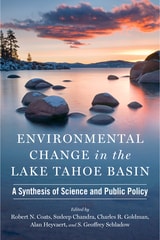
Environmental Change in the Lake Tahoe Basin
A Synthesis of Science and Public PolicyRobert N. Coats
University of Nevada Press, 2025
For over a century, scientific research and management efforts have aimed to mitigate the impacts of logging, mining, pollution, and invasive species while balancing urban development, tourism, and ecological preservation on the Lake. The book explores these challenges through a multidisciplinary lens, integrating environmental science, policy analysis, and case studies of both successful and failed management strategies. Written by experts who have played direct roles in key scientific discoveries and policy decisions, the book also examines the influence of environmental organizations and litigation in shaping conservation efforts.
At its core, the authors argue that the Tahoe Basin serves as a model for science-driven land and water stewardship. The book evaluates long-term monitoring programs, offering actionable recommendations for improving environmental oversight and resource management. Combining scientific analysis with accessible language, Environmental Change in the Lake Tahoe Basin serves as an up-to-date review of the region’s environmental challenges, providing an essential guide for scientists, resource managers, and policymakers.
The authors will donate all royalties from the sale of this volume to the Union of Concerned Scientist, www.ucs.org.

Environmental Imaginaries of the Middle East and North Africa
Diana K. Davis
Ohio University Press, 2011
The landscapes of the Middle East have captured our imaginations throughout history. Images of endless golden dunes, camel caravans, isolated desert oases, and rivers lined with palm trees have often framed written and visual representations of the region. Embedded in these portrayals is the common belief that the environment, in most places, has been deforested and desertified by centuries of misuse. It is precisely such orientalist environmental imaginaries, increasingly undermined by contemporary ecological data, that the eleven authors in this volume question. This is the first volume to critically examine culturally constructed views of the environmental history of the Middle East and suggest that they have often benefitted elites at the expense of the ecologies and the peoples of the region. The contributors expose many of the questionable policies and practices born of these environmental imaginaries and related histories that have been utilized in the region since the colonial period. They further reveal how power, in the form of development programs, notions of nationalism, and hydrological maps, for instance, relates to environmental knowledge production.
Contributors: Samer Alatout, Edmund Burke III, Shaul Cohen, Diana K. Davis, Jennifer L. Derr, Leila M. Harris, Alan Mikhail, Timothy Mitchell, Priya Satia, Jeannie Sowers, and George R. Trumbull IV

Environmental Inequality
Explaining Variation in Environmental Justice Efforts in the Mid-Atlantic StatesKimberly P. Fields
Temple University Press, 2027
The Mid-Atlantic region is often overlooked in environmental justice scholarship, but as Kimberly Fields argues, it provides insights into broadly applicable patterns of state policymaking. Focusing on Pennsylvania, Delaware, Maryland, and Virginia, Fields examines how state governments respond to claims of environmental racism—deliberate decisions about whose neighborhoods should host environmental burdens—and to sustained pressure from community activists.
Environmental Inequality examines how these states develop their environmental justice policies and approaches as a way to understand why they vary in form and focus despite similar issues and demands. Fields reviews the institutional and structural factors that shape environmental justice policymaking. She pays particular attention to how the relevant policy-formulating bodies are organized and how they engage—or fail to engage—with affected communities. She considers race-conscious and race-dismissive models, as well as open versus closed approaches to deliberations with engaged local activists. By analyzing these processes, Fields uncovers profound implications of policymaking and institutional design choices, showing how differing arrangements produce variation in states’ policy focus and enactment.
Drawing on extensive original research, Environmental Inequality offers a nuanced and detailed explanation for the variation in state-level environmental justice efforts
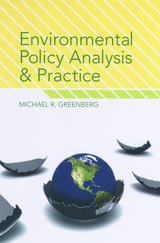
Environmental Policy Analysis and Practice
Greenberg, Michael R
Rutgers University Press, 2008
In Environmental Policy Analysis and Practice, Michael R. Greenberg cuts through the complicated layers of bureaucracy, science, and the public interest to show how all policy considerations can be broken down according to six specific factors: 1) the reaction of elected government officials, 2) the reactions of the public and special interests, 3) knowledge developed by scientists and engineers, 4) economics, 5) ethical imperatives, and 6) time pressure to make a decision.
The book is organized into two parts, with the first part defining and illustrating each one of these criteria. Greenberg draws on examples such as nuclear power, pesticides, brownfield redevelopment, gasoline additives, and environmental cancer, but focuses on how these subjects can be analyzed rather than exclusively on the issues themselves. Part two goes on to describe a set of over twenty tools that are used widely in policy analysis, including risk assessment, environmental impact analysis, public opinion surveys, cost-benefit analysis, and others. These tools are described and then illustrated with examples from part one.
Weaving together an impressive combination of practical advice and engaging first person accounts from government officials, administrators, and leaders in the fields of public health and medicine, this clearly written volume is poised to become a leading text in environmental policy.

Environmental Politics and Policy in the West, Revised Edition
Zachary A. Smith
University Press of Colorado, 2007
Zachary A. Smith and John Freemuth bring together a roster of top scholars to explicate the issues noted above as well as other key questions in this new edition of Environmental Politics and Policy in the West, which was first published in 1993. This thoroughly revised and updated edition offers a comprehensive and current survey.
Contributors address the policy process as it affects western states, how bureaucracy and politics shape environmental dialogues in the West, how western states innovate environmental policies independently of Washington, and how and when science is involved (or ignored) in management of the West's federal lands. Experts in individual resource areas explore multifaceted issues such as the politics of dam removal and restoration, wildlife resource concerns, suburban sprawl and smart growth, the management of hard-rock mining, and the allocation of the West's tightly limited water resources. Contributors include: Leslie R. Alm, Carolyn D. Baber, Walter F. Baber, Robert V. Bartlett, Hugh Bartling, Matthew A. Cahn, R. McGreggor Cawley, Charles Davis, Sandra Davis, John C. Freemuth, Sheldon Kamieniecki, Matt Lindstrom, William R. Mangun, Denise McCain-Tharnstrom, Daniel McCool, Jaina L. Moan, and Zachary A. Smith.