Results by title
753 books match the query 'Race' and 16 start with e

EC Comics
Race, Shock, and Social ProtestQiana Whitted
Rutgers University Press, 2019
Entertaining Comics Group (EC Comics) is perhaps best-known today for lurid horror comics like Tales from the Crypt and for a publication that long outlived the company’s other titles, Mad magazine. But during its heyday in the early 1950s, EC was also an early innovator in another genre of comics: the so-called “preachies,” socially conscious stories that boldly challenged the conservatism and conformity of Eisenhower-era America.
EC Comics examines a selection of these works—sensationally-titled comics such as “Hate!,” “The Guilty!,” and “Judgment Day!”—and explores how they grappled with the civil rights struggle, antisemitism, and other forms of prejudice in America. Putting these socially aware stories into conversation with EC’s better-known horror stories, Qiana Whitted discovers surprising similarities between their narrative, aesthetic, and marketing strategies. She also recounts the controversy that these stories inspired and the central role they played in congressional hearings about offensive content in comics.
The first serious critical study of EC’s social issues comics, this book will give readers a greater appreciation of their legacy. They not only served to inspire future comics creators, but also introduced a generation of young readers to provocative ideas and progressive ideals that pointed the way to a better America.

Edna Ferber's Hollywood
American Fictions of Gender, Race, and HistoryBy J. E. Smyth
University of Texas Press, 2009
Edna Ferber's Hollywood reveals one of the most influential artistic relationships of the twentieth century—the four-decade partnership between historical novelist Edna Ferber and the Hollywood studios. Ferber was one of America's most controversial popular historians, a writer whose uniquely feminist, multiracial view of the national past deliberately clashed with traditional narratives of white masculine power. Hollywood paid premium sums to adapt her novels, creating some of the most memorable films of the studio era—among them Show Boat, Cimarron, and Giant. Her historical fiction resonated with Hollywood's interest in prestigious historical filmmaking aimed principally, but not exclusively, at female audiences.
In Edna Ferber's Hollywood, J. E. Smyth explores the research, writing, marketing, reception, and production histories of Hollywood's Ferber franchise. Smyth tracks Ferber's working relationships with Samuel Goldwyn, Leland Hayward, George Stevens, and James Dean; her landmark contract negotiations with Warner Bros.; and the controversies surrounding Giant's critique of Jim-Crow Texas. But Edna Ferber's Hollywood is also the study of the historical vision of an American outsider—a woman, a Jew, a novelist with few literary pretensions, an unashamed middlebrow who challenged the prescribed boundaries among gender, race, history, and fiction. In a masterful film and literary history, Smyth explores how Ferber's work helped shape Hollywood's attitude toward the American past.
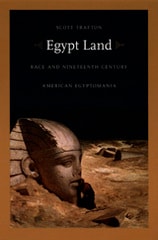
Egypt Land
Race and Nineteenth-Century American EgyptomaniaScott Trafton
Duke University Press, 2004
Drawing on literary and cultural studies, art and architectural history, political history, religious history, and the histories of archaeology and ethnology, Trafton illuminates anxieties related to race in different manifestations of nineteenth-century American Egyptomania, including the development of American Egyptology, the rise of racialized science, the narrative and literary tradition of the imperialist adventure tale, the cultural politics of the architectural Egyptian Revival, and the dynamics of African American Ethiopianism. He demonstrates how debates over what the United States was and what it could become returned again and again to ancient Egypt. From visions of Cleopatra to the tales of Edgar Allan Poe, from the works of Pauline Hopkins to the construction of the Washington Monument, from the measuring of slaves’ skulls to the singing of slave spirituals—claims about and representations of ancient Egypt served as linchpins for discussions about nineteenth-century American racial and national identity.
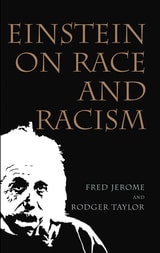
Einstein on Race and Racism
Einstein on Race and Racism, First Paperback EditionJerome, Fred
Rutgers University Press, 2005
Nearly fifty years after his death, Albert Einstein remains one of America's foremost cultural icons. A thicket of materials, ranging from scholarly to popular, have been written, compiled, produced, and published about his life and his teachings. Among the ocean of Einsteinia-scientific monographs, biographies, anthologies, bibliographies, calendars, postcards, posters, and Hollywood films-however, there is a peculiar void when it comes to the connection that the brilliant scientist had with the African American community. Nowhere is there any mention of his close relationship with Paul Robeson, despite Einstein's close friendship with him, or W.E.B. Du Bois, despite Einstein's support for him.
This unique volume is the first to bring together a wealth of writings by the scientist on the topic of race. Although his activism in this area is less well known than his efforts on behalf of international peace and scientific cooperation, Einstein spoke out vigorously against racism both in the United States and around the world. Fred Jerome and Rodger Taylor suggest that one explanation for this historical amnesia is that Einstein's biographers avoided "controversial" topics, such as his friendships with African Americans and his political activities, including his involvement as co-chair of an antilynching campaign, fearing that mention of these details may tarnish the feel-good impression his image lends topics of science, history, and America.
Combining the scientist's letters, speeches, and articles with engaging narrative and historical discussions that place his public statements in the context of his life and times, this important collection not only brings attention to Einstein's antiracist public activities, but also provides insight into the complexities of antiracist culture in America. The volume also features a selection of candid interviews with African Americans who knew Einstein as children.
For a man whose words and reflections have influenced so many, it is long overdue that Einstein's thoughts on this vital topic are made easily accessible to the general public.
Emerging Intersections
Race, Class, and Gender in Theory, Policy, and PracticeDill, Bonnie Thornton
Rutgers University Press, 2009
Emerging Intersections, an anthology of ten previously unpublished essays, looks at the problems of inequality and oppression from new angles and promotes intersectionality as an interpretive tool that can be utilized to better understand the ways in which race, class, gender, ethnicity, and other dimensions of difference shape our lives today. The book showcases innovative contributions that expand our understanding of how inequality affects people of color, demonstrates the ways public policies reinforce existing systems of inequality, and shows how research and teaching using an intersectional perspective compels scholars to become agents of change within institutions. By offering practical applications for using intersectional knowledge, Emerging Intersections will help bring us one step closer to achieving positive institutional change and social justice.

Empire of Defense
Race and the Cultural Politics of Permanent WarJoseph Darda
University of Chicago Press, 2019
From the formation of the DOD to the long wars of the twenty-first century, the United States rebranded war as the defense of Western liberalism from first communism, then crime, authoritarianism, and terrorism. Officials learned to frame state violence against Asians, Black and brown people, Arabs, and Muslims as the safeguarding of human rights from illiberal beliefs and behaviors. Through government documents, news media, and the writing and art of Joseph Heller, June Jordan, Trinh T. Minh-ha, I. F. Stone, and others, Darda shows how defense remade and sustained a weakened color line with new racial categories (the communist, the criminal, the authoritarian, the terrorist) that cast the state’s ideological enemies outside the human of human rights. Amid the rise of anticolonial and antiracist movements the world over, defense secured the future of war and white dominance.
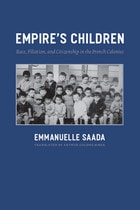
Empire's Children
Race, Filiation, and Citizenship in the French ColoniesEmmanuelle Saada
University of Chicago Press, 2012
Europe’s imperial projects were often predicated on a series of legal and scientific distinctions that were frequently challenged by the reality of social and sexual interactions between the colonized and the colonizers.When Emmanuelle Saada discovered a 1928 decree defining the status of persons of mixed parentage born in French Indochina—the métis—she found not only a remarkable artifact of colonial rule, but a legal bombshell that introduced race into French law for the first time. The decree was the culmination of a decades-long effort to resolve the “métis question”: the educational, social, and civil issues surrounding the mixed population. Operating at the intersection of history, anthropology, and law, Empire’s Children reveals the unacknowledged but central role of race in the definition of French nationality.
Through extensive archival work in both France and Vietnam, and a close reading of primary and secondary material from the Pacific islands and sub-Saharan and North Africa, Saada has created in Empire’s Children an original and compelling perspective on colonialism, law, race, and culture from the end of the nineteenth century until decolonization.
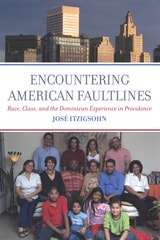
Encountering American Faultlines
Race, Class, and the Dominican Experience in ProvidenceJose Itzigsohn
Russell Sage Foundation, 2009
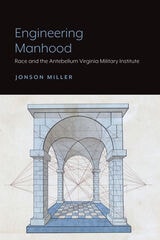
Engineering Manhood
Race and the Antebellum Virginia Military InstituteJonson Miller
Lever Press, 2020
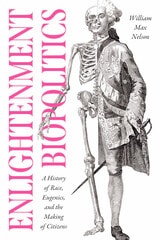
Enlightenment Biopolitics
A History of Race, Eugenics, and the Making of CitizensWilliam Max Nelson
University of Chicago Press, 2024
In Enlightenment Biopolitics, historian William Max Nelson pursues the ambitious task of tracing the context in which biopolitical thought emerged and circulated. He locates that context in the Enlightenment when emancipatory ideals sat alongside the horrors of colonialism, slavery, and race-based discrimination. In fact, these did not just coexist, Nelson argues; they were actually mutually constitutive of Enlightenment ideals.
In this book, Nelson focuses on Enlightenment-era visions of eugenics (including proposals to establish programs of selective breeding), forms of penal slavery, and spurious biological arguments about the supposed inferiority of particular groups. The Enlightenment, he shows, was rife with efforts to shape, harness, and “organize” the minds and especially the bodies of subjects and citizens. In his reading of the birth of biopolitics and its transformations, Nelson examines the shocking conceptual and practical connections between inclusion and exclusion, equality and inequality, rights and race, and the supposed “improvement of the human species” and practices of dehumanization.
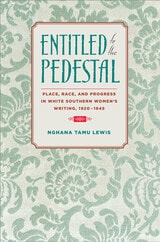
Entitled to the Pedestal
Place, Race, and Progress in White Southern Women’s Writing, 1920–1945Nghana tamu Lewis
University of Iowa Press, 2007
In this searching study, Nghana Lewis offers a close reading of the works and private correspondences, essays, and lectures of five southern white women writers: Julia Peterkin, Gwen Bristow, Caroline Gordon, Willa Cather, and Lillian Smith. At the core of this work is a sophisticated reexamination of the myth of southern white womanhood.
Lewis overturns the conventional argument that white women were passive and pedestal-bound. Instead, she argues that these figures were complicit in the day-to-day dynamics of power and authorship and stood to gain much from these arrangements at the expense of others.
At the same time that her examination of southern mythology explodes received wisdom, it is also a journey of self-discovery. As Lewis writes in her preface, “As a proud daughter of the South, I have always been acutely aware of the region’s rich cultural heritage, folks, and foodstuffs. How could I not be? I was born and reared in Lafayette, Louisiana, where an infant’s first words are not ‘da-da’ and ‘ma-ma’ but ‘crawfish boil’ and ‘fais-do-do.’ . . . I have also always been keenly familiar with its volatile history.” Where these conflicting images—and specifically the role of white southern women as catalysts, vindicators, abettors, and antagonists—meet forms the crux of this study. As such, this study of the South by a daughter of the South offers a distinctive perspective that illuminates the texts in novel and provocative ways.
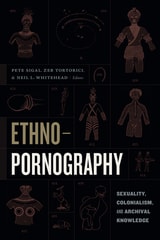
Ethnopornography
Sexuality, Colonialism, and Archival KnowledgePete Sigal, Zeb Tortorici, and Neil L. Whitehead, editors
Duke University Press, 2020
Contributors. Joseph A. Boone, Pernille Ipsen, Sidra Lawrence, Beatrix McBride, Mireille Miller-Young, Bryan Pitts, Helen Pringle, Pete Sigal, Zeb Tortorici, Neil L. Whitehead
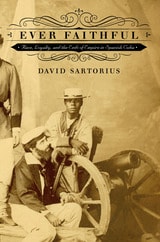
Ever Faithful
Race, Loyalty, and the Ends of Empire in Spanish CubaDavid Sartorius
Duke University Press, 2013
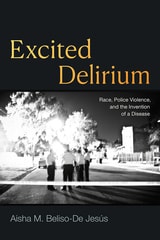
Excited Delirium
Race, Police Violence, and the Invention of a DiseaseAisha M. Beliso-De Jesús
Duke University Press, 2024
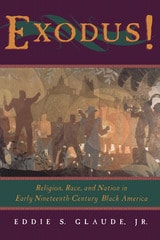
Exodus!
Religion, Race, and Nation in Early Nineteenth-Century Black AmericaEddie S. Glaude Jr.
University of Chicago Press, 2000
Exodus! shows how this biblical story inspired a pragmatic tradition of racial advocacy among African Americans in the early nineteenth century—a tradition based not on race but on a moral politics of respectability. Eddie S. Glaude, Jr., begins by comparing the historical uses of Exodus by black and white Americans and the concepts of "nation" it generated. He then traces the roles that Exodus played in the National Negro Convention movement, from its first meeting in 1830 to 1843, when the convention decided—by one vote—against supporting Henry Highland Garnet's call for slave insurrection.
Exodus! reveals the deep historical roots of debates over African-American national identity that continue to rage today. It will engage anyone interested in the story of black nationalism and the promise of African-American religious culture.
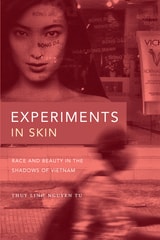
Experiments in Skin
Race and Beauty in the Shadows of VietnamThuy Linh Nguyen Tu
Duke University Press, 2021