Results by title
57 books match the query 'Readings' and 2 start with e
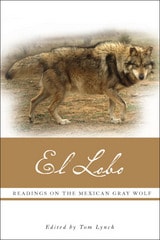
El Lobo
Readings on the Mexican Gray WolfTom Lynch
University of Utah Press, 2005
In many ways the opponents of wolves seem so much like the wolves themselves that it is wildly ironic: though their numbers are small, they seem to retain a core fierceness that cannot be ignored—nor would you want to, for fear is one of the most primal emotions of any place. It’s never going to go entirely away—not in a wild, healthy ecosystem.' —from 'The Feds' by Rick Bass
After roaming the desert Southwest for thousands of years, the Mexican gray wolf was, almost in the blink of an eye, driven to the brink of extinction. El Lobo collects writings that explore how this subspecies of wolf was brought so close to the edge of annihilation.
The first section, 'To the Brink,' includes essays that describe wolf biology, the campaign to exterminate wolves from the Southwest, and the wolf’s role in Native American cultures and in Mexican folklore. The second section, 'And Back,' illustrates a turnaround in attitudes and policy and includes Aldo Leopold’s famous essay 'Thinking Like a Mountain,' Rick Bass’s astute analysis of the political divide, and Sharman Apt Russell’s carefully woven plea in which she shares her experience with Pueblo Indian children meeting a wolf in their school auditorium. These essays, from both sides of the contested issue, resonate with passion, conviction, and the desire to save a world that is mightily at risk.
[more]
Exploring the World of Human Practice
Readings in and about the Philosophy of Aurel KolnaiZoltán Balázs
Central European University Press, 2005
Aurel Kolnai was born in Budapest, in 1900 and died in London, in 1973. He was, according to Karl Popper and the late Bernard Williams, one of the most original, provocative, and sensitive philosophers of the twentieth century. Kolnai's moral philosophy is best described in his own words as intrinsicalist, non-naturalist, non-reductionist", which took its original impetus from Scheler's value ethics, and was developed by using a natural phenomenologist method. The unique combination of linguistic analysis and phenomenology yields highly original ideas on classical fields of moral theory, such as responsibility and free will, the meaning of right and wrong, the universalisability of ethical norms, the role of moral emotions, internalism vs externalism, to mention a few. The volume presents a selection of essays by Kolnai, including his main political theoretical work, "What is Politics About", available in English here for the first time. The second half of the book Kolnai's work is analyzed in a series of essays by eminent scholars
[more]