Results by title
1017 books match the query 'Reference' and 23 start with e
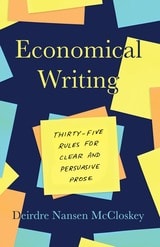
Economical Writing, Third Edition
Thirty-Five Rules for Clear and Persuasive ProseDeirdre Nansen McCloskey
University of Chicago Press, 2019
Economics is not a field that is known for good writing. Charts, yes. Sparkling prose, no.
Except, that is, when it comes to Deirdre Nansen McCloskey. Her conversational and witty yet always clear style is a hallmark of her classic works of economic history, enlivening the dismal science and engaging readers well beyond the discipline. And now she’s here to share the secrets of how it’s done.
Economical Writing is itself economical: a collection of thirty-five pithy rules for making your writing clear, concise, and effective. Proceeding from big-picture ideas to concrete strategies for improvement at the level of the paragraph, sentence, or word, McCloskey shows us that good writing, after all, is not just a matter of taste—it’s a product of adept intuition and a rigorous revision process. Debunking stale rules, warning us that “footnotes are nests for pedants,” and offering an arsenal of readily applicable tools and methods, she shows writers of all levels of experience how to rethink the way they approach their work, and gives them the knowledge to turn mediocre prose into magic.
At once efficient and digestible, hilarious and provocative, Economical Writing lives up to its promise. With McCloskey as our guide, it’s impossible not to see how any piece of writing—on economics or any other subject—can be a pleasure to read.
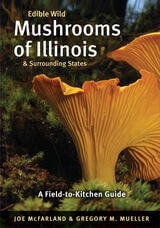
Edible Wild Mushrooms of Illinois and Surrounding States
A Field-to-Kitchen GuideJoe McFarland and Gregory M. Mueller
University of Illinois Press, 2008
Lavishly illustrated with nearly three hundred gorgeous full-color photos, this engaging guidebook carefully describes forty different edible species of wild mushrooms found around Illinois and surrounding states, including Iowa, Wisconsin, Missouri, Indiana, and Kentucky. With conversational and witty prose, the book provides extensive detail on each edible species, including photographs of potential look-alikes to help you safely identify and avoid poisonous species. Mushroom lovers from Chicago to Cairo will find their favorite local varieties, including morels, chanterelles, boletes, puffballs, and many others. Veteran mushroom hunters Joe McFarland and Gregory M. Mueller also impart their wisdom about the best times and places to find these hidden gems.
Edible Wild Mushrooms of Illinois and Surrounding States also offers practical advice on preparing, storing, drying, and cooking with wild mushrooms, presenting more than two dozen tantalizing mushroom recipes from some of the best restaurants and chefs in Illinois, including one of Food & Wine magazine's top 10 new chefs of 2007. Recipes include classics like Beer Battered Morels, Parasol Mushroom Frittatas, and even the highly improbable (yet delectable) Morel Tiramisu for dessert.
As the first new book about Illinois mushrooms in more than eighty years, this is the guide that mushroom hunters and cooks have been craving.
Visit the book's companion website at www.illinoismushrooms.com.
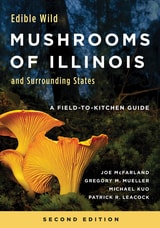
Edible Wild Mushrooms of Illinois and Surrounding States
A Field-to-Kitchen Guide, Second EditionJoe McFarland, Gregory M. Mueller, Michael Kuo, and Patrick R. Leacock
University of Illinois Press, 2027
* Fifty-two entries packed with information on edible species;
* Almost 400 color photographs;
* Tips on where and when to look for mushrooms, how to pick them, and identification and note-taking;
* Photographs of lookalikes for safely identifying and avoiding poisonous species;
* An extensive new section on truffles;
* Advice on preparing, storing, drying, and cooking with wild mushrooms, plus an expanded recipe section that invites cooks to serve up wild turkey and morels, toss an oyster mushroom salad, and add mushroom powder to everything.
Reader friendly and detailed, the second edition of Edible Wild Mushrooms of Illinois and Surrounding States is an invaluable morels-to-puffballs resource for Midwestern mushroom hunters.
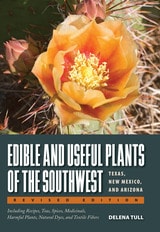
Edible and Useful Plants of the Southwest
Texas, New Mexico, and ArizonaBy Delena Tull
University of Texas Press, 2013
All around us there are wild plants useful for food, medicine, and clothing, but most of us don’t know how to identify or use them. Delena Tull amply supplies that knowledge in this book, which she has now expanded to more thoroughly address plants found in New Mexico and Arizona, as well as Texas.
Extensively illustrated with black-and-white drawings and color photos, this book includes the following special features:
- Recipes for foods made from edible wild plants
- Wild teas and spices
- Wild plant dyes, with instructions for preparing the plants and dying wool, cotton, and other materials
- Instructions for preparing fibers for use in making baskets, textiles, and paper
- Information on wild plants used for making rubber, wax, oil, and soap
- Information on medicinal uses of plants
- Details on hay fever plants and plants that cause rashes
- Instructions for distinguishing edible from poisonous berries
- Detailed information on poisonous plants, including poison ivy, oak, and sumac, as well as herbal treatments for their rashes
Edmund Burke and the Natural Law
Peter J. Stanlis
University of Michigan Press, 1958
Education in Ethiopia
Prospect and RetrospectTeshome G. Wagaw
University of Michigan Press, 2025
El derecho en español
terminología y habilidades jurídicas para un ejercicio legal exitosoBy Katia Fach Gómez
University of Texas Press, 2014
El español es el segundo idioma más hablado en el mundo. Un número creciente de personas en los Estados Unidos y en otros países son conocedores de este idioma y además lo utilizan profesionalmente en el ámbito jurídico. No obstante, a muchos de ellos les gustaría mejorar su comprensión idiomática y jurídica del mismo. En la actualidad existen pocos recursos didácticos y profesionales a los que recurrir. El derecho en español: Terminología y habilidades jurídicas para un ejercicio legal exitoso es el único libro actualmente en el mercado que ofrece al mismo tiempo instrucción avanzada en español jurídico e información selecta sobre los marcos legales contemporáneos en los que este idioma se utiliza.
Este libro monolingüe en español puede ser utilizado en el aula y también como herramienta de auto-aprendizaje por parte de universitarios y profesionales que posean un nivel intermedio de conocimiento del idioma. El libro contiene diez lecciones, cada una de ellas dedicada a un área clave del derecho: constitucional, contratos, actividades bancarias, penal, familia, inmigración, derechos humanos, litigios internacionales y arbitraje. Todas estas lecciones presentan un vocabulario escogido sobre el tema jurídico abordado en ellas, y después ofrecen una serie de ejercicios basados en documentos jurídicos reales procedentes de diversos países de habla hispana. El último capítulo es una guía para facilitar la comprensión de varias películas que contienen interesantes cuestiones legales y que pueden ser utilizadas para el análisis contextual de los temas abordados en las lecciones precedentes. A través de todos estos materiales de capacitación, los lectores aprenderán a utilizar el vocabulario español jurídico en su contexto operativo adecuado, y podrán entender las diferencias lingüísticas y conceptuales entre los distintos países de América Latina y España. Al mismo tiempo se familiarizarán con las disposiciones y los documentos más utilizados en la práctica jurídica en español. Finalmente, también podrán mejorar sus habilidades de escucha y de redacción jurídica.
Elements of French Deaf Heritage
Ulf Hedberg
Gallaudet University Press, 2019
Elite Oral History Discourse
A Study of Cooperation and CoherenceEva M. McMahan
University of Alabama Press, 1989
Over the past thirty years, oral history has found increasing favor among social scientists and humanists, with scholars “rediscovering” the oral interview as a valuable method for obtaining information about the daily realities and historical consciousness of people, their histories, and their culture. One primary issue is the question of how the communicative performances of the interviewer and narrator jointly influence the interview. Using methods of conversation/discourse analysis, the author describes the collaborative processes that enable interviewers and narrators to interact successfully in the interview context.
Eloquent Science
A Practical Guide to Becoming a Better Writer, Speaker and ScientistDavid M. Schultz
American Meteorological Society, 2009
Eloquent Science evolved from a workshop aimed at offering atmospheric science students formal guidance in communications, tailored for their eventual scientific careers. Drawing on advice from over twenty books and hundreds of other sources, this volume presents informative and often humorous tips for writing scientific journal articles, while also providing a peek behind the curtain into the operations of editorial boards and publishers of major journals. The volume focuses on writing, reviewing, and speaking and is aimed at the domain of the student or scientist at the start of her career. The volume offers tips on poster presentations, media communication, and advice for non-native speakers of English, as well as appendices on proper punctuation usage and commonly misunderstood meteorological concepts. A further reading section at the end of each chapter suggests additional sources for the interested reader, and sidebars written by experts in the field offer diverse viewpoints on reference topics.

Emerging Trends in Continental Philosophy
Edited by Todd May
University of Chicago Press, 2010
From Kant to Kierkegaard, from Hegel to Heidegger, continental philosophers have indelibly shaped the trajectory of Western thought since the eighteenth century. Although much has been written about these monumental thinkers, students and scholars lack a definitive guide to the entire scope of the continental tradition. The most comprehensive reference work to date, this eight-volume History of Continental Philosophy will both encapsulate the subject and reorient our understanding of it. Beginning with an overview of Kant’s philosophy and its initial reception, the History traces the evolution of continental philosophy through major figures as well as movements such as existentialism, phenomenology, hermeneutics, and poststructuralism. The final volume outlines the current state of the field, bringing the work of both historical and modern thinkers to bear on such contemporary topics as feminism, globalization, and the environment. Throughout, the volumes examine important philosophical figures and developments in their historical, political, and cultural contexts.
The first reference of its kind, A History of Continental Philosophy has been written and edited by internationally recognized experts with a commitment to explaining complex thinkers, texts, and movements in rigorous yet jargon-free essays suitable for both undergraduates and seasoned specialists. These volumes also elucidate ongoing debates about the nature of continental and analytic philosophy, surveying the distinctive, sometimes overlapping characteristics and approaches of each tradition. Featuring helpful overviews of major topics and plotting road maps to their underlying contexts, A History of Continental Philosophy is destined to be the resource of first and last resort for students and scholars alike.
Empty Moments
Cinema, Modernity, and DriftLeo Charney
Duke University Press, 1998
Empty Moments creates a catalytic dialogue among those who, at the time of the invention of film, attempted to define the experience of the fleeting present. Interspersing philosophical discussions with stylistically innovative prose, Charney mingles Proust’s conception of time/memory with Cubism’s attempt to interpret time through perspective and Surrealism’s exploration of subliminal representations of the present. Other topics include Husserl’s insistence that the present can only be fantasy or fabrication and the focus on impossibility, imperfection, and loss in Kelvin’s laws of thermodynamics. Ultimately, Charney’s work hints at parallels among such examples, the advent and popularity of cinema, and early film theory.
A book with a structural modernity of its own, Empty Moments will appeal to those interested in cinema and its history, as well as to other historians, philosophers, literary, and cultural scholars of modernity.
Encyclopedia of New Jersey
Lurie, Maxine
Rutgers University Press, 2004
Named an Outstanding Reference Work by the New Jersey Studies Academic Alliance
The Encyclopedia of New Jersey is the most extensive reference work ever published on the Garden State. The Encyclopedia contains nearly 3,000 original articles, along with 585 illustrations and 130 maps, collecting a wealth of information about the state in one volume. The Encyclopedia is filled with fascinating and interesting entries ranging from New Jersey's earliest history to the present. For example-Did you know that New Jersey was once divided into two parts-East Jersey and West Jersey? That streptomycin was first isolated at Rutgers University? Or that the first vote cast by an African American under the Fifteenth Amendment was in Perth Amboy? How about that New Jersey was the site of the first intercollegiate football game? These facts, and thousands more, can be found in the pages of the Encyclopedia of New Jersey. This volume will provide the answers to questions about New Jersey that you never even knew you had!
Whether you are merely perusing the pages or are researching a particular subject, the Encyclopedia of New Jersey is your definitive source for information on the Garden State, covering a broad range of subject areas, including:
* Architecture, decorative arts, painting, and sculpture
* Biographies
* Business and economics
* Communications and media
* Education
* Ethnicity
* Folklore, museums, and theater
* Geography
* History
* Government, law, politics, and public policy
* Literature
* Medicine and health
* Municipalities and counties
* Recreation and sports
* Religion
* Science and technology
* Transportation
* and many more subjects
Encyclopedia of Romantic Nationalism in Europe, Vol. 1 and 2
Edited by Joep Leerssen
Amsterdam University Press, 2016

English Language Criticism on the Foreign Novel, 1965–1975
1965-1975Harriet Semmes Alexander
Ohio University Press, 1989
Critical interest in foreign novels, especially the Latin American and African novel, has burgeoned in the past two decades. The purpose of this reference bibliography is to provide easier access to the criticism produced from 1965 to 1975 on novels published in Africa, Latin America, Europe, Asia, Canada, Australia, and the middle East. A second volume will cover criticism between 1976 and 1985.
Throughout this work, the term “foreign novel” includes novels and other longer works of fiction produced in all countries other than the United States and the United Kingdom. Coverage ranges in time of writing from Apuleius’ Metamorphosis (first century, A.D.) and Murasaki’s Tale of Genji (11th century) to Garcia Marquez’s 100 Years of Solitude (1967) and Margaret Atwood’s Surfacing (1972). The 277 journals—chosen primarily because of their wide circulation—and 584 books indexed for relevant material contribute to the 13,000 bibliographic citations on 1,500 authors. This is a reference tool which is surely essential for any library or world literature scholar.
English Words from Latin and Greek Elements
Donald M. Ayers; Revised by Thomas D. Worthen
University of Arizona Press, 1986
Since its first publication in 1965, English Words from Latin and Greek Elements by Donald M. Ayers has empowered thousands of students to expand their vocabulary by uncovering the classical roots embedded in modern English. Now in its enduring second edition, this trusted resource proves that vocabulary is most effectively learned through understanding—not memorization.
Why dedicate an entire book to this approach? Because Ayers goes beyond the basics. Students are introduced to a broad spectrum of Latin and Greek roots, encounter new vocabulary in meaningful context, and reinforce their learning through targeted exercises. This method equips learners with lifelong tools to decode unfamiliar words and deepen their command of English.
Written for English learners—not classical language scholars—this book requires no prior knowledge of Latin or Greek. It’s proven effective across high school and college classrooms, and adaptable for both remedial and accelerated programs.
Epitaphs
A Dying ArtEdited by Samuel Fanous
Bodleian Library Publishing, 2016
Epitaphs brings together more than 250 epitaphs from cemeteries, churchyards, monuments, and historical records. Some announce the cause of death with a surprisingly macabre sense of humor: “Here lies John Ross. Kicked by a hoss.” Others wryly remind readers of their own impending mortality, such as a tombstone whose rhyming inscription reads “As I am now you will surely be. / Prepare thyself to follow me.” In death as in life, many of the most famous writers were not at a loss for words. Emily Dickinson’s concise wit is evident in her headstone’s inscription “Called Back.” Yeats encouraged the horsemen of the apocalypse to “pass by.” Shakespeare’s funerary monument at Stratford-upon-Avon carries the warning “Curst be he that moves my bones,” an inscription many believe the Bard himself wrote to prevent his corpse from being exhumed in the name of research, a common practice at the time.
As tribute to a form of expression that is very much alive, Epitaphs collects some of the most intriguing examples, many of which perfectly encapsulate the person buried beneath them.
Equipping The Saints
Barbara Elliott
Templeton Press, 2004
For any individual donor or foundation giving money to a faith-based organization, this guide is indispensable. Equipping the Saints offers sage advice on recognizing the qualities of good leaders, effective programs, and the methods of evaluating outcomes. Based on hundreds of interviews with donors and civic leaders, this guide provides a candid look at the unique strengths and weaknesses of these groups. Equipping the Saints is packed with useful tools like a donor's interest inventory, a checklist for making a site visit, tips on reading nonprofit financial statements, and hands-on recommendations for making grants that are both effective and prudent.
"An excellent guide for philanthropists seeking to unleash the power of faith in healing troubled souls and transforming troubled neighborhoods." —Adam Meyerson, president, Philanthropy Roundtable
"Most donors quickly learn how all that glitters is not gold. Some go on to learn how all that is gold does not glitter. In this book Barbara Elliott provides the lessons in discernment and the tools for evaluation that donors need. Take advantage of her understanding by making it your own." —Marvin Olasky, ditor of World magazine, author of Compassionate Conservatism and The Tragedy of American Compassion
"Any donor with even a hint of interest in exploring investments in the work of faith-based organizations (FBOs) needs this book. It is packed with practical information about how to understand and assess FBOs. Its numerous examples of real-life donors making real-life differences through partnerships with faith-inspired community healers ought to stimulate much creative brainstorming among philanthropists." —Dr. Amy L. Sherman, senior fellow and director, Faith in Communities Initiative of the Foundation for American Renewal
"From the perspective of a local foundation giving to faith-based ministries, we have found Barbara Elliott's work to be inspiring, practical and instructive to us as we think through our priorities and principles for funding decisions…I have extraordinary respect for Barbara's scope of understanding, ability to communicate with passion and reason, and her deep understanding of a very complex field. She gives all of us—ministries and funders—genuine hope and invaluable insight." —Fred Smith, president, The Gathering
Error and the Growth of Experimental Knowledge
Deborah G. Mayo
University of Chicago Press, 1996
Mayo has long argued for an account of learning from error that goes far beyond detecting logical inconsistencies. In this book, she presents her complete program for how we learn about the world by being "shrewd inquisitors of error, white gloves off." Her tough, practical approach will be important to philosophers, historians, and sociologists of science, and will be welcomed by researchers in the physical, biological, and social sciences whose work depends upon statistical analysis.
Escaping Nature
How to Survive Global Climate ChangeOrrin H. Pilkey, Charles O. Pilkey, Linda P. Pilkey-Jarvis, Norma J. Longo, Keith C. Pilkey, Fred B. Dodson, and Hannah L. Hayes
Duke University Press, 2024
Ethics and Practice in Science Communication
Edited by Susanna Priest, Jean Goodwin, and Michael F. Dahlstrom
University of Chicago Press, 2018
In three sections—how ethics matters, professional practice, and case studies—contributors to this volume explore the many complex questions surrounding the communication of scientific results to nonscientists. Has the science been shared clearly and accurately? Have questions of risk, uncertainty, and appropriate representation been adequately addressed? And, most fundamentally, what is the purpose of communicating science to the public: Is it to inform and empower? Or to persuade—to influence behavior and policy? By inspiring scientists and science communicators alike to think more deeply about their work, this book reaffirms that the integrity of the communication of science is vital to a healthy relationship between science and society today.
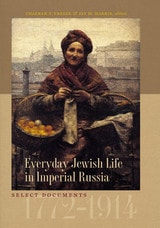
Everyday Jewish Life in Imperial Russia
Select Documents, 1772–1914Edited by ChaeRan Y. Freeze and Jay M. Harris
Brandeis University Press, 2013
Everyday Mathematics for Parents
What You Need to Know to Help Your Child SucceedThe University of Chicago School Mathematics Project
University of Chicago Press, 2017
The Everyday Mathematics (EM) program was developed by the University of Chicago School Mathematics Project (UCSMP) and is now used in more than 185,000 classrooms by almost three million students. Its research-based learning delivers the kinds of results that all school districts aspire to. Yet despite that tremendous success, EMoften leaves parents perplexed. Learning is accomplished not through rote memorization, but by actually engaging in real-life math tasks. The curriculum isn’t linear, but rather spirals back and forth, weaving concepts in and out of lessons that build overall understanding and long-term retention. It’s no wonder that many parents have difficulty navigating this innovative mathematical and pedagogic terrain.
Now help is here. Inspired by UCSMP’s firsthand experiences with parents and teachers, Everyday Mathematics for Parents will equip parents with an understanding of EM and enable them to help their children with homework—the heart of the great parental adventure of ensuring that children become mathematically proficient.
Featuring accessible explanations of the research-based philosophy and design of the program, and insights into the strengths of EM, this little book provides the big-picture information that parents need. Clear descriptions of how and why this approach is different are paired with illustrative tables that underscore the unique attributes of EM. Detailed guidance for assisting students with homework includes explanations of the key EM concepts that underlie each assignment. Resources for helping students practice math more at home also provide an understanding of the long-term utility of EM. Easy to use, yet jam-packed with knowledge and helpful tips, Everyday Mathematics for Parents will become a pocket mentor to parents and teachers new to EM who are ready to step up and help children succeed. With this book in hand, you’ll finally understand that while this may not be the way that you learned math, it’s actually much better.