Results by title
346 books match the query 'Relations' and 11 start with e
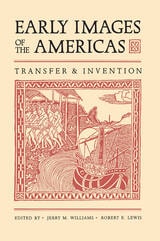
Early Images of the Americas
Transfer and InventionEdited by Jerry M. Williams and Robert E. Lewis
University of Arizona Press, 1993
East is West and West is East
Gender, Culture, and Interwar Encounters between Asia and AmericaKaren Kuo
Temple University Press, 2012
Between 1919-1938, contact between Asia and America forced a reassessment of the normative boundaries of race, sex, gender, class, home, and nation. Karen Kuo’s provocative East Is West and West Is East looks closely at these global shifts to modernity.
In her analysis of five forgotten texts—the 1930 film East Is West, Frank Capra’s 1937 version of Lost Horizon and its 1973 remake, Younghill Kang's novel East Goes West, and Baroness Ishimoto’s memoir/manifesto, Facing Both Ways—Kuo elucidates how “Asia” played a role in shaping American gender and racial identities and how Asian authors understood modern America and its social, political, and cultural influence on Asia.
Kuo asserts that while notions of white and Asian racial difference remain salient, sexual and gendered constructions of Asians and whites were at times about similarity and intersections as much as they were about establishing differences.
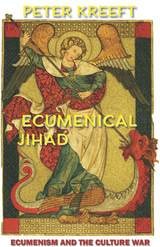
Ecumenical Jihad
Ecumenism and the Culture WarPeter Kreeft
St. Augustine's Press, 2015
Aware of the deep theological differences of these monotheistic faiths, Kreeft calls for a moratorium on our polemics against one another so that we can form an alliance to fight together to save Western civilization.
Empire and Dissent
The United States and Latin AmericaFred Rosen, ed.
Duke University Press, 2008
Several essays provide historical perspective on contemporary U.S.–hemispheric relations. These include an analysis of the nature and dynamics of imperial domination, an assessment of financial relations between the United States and Latin America since the end of World War II, an account of Native American resistance to colonialism, and a consideration of the British government’s decision to abolish slavery in its colonies. Other essays focus on present-day conflicts in the Americas, highlighting various modes of domination and dissent, resistance and accommodation. Examining southern Mexico’s Zapatista movement, one contributor discusses dissent in the era of globalization. Other contributors investigate the surprisingly conventional economic policies of Brazil’s president, Luiz Inácio Lula da Silva; Argentina’s recovery from its massive 2001 debt default; the role of coca markets in the election of Bolivia’s first indigenous president, Evo Morales; and the possibilities for extensive social change in Venezuela. A readers’ guide offers a timeline of key events from 1823 through 2007, along with a list of important individuals, institutions, and places.
Contributors: Daniel A. Cieza, Gregory Evans Dowd, Steve Ellner, Neil Harvey, Alan Knight, Carlos Marichal, John Richard Oldfield, Silvia Rivera, Fred Rosen, Jeffrey W. Rubin
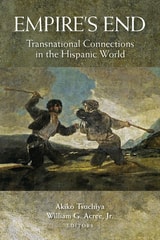
Empire's End
Transnational Connections in the Hispanic WorldAkiko Tsuchiya
Vanderbilt University Press, 2015
Empire's End showcases the work of scholars of literature, cultural studies, and history, centering on four interrelated issues crucial to understanding the end of the Spanish empire: the mappings of the Hispanic Atlantic, race, human rights, and the legacies of empire.

Epidemic Invasions
Yellow Fever and the Limits of Cuban Independence, 1878-1930Mariola Espinosa
University of Chicago Press, 2009
In the early fall of 1897, yellow fever shuttered businesses, paralyzed trade, and caused tens of thousand of people living in the southern United States to abandon their homes and flee for their lives. Originating in Cuba, the deadly plague inspired disease-control measures that not only protected U.S. trade interests but also justified the political and economic domination of the island nation from which the pestilence came. By focusing on yellow fever, Epidemic Invasions uncovers for the first time how the devastating power of this virus profoundly shaped the relationship between the two countries.
Yellow fever in Cuba, Mariola Espinosa demonstrates, motivated the United States to declare war against Spain in 1898, and, after the war was won and the disease eradicated, the United States demanded that Cuba pledge in its new constitution to maintain the sanitation standards established during the occupation. By situating the history of the fight against yellow fever within its political, military, and economic context, Espinosa reveals that the U.S. program of sanitation and disease control in Cuba was not a charitable endeavor. Instead, she shows that it was an exercise in colonial public health that served to eliminate threats to the continued expansion of U.S. influence in the world.

Erasmus and the Jews
Shimon Markish
University of Chicago Press, 1986
Erasmus and the Jews discusses Erasmus' critique of Mosaic law and his view of the conflict between "Judaism" as legalistic morality and Jesus' teaching; his judgment on the Pharisees of Jesus' time; his emphasis on the importance of the study of Hebrew; and his opinions of sixteenth-century Jews. This meticulous analysis reveals an Erasmus who defended his vision of true piety by rejecting "Judaizing" Christians more than Jews and who saw the Old Testament as integral to the Christian worldview. As a Christian, he regretted nonbelief and pitied unbelievers, without vicious hostility toward any single people. His theological opposition to a form of religious thought which he identified with Judaism was not translated into crude prejudice against actual Jews. In general, his calm consideration of the strange and the foreign and his willingness to restrict his judgments to the philosophical realm were, Markish argues, early and significant steps toward enlightened toleration.
Markish's discussion of Erasmus is supplemented with an Afterword by theologian and philosopher Arthur A. Cohen, who offers a variant interpretation of Erasmus' writings and attitudes. The juxtaposed arguments of the two scholars make this an especially illuminating work for any student of Erasmus and his influence. Erasmus and the Jews also gives a necessary clarity to our understanding of the meaning of anti-Semitism and the history of religious toleration. Markish's profound knowledge of Erasmus allows him to demonstrate the fundamental importance of putting arguments and terminology in the context of a thinker's work and his own time.
Essays on American Indian and Mormon History
Edited by P. Jane Hafen and Brenden W. Rensink
University of Utah Press, 2019
This collection of essays, many the result of a seminar hosted by the Charles Redd Center for Western Studies at Brigham Young University, explores the historical and cultural complexities of this narrative from a decolonizing perspective. Essays cover the historical construction of the “Lamanite,” settler colonialism and the Book of Mormon, and connections between the Seneca leader Handsome Lake and Joseph Smith. Authors also address American Indian Mormon tribal identities, Navajo and Mormon participation at the dedication of Glen Canyon Dam, the impact of Mormon Polynesian missionaries in Diné Bikéyah, the ISPP, and other topics. Prominent American Indian Mormon voices lend their creative work and personal experiences to the book.
With the aim of avoiding familiar narrative patterns of settler colonialism, contributors seek to make American Indians the subjects rather than the objects of discussion in relation to Mormons, presenting new ways to explore and reframe these relationships.

Essential Vulnerabilities
Plato and Levinas on Relations to the OtherDeborah Achtenberg
Northwestern University Press, 2014
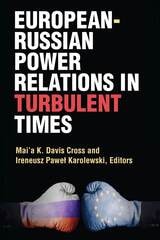
European-Russian Power Relations in Turbulent Times
Mai’a K. Davis Cross and Ireneusz Pawel Karolewski, Editors
University of Michigan Press, 2021
The volume editors’ primary goal is to illuminate the nature of the deteriorating security relationship between Europe and Russia, and the key implications for its future. While the book is timely, the editors and contributors also draw out long-term lessons from this era of diplomatic degeneration to show how increasing cooperation between two regions can devolve into rapidly escalating conflict. While it is possible that the relationship between Russia and Europe can ultimately be restored, it is also necessary to understand why it was undermined in the first place. The fact that these transformations occur under the backdrop of an uncertain transatlantic relationship makes this investigation all the more pressing.
Each chapter in this volume addresses three dimensions of the problem: first, how and why the power status quo that had existed since the end of the Cold War has changed in recent years, as evidenced by Russia’s newly aggressive posturing; second, the extent to which the EU’s power has been enabled or constrained in light of Russia’s actions; and third, the risks entailed in Europe’s reactive power—that is, the tendency to act after-the-fact instead of proactively toward Russia—in light of the transatlantic divide under Trump.
Exporting Revolution
Cuba's Global SolidarityMargaret Randall
Duke University Press, 2017