Results by title
231 books match the query 'Revolutionary Period (1775-1800)' and 6 start with e
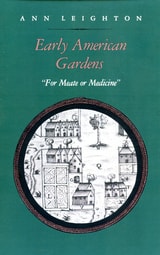
Early American Gardens
"For Meate or Medicine"Ann Leighton
University of Massachusetts Press, 1970
Early American Gardens, published in 1970, was the first of three authoritative volumes of garden history by Ann Leighton. The 464-page masterwork of garden history was reissued in this paperback edition by University of Massachusetts Press in 1986. Concentrating on the gardens of the early settlers of New England, this volume deals with gardeners as well as the plants they depended upon for household aids, flavorings, drinks, and medicines. The well-illustrated, thorough, and scholarly volume is a book for history buffs as well as avid and inquisitive gardeners.
Companion volumes by Ann Leighton
American Gardens in the Eighteenth Century “For Use or for Delight”
American Gardens of the Nineteenth Century “For Comfort and Affluence”
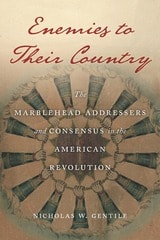
Enemies to Their Country
The Marblehead Addressers and Consensus in the American RevolutionNicholas W. Gentile
University of Massachusetts Press, 2025
Runner-up, 2025 Journal of the American Revolution Book of the Year Award
Complicating the American Revolution through a microhistory of one Massachusetts town
In 1774, a group of elite men in the town of Marblehead, Massachusetts, just outside Salem, wrote an address to the royal governor thanking him for his service to the colony, even as town residents began demanding independence from Great Britain. Town meeting records reveal how the town’s patriot majority pressured the signers to withdraw their support for the governor and demanded public recantations and issued damning reports, even forcing some of the signers into exile.
Enemies to Their Country tells the story of the year following the Address, chronicling the town’s struggle to achieve consensus even as the war for American independence started. This microhistory of one vitally important town, the second largest in Massachusetts at the time, with a thriving local economy based on fishing and a robust community of religious and civically engaged citizens, complicates simplistic ideas of the American Revolution. Through compelling stories of neighboring individuals and families, many of which have not been told, it also provides an example of a politically polarized constituency struggling to find consensus at a time of great conflict.
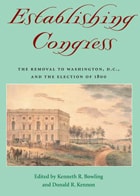
Establishing Congress
The Removal to Washington, D.C., and the Election of 1800Kenneth R. Bowling
Ohio University Press, 2005
Establishing Congress: The Removal to Washington, D.C., and the Election of 1800 focuses on the end of the 1790s, when, in rapid succession, George Washington died, the federal government moved to Washington, D.C., and the election of 1800 put Thomas Jefferson and the Democratic-Republican Party in charge of the federal government.
Establishing Congress dispels the myths and misinformation that surround the federal government’s move to Washington and demonstrates that the election of 1800 changed American party politics forever, establishing the success of the American experiment in government and completing the founding of the Republic. It also contends that the lame-duck session of Congress had far-reaching implications for the governance of the District of Columbia. Later chapters examine aspects of the political iconography of the Capitol—one illuminating Jefferson’s role in turning the building into a temple for the legislature and an instrument for nation-building, another analyzing the fascinating decades-long debate over whether to bury George Washington in the Capitol.
The book considers as well the political implications of social life in early Washington, examining the political lobbying by Washington women within a social context and detailing the social and political life in the city’s homes, hotels, boardinghouses, and eating messes. Establishing Congress is an invaluable reference work for anyone interested in these pivotal moments in American history.
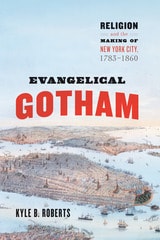
Evangelical Gotham
Religion and the Making of New York City, 1783–1860Kyle B. Roberts
University of Chicago Press, 2016
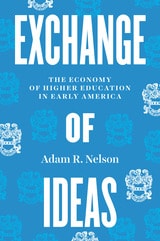
Exchange of Ideas
The Economy of Higher Education in Early AmericaAdam R. Nelson
University of Chicago Press, 2023
Exchange of Ideas launches a breathtakingly ambitious new economic history of American higher education. In this volume, Adam R. Nelson focuses on the early republic, explaining how knowledge itself became a commodity, as useful ideas became salable goods and American colleges were drawn into transatlantic commercial relations. American scholars might once have imagined that higher education could sit beyond the sphere of market activity—that intellectual exchange could transcend vulgar consumerism—but already by the end of the eighteenth century, they saw how ideas could be factored into the nation’s balance of trade. Moreover, they concluded that it was the function of colleges to oversee the complex process whereby knowledge could be priced and purchased. The history of capitalism and the history of higher education, Nelson reveals, are intimately intertwined—which raises a host of important and strikingly urgent questions. How do we understand knowledge and education as commercial goods? Who should pay for them? And, fundamentally, what is the optimal system of higher education in a capitalist democracy?