Results by title
81 books match the query 'Revolutions, Uprisings & Rebellions' and 5 start with e
Echoes of the Marseillaise
Two Centuries Look Back on the French RevolutionHobsbawm, Eric
Rutgers University Press, 1990
We can learn a great deal from studying the French Revolution itself, but we can also learn from studying the ways in which scholars have interpreted the French Revolution, and from the ways their views have changed. For over a century following the Revolution, commentators and scholars spoke of it in glowing terms. But in the past three decades, revisionist historians have become skeptical. Eric Hobsbawm reiterates the centrality of the Revolution for history on a global basis. He argues that those who wrote about the Revolution in the nineteenth century were convinced it had changed their lives dramatically, improving the economy and the lot of peasants. They saw the Revolution as a prototype of of the bourgeois revolution, enabling the middle class to gain power from the ruling class of aristocrats. Many believed proletarian revolutions would inevitably follow. In the years between 1917 and the 1960s, Marxists continued to use the French Revolution as a point of reference, paying increasing attention to the social and economic factors in the Revolution, not only to the political factors. In the 1970s and 1980s, many historians began to argue that the Revolution achieved modest results at disproportionate costs. Hobsbawm argues that this massive historiographical reaction against the centrality of the Revolution reflects the personal politics of those contemporary historians for whom Marxism and communism are now out of favor. They are, he maintains, wrong. The Revolution transformed the world permanently and introduced forces that continue to transform it.
Echoes of the Marseillaise
Two Centuries Look Back on the French RevolutionHobsbawm, Eric
Rutgers University Press, 2019
E.J. Hobsbawm’s classic historiographic study—written at the very moment when a new set of revolutions swept through the Eastern Bloc and brought down the Iron Curtain—explores how the French Revolution was perceived over the following two centuries. He traces how the French Revolution became integral to nineteenth-century political discourse, when everyone from bourgeois liberals to radical socialists cited these historical events, even as they disagreed on what their meaning. And he considers why references to the French Revolution continued to inflame passions into the twentieth century, as a rhetorical touchstone for communist revolutionaries and as a boogeyman for social conservatives.
Echoes of the Marseillaise is a stimulating examination of how the same events have been reimagined by different generations and factions to serve various political agendas. It will give readers a new appreciation for how the French Revolution not only made history, but also shaped our fundamental notions about history itself.
Elementary Aspects of Peasant Insurgency in Colonial India
Ranajit Guha
Duke University Press, 1999
This classic work in subaltern studies explores the common elements present in rebel consciousness during the Indian colonial period. Ranajit Guha—intellectual founder of the groundbreaking and influential Subaltern Studies Group—describes from the peasants’ viewpoint the relations of dominance and subordination in rural India from 1783 to 1900.
Challenging the idea that peasants were powerless agents who rebelled blindly against British imperialist oppression and local landlord exploitation, Guha emphasizes their awareness and will to effect political change. He suggests that the rebellions represented the birth of a theoretical consciousness and asserts that India’s long subaltern tradition lent power to the landmark insurgence led by Mahatma Gandhi. Yet as long as landlord authority remains dominant in a ruling culture, Guha claims, all mass struggles will tend to model themselves after the unfinished projects documented in this book.
Students and scholars will welcome this paperback edition of Guha’s 1983 original, which was distributed on a limited scale in the United States. It will influence new generations studying colonialism, postcolonialism, subaltern studies, historiography, anthropology, and Indian, Asian, and Latin American history.
Elizabeth Gurley Flynn
The Rebel Girl, Democracy, and RevolutionMary Anne Trasciatti
Rutgers University Press, 2025
International Labor History Association Honorable Mention Book Award for 2025
Elizabeth Gurley Flynn was involved in almost every major campaign of the U.S. Left in the first two thirds of the twentieth century. An outstanding orator, writer, and tactician, Flynn is one of the most important figures in the history of the American labor movement. Inspired by the Irish freedom struggle and appalled by the exploitation and grinding poverty she saw around her, she devoted her life to the advancement of civil liberties. Here, Mary Anne Trasciatti traces Flynn’s personal and political life to explore the broader social issues of a fraught era.
Born in 1890, Flynn began her activist career by joining the Industrial Workers of the World (IWW) when she was just sixteen, and she ended it as the first female chair of the American Communist Party, a position she held from 1961 until her death in 1964. In the intervening years she organized workers into unions, led strikes, championed women’s rights, supported anti-imperialist movements around the globe, protested deportation, advocated for prison reform, and fought for Black liberation. Above all, she showed absolute devotion to workers and their struggles.
Slandered as an “un-American” in the anticommunist fervor of the 1940s and 1950s, Flynn was eventually ousted from the very organization she helped found, the American Civil Liberties Union, and imprisoned for two years. Though her own movement abandoned her, her commitment to the cause never wavered. This stirring biography illuminates Flynn’s inspiring life and worldview and returns her to her rightful place at the heart of labor and civil liberties history.
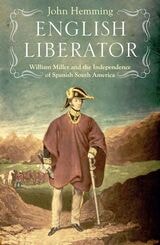
English Liberator
William Miller and the Independence of Spanish South AmericaJohn Hemming
Haus Publishing, 2025
During Admiral Thomas Cochrane’s demolition of imperial Spain’s naval presence in the Pacific amid the revolutionary wars for Spanish South America, all the raids were carried out by his marines under a young officer called William Miller. One of three sons of a baker in a small village in Kent, with no family influence, money, or even secondary education, he came from nowhere, but he went on to have a meteoric rise in the armies that liberated the nations of Chile and Peru. By the time of Ayacucho in 1824, the large battle that ended Spanish rule in South America, there were seven generals in the royalist Spanish army and five on the patriot side. Eleven of these generals were Hispanic; Miller was the only foreigner.
Set in the context of the great European powers’ weakening grip over their global empires and the ensuing wars of independence in Spanish South America, John Hemming’s gripping narrative spans Miller’s time as a teenage soldier in Wellington’s Peninsular War, his contribution to the liberation of the new nations Chile and Peru, and his years in diplomacy thereafter. Drawing on written accounts by many of Miller’s contemporaries in addition to a wealth of modern research, Hemming casts the anti-imperialist, anti-slavery soldier as highly regarded by all the leaders of independence and popular with ordinary people and peasant farmers due to his own humble origins—a legacy evidenced by his burial in the Pantheon of founding fathers of Peru decades after the battles in which he made his name.