Results by title
200 books match the query 'Second Edition' and 9 start with e
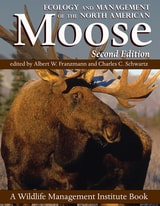
Ecology and Management of the North American Moose, Second Edition
Charles C. Schwartz
University Press of Colorado, 2007
Contributors include Warren B. Ballard, Arnold H. Boer, Anthony B. Bubenik, M. E. Buss, Kenneth N. Child, Vincent F.J. Crichton, Albert W. Franzmann, Kris J. Hundertmark, Patrick D. Karns, Murray W. Lankester, Richard E. McCabe, James M. Peek, Henry M. Reeves, Wayne L. Regelin, Lyle A. Renecker, William M. Samuel, Charles C. Schwartz, Robert W. Stewart, Ian D. Thompson, H. R. Timmermann, and Victor Van Ballenberghe. A Wildlife Management Institute book

Economics for Everyone, Second Edition
A Short Guide to the Economics of CapitalismJim Stanford
Pluto Press, 2015
Through clear bite-sized chapters interspersed with illuminating illustrations, this is an antidote to the abstract and ideological way that economics is normally taught and reported on in in media. Key concepts such as finance, competition and wages are explored, and their importance to everyday life is revealed. It answers questions such as 'Do workers need capitalists?', 'Why does capitalism harm the environment?', and 'What really happens on the stock market?'.
The book is supported with a comprehensive set of web-based course materials including videos for popular economics courses.
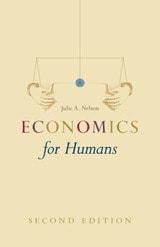
Economics for Humans, Second Edition
Julie A. Nelson
University of Chicago Press, 2018
Economics for Humans argues against the well-ingrained notion that economics is immune to moral values and distant from human relationships. Here, Nelson locates the impediment to a more considerate economic world in an assumption that is shared by both neoliberals and the political left. Despite their seemingly insurmountable differences, both make use of the metaphor, first proposed by Adam Smith, that the economy is a machine. This pervasive idea, Nelson argues, has blinded us to the qualities that make us work and care for one another—qualities that also make businesses thrive and markets grow. We can wed our interest in money with our justifiable concerns about ethics and social well-being. And we can do so if we recognize that an economy is not a machine, but a living thing in need of attention and careful tending.
This second edition has been updated and refined throughout, with expanded discussions of many topics and a new chapter that investigates the apparent conflict between economic well-being and ecological sustainability. Further developing the main points of the first edition, Economics for Humans will continue to both invigorate and inspire readers to reshape the way they view the economy, its possibilities, and their place within it.
Economics for Humans, Second Edition
Julie A. Nelson
University of Chicago Press, 2018
At its core, an economy is about providing goods and services for human well-being. But many economists and critics preach that an economy is something far different: a cold and heartless system that operates outside of human control. In this impassioned and perceptive work, Julie A. Nelson asks a compelling question: given that our economic world is something that we as humans create, aren’t ethics and human relationships—dimensions of a full and rich life—intrinsically part of the picture?
Economics for Humans argues against the well-ingrained notion that economics is immune to moral values and distant from human relationships. Here, Nelson locates the impediment to a more considerate economic world in an assumption that is shared by both neoliberals and the political left. Despite their seemingly insurmountable differences, both make use of the metaphor, first proposed by Adam Smith, that the economy is a machine. This pervasive idea, Nelson argues, has blinded us to the qualities that make us work and care for one another—qualities that also make businesses thrive and markets grow. We can wed our interest in money with our justifiable concerns about ethics and social well-being. And we can do so if we recognize that an economy is not a machine, but a living thing in need of attention and careful tending.
This second edition has been updated and refined throughout, with expanded discussions of many topics and a new chapter that investigates the apparent conflict between economic well-being and ecological sustainability. Further developing the main points of the first edition, Economics for Humans will continue to both invigorate and inspire readers to reshape the way they view the economy, its possibilities, and their place within it.

Edible Wild Mushrooms of Illinois and Surrounding States
A Field-to-Kitchen Guide, Second EditionJoe McFarland, Gregory M. Mueller, Michael Kuo, and Patrick R. Leacock
University of Illinois Press, 2027
* Fifty-two entries packed with information on edible species;
* Almost 400 color photographs;
* Tips on where and when to look for mushrooms, how to pick them, and identification and note-taking;
* Photographs of lookalikes for safely identifying and avoiding poisonous species;
* An extensive new section on truffles;
* Advice on preparing, storing, drying, and cooking with wild mushrooms, plus an expanded recipe section that invites cooks to serve up wild turkey and morels, toss an oyster mushroom salad, and add mushroom powder to everything.
Reader friendly and detailed, the second edition of Edible Wild Mushrooms of Illinois and Surrounding States is an invaluable morels-to-puffballs resource for Midwestern mushroom hunters.
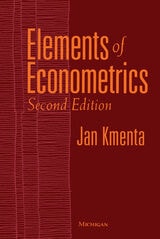
Elements of Econometrics
Second EditionJan Kmenta
University of Michigan Press, 1997
Throughout the book the emphasis is on simplification whenever possible, assuming the readers know college algebra and basic calculus. Jan Kmenta explains all methods within the simplest framework, and generalizations are presented as logical extensions of simple cases. And while a relatively high degree of rigor is preserved, every conflict between rigor and clarity is resolved in favor of the latter. Apart from its clear exposition, the book's strength lies in emphasizing the basic ideas rather than just presenting formulas to learn and rules to apply.
The book consists of two parts, which could be considered jointly or separately. Part one covers the basic elements of the theory of statistics and provides readers with a good understanding of the process of scientific generalization from incomplete information. Part two contains a thorough exposition of all basic econometric methods and includes some of the more recent developments in several areas.
As a textbook, Elements of Econometrics is intended for upper-level undergraduate and master's degree courses and may usefully serve as a supplement for traditional Ph.D. courses in econometrics. Researchers in the social sciences will find it an invaluable reference tool.
A solutions manual is also available for teachers who adopt the text for coursework.
Jan Kmenta is Professor Emeritus of Economics and Statistics, University of Michigan.

Exotic No More, Second Edition
Anthropology for the Contemporary WorldEdited by Jeremy MacClancy
University of Chicago Press, 2019
Contributors:Ruben Andersson, Philippe Bourgois, Catherine Buerger, James G. Carrier, Marcus Colchester, James Fairhead, Kim Fortun, Mike Fortun, Katy Gardner, Faye Ginsburg, Roberto J. González, Tom Griffiths, Chris Hann, Susan Harding, Faye V. Harrison, Laurie Kain Hart, Richard Jenkins, George Karandinos, Christopher M. Kelty, Melissa Leach, Margaret Lock, Jeremy MacClancy, Sally Engle Merry, Fernando Montero, Matt Sakakeeny, Anthony Alan Shelton, Christopher B. Steiner, Richard Ashby Wilson
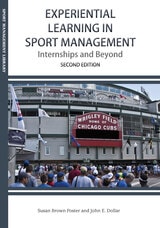
Experiential Learning in Sport Management
Second EditionSusan B. Foster
FiT Publishing, 2017
In the multi-billion dollar sport industry that captures the interest of a global audience, opportunities abound on the front lines and behind the scenes for those who have the education, skill, and drive to succeed. Often the biggest hurdles for those who want to work in the sport industry is breaking through with an initial opportunity. Experiential Learning in Sport Management: Internships and Beyond, 2nd Edition, presents aspiring sport practitioners with a wealth of information about the industry and provides professors within sport management programs a framework for how to lead students through the experiential learning experience.
Authors Susan Brown Foster and John E. Dollar draw from more than 50 years of combined experience in teaching, research, and internship supervision in writing a comprehensive yet concise manual for students preparing for a career in sport. This new edition includes enhanced content on trending topics such as social media and eSports.
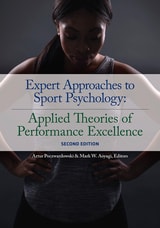
Expert Approaches to Sport Psychology
Applied Theories of Performance Excellence, Second EditionArtur Poczwardowski
FiT Publishing, 2021
Most existing applied sport psychology literature has focused on interventions and techniques. Rather than rework the questions of “what” to do, the second edition of Expert Approaches to Sport Psychology: Applied Theories of Performance Excellence illuminates the questions of “who,” “when,” “why,” and “how.” The answers to these questions reside in the theories that seasoned practitioners have developed about the psychological, emotional, and behavioral skills and conditions that facilitate optimal performance.
Edited by Artur Poczwardowski and Mark W. Aoyagi, the second edition features a diverse collection of 21 distinguished practitioners in the field of sport psychology. Each chapter is an autobiographical and personal perspective on how these preeminent experts developed their authentic and distinctive approaches to the practice of sport psychology with real-life examples and case studies. Their rich cultural and educational backgrounds are reflected in ethnicity, international origin, gender, age, and sociocultural perspectives and experiences.
Expert Approaches to Sport Psychology serves as a master class by those who have helped advance the field—preserving the knowledge and contributions of the founders and intellectual leaders of applied sport psychology, while also presenting the contemporary innovators of the field. The collective wisdom passed on within this book will be immensely beneficial to both those practicing and studying sport psychology.