Results by title
65 books match the query 'Security' and 4 start with e

Edge Computing
Models, technologies and applicationsJavid Taheri
The Institution of Engineering and Technology, 2020
Cloud computing has evolved as a cost-effective, easy-to-use, elastic and scalable computing paradigm to transform today's business models. 5G, Industrial IoT, Industry 4.0 and China-2050 frameworks and technologies are introducing new challenges that cannot be solved efficiently using current cloud architectures. To handle the collected information from such a vast number of devices and actuators, and address these issues, novel concepts have been proposed to bring cloud-like resources closer to end users at the edge of the network, a technology called edge computing.
[more]

Endangered City
The Politics of Security and Risk in BogotáAustin Zeiderman
Duke University Press, 2016
Security and risk have become central to how cities are planned, built, governed, and inhabited in the twenty-first century. In Endangered City, Austin Zeiderman focuses on this new political imperative to govern the present in anticipation of future harm. Through ethnographic fieldwork and archival research in Bogotá, Colombia, he examines how state actors work to protect the lives of poor and vulnerable citizens from a range of threats, including environmental hazards and urban violence. By following both the governmental agencies charged with this mandate and the subjects governed by it, Endangered City reveals what happens when logics of endangerment shape the terrain of political engagement between citizens and the state. The self-built settlements of Bogotá’s urban periphery prove a critical site from which to examine the rising effect of security and risk on contemporary cities and urban life.
[more]
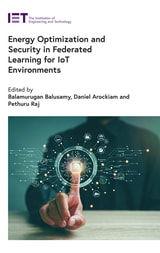
Energy Optimization and Security in Federated Learning for IoT Environments
Balamurugan Balusamy
The Institution of Engineering and Technology, 2025
Smart environments such as smart homes and industrial automation have been transformed by the rapid developments in internet of things (IoT) devices and systems. However, the widespread use of these devices poses significant difficulties, particularly in settings with limited energy resources. Due to the significant energy consumption and communication overhead associated with delivering huge amounts of data, traditional machine learning algorithms which rely on centralized cloud servers for training are not always suitable.
[more]
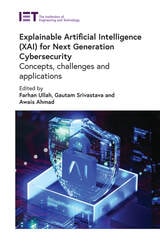
Explainable Artificial Intelligence (XAI) for Next Generation Cybersecurity
Concepts, challenges and applicationsFarhan Ullah
The Institution of Engineering and Technology, 2025
As AI technologies progress and influence more facets of our lives, the requirement for openness and interpretability becomes increasingly important. Explainable AI (XAI) has the potential to be a paradigm shift in the next generation of AI systems. XAI strives to make AI algorithms and methods understandable by tackling trust, bias, compliance, and accountability challenges. XAI improves model disclosure, produces intrinsically interpretable deep learning approaches, offers real-time rationales, and promotes legitimate AI practice. These advances assist in the development of a more ethically sound AI ecosystem.
[more]