Results by title
125 books match the query 'Perspectives' and 10 start with a

Academic Library Research
Perspectives and Current TrendsMarie L. Radford
Assoc of College & Research Libraries, 2011
Academic Library Research
Perspectives and Current TrendsMarie L. Radford
Assoc of College & Research Libraries, 2011
Accomplishing NAGPRA
Perspectives on the Intent, Impact, and Future of the Native American Graves Protection and Repatriation ActSangita Chari and Jaime M. N. Lavallee
Oregon State University Press, 2013
NAGPRA requires museums and federal agencies to return requested Native American cultural items to lineal descendants, culturally affiliated Indian tribes, and Native Hawai’ian organizations. Since the 1990 passage of the act, museums and federal agencies have made more than one million cultural items—and the remains of nearly forty thousand Native Americans—available for repatriation.
Drawing on case studies, personal reflections, historical documents, and statistics, the volume examines NAGPRA and its grassroots, practical application throughout the United States.? Accomplishing NAGPRA will appeal to professionals and academics with an interest in cultural resource management, Indian and human rights law, Indigenous studies, social justice movements, and public policy.
After Communism
Perspectives on DemocracyDonald R. Kelley
University of Arkansas Press, 2003
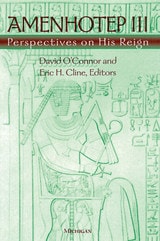
Amenhotep III
Perspectives on His ReignDavid O'Connor and Eric H. Cline, Editors
University of Michigan Press, 2001
Amenhotep III: Perspectives on His Reign, edited by David O'Connor and Eric H. Cline consists of a series of essays on this complex individual and his reign. In addition to offering several provocative and ground-breaking essays, this volume serves as a compendium and sourcebook for hard-to-obtain details about the reign of Amenhotep III.
The volume begins with an overview of the pharaoh by Larry Berman: his life, his family, and the history of his reign. Betsy Bryan describes the historical antecedents of Amenhotep's reign. Ray Johnson deals first with the building activities of Amen-hotep III and then presents a study of his carved relief decoration, with particular emphasis on the tendencies towards "Atenism." Arielle Kozloff discusses a variety of small objects including cosmetic spoons, glass vessels, jewelry, and funerary equipment. David O'Connor discusses city planning, building functions, and aspects of religion in light of the contemporary Egyptian worldview. Bill Murnane's chapter on government is a fascinating glimpse of the system of government in place at the time. Extensive documentation is provided on the activities of Amenhotep in the Aegean and Anatolia, Mesopotamia, Nubia, and Syro-Palestine. The volume concludes with John Baines's chapter on the Amarna Age.
Amenhotep III: Perspectives on His Reign is a valuable contribution to pharaonic studies. It will be of interest to a wide range of scholars interested in Mediterranean literatures and cultures. It draws on literary, archaeological, and historical material to form an interdisciplinary study of a complex figure in pharaonic Egypt.
David O'Connor is Lila Acheson Wallace Professor of Ancient Egyptian Art, Institute of Fine Arts, New York University. Eric H. Cline is Assistant Professor of History, Xavier University.
American Denominational History
Perspectives on the Past, Prospects for the FutureEdited by Keith Harper
University of Alabama Press, 2008
Fruitful questions that are posed by the positions and experiences of the various groups are carefully examined. American Denominational History points the way for the next decade of scholarly effort.

American Ethnic History
Themes and PerspectivesMcDonald, Jason J
Rutgers University Press, 2007
Chapters explore a range of topics, including how different ethnic groups arrived in the United States—whether through violence and coercion or willing immigration; the peculiar identification of Native Americans as “ethnic,” despite the fact that they are indigenous to the land; whether the American public’s attitudes toward and treatment of difference has been consistent with the nation’s professed egalitarian ideals; and how factors such as language, religion, class, gender, and intermarriage play in either strengthening or weakening ethnic identity and group solidarity.
An engaging and critical look at a term that remains stubbornly ambiguous in both scholarly discussion and the vernacular, this book makes an important contribution to the ongoing debates about “difference” in American society.
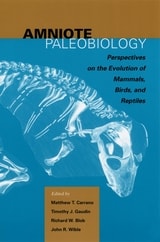
Amniote Paleobiology
Perspectives on the Evolution of Mammals, Birds, and ReptilesEdited by Matthew T. Carrano, Timothy J. Gaudin, Richard W. Blob, and John R. Wi
University of Chicago Press, 2006
A collaborative effort of twenty-four researchers, Amniote Paleobiology presents thirteen new and important scientific perspectives on the evolution and biology of this familiar group. It includes new discoveries of dinosaurs and primitive relatives of mammals; studies of mammalian chewing and locomotion; and examinations of the evolutionary process in plesiosaurs, mammals, and dinosaurs. Emphasizing the rich variety of analytical techniques available to vertebrate paleontologists—from traditional description to multivariate morphometrics and complex three-dimensional kinematics—Amniote Paleobiology seeks to understand how species are related to each other and what these relationships reveal about changes in anatomy and function over time. A timely synthesis of modern contributions to the field of evolutionary studies, Amniote Paleobiology furthers our understanding of this diverse group.
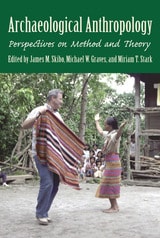
Archaeological Anthropology
Perspectives on Method and TheoryEdited by James M. Skibo, Michael W. Graves, and Miriam T. Stark
University of Arizona Press, 2014
In this collection of twelve new chapters, four generations of Longacre protégés show how they are building upon and developing but also modifying the theoretical paradigm that remains at the core of Americanist archaeology. The contributions focus on six themes prominent in Longacre’s career: the intellectual history of the field in the late twentieth century, archaeological methodology, analogical inference, ethnoarchaeology, cultural evolution, and reconstructing ancient society.
More than a comprehensive overview of the ideas developed by one of the most influential scholars in the field, however, Archaeological Anthropology makes stimulating contributions to contemporary research. The contributors do not unequivocally endorse Longacre’s ideas; they challenge them and expand beyond them, making this volume a fitting tribute to a man whose robust research and teaching career continues to resonate.
Argumentative Writing in a Second Language
Perspectives on Research and PedagogyAlan R. Hirvela and Diane D. Belcher
University of Michigan Press, 2021
Part I of the volume is topic-oriented and focuses on explorations of important issues and perspectives, while Part II features several chapters reporting classroom-based studies of a variety of instructional approaches that expand our understanding of how argumentative writing can be taught. The book will be of value to pre-service and in-service teachers in varying instructional contexts, as well as teacher educators and L2 writing scholars/researchers.