Results by title
64 books match the query 'Self in literature' and 3 start with e

Echo Chambers
Figuring Voice In NarrativePatrick O'Donnell
University of Iowa Press, 1992
Echo Chambers provides an illuminating discussion of the representation of “voice” in novels by Dickens, Joyce, Faulkner, Lowry, and Gaddis. Focusing on the paradoxes of “voice” as an indication of how different authors understand the contradictions of “identity,” O'Donnell charts the recent history of subjectivity as reflected in the development of modern fiction. With strong theoretical underpinning—O'Donnell skillfully utilizes the theories formulated by Bakhtin, Derrida, Bersani, De Man, Deleuze, and Guattari, among others, and the semiotics of voice put forth by Julia Kristeva—Echo Chambers shows how identity is inherently contradictory, conflicted, and multiple.
This insightful volume compellingly demonstrates that “voice” is a revealing (because contradictory and heterogeneous) site where language, the body, culture, and subjectivity meet. Echo Chambers makes an important contribution to the study of modern literature, the semiotics of identity, and cultural poetics as they are informed by the projections of voice in modern narrativ
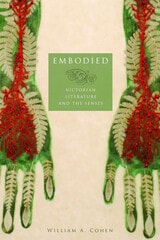
Embodied
Victorian Literature and the SensesWilliam A. Cohen
University of Minnesota Press, 2008
Making sense of the body in Victorian literature
What does it mean to be human? British writers in the Victorian period found a surprising answer to this question. What is human, they discovered, is nothing more or less than the human body itself. In literature of the period, as well as in scientific writing and journalism, the notion of an interior human essence came to be identified with the material existence of the body. The organs of sensory perception were understood as crucial routes of exchange between the interior and the external worlds.
Anatomizing Victorian ideas of the human, William A. Cohen considers the meaning of sensory encounters in works by writers including Charles Dickens, Charlotte Brontë, Anthony Trollope, Thomas Hardy, and Gerard Manley Hopkins. Rather than regarding the bodily exterior as the primary location in which identity categories—such as gender, sexuality, race, and disability—are expressed, he focuses on the interior experience of sensation, whereby these politics come to be felt. In these elegant engagements with literary works, cultural history, and critical theory, Cohen advances a phenomenological approach to embodiment, proposing that we encounter the world not through our minds or souls but through our senses.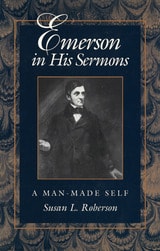
Emerson in His Sermons
A Man-Made SelfSusan L. Roberson
University of Missouri Press, 1994
Ralph Waldo Emerson is universally recognized as one of America's most influential authors and thinkers. Before achieving eminence as lecturer, essayist, and poet, though, he was a Unitaarian preacher. Emerson in His Sermons is the first major study of the sermons since the publication of The Complete Sermons of Ralph Waldo Emerson. Susan Roberson examines Emerson's ministerial career from 1826 to 1832, shedding new light on those early, crucial years in Emerson's personal and intellectual development.
Treating the sermons extensively as an autobiographical text, Roberson establishes that Emerson's years in the pulpit were pivotal and that his sermons are key texts in revealing the essential development of his thought. Central to Roberson's explication of the sermons is Emerson's conception of self-reliance, his invention of a new hero for a new age, and his merging of his own identity with that heroic idea.
Roberson focuses on Emerson's reaction to what was perhaps the most signifcant event in his personal life: the death of his young wife, Ellen, of tuberculosis in 1831, after only sixteen months of marriage. Roberson's correlation of the sermons written during that time with the complexity of Emerson's emotional and intellectual response to the tragedy of Ellen's illness and death is the most detailed and sophisticated treatment of that material to date.
Roberson understands Emerson's emergence from the ministry as his rejection of ready-made institutions and sytems of thought. Through her careful readings of the sermons, Roberson finds that Emerson's objective was less the translation of his life into writing than the translation of his life through writing. By considering the sermons in this way, Roberson is able to enrich our understanding of the private and passionte impulses of this seminal thinker.
Emerson in His Sermons offers the first real look at how the sermons fit into Emerson's own development and will have a far-reaching impact on Emerson scholarship. Anyone concerned with the cultural and religious history of America will find this book invaluable.