Results by title
7 books match the query 'Consolation'

A Book of Consolation
Seeing Our Quests for Love, Success, and Meaning in a New LightAndrew Stark
University of Chicago Press, 2027
An invitation to rest in the mystery that there is no single route to fulfillment, but many—often contradictory, unpredictable, endlessly available.
Our lives are restless. Though we strive for meaning, we are often unfulfilled: our loves fail, our careers stall, and our purpose eludes us. We may temporarily ease our frustration by blaming our methods or embracing our limitations, and we may even embrace the self-defeating lie that we must discover the one, linear path for success in love, work, or life. In A Book of Consolation, Andrew Stark offers a liberating third way between self-abandonment and complacency, revealed through a simple mystery: for each road where someone found fulfillment, someone else walked the opposite path to the same end.
Drawing on literature, popular culture, philosophy, and more, A Book of Consolation invites us to appreciate, even marvel at, the possibility that the routes to love, success, and meaning are so various that even inverse lives can satisfy us. Stark holds up a series of opposing journeys for consideration—from the contradictory loves in modern romantic comedies, to the regrets of Dolly Parton and Ernest Hemingway, to the mindsets behind Tiger Woods and Richard Nixon’s success. In juxtaposing these lives, Stark expands our sense of what counts as fulfillment and what alternatives may be available when our own paths falter. Rich in possibility but without prescription, A Book of Consolation encourages us to navigate the frustrations of our finitude by cultivating a faith that the paths to fulfillment are far more pluralized—and often more contradictory—than we know.
Consolation to Stagirius
Robert G.T. St. John Chrysostom
Catholic University of America Press, 2025
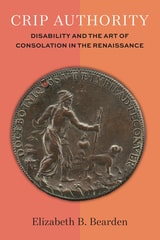
Crip Authority
Disability and the Art of Consolation in the RenaissanceElizabeth B. Bearden
University of Michigan Press, 2025
Disabled authors include Francesco Petrarca, Teresa de Cartagena, Giovani Paolo Lomazzo, Miguel de Cervantes Saavedra, Robert Burton, and John Milton. They all explore their experiences of disability, but their work has rarely or never been considered from a disability studies perspective. Bearden thus brings today’s models of disability studies and crip theory together with early modern articulations of disability based on ancient and Renaissance models of military, political, biblical, and literary authority. In sum, Crip Authority makes a significant contribution to the growing field of early modern disability studies and invites us to rethink the extent of crip history and the endurance of disability gain.
Grief is a Sneaky Bitch
An Uncensored Guide to Navigating LossLisa Keefauver
University of Texas Press, 2024
A comprehensive and compassionate guide to navigating loss.
When social worker Lisa Keefauver became a widow in 2011, she was alarmed to discover that even though 100 percent of us experience loss, we’re living in a grief illiterate world. In her work as a therapist, and in her search for help in the wake of her own loss, Keefauver began to see how the misguided stories we consume about grief lead to unnecessary suffering. Responding to the problematic narratives that grief is something to move on from after completing the five stages like some sort of to-do list, Keefauver became a grief activist. Through this book and her hit podcast of the same title, she creates a safe place to be inside the messiness of it all, to discover the full spectrum of grief, and to find the tools that help grievers move forward, not on. Grief is a Sneaky Bitch is a comprehensive guide—both a manual full of insights and skills and, even more importantly, a thoughtful companion that helps readers feel seen and held.
Keefauver shares her personal and professional wisdom alongside the lessons she’s learned from clinicians, authors, poets, and friends. In place of rigid instructions and must-do checklists, Grief is a Sneaky Bitch invites reflection, encourages self-compassion, and explores the therapeutic power of humor with, yes, a bit of profanity.
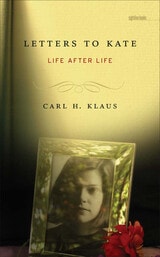
Letters to Kate
Life after LifeCarl H. Klaus
University of Iowa Press, 2006
The Death of the Child Valerio Marcello
Margaret L. King
University of Chicago Press, 1994
This child, scion of a family of power and privilege at Venice's time of greatness, left his father in a state of despair so profound and so public that it occasioned an outpouring of consoling letters, orations, treatises, and poems. In these documents, we find a firsthand account, richly colored by humanist conventions and expectations, of the life of the fifteenth-century boy, the passionate devotion of his father, the feelings of his brothers and sisters, the striking absence of his mother. The father's story is here as well: the career of a Venetian nobleman and scholar, patron and soldier, a participant in Venice's struggle for dominion in the north of Italy.
Through these sources also King traces the cultural trends that made Marcello's century famous. Her work enlarges our view of the literature of consolation, which had a distinctive tradition in Venice, and shifting attitudes toward death from the late Middle Ages onward.
For the depth and acuity of its insights into political, cultural, and private life in fifteenth-century Venice, this book will be essential reading for students of the Renaissance. For the grace and drama of its storytelling, it will be savored by anyone who wishes to look into life and death in a palace, and a city, long ago.
The Legacy of Boethius in Medieval England
The Consolation and its AfterlivesA. Joseph McMullen
Arizona Center for Medieval and Renaissance Studies, 2018