127 books match the query 'Sexual behavior' and 7 start with e

cover of Economies of Desire: Sex and Tourism in Cuba and the Dominican Republic

Economies of Desire

Sex and Tourism in Cuba and the Dominican Republic

Amalia L. Cabezas

Temple University Press, 2009

Is a native-born tour guide who has sex with tourists—in exchange for dinner or gifts or cash—merely a prostitute or gigolo? What if the tourist continues to send gifts or money to the tour guide after returning home? As this original and provocative book demonstrates, when it comes to sex—and the effects of capitalism and globalization —nothing is as simple as it might seem.

Based on ten years of research, Economies of Desire is the first ethnographic study to examine the erotic underpinnings of transnational tourism. It offers startling insights into the commingling of sex, intimacy, and market forces in Cuba and the Dominican republic, two nations where tourism has had widespread effects. In her multi-layered analyses, amalia cabezas reconceptualizes our understandings of informal economies (particularly "affective economies"), "sex workers," and “sexual tourism,” and she helps us appreciate how money, sex and love are intertwined within the structure of globalizing capitalism.
[more]
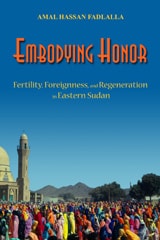
cover of Embodying Honor: Fertility, Foreignness, and Regeneration in Eastern Sudan

Embodying Honor

Fertility, Foreignness, and Regeneration in Eastern Sudan

Amal Hassan Fadlalla

University of Wisconsin Press, 2007

In the Red Sea Hills of eastern Sudan, where poverty, famines, and conflict loom large, women struggle to gain the status of responsible motherhood through bearing and raising healthy children, especially sons. But biological fate can be capricious in impoverished settings. Amidst struggle for survival and expectations of heroic mothering, women face realities that challenge their ability to fulfill their prescribed roles. Even as the effects of modernity and development, global inequities, and exclusionary government policies challenge traditional ways of life in eastern Sudan and throughout many parts of Africa, reproductive traumas—infertility, miscarriage, children’s illnesses, and mortality—disrupt women’s reproductive health and impede their efforts to achieve the status that comes with fertility and motherhood.
    In Embodying Honor Amal Hassan Fadlalla finds that the female body is the locus of anxieties about foreign dangers and diseases, threats perceived to be disruptive to morality, feminine identities, and social well-being. As a “northern Sudanese” viewed as an outsider in this region of her native country, Fadlalla presents an intimate portrait and thorough analysis that offers an intriguing commentary on the very notion of what constitutes the “foreign.” Fadlalla shows how Muslim Hadendowa women manage health and reproductive suffering in their quest to become “responsible” mothers and valued members of their communities. Her historically grounded ethnography delves into women’s reproductive histories, personal narratives, and ritual logics to reveal the ways in which women challenge cultural understandings of gender, honor, and reproduction. 
[more]
cover of Erotic Attunement: Parenthood and the Ethics of Sensuality between Unequals

Erotic Attunement

Parenthood and the Ethics of Sensuality between Unequals

Cristina L. H. Traina

University of Chicago Press, 2011

Heightened awareness of the problem of sexual abuse has led to deep anxiety over adults touching children—in nearly any context. Though our society has moved toward increasingly strict enforcement of this taboo, studies have shown that young children need regular human contact, and the benefits of breastfeeding have been widely extolled. Exploring the complicated history of love, desire, gender, sexuality, parenthood, and inequality, Erotic Attunement probes the disquieting issue of how we can draw a clear line between natural affection toward children and perverse exploitation of them.

Cristina L. H. Traina demonstrates that we cannot determine what is wrong about sexual abuse without first understanding what is good about appropriate sensual affection. Pondering topics such as the importance of touch in nurturing children, the psychology of abuse and victimhood, and recent ideologies of motherhood, she argues that we must expand our philosophical and theological language of physical love and make a distinction between sexual love and erotic love. Taking on theological and ethical arguments over the question of sexuality between unequals, she arrives at the provocative conclusion that it can be destructive to completely bar eroticism from these relationships.
[more]
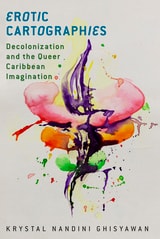
cover of Erotic Cartographies: Decolonization and the Queer Caribbean Imagination

Erotic Cartographies

Decolonization and the Queer Caribbean Imagination

Krystal Nandini Ghisyawan

Rutgers University Press, 2022
Erotic Cartographies uses subjective mapping, a participatory data collection technique, to demonstrate how Trinidadian same-sex-loving women use their gender performance, erotic autonomy, and space-making practices to reinforce and resist colonial ascriptions on subject bodies. The women strategically embody their sexual identities to challenge imposed subject categories and to contest their invisibility and exclusion from discourses of belonging. Erotic Cartographies refers to the processes of mapping territories of self-knowing and self-expression, both cognitively in the imagination and on paper during the mapping exercise, exploring how meaning is given to space, and how it is transformed. Using the women’s quotes and maps, the book focuses on the false binary of public-private, the practices of home and family, and religious nationalism and spiritual self-seeking, to demonstrate the women’s challenges to the structural, symbolic, and interpersonal violence of colonial discourses and practices related to gender, knowledge, and power in Trinidadian society.
[more]
cover of Ethno-erotic Economies: Sexuality, Money, and Belonging in Kenya

Ethno-erotic Economies

Sexuality, Money, and Belonging in Kenya

George Paul Meiu

University of Chicago Press, 2017

Ethno-erotic Economies explores a fascinating case of tourism focused on sex and culture in coastal Kenya, where young men deploy stereotypes of African warriors to help them establish transactional sexual relationships with European women. In bars and on beaches, young men deliberately cultivate their images as sexually potent African men to attract women, sometimes for a night, in other cases for long-term relationships.
 
George Paul Meiu uses his deep familiarity with the communities these men come from to explore the long-term effects of markets of ethnic culture and sexuality on a wide range of aspects of life in rural Kenya, including kinship, ritual, gender, intimate affection, and conceptions of aging. What happens to these communities when young men return with such surprising wealth? And how do they use it to improve their social standing locally? By answering these questions, Ethno-erotic Economies offers a complex look at how intimacy and ethnicity come together to shape the pathways of global and local trade in the postcolonial world.

[more]
cover of Everyday Erotics: Older Chinese Women and Same-Sex Desire

Everyday Erotics

Older Chinese Women and Same-Sex Desire

Denise Tse-Shang Tang

Duke University Press, 2026
In Everyday Erotics, Denise Tse-Shang Tang explores the lives of older women with same-sex desire in Hong Kong, Singapore, and Taiwan. Tang interviews women born in the 1930’s through the 1960’s, looking at how their lives differ across culture, class, and place, and how they lived and understood their own desires and social worlds. Through these tales of love, intimacy, family obligations, and personal respectability, she presents narrative accounts and analyses that complicate cultural notions of romance and desire at the intersections of gender roles, social class, and history. An ethnography grounded in inter-Asian cultural flows and connected histories, Everyday Erotics builds an archive of queer women’s lives and a genealogy of their experiences.
[more]
cover of Ezili's Mirrors: Imagining Black Queer Genders

Ezili's Mirrors

Imagining Black Queer Genders

Omise'eke Natasha Tinsley

Duke University Press, 2018

From the dagger mistress Ezili Je Wouj and the gender-bending mermaid Lasiren to the beautiful femme queen Ezili Freda, the Ezili pantheon of Vodoun spirits represents the divine forces of love, sexuality, prosperity, pleasure, maternity, creativity, and fertility. And just as Ezili appears in different guises and characters, so too does Omise’eke Natasha Tinsley in her voice- and genre-shifting, exploratory book Ezili's Mirrors. Drawing on her background as a literary critic as well as her quest to learn the lessons of her spiritual ancestors, Tinsley theorizes black Atlantic sexuality by tracing how contemporary queer Caribbean and African American writers and performers evoke Ezili. Tinsley shows how Ezili is manifest in the work and personal lives of singers Whitney Houston and Azealia Banks, novelists Nalo Hopkinson and Ana Lara, performers MilDred Gerestant and Sharon Bridgforth, and filmmakers Anne Lescot and Laurence Magloire—none of whom identify as Vodou practitioners. In so doing, Tinsley offers a model of queer black feminist theory that creates new possibilities for decolonizing queer studies.
[more]