Results by title
150 books match the query 'Social psychology' and 4 start with e
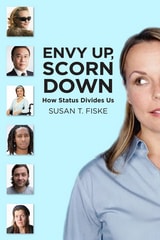
Envy Up, Scorn Down
How Status Divides UsSusan T. Fiske
Russell Sage Foundation, 2011
An insightful examination of why we compare ourselves to those above and below us. The United States was founded on the principle of equal opportunity for all, and this ethos continues to inform the nation's collective identity. In reality, however, absolute equality is elusive. The gap between rich and poor has widened in recent decades, and the United States has the highest level of economic inequality of any developed country. Social class and other differences in status reverberate throughout American life, and prejudice based on another's perceived status persists among individuals and groups. In Envy Up, Scorn Down, noted social psychologist Susan Fiske examines the psychological underpinnings of interpersonal and intergroup comparisons, exploring why we compare ourselves to those both above and below us and analyzing the social consequences of such comparisons in day-to-day life. What motivates individuals, groups, and cultures to envy the status of some and scorn the status of others? Who experiences envy and scorn most? Envy Up, Scorn Down marshals a wealth of recent psychological studies as well as findings based on years of Fiske's own research to address such questions. She shows that both envy and scorn have distinctive biological, emotional, cognitive, and behavioral characteristics. And though we are all "wired" for comparison, some individuals are more vulnerable to these motives than others. Dominant personalities, for example, express envy toward high-status groups such as the wealthy and well-educated, and insecurity can lead others to scorn those perceived to have lower status, such as women, minorities, or the disabled. Fiske shows that one's race or ethnicity, gender, and education all correlate with perceived status. Regardless of whether one is accorded higher or lower status, however, all groups rank their members, and all societies rank the various groups within them. We rate each group as either friend or foe, able or unable, and accordingly assign them the traits of warmth or competence. The majority of groups in the United States are ranked either warm or competent but not both, with extreme exceptions: the homeless or the very poor are considered neither warm nor competent. Societies across the globe view older people as warm but incompetent. Conversely, the very rich are generally considered cold but highly competent. Envy Up, Scorn Down explores the nuances of status hierarchies and their consequences and shows that such prejudice in its most virulent form dehumanizes and can lead to devastating outcomes—from the scornful neglect of the homeless to the envious anger historically directed at Tutsis in Rwanda or Jews in Europe. Individuals, groups, and even cultures will always make comparisons between and among themselves. Envy Up, Scorn Down is an accessible and insightful examination of drives we all share and the prejudice that can accompany comparison. The book deftly shows that understanding envy and scorn—and seeking to mitigate their effects—can prove invaluable to our lives, our relationships, and our society.
[more]
Everyday Troubles
The Micro-Politics of Interpersonal ConflictRobert M. Emerson
University of Chicago Press, 2015
From roommate disputes to family arguments, trouble is inevitable in interpersonal relationships. In Everyday Troubles, Robert M. Emerson explores the beginnings and development of the conflicts that occur in our relationships with the people we regularly encounter—family members, intimate partners, coworkers, and others—and the common responses to such troubles.
To examine these issues, Emerson draws on interviews with college roommates, diaries documenting a wide range of irritation with others, conversations with people caring for family members suffering from Alzheimer’s, studies of family interactions, neighborly disputes, and other personal accounts. He considers how people respond to everyday troubles: in non-confrontational fashion, by making low-visibility, often secretive, changes in the relationship; more openly by directly complaining to the other person; or by involving a third party, such as friends or family. He then examines how some relational troubles escalate toward extreme and even violent responses, in some cases leading to the involvement of outside authorities like the police or mental health specialists.
By calling attention to the range of possible reactions to conflicts in interpersonal relationships, Emerson also reminds us that extreme, even criminal actions often result when people fail to find ways to deal with trouble in moderate, non-confrontational ways. Innovative and insightful, Everyday Troubles is an illuminating look at how we deal with discord in our relationships.
[more]
Evolution and the Capacity for Commitment
Randolph Nesse
Russell Sage Foundation, 2001
Commitment is at the core of social life. The social fabric is woven from promises and threats that are not always immediately advantageous to the parties involved. Many commitments, such as signing a contract, are fairly straightforward deals, in which both parties agree to give up certain options. Other commitments, such as the promise of life-long love or a threat of murder, are based on more intangible factors such as human emotions. In Evolution and the Capacity for Commitment, distinguished researchers from the fields of economics, psychology, ethology, anthropology, philosophy, medicine, and law offer a rich variety of perspectives on the nature of commitment and question whether the capacity for making, assessing, and keeping commitments has been shaped by natural selection. Game theorists have shown that players who use commitment strategies—by learning to convey subjective offers and to gauge commitments others are willing to make—achieve greater success than those who rationally calculate every move for immediate reward. Evolution and the Capacity for Commitment includes contributions from some of the pioneering students of commitment. Their elegant analyses highlight the critical role of reputation-building, and show the importance of investigating how people can believe that others would carry out promises or threats that go against their own self-interest. Other contributors provide real-world examples of commitment across cultures and suggest the evolutionary origins of the capacity for commitment. Perhaps nowhere is the importance of commitment and reputation more evident than in the institutions of law, medicine, and religion. Essays by professionals in each field explore why many practitioners remain largely ethical in spite of manifest opportunities for client exploitation. Finally, Evolution and the Capacity for Commitment turns to leading animal behavior experts to explore whether non-humans also use commitment strategies, most notably through the transmission of threats or signs of non-aggression. Such examples illustrate how such tendencies in humans may have evolved. Viewed as an adaptive evolutionary strategy, commitment offers enormous potential for explaining complex and irrational emotional behaviors within a biological framework. Evolution and the Capacity for Commitment presents compelling evidence for this view, and offers a potential bridge across the current rift between biology and the social sciences. A Volume in the Russell Sage Foundation Series on Trust
[more]
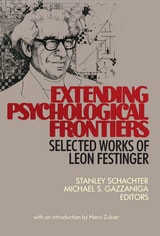
Extending Psychological Frontiers
Stanley Schachter
Russell Sage Foundation, 1989
Leon Festinger's forty-year scrutiny of that "curious animal, the modern human being" fundamentally transformed psychological thinking and shaped an entire scientific field, that of social psychology. The twenty-four papers brought together for the first time in Extending Psychological Frontiers encompass the classic contributions and critical turning points of Festinger's long career. Spanning the post-war decades, this unprecedented volume reveals the full scope, diversity, and import of Festinger's work. Its thematic arrangement clarifies the complex network of problems that preoccupied Festinger and the unique imaginative style that characterized his intellect. Whether examining the voting behavior of Catholics and Jews, the meaning of minute eye movements, the decisions of maze-running rats, or the proselytizing behavior of cultists, Festinger consistently transcended the traditional bounds of the discipline. His theory of cognitive dissonance, which describes how people attempt to resolve the tensions that result when they hold simultaneously two inconsistent beliefs, challenged preexisting psychological theories and produced more important ideas and experimentation than any other development in social psychology. Major writings on group dynamics, decision making, and perceptual processes further underscore the impact of Festinger's research not only on psychology, but also on a wide range of intellectual fronts, from literary theory to ethnology and from historical studies to contemporary political analysis. Extending Psychological Frontiers is an invaluable resource, providing a comprehensive and coherent picture of an extraordinary body of work.
[more]