Results by title
661 books match the query 'South America' and 21 start with e
Early Settlement and Subsistence in the Casma Valley, Peru
Shelia Pozorski
University of Iowa Press, 1987
Earth Beings
Ecologies of Practice across Andean WorldsMarisol de la Cadena
Duke University Press, 2015
Earth Politics
Religion, Decolonization, and Bolivia's Indigenous IntellectualsWaskar Ari
Duke University Press, 2014
El Alto, Rebel City
Self and Citizenship in Andean BoliviaSian Lazar
Duke University Press, 2007
Drawing on ethnographic fieldwork conducted between 1997 and 2004, Lazar contends that in El Alto, citizenship is a set of practices defined by one’s participation in a range of associations, many of them collectivist in nature. Her argument challenges Western liberal notions of the citizen by suggesting that citizenship is not only individual and national but in many ways communitarian and distinctly local, constituted through different kinds of affiliations. Since in El Alto these affiliations most often emerge through people’s place of residence and their occupational ties, Lazar offers in-depth analyses of neighborhood associations and trade unions. In so doing, she describes how the city’s various collectivities mediate between the state and the individual. Collective organization in El Alto and the concept of citizenship underlying it are worthy of attention; they are the basis of the city’s formidable power to mobilize popular protest.
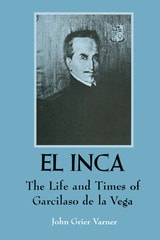
El Inca
The Life and Times of Garcilaso de la VegaBy John Grier Varner
University of Texas Press, 1968
Garcilaso de la Vega, the great chronicler of the Incas and the conquistadors, was born in Cuzco in 1539. At the age of twenty, he sailed to Spain to acquire an education, and he remained there until his death at Córdoba in 1616. As the natural son of a noble conquistador and an Indian woman of royal blood, he took immense pride in both his Spanish and Inca heritage, and, living as he did during a bewildering but stimulating epoch, he personally witnessed the last gasp of the dying Inca empire, the fratricidal conflicts that accompanied the Conquest, and the literary growth as well as the political decline of the Spain of Philip II and Philip III.
Garcilaso left for posterity one of the earliest accounts of the ancient Incas, a reliable though admittedly biased chronicle of Spanish conquests in Andean America and a glowing story of Hernando de Soto’s exploration of North America. Though he never lost pride in his Spanish heritage, continued rebuffs in caste-conscious Spain strengthened his pride in his Indian heritage and his sympathy for his mother’s people. Thus his histories, while ennobling Spaniards, also ennobled the Incas, and eventually were to have some influence in the struggle of South Americans for political independence from Spain. In both blood and character El Inca Garcilaso was a true mestizo. He is generally considered to have been the first native-born American to attain the honor of publication.
This was the life, and these were the times, that Varner has evoked so richly in his narrative. It rings and glitters with the sounds and colors of festivals, pageantry, and battle; it listens to the murmur of prayers, the defeated mutter of the Incas, the scratch of the scholar’s quill; it pictures both highlights and shadows. For the reader already acquainted with Garcilaso’s chronicles, this book will be a welcome complement; for those who are meeting El Inca here for the first time, it will be a rewarding and satisfying introduction.
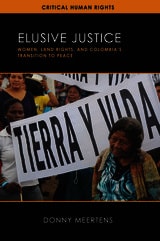
Elusive Justice
Women, Land Rights, and Colombia's Transition to PeaceDonny Meertens
University of Wisconsin Press, 2019
Drawing on decades of research, Elusive Justice demonstrates how these women continue to face numerous adverse circumstances, including geographical isolation, encroaching capitalist enterprises, and a dearth of social and institutional support. Donny Meertens contends that women's advocacy organizations must have a prominent role in overseeing these transitional policies in order to create a more just society. By bringing together the underresearched topic of property repayment and the pursuit of gender justice in peacebuilding, these findings have broad significance elsewhere in the world.
Embers of the Past
Essays in Times of DecolonizationJavier Sanjinés C.
Duke University Press, 2013
Embodied Protests
Emotions and Women's Health in BoliviaMaria Tapias
University of Illinois Press, 2015
Evocative and compassionate, Embodied Protests gives voice to the human costs of the ongoing neoliberal experiment.
Embodying the Sacred
Women Mystics in Seventeenth-Century LimaNancy E. van Deusen
Duke University Press, 2018
Endangered City
The Politics of Security and Risk in BogotáAustin Zeiderman
Duke University Press, 2016
Enemy in the Blood
Malaria, Environment, and Development in ArgentinaEric D. Carter
University of Alabama Press, 2012
Tracing the Fight Against Malaria and the Making of Modern Argentina.
Enemy in the Blood: Malaria, Environment, and Development in Argentina examines the dramatic yet mostly forgotten history of malaria control in northwest Argentina. Carter traces the evolution of malaria science and policy in Argentina from the disease’s emergence as a social problem in the 1890s to its effective eradication by 1950. Malaria-control proponents saw the campaign as part of a larger project of constructing a modern identity for Argentina. Insofar as development meant building a more productive, rational, and hygienic society, the perceptions of a culturally backwards and disease-ridden interior prevented Argentina from joining the ranks of “modern” nations. The path to eradication, however, was not easy due to complicated public health politics, inappropriate application of foreign malaria control strategies, and a habitual misreading of the distinctive ecology of malaria in the northwest, especially the unique characteristics of the local mosquito vector. Homegrown scientific expertise, a populist public health agenda, and an infusion of new technologies eventually brought a rapid end to malaria’s scourge, if not the cure for regional underdevelopment.
Enemy in the Blood sheds light on the often neglected history of northwest Argentina’s interior, adds to critical perspectives on the history of development and public health in modern Latin America, and demonstrates the merits of integrative social-environmental research.
Engendering Revolution
Women, Unpaid Labor, and Maternalism in Bolivarian VenezuelaBy Rachel Elfenbein
University of Texas Press, 2019
In 1999, Venezuela became the first country in the world to constitutionally recognize the socioeconomic value of housework and enshrine homemakers’ social security. This landmark provision was part of a larger project to transform the state and expand social inclusion during Hugo Chávez’s presidency. The Bolivarian revolution opened new opportunities for poor and working-class—or popular—women’s organizing. The state recognized their unpaid labor and maternal gender role as central to the revolution. Yet even as state recognition enabled some popular women to receive public assistance, it also made their unpaid labor and organizing vulnerable to state appropriation.
Offering the first comprehensive analysis of this phenomenon, Engendering Revolution demonstrates that the Bolivarian revolution cannot be understood without comprehending the gendered nature of its state-society relations. Showcasing field research that comprises archival analysis, observation, and extensive interviews, these thought-provoking findings underscore the ways in which popular women sustained a movement purported to exalt them, even while many could not access social security and remained socially, economically, and politically vulnerable.
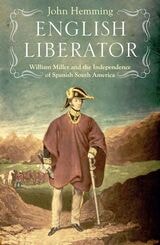
English Liberator
William Miller and the Independence of Spanish South AmericaJohn Hemming
Haus Publishing, 2025
During Admiral Thomas Cochrane’s demolition of imperial Spain’s naval presence in the Pacific amid the revolutionary wars for Spanish South America, all the raids were carried out by his marines under a young officer called William Miller. One of three sons of a baker in a small village in Kent, with no family influence, money, or even secondary education, he came from nowhere, but he went on to have a meteoric rise in the armies that liberated the nations of Chile and Peru. By the time of Ayacucho in 1824, the large battle that ended Spanish rule in South America, there were seven generals in the royalist Spanish army and five on the patriot side. Eleven of these generals were Hispanic; Miller was the only foreigner.
Set in the context of the great European powers’ weakening grip over their global empires and the ensuing wars of independence in Spanish South America, John Hemming’s gripping narrative spans Miller’s time as a teenage soldier in Wellington’s Peninsular War, his contribution to the liberation of the new nations Chile and Peru, and his years in diplomacy thereafter. Drawing on written accounts by many of Miller’s contemporaries in addition to a wealth of modern research, Hemming casts the anti-imperialist, anti-slavery soldier as highly regarded by all the leaders of independence and popular with ordinary people and peasant farmers due to his own humble origins—a legacy evidenced by his burial in the Pantheon of founding fathers of Peru decades after the battles in which he made his name.

Epitacio Pessoa
BrazilMichael Streeter
Haus Publishing, 2010

Escaping Hitler
A Jewish Haven in ChileEva Goldschmidt Wyman
University of Alabama Press, 2013
A family’s flight from Nazi terror to an unexpected refuge in Chile.
Escaping Hitler is the personal story of Eva Wyman and her family’s escape from Nazi Germany to Chile in the sociohistorical context of 1930s and 1940s, a time when the Chilean Nazi party had an active presence in the country’s major institutions.
Based primarily on interviews with German Jewish refugees and family correspondence, Eva Goldschmidt Wyman provides an intimate account of Jews in Germany in the 1930s as Nazi controls tightened and family members were taken to Riga concentration camp. Wyman recounts Kristallnacht in Stuttgart, where her father was principal of the Jewish school, his imprisonment in Dachau, and his release and immigration to Great Britain. Escaping Hitler details the family’s escape from Germany and subsequent life in Chile, providing an intimate look at daily life on the steam ship Conte Grande during the voyage from Italy to Chile in 1939, Nazi espionage and anti-Semitic activity in Chile, and the Nazi influence in South America in general.
Recounted in an intimate and personal style, Escaping Hitler immerses the reader in an extraordinary chapter of contemporary Jewish history both inside Germany and South America.
Ethnicity, Markets, and Migration in the Andes
At the Crossroads of History and AnthropologyBrooke Larson, Olivia Harris, and Enrique Tandeter, eds.
Duke University Press, 1995
Bringing together the work of outstanding scholars in Andean history, anthropology, and ethnohistory, these pioneering essays show how, from the very earliest period of Spanish rule, Andean peasants and their rulers embraced the new economic opportunities and challenged or subverted the new structures introduced by the colonial administration. They also convincingly explain why in the twentieth century the mistaken idea developed that Andean peasants were conservative and unable to participate effectively in different markets, and reveal how closely ethnic inequalities were tied to evolving market relations. Inviting a critical reconsideration of ethnic, class, and gender issues in the context of rural Andean markets, this book will revise the prevailing view of Andean history and provide a more fully informed picture of the complex mercantile activities of Andean peasants.

Everyday Anarchism
Prefiguring Utopia in Spain and Argentina, 1890-1930Nathaniel Andrews
University of Illinois Press, 2027
In Spain and Argentina during the late nineteenth and early twentieth centuries, anarchists sought to build their ideal society in the present rather than wait for the revolution. These radicals built their daily lives around their beliefs—a far-sighted cultural project that shaped education, family life, leisure time, and moral values.
Nathaniel Andrews looks at life in four communities to explore how anarchists fused radical politics with the everyday. As Andrews shows, anarchists created networks across the Atlantic that not only shared people and ideas, but practices, too. Small actions—picnics, childrearing, using time differently—became a part of pursuing larger political goals. But these practices also revealed tensions within the movement by highlighting the gap separating ideas and actions, particularly in matters of gender.
Vivid and surprising, <i>Everyday Anarchism</i> reveals a daring program to model a radical society within the very world anarchism hoped to transform.
Exemplary Violence
Rewriting History in Colonial ColombiaAlberto Villate-Isaza
Bucknell University Press, 2021
Exile within Exiles
Herbert Daniel, Gay Brazilian RevolutionaryJames N. Green
Duke University Press, 2018
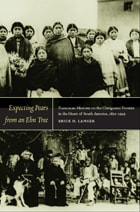
Expecting Pears from an Elm Tree
Franciscan Missions on the Chiriguano Frontier in the Heart of South America, 1830–1949Erick D. Langer
Duke University Press, 2009
Expecting Pears from an Elm Tree is based on twenty years of research, including visits to the sites of nearly every mission discussed and interviews with descendants of mission Indians, Indian chiefs, Franciscan friars, mestizo settlers, and teachers. Langer chronicles how, beginning in the 1840s, the establishment of missions fundamentally changed the relationship between the Chiriguano villages and national society. He looks at the Franciscan missionaries’ motives, their visions of ideal missions, and the realities they faced. He also examines mission life from the Chiriguano point of view, considering their reasons for joining missions and their resistance to conversion, as well as the interrelated issues of Indian acculturation and the development of the mission economy, particularly in light of the relatively high rates of Indian mortality and outmigration. Expanding his focus, Langer delves into the complex interplay of Indians, missionaries, frontier society, and the national government until the last remaining missions were secularized in 1949. He concludes with a comparative analysis between colonial and republican-era missions throughout Latin America.
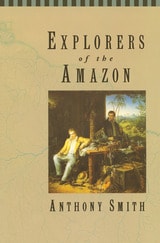
Explorers of the Amazon
Anthony Smith
University of Chicago Press, 1993
"The history of Amazonian exploration, wonderfully told by Anthony Smith, is awash with madness—an extravagant mixture of the malevolent and the miraculous."—Stephen Mills, Times Literary Supplement