Results by title
84 books match the query 'Special education' and 7 start with e
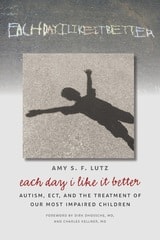
Each Day I Like It Better
Autism, ECT, and the Treatment of Our Most Impaired ChildrenAmy S. F. Lutz
Vanderbilt University Press, 2014
Each Day I Like It Better recounts the journeys of Jonah and seven other children and their families (interviewed by the author) in their quests for appropriate educational placements and therapeutic interventions. The author describes their varied, but mostly successful, experiences with ECT.
A survey of research on pediatric ECT is incorporated into the narrative, and a foreword by child psychiatrist Dirk Dhossche and ECT researcher and practitioner Charles Kellner explains how ECT works, the side effects patients may experience, and its current use in the treatment of autism, catatonia, and violent behavior in children.
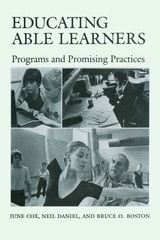
Educating Able Learners
Programs and Promising PracticesBy June Cox, Neil Daniel, and Bruce O. Boston
University of Texas Press, 1985
American education has long been under a microscope. In a time when all aspects of our school system face close scrutiny, educators, administrators, and parents are asking critical questions about how we educate those superior students we call “able learners.”
Our schools reward behavior inappropriate for an independent thinker, researcher, or artist. Programming for our most capable students is fragmented and discontinuous. And yet there are schools and programs that hold significant promise.
This four-year national study from the Sid W. Richardson Foundation provides a broad database, looks into the backgrounds of a few unusually creative individuals, and examines programs with a record of success. It argues in favor of comprehensive programming for able learners, providing a steady challenge for all students, helping to insure that no individual talent withers for want of opportunity. Included are recommendations for discovering and nurturing talent in students (including traditionally neglected groups, the economically disadvantaged, and the culturally diverse), building and administering sound programs, developing appropriately trained staff and teachers, and evaluating effectiveness of programs to assure accountability and add credibility.
Compiling data from diverse sources—including 35 MacArthur Foundation Fellows, 400 schools, 1,172 school districts, and countless school personnel and students—the study looks at programs for able learners throughout the country, from Project Pegasus in Iowa to Oaks Academy in Texas, from Bronx High School of Science in New York to Bishop Carroll High School in Alberta, Canada. The authors’ conclusions based on this broad investigation provide an impassioned call for coordinated schooling and cooperation among all segments of society to develop a new generation of creative, self-motivated students.
Educating Deaf Students
Global PerspectivesDes Power
Gallaudet University Press, 2005
The 19th International Congress on Education of the Deaf (ICED) in 2000, held in Sydney, Australia, brought together 1,067 teachers, administrators and researchers from 46 countries to address an extremely wide selection of topics. Experts from around the world discussed inclusion of deaf students in regular educational environments, literacy, audiology, auditory development and listening programs, hearing aids, programming for children with cochlear implants, signed communication in education, bilingual education, early intervention (including the rapidly emerging area of newborn hearing screening), education in developing countries, deaf students with multiple disabilities, and deaf students in post-secondary school education.
The 19 chapters of Educating Deaf Students: Global Perspectives present a select cross-section of the issues addressed at the 19th ICED. Divided into four distinct parts – Contemporary Issues for all Learners, The Early Years, The School Years, and Contemporary Issues in Postsecondary Education – the themes considered here span the entire student age range. Authored by 27 different researchers and practitioners from six different countries, this book can be seen as a valuable description of the zeitgeist in the field of education of the deaf at the turn of the 21st century and the millennium.
Educational Interpreting
How It Can SucceedElizabeth A. Winston
Gallaudet University Press, 2004
This incisive book explores the current state of educational interpreting and how it is failing deaf students. The contributors, all renowned experts in their field, include former educational interpreters, teachers of deaf students, interpreter trainers, and deaf recipients of interpreted educations.
Educational Interpreting presents the salient issues in three distinct sections. Part 1 focuses on deaf students—their perspectives on having interpreters in the classroom, the language myths that surround them, the accessibility of language to them, and their cognition. Part 2 raises questions about the support and training that interpreters receive from the school systems, the qualifications that many interpreters bring to an interpreted education, and the accessibility of everyday classrooms for deaf students placed in such environments. Part 3 presents a few of the possible suggestions for addressing the concerns of interpreted educations, and focuses primarily on the interpreter.
The contributors discuss the need to (1) define the core knowledge and skills interpreters must have and (2) develop standards of practice and assessment. They also stress that interpreters cannot effect the necessary changes alone; unless and until administrators, parents, teachers, and students recognize the inherent issues of access to education through mediation, little will change for deaf students.
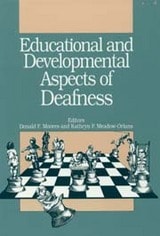
Educational and Developmental Aspects of Deafness
Donald F. Moores
Gallaudet University Press, 1990
Educational and Developmental Aspects of Deafness details the ongoing revolution in the education of deaf children. More than 20 researchers contributed their discoveries in anthropology, education, linguistics, psychology, sociology, and other major disciplines, with special concentration upon the education of deaf children.
Divided into two parts on education at home and in school, this incisive book documents breakthroughs such as the public's interest in sign language, the increasing availability of interpreters, the growing perception of deafness as a social condition, not a pathology, and other positive trends. It is unique as the first purely research-based text and reference point for further study of the education of deaf children.
Ethical Considerations in Educating Children Who Are Deaf or Hard of Hearing
Kathee Mangan Christensen
Gallaudet University Press, 2011
The education of deaf or hard of hearing children has become as complex as the varying needs of each individual child. Teachers face classrooms filled with students who are culturally Deaf, hard of hearing, or post-lingually deaf; they might use American Sign Language, cochlear implants, hearing aids/FM systems, speech, Signed English, sign-supported speech, contact signing, nonverbal communication, or some combination of methods. Educators who decide what tools are best for these children are making far-reaching ethical decisions in each case. This collection features ten chapters that work as constructive conversations to make the diverse needs of these deaf students the primary focus.
The initial essays establish fundamental points of ethical decision-making and emphasize that every situation should be examined not with regard for what is “right or wrong,” but for what is “useful.” Absolute objectivity is unattainable due to social influences, while “common knowledge” is ruled out in favor of “common awareness.” Other chapters deal with the reality of interpreting through the professional’s eyes, of how they are assessed, participate, and are valued in the total educational process, including mainstream environments. The various settings of education for deaf children are profiled, from residential schools to life in three cultures for deaf Latino students, to self-contained high school programs. Ethical Considerations in Educating Deaf Children Who Are Deaf or Hard of Hearing offers an invaluable set of guidelines for administrators and educators of children with hearing loss in virtually every environment in a postmodern world.
Expecting Teryk
An Exceptional Path to ParenthoodDawn Prince-Hughes
Ohio University Press, 2005
“Expecting Teryk is a rich and sumptuous work that speaks to the deeper realities and represents a unique viewpoint of experiences shared by all individuals who choose the path to parenthood.”—Disability, Pregnancy, and Parenthood
The period just prior to the birth of a child is a time of profound personal transformation for expectant parents. Expecting Teryk: An Exceptional Path to Parenthood is an intimate exploration, written in the form of a letter from a parent to her future son, that reclaims a rite of passage that modern society would strip of its magic.
Dawn Prince-Hughes, renowned author of Songs of the Gorilla Nation: My Journey through Autism, considers the ways being autistic might inform her parenting. She also candidly narrates her experience of becoming a parent as part of a lesbian couple—from meeting her partner to the questions they ask about their readiness to become parents and the practical considerations of choosing a sperm donor.
Expecting Teryk is viewed through the lens of autism as Prince-Hughes shares the unique way she sees and experiences the world—as well as her aching will to be fully present for her son. Contemplating the evolutionary traditions of parenting from both animal and human perspectives and the reassurances that nature offers, Expecting Teryk is a work of sensuous wonder that speaks to the deeper realities and archetypal experiences shared by all who embark on the journey of parenthood.