Results by title
389 books match the query 'State' and 5 start with e

Edges of the State
John Protevi
University of Minnesota Press, 2019
Using philosophical and scientific work to engage the perennial question of human nature
This book takes a look at the formation, and edges, of states: their breakdowns and attempts to repair them, and their encounters with non-state peoples. It draws upon anthropology, political philosophy, neuroscience, evolutionary biology, child developmental psychology, and other fields to look at states as projects of constructing “bodies politic,” where the civic and the somatic intersect. John Protevi asserts that humans are predisposed to “prosociality,” or being emotionally invested in social partners and patterns. With readings from Jean-Jacques Rousseau and James C. Scott; a critique of the assumption of widespread pre-state warfare as a selection pressure for the evolution of human prosociality and altruism; and an examination of the different “economies of violence” of state and non-state societies, Edges of the State sketches a notion of prosocial human nature and its attendant normative maxims.
Forerunners: Ideas First
Short books of thought-in-process scholarship, where intense analysis, questioning, and speculation take the lead
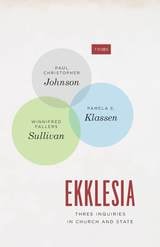
Ekklesia
Three Inquiries in Church and StatePaul Christopher Johnson, Pamela E. Klassen, and Winnifred Fallers Sullivan
University of Chicago Press, 2018
The first of a closely linked trio of essays is by Paul Johnson, and offers a new interpretation of the Brazilian community gathered at Canudos and its massacre in 1896–97, carried out as a joint churchstate mission and spectacle. In the second essay, Pamela Klassen argues that the colonial churchstate relationship of Canada came into being through local and national practices that emerged as Indigenous nations responded to and resisted becoming “possessions” of colonial British America. Finally, Winnifred Sullivan’s essay begins with reflection on the increased effort within the United States to ban Bibles and scriptural references from death penalty courtrooms and jury rooms; she follows with a consideration of the political theological pressure thereby placed on the jury that decides between life and death. Through these three inquiries, Ekklesia takes up the familiar topos of “church and state” in order to render it strange.
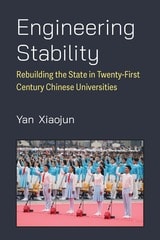
Engineering Stability
Rebuilding the State in Twenty-First Century Chinese UniversitiesYan Xiaojun
University of Michigan Press, 2024
Drawing on rich materials gathered from in-depth field research in China during the Xi Jinping era, Engineering Stability invites scholars of comparative politics, state theory, contentious politics, and political development to rethink and reimagine how what Yan calls “a compromised autocratic state” is rebuilt within and from itself after overcoming a traumatic moment of vulnerability. The book further details the four types of infrastructure — institutional, significative, regulatory, and incentivizing — that state rebuilders need to overhaul, and looks into the campaign of state rebuilding in post-Tiananmen Chinese universities and its implications for our understanding of politics in general.
Ethics by Committee
A History of Reasoning Together about Medicine, Science, Society, and the StateNoortje Jacobs
University of Chicago Press, 2022
Ethics boards have become obligatory passage points in today’s medical science, and we forget how novel they really are. The use of humans in experiments is an age-old practice that records show goes back to at least the third century BC, and it has been popular as a practice since the early modern period. Yet in most countries around the world, hardly any formal checks and balances existed to govern the communal oversight of experiments involving human subjects until at least the 1960s. Ethics by Committee traces the rise of ethics boards for human experimentation in the second half of the twentieth century.
Using the Netherlands as a case study, historian Noortje Jacobs shows how the authority of physicians to make decisions about clinical research in this period gave way in most developed nations to formal mechanisms of communal decision-making that served to regiment the behavior of individual researchers. This historically unprecedented change in scientific governance came out of the growing international wariness of medical research in the decades after World War II and was meant to solidify a new way of reasoning together in liberal democracies about medicine and science. But what reasoning together meant, and who was invited to participate, changed drastically over time. In detailing this history, Jacobs shows that research ethics committees were originally intended not only to make human experimentation more ethical but also to raise its epistemic quality and intensify the use of new clinical research methods. By examining complex negotiations over the appropriate governance of human subjects research, Ethics by Committee is an important contribution to our understanding of the randomized controlled trial and the history of research ethics and bioethics more generally.
Experimentation with Human Beings
The Authority of the Investigator, Subject, Professions, and State in the Human Experimentation ProcessJay Katz
Russell Sage Foundation, 1972