Results by title
270 books match the query 'Technology' and 19 start with e
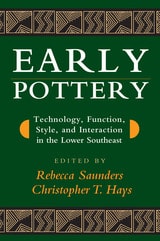
Early Pottery
Technology, Function, Style, and Interaction in the Lower SoutheastEdited by Rebecca Saunders and Christopher T. Hays
University of Alabama Press, 2004
A synthesis of research on earthenware technologies of the Late Archaic Period in the southeastern U.S.
Information on social groups and boundaries, and on interaction between groups, burgeons when pottery appears on the social landscape of the Southeast in the Late Archaic period (ca. 5000-3000 years ago). This volume provides a broad, comparative review of current data from "first potteries" of the Atlantic and Gulf coastal plains and in the lower Mississippi River Valley, and it presents research that expands our understanding of how pottery functioned in its earliest manifestations in this region.
Included are discussions of Orange pottery in peninsular Florida, Stallings pottery in Georgia, Elliot's Point fiber-tempered pottery in the Florida panhandle, and the various pottery types found in excavations over the years at the Poverty Point site in northeastern Louisiana. The data and discussions demonstrate that there was much more interaction, and at an earlier date, than is often credited to Late Archaic societies. Indeed, extensive trade in pottery throughout the region occurs as early as 1500 B.C.
These and other findings make this book indispensable to those involved in research into the origin and development of pottery in general and its unique history in the Southeast in particular.

Edited Clean Version
Technology and the Culture of ControlRaiford Guins
University of Minnesota Press, 2009
Where is censorship in the age of digital technology?
Not long ago it would have been an absurd idea to purchase a television, CD or MP3 or DVD player, computer software, or game console with the intention of limiting its capabilities. However, as Raiford Guins demonstrates in Edited Clean Version, today’s media technology is marketed and sold for what it does not contain and what it will not deliver.
TVs equipped with V-chips, Internet filters, editing DVD players, clean-version CDs and MP3s, and game consoles with parental control features can block out, monitor, disable, and filter information. As Guins argues in this provocative book, consumers now find themselves in new relationships with their everyday media in which they inscribe their viewing, listening, and playing experiences with self-prescribed and technologically enabled values and morals. Censorial practices are not so much enacted on media by regulatory bodies today as they are in our media technology.According to Guins, these new “control technologies” are designed to embody an ethos of neoliberal governance—through the very media that have been previously presumed to warrant management, legislation, and policing. Repositioned within a discourse of empowerment, security, and choice, the action of regulation, he reveals, has been relocated into the hands of users.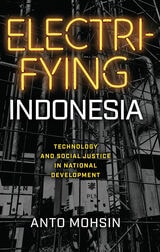
Electrifying Indonesia
Technology and Social Justice in National DevelopmentAnto Mohsin
University of Wisconsin Press, 2023
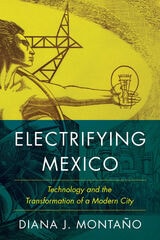
Electrifying Mexico
Technology and the Transformation of a Modern CityBy Diana J. Montaño
University of Texas Press, 2021
2022 Alfred B. Thomas Book Award, Southeastern Council of Latin American Studies (SECOLAS)
2022 Bolton-Johnson Prize, Conference on Latin American History (CLAH)
2022 Best Book in Non-North American Urban History, Urban History Association (Co-winner)
2023 Honorable Mention, Best Book in the Humanities, Latin American Studies Association Mexico Section
2023 Turriano Book Prize, International Committee for the History of Technology
2023 Michael C. Meyer Award for Best Book on Mexican History in a Five-Year Period, Rocky Mountain Council for Latin American Studies
Many visitors to Mexico City’s 1886 Electricity Exposition were amazed by their experience of the event, which included magnetic devices, electronic printers, and a banquet of light. It was both technological spectacle and political messaging, for speeches at the event lauded President Porfirio Díaz and bound such progress to his vision of a modern order.
Diana J. Montaño explores the role of electricity in Mexico’s economic and political evolution, as the coal-deficient country pioneered large-scale hydroelectricity and sought to face the world as a scientifically enlightened “empire of peace.” She is especially concerned with electrification at the social level. Ordinary electricity users were also agents and sites of change. Montaño documents inventions and adaptations that served local needs while fostering new ideas of time and space, body and self, the national and the foreign. Electricity also colored issues of gender, race, and class in ways specific to Mexico. Complicating historical discourses in which Latin Americans merely use technologies developed elsewhere, Electrifying Mexico emphasizes a particular national culture of scientific progress and its contributions to a uniquely Mexican modernist political subjectivity.
Electronic Elsewheres
Media, Technology, and the Experience of Social SpaceChris Berry
University of Minnesota Press, 2009
Media do not simply portray places that already exist; they actually produce them. In exploring how world populations experience "place" through media technologies, the essays included here examine how media construct the meanings of home, community, work, nation, and citizenship.
Tracing how media reconfigure the boundaries between public and private-and global and local-to create "electronic elsewheres," the essays investigate such spaces and identities as the avatars that women are creating on Web sites, analyze the role of satellite television in transforming Algerian neighborhoods, inquire into the roles of radio and television in Israel and India, and take a skeptical look at the purported novelty of the "new media home."
Contributors: Asu Aksoy, Istanbul Bilgi U; Charlotte Brunsdon, U of Warwick; Ratiba Hadj-Moussa, York U (Toronto); Tamar Liebes-Plesner, Hebrew U; David Morley, Goldsmiths, U of London; Lisa Nakamura, U of Illinois; Arvind Rajagopal, New York U; Kevin Robins, Goldsmiths, U of London; Jeffrey Sconce, Northwestern U; Marita Sturken, New York U; and Shunya Yoshimi, U of Tokyo.
Elements for an Anthropology of Technology
Pierre Lemonnier
University of Michigan Press, 1992

Ellie's Log
Exploring the Forest Where the Great Tree FellJudith L. Li
Oregon State University Press, 2013
After a huge tree crashes to the ground during a winter storm, ten-year-old Ellie and her new friend, Ricky, explore the forest where Ellie lives. Together, they learn how trees provide habitat for plants and animals high in the forest canopy, down among mossy old logs, and deep in the pools of a stream. The plants, insects, birds, and mammals they discover come to life in colored pen-and-ink drawings.
An engaging blend of science and storytelling, Ellie’s Log also features:
• Pages from Ellie’s own field notebook, which provide a model for recording observations in nature
• Ellie’s advice to readers for keeping a field notebook
• Ellie’s book recommendations Online resources for readers and teachers—including a Teacher’s Guide—are available at ellieslog.org.
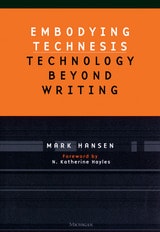
Embodying Technesis
Technology beyond WritingMark Hansen
University of Michigan Press, 2000
Embodying Technesis examines how technological changes have rendered obsolete notions of technology as machine and as text. Voicing a sustained plea for rethinking the technological, Hansen argues that radical technological changes--from the steam engine to the internet and virtual reality--have fundamentally altered conditions of perception and, in so doing, changed the prevailing structures of modern experience. By emphasizing the dynamic interaction between technologies and bodies, between the diffuse effects of technological shifts and the collective embodied experiences of contemporary agents, Hansen opens the path for a radical revision of our understanding of the technological.
Mark Hansen is Assistant Professor of English, Princeton University.
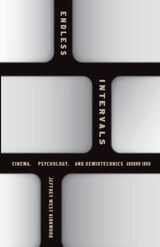
Endless Intervals
Cinema, Psychology, and Semiotechnics around 1900Jeffrey West Kirkwood
University of Minnesota Press, 2022
Revealing cinema’s place in the coevolution of media technology and the human
Cinema did not die with the digital, it gave rise to it. According to Jeffrey West Kirkwood, the notion that digital technologies replaced analog obscures how the earliest cinema laid the technological and philosophical groundwork for the digital world. In Endless Intervals, he introduces a theory of semiotechnics that explains how discrete intervals of machines came to represent something like a mind—and why they were feared for their challenge to the uniqueness of human intelligence.
Examining histories of early cinematic machines, Kirkwood locates the foundations for a scientific vision of the psyche as well as the information age. He theorizes an epochal shift in the understanding of mechanical stops, breaks, and pauses that demonstrates how cinema engineered an entirely new model of the psyche—a model that was at once mechanical and semiotic, discrete and continuous, physiological and psychological, analog and digital.
Recovering largely forgotten and untranslated texts, Endless Intervals makes the case that cinema, rather than being a technology assaulting the psyche, is in fact the technology that produced the modern psyche. Kirkwood considers the ways machines can create meaning, offering a fascinating theory of how the discontinuous intervals of soulless mechanisms ultimately produced a rich continuous experience of inner life.
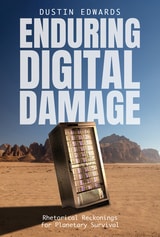
Enduring Digital Damage
Rhetorical Reckonings for Planetary SurvivalDustin Edwards
University of Alabama Press, 2025
Networks the intricate relationship between rapidly advancing digital technologies and environmental degradation and reveals the costs of our globally connected world.
Taking a step back from the screens of electronic devices and exploring the profound impacts of digital technologies on our environment, Enduring Digital Damage lifts the veil on the “hidden costs” in our modern technological world.
Dustin Edwards traces key moments in the lifecycle of technology—such as the extraction of raw materials to the disposal of electronic waste—to uncover the often overlooked consequence of our digital age. He illuminates how data centers, mining operations, and other digital infrastructures contribute to environmental harm and how the rapidly increasing demand for land use and water access is essential to sustain our growing digital needs. Weaving together narratives of technological advancement and ecological destruction, Edwards presents a comprehensive analysis of the true cost of our digital lives. By drawing on case studies, cultural critique, and a critical examination of labor and sustainability, Enduring Digital Damage reveals the deeper histories and ongoing struggles that make our digital lives possible, urging readers to imagine the possibility of a less harmful and extractive world.
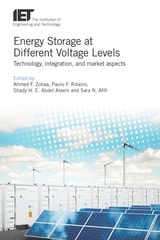
Energy Storage at Different Voltage Levels
Technology, integration, and market aspectsAhmed F. Zobaa
The Institution of Engineering and Technology, 2018
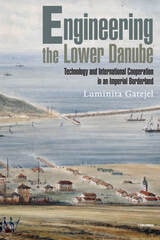
Engineering the Lower Danube
Technology and Territoriality in an Imperial Borderland, Late Eighteenth and Nineteenth CenturiesLuminita Gatejel
Central European University Press, 2023
The Lower Danube—the stretch of Europe’s second longest river between the Romanian-Serbian border and the confluence to the Black Sea—was effectively transformed during the late eighteenth and nineteenth centuries. In describing this lengthy undertaking, Luminita Gatejel proposes that remaking two key stretches—the Iron Gates and the delta—not only physically altered the river but also redefined it in a legal and political sense.
Since the late eighteenth century, military conflicts and peace treaties changed the nature of sovereignty over the area, as the expansionist tendencies of the Habsburg and British Empires encountered rival Ottoman and Russian imperial plans. The inconvenience that the river’s physical shape obstructed free navigation and the growth of commercial traffic, was an increasing concern to all parties. This book shows that alongside imperial aspirations, transnational actors like engineers, commissioners and entrepreneurs were the driving force behind the river regulation. In this highly original, deeply researched, and carefully crafted study, Gatejel explores the formation of international cooperation, the emergence of technical expertise and the emergence of engineering as a profession. This constellation turned the Lower Danube into a laboratory for experimenting with new forms of international cooperation, economic integration, and nature transformation.
Essays on the History of Transportation and Technology
EMORY L. KEMP
West Virginia University Press, 2014
Emory Kemp is the founder and director of the Institute for the History of Technology and Industrial Archaeology at West Virginia University, where he also served as a chair and professor of civil engineering and a professor of history. This collection of essays encompasses over fifty years of his research in the field of the history of technology.
Within these twelve essays, Kemp describes and analyzes nineteenth century improvements in building materials such as iron, steel, and cement; roads and bridges, especially the evolution of the suspension bridge; canals and navigable rivers, including the Ohio River and its tributaries; and water supply systems. As one of the few practicing American engineers who also researches and writes as an academic, Kemp adds an important historical context to his work by focusing not only on the construction of a structure but also on the analytical science that heralds a structure’s design and development.
Essentials of STEM Librarianship
Alexander J. Carroll and Joshua Borycz; Foreword by Carol Tenopir
American Library Association, 2025
Amid overall falling enrollment figures for higher education, the growing success of STEM programs bucks the trend. Ensuring that these programs flourish has become a priority for administrators at the provost level and above. But this emphasis on STEM poses challenges for academic libraries, many of which have instead historically focused on the humanities and social sciences. This primer helps to fill that knowledge gap, demystifying the scientific teaching and research processes for LIS students and current academic librarians alike. Regardless of their background or level of experience, readers of this guide will
- gain an overview of the contemporary STEM teaching and research enterprise by learning about the roles and needs of STEM community members such as program administrators, tenure track principal investigators (PIs), non-tenure track teaching faculty, research staff, graduate students, and undergraduate students;
- become familiarized with the “research group,” the organizational structure through which these different personas come together to advance the university research enterprise;
- get pointers on building teaching and learning programs that enhance student success and designing research support services that integrate into STEM researchers' actual workflows;
- receive proven outreach strategies for engaging STEM communities;
- learn approaches for incorporating AI (artificial intelligence) and LLMs (large language models) into information literacy programs for scientists and engineers; and
- discover how library leaders can support both nascent and established STEM librarians to advance STEM education and research at their local institutions.
Everyday Sciences
Practical Knowledge and Knowledgeable Practice in Medieval South AsiaEric Moses Gurevitch
University of Chicago Press, 2027
How people across society in medieval South Asia—including coppersmiths, merchants, bureaucrats, philosophers, and physicians—pioneered new vernacular sciences.
Starting in the eleventh century, South Asian scholars and artisans began to investigate and shape the world in a novel manner. Intellectuals translated Sanskrit texts into regional languages such as Kannada, situating knowledge in particular places. At the same time, architects and artisans began to assert their intellectual and literary presence, often claiming the title of “scholar” as they negotiated a space between classical textual erudition, professional expertise, and personal experience. Working within the perilous world of court politics, a new class of scholar-administrators began collecting recipes and composing texts about weather prediction, horticulture, mathematics, astrology, sexual life, and medicine.
Everyday Sciences traces this emergence of vernacular sciences by engaging with untapped archives and an array of sources in multiple languages. By exploring how historical actors resolved disputes about the physiology of vision, the use of meat and alcohol in medicine, and the management of information in elephant stables, Eric Moses Gurevitch unveils the complex textual and social orders that structured medieval society in India. He argues that a focus on everyday sciences in the non-modern non-West allows historians to reassess how places outside—and even inside—Europe are brought into narratives of a global history of science. Gurevitch articulates a “big-enough” history of science in South Asia, one open to little voices and unexpected connections that might not make their way through the fray in other histories.
Everyday Sciences demonstrates how practical, everyday activities were engines of profound intellectual innovation—and it shows the promise of revisiting the past without colonial hang-ups, and with fresh eyes.
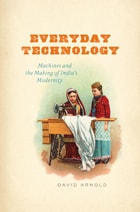
Everyday Technology
Machines and the Making of India's ModernityDavid Arnold
University of Chicago Press, 2013

Ex Ante
Power and Prediction in the Real-Time FutureJohn Cheney-Lippold
University of Chicago Press, 2027
An incisive framework for understanding how predictive AI has reshaped our relationship with time.
Ex Ante argues that AI systems draw us into a new experience of time, a continuous stream of machine-generated futures that reshapes our relationship to ourselves, to capitalism, and to infrastructure. Unlike other predictive tools that help us prepare for what might come, these projections—produced by algorithms and sourced by massive flows of data—calibrate our actions moment by moment, second by second.
In this book, John Cheney-Lippold offers a framework he calls the ex ante, Latin for “before the event,” as a way to consider how the future has become capitalism’s latest resource for exploitation. Through case studies spanning TikTok beauty filters that have fueled a surge in plastic surgery consultations, chess engines that redefine how the game is played, online sports betting platforms that commodify probability itself, hospital sepsis algorithms that transform the labor of nursing, and coordinated vehicle networks that collectively anticipate their surroundings to function, Ex Ante offers an exploration and powerful critique of our algorithmic present and the powers behind it.
Exceptional Creativity in Science and Technology
Individuals, Institutions, and InnovationsAndrew Robinson
Templeton Press, 2013
Experimental Practice
Technoscience, Alterontologies, and More-Than-Social MovementsDimitris Papadopoulos
Duke University Press, 2018