Results by title
1185 books match the query 'Travel' and 34 start with e
East Of Eden, West Of Zion
Essays On NevadaWilbur S. Shepperson
University of Nevada Press, 1989
A collection of essays in which a dozen historians and novelists present their impressions and concerns about "end of the century Nevada." Human expectations and illusions are seen as a backdrop for today's Nevada as a new human frontier. As an overview of Nevada society, this study deals with culture as well as economics, with tradition as well as rapid population growth. The essayists inquire whether the friction between acquisition and preservation, quick wealth and refined sensitivity, will build a more humane and enlightened society.
Ecuador
A Travel JournalHenri Michaux
Northwestern University Press, 2001
Edible Wild Mushrooms of Illinois and Surrounding States
A Field-to-Kitchen Guide, Second EditionJoe McFarland, Gregory M. Mueller, Michael Kuo, and Patrick R. Leacock
University of Illinois Press, 2027
* Fifty-two entries packed with information on edible species;
* Almost 400 color photographs;
* Tips on where and when to look for mushrooms, how to pick them, and identification and note-taking;
* Photographs of lookalikes for safely identifying and avoiding poisonous species;
* An extensive new section on truffles;
* Advice on preparing, storing, drying, and cooking with wild mushrooms, plus an expanded recipe section that invites cooks to serve up wild turkey and morels, toss an oyster mushroom salad, and add mushroom powder to everything.
Reader friendly and detailed, the second edition of Edible Wild Mushrooms of Illinois and Surrounding States is an invaluable morels-to-puffballs resource for Midwestern mushroom hunters.
Edward Palmer's Arkansaw Mounds
Edited and preface by Marvin D. Jeter
University of Alabama Press, 2010
"This thoroughly researched volume is highly recommended to anyone—at any level—who is interested in the archaeology of the Southeast." —CHOICE
During the 1880s a massive scientific effort was launched by the Smithsonian Institution to discover who had built the prehistoric burial mounds found throughout the United States. Arkansaw Mounds tells the story of this exploration and of Edward Palmer, one of the nineteenth century’s greatest natural historians and archaeologists, who was recruited to lead the research project. Arkansas was unusually rich in prehistoric remains, especially mounds, and became a major focus of the study. Palmer and his team of researchers discovered that the mounds had been built by the ancestors of the historic North American Indians, shattering the then-popular theory that a lost non-Indian race had built them.
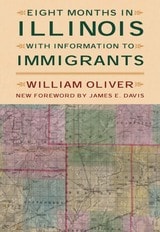
Eight Months in Illinois
With Information to ImmigrantsWilliam Oliver. Foreword by James E. Davis
Southern Illinois University Press, 2002
The Illinois frontier offered abundant opportunity, noted English traveler William Oliver after his journey to America in 1841–42, but life there was hard. Accordingly, Oliver advised the wealthy and comfortable to remain in England and counseled the unprosperous to seek their fortunes in America. Written for the poor who would migrate and published in 1843, his Eight Months in Illinois: With Information to Immigrants sought only to provide pertinent, valid, and practical information about what people might encounter in the frontier state. What Oliver actually accomplished, however, was much more: he imparted invaluable insights into and analyses of American life during an era of sweeping social, economic, and political change.
In his new foreword to this edition, James E. Davis stresses Oliver’s sincere desire to help British immigrants succeed in America. Oliver, Davis notes, “devoted dozens of pages of advice on numerous matters: various routes to Illinois and their advantages and disadvantages, processes of settling, qualities of western houses, costs of obtaining a new farm.” Oliver discussed other practical matters, such as the importance of having sons. He also assured his intended readership that “in the West, distinction of classes is little known and seldom recognized.”
As a document covering the middle west in the 1840s, Eight Months in Illinois: With Information to Immigrants has few equals. Its portrayal of farming and trade in relatively primitive times is historically accurate. It paints a plain picture, laying out the essential facts and presenting the typical incidents that enable us to trace the course of a settler’s simple, diligent, laborious day-to-day life. According to Davis, Oliver depicted “accurate and balanced slices of life in Illinois and America, including nasty insects, crude conditions, and the necessity of work.” And he did so without a trace of anti-American bias.
Eight Months in Illinois with Information to Immigrants was reprinted with emendations in 1924 by Walter Hill.
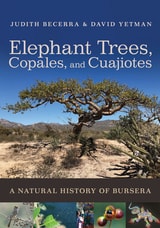
Elephant Trees, Copales, and Cuajiotes
A Natural History of BurseraJudith Becerra and David Yetman; Foreword by Exequiel Ezcurra
University of Arizona Press, 2024
In the United States, Bursera is represented by the short, contorted, and aromatic elephant tree of the hot Sonoran Desert and the stately and colorful gumbo limbo of southern Florida, while in the torrid lowlands of southern Mexico, the engines of evolution have produced forests dominated by dozens of species of Bursera, each with a peculiar ecological slot. This evolutionary tableau presents a complicated sex life that puzzles scientists. Recent research also reveals a gripping narrative of an epic struggle between trees and the insects that would subsist on their leaves: the insects seeking to exploit a food resource, the trees reacting with ever-changing, dramatic counter strategies. In addition to the fascinating and intricate workings of the genus’s ecological adaptations, burseras play a formative role in the lives of indigenous populations. Native peoples relish the plants’ aromatic resin, workable wood, and often colorful bark as a source for endless human applications.
Written in an engaging style, enhanced with two hundred color photographs, and complete with a compendium of species descriptions, this book will be an essential reference on a significant North American plant.
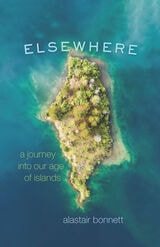
Elsewhere
A Journey into Our Age of IslandsAlastair Bonnett
University of Chicago Press, 2020
There are millions of islands on our planet. New islands are being built at an unprecedented rate, for tourism and territorial ambition. Many are also disappearing, besieged by rising sea levels. The story of our world’s islands is one of the great dramas of our time, and it is playing out around the planet—islands are sprouting or being submerged everywhere from the South China Sea to the Atlantic. Elsewhere is the story of this strange and mesmerizing planetary spectacle.
In this book, explorer and geographer Alastair Bonnett takes us on a thought-provoking tour of the world’s most fascinating islands. He traveled the globe to provide a firsthand look at numerous islands, sketching a vivid likeness of each one he visited. From a “crannog,” an ancient artificial island in a Scottish loch, to the militarized artificial islands China is building; from the disappearing islands that remain the home of native Central Americans to the ritzy new islands of Dubai; from Hong Kong to the Isles of Scilly—all have compelling stories to tell. As we journey around the world with Bonnett, he addresses urgent contemporary issues such as climate change, economic inequality, and the changing balance of world power as reflected in the fates of islands. Along the way, we also learn about the many ways islands rise and fall, the long and little-known history of human island-building and the prospect that the inland hills and valleys will one day be archipelagos.
Featuring Bonnett’s charming hand-drawn maps and 33 full-color photos, Elsewhere is a captivating travel book for any armchair adventurer.
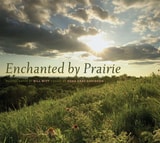
Enchanted by Prairie
Bill Witt
University of Iowa Press, 2009
Witt gives us close-ups of pasque flower shoots covered with ice in spring, coneflowers dancing in a summer breeze, and prairie dropseed in its autumn colors as well as such prairie companions as sandhill cranes, northern harriers, and bison. His panoramic visions of prairie landscapes in all seasons focus on the personal pleasure and spiritual sustenance that connecting with prairies, even small and neglected ones, can bring us. Osha Davidson’s essay compares today’s prairie remnants with yesterday’s expanses and calls for us to restore balance to this damaged landscape. Altogether, Enchanted by Prairie celebrates today’s prairie landscape and encourages us, in Davidson’s words, to restore its “beauty and scents and textures and sounds.”
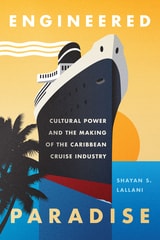
Engineered Paradise
Cultural Power and the Making of the Caribbean Cruise IndustryShayan S. Lallani
University of Illinois Press, 2027
We celebrate cruise ships as gateways to new cultures. However, over the past half a century, the mass-market cruise industry has increasingly relied on global supply chains, exploited maritime labor, and corporate control over the consumer experience to turn cultural contact into profit.
Shayan S. Lallani uncovers the historical scaffolding behind the cruise industry’s strategic co-opting of global cultures. Tracing the evolution of the modern mega-ship from its roots in postwar ocean liners to the floating cities of the twenty-first century, Lallani demonstrates how cruise lines paired commodified cultural referents with immersive spatial design and international labor to maximize guest spending. This corporate grip extended to Caribbean destinations, where companies steadily gained control of port enclaves and vetted shore excursions to manage contact with local communities while retaining the profits.
A sobering look at a vacation mainstay, <i>Engineered Paradise</i> explores where leisure becomes entangled with culture, capitalism, and power.
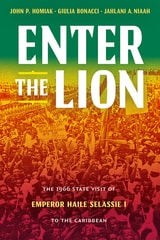
Enter the Lion
The 1966 State Visit of Emperor Haile Selassie I to the CaribbeanJohn P. Homiak, Giulia Bonacci, and Jahlani A. Niaah
Duke University Press, 2026
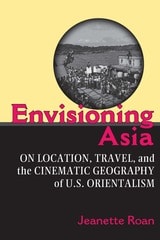
Envisioning Asia
On Location, Travel, and the Cinematic Geography of U.S. OrientalismJeanette Roan
University of Michigan Press, 2010
"Whereas some other scholars read selected films mainly to illustrate political arguments, Roan never loses sight of the particularities of film as a distinctive cultural form and practice. Her drive to see 'cinema as a mechanism of American orientalism' results in not just a textual analysis of these films, but also a history of their material production and distribution."
---Josephine Lee, University of Minnesota
"Envisioning Asia offers an exciting new contribution to our understandings of the historical developments of American Orientalism. Jeannette Roan deftly situates changing cinematic technologies within the context of U.S. imperial agendas in this richly nuanced analysis of 'shooting on location' in Asia in early 20th century American cinema."
---Wendy Kozol, Oberlin College
"Through her vivid illustration of the role of American cinema in the material, visual, and ideological production of Asia, Jeanette Roan takes the reader on a journey to Asia through a very different route from the virtual travel taken by the viewers of the films she discusses."
---Mari Yoshihara, University of Hawai'i at Manoa
The birth of cinema coincides with the beginnings of U.S. expansion overseas, and the classic Hollywood era coincides with the rise of the United States as a global superpower. In Envisioning Asia, Jeanette Roan argues that throughout this period, the cinema's function as a form of virtual travel, coupled with its purported "authenticity," served to advance America's shifting interests in Asia. Its ability to fulfill this imperial role depended, however, not only on the cinematic representations themselves but on the marketing of the films' production histories---and, in particular, their use of Asian locations. Roan demonstrates this point in relation to a wide range of productions, offering an engaging and useful survey of a largely neglected body of film. Not only that, by focusing on the material practices involved in shooting films on location---that is, the actual travels, negotiations, and labor of making a film---she moves beyond formal analysis to produce a richly detailed history of American interests, attitudes, and cultural practices during the first half of the twentieth century.
Jeanette Roan is Adjunct Professor of Visual Studies at California College of the Arts and author of "Exotic Explorations: Travels to Asia and the Pacific in Early Cinema" in Re/collecting Early Asian America: Essays in Cultural History (2002).
Cover art: Publicity still, Tokyo File 212 (Dorrell McGowan and Stuart McGowan, 1951). The accompanying text reads: "Hundreds of spectators gather on the sidelines as technicians prepare to photograph a parade scene in 'Tokyo File 212,' a Breakston-McGowan Production filmed in Japan for RKO Radio distribution." Courtesy of the Academy of Motion Picture Arts and Sciences.
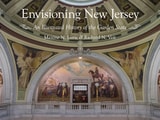
Envisioning New Jersey
An Illustrated History of the Garden StateLurie, Maxine N
Rutgers University Press, 2016
Winner of the 2017 New Jersey Studies Academic Alliance Author Award
See New Jersey history as you read about it! Envisioning New Jersey brings together 650 spectacular images that illuminate the course of the state’s history, from prehistoric times to the present. Readers may think they know New Jersey’s history—the state’s increasing diversity, industrialization, and suburbanization—but the visual record presented here dramatically deepens and enriches that knowledge.
Compiled by the authors of New Jersey: A History of the Garden State, this volume is intended as an illustrated companion to that earlier volume. Envisioning New Jersey also stands on its own because essays synthesizing each era accompany the illustrations. A fascinating gold mine of images from the state’s past, Envisioning New Jersey is the first illustrated book on the Garden State that covers its complete history, capturing the amazing transformation of New Jersey over time.
View sample pages (http://issuu.com/rutgersuniversitypress/docs/lurie_veit_envisioning_sample)
Thanks to the New Jersey Historical Commission, the New Jersey Council for the Humanities, and generous individual donors for making this project possible.
Eothen
Traces of Travel Brought Home from the EastAlexander William Kinglake
Northwestern University Press, 1997
Eothen has the freshness of the immediate and the new. Kinglake kept it free of the details of geography, history, science, politics, religion, and statistics; it is far less about the countries and the cities he passes through that it is about himself. This is what makes Eothen a modern travel book, possibly the first and certainly one of the greatest of its kind.
Ephemeral City
A People's History of Chicago's Century of Progress World's FairLindsay Fullerton
University of Illinois Press, 2025
Less celebrated than the 1893 Chicago World’s Fair, the 1933–1934 Century of Progress Exposition brought visitors face-to-face with gleaming American consumerism in the midst of the Great Depression. Lindsay Fullerton draws on a wealth of personal photographs, scrapbooks, oral histories, and writings to illuminate the wildly different experiences of fairgoers against the backdrop of a city steeped in poverty and segregation.
The Exposition took place amidst massive changes sparked by expansion of mass media, Franklin Roosevelt’s election, the repeal of Prohibition, and the Great Migration. A diverse cross-section of Chicagoans informs Fullerton’s history of the event in the context of the fast-changing America of the interwar era. These personal accounts tell stories of how attendees interpreted their own experiences while being surrounded by whiz-bang products and full-throated evangelism on the benefits of progress.
A colorful people’s history, Ephemeral City takes readers inside the other Chicago World’s Fair and how visitors interacted with a pivotal moment in American history.
Errant Journeys
Adventure Travel in a Modern AgeBy David Zurick
University of Texas Press, 1995
Tourism is becoming one of the world's most important economic activities. There is hardly a place on earth, no matter how inaccessible, that has not been visited by some traveler seeking adventure, enlightenment, or simply change from the familiar world back home.
In this pathfinding book, David Zurick explores the fastest-growing segment of the travel industry—adventure travel. He raises important questions about what constitutes the travel experience and shows how the modern adventure industry has commercialized the very notion of adventure by packaging it as tours.
Drawing on two decades of personal travel, as well as the writings of others, Zurick unravels the paradox of adventure travel—that the very act of visiting remote places untouched by Western culture introduces that culture and begins irreversible changes. This first in-depth look at adventure travel opens new insights into the physical, philosophical, and spiritual attributes of the travel experience. Written in a lively style, the book is intended for everyone interested in travel and its effects on both travelers and the people and places they visit.
Escalante
The Best Kind of NothingText by Brooke Williams; Photographs by Chris Noble
University of Arizona Press, 2006
Escaping Kakania
Eastern European Travels in Colonial Southeast AsiaJan Mrázek
Central European University Press, 2024
Escaping Kakania is about fascinating characters—soldiers, doctors, scientists, writers, painters—who traveled from their eastern European homelands to colonial Southeast Asia. Their stories are told by experts on different countries in the two regions, who bring diverse approaches into a conversation that crosses disciplinary and national borders.
The 14 chapters deal with the diverse encounters of eastern Europeans with the many faces of colonial southeast Asia. Some essays directly engage with post-colonial studies, contributing to an ongoing critical re-evaluation of eastern European “semi-peripheral” (non-)involvement in colonialism. Other chapters disclose a range of perspectives and narratives that illuminate the plurality of the travelers’ positions while reflecting on the specificity of the eastern European experience.
The travellers moved—as do the chapter authors—between two regions that are off-centre, in-between, shiftingly “Eastern,” and disorientingly heterogeneous, thus complicating colonial and postcolonial notions of “Europe,” “East,” and East-West distinctions. Both at home and overseas, they navigated among a multiplicity of peoples, “races,” and empires, Occidents and Orients, fantasies of the Self and the Other, adopting/adapting/mimicking/rejecting colonialist identities and ideologies. They saw both eastern Europe and southeast Asia in a distinctive light, as if through each other—and so will the readers of Escaping Kakania.
Europe
or Up and Down with Schreiber and BaggishRichard Stern
Northwestern University Press, 2007
Originally published in 1961, this shrewd, smartly written novel follows two American men traveling in Europe. Though both have struck out for the same continent, each man’s methods of and motives for travel lead him to have a very different experience than the other. Underlying it all is the premise that Europe--the contrast, the otherness of it--can be a refiner’s fire, deeply affecting a person’s character. Europe represents a crucial step in Stern’s development as a writer and stands as a witty, sharp point of entry into his writings and the writings of novelists who rose to prominence in the 1960s.
Everything Lost
The Latin American Notebook of William S. Burroughs, Revised EditionWilliam S. Burroughs, Edited by Geoffrey D. Smith, John M. Bennett, and Oliver Harris
The Ohio State University Press, 2017
In late summer 1953, as he returned to Mexico City after a seven-month expedition through the jungles of Ecuador, Colombia, and Peru, William Burroughs began a notebook of final reflections on his four years in Latin America. His first novel, Junkie, had just been published and he would soon be back in New York to meet Allen Ginsberg and together complete the manuscripts of what became The Yage Letters and Queer. Yet this notebook, the sole survivor from that period, reveals Burroughs not as a writer on the verge of success, but as a man staring down personal catastrophe and visions of looming cultural disaster.
Losses that will not let go of him haunt Burroughs throughout the notebook: “Bits of it keep floating back to me like memories of a daytime nightmare.” However, out of these dark reflections we see emerge vivid fragments of Burroughs’ fiction and, even more tellingly, unique, primary evidence for the remarkable ways in which his early manuscripts evolved. Assembled in facsimile and transcribed by Geoffrey D. Smith, John M. Bennett, and Burroughs scholar Oliver Harris, the notebook forces us to change the way we see both Burroughs and his writing at a turning point in his literary career.
Evidence of My Existence
Jim Lo Scalzo
Ohio University Press, 2007
From a leper colony in India to an American research station on the Antarctic Peninsula, from the back rooms of the White House to the battlefields of Iraq and Afghanistan, Evidence of My Existence tells a unique and riveting story of seventeen years spent racing from one photo assignment to the next. It is also a story of photojournalism and theconsequences of obsessive wanderlust.
When the book opens, Jim Lo Scalzo is a blur to his wife, her remarkable tolerance wearing thin. She is heading to the hospital with her second miscarriage, and Jim is heading to Baghdad to cover the American invasion of Iraq. He hates himself for this—for not giving her a child, for deserting her when she soobviously needs him, for being consumed by his job—but how to stop moving? Sure, there have been some tough trips. He’s been spit on by Mennonites in Missouri, by heroin addicts in Pakistan, and by the KKK in South Carolina. He’s contracted hepatitis on the Navajo Nation, endured two bouts of amoebic dysentery in India and Burma and four cases of giardia in Nepal, Peru, Afghanistan, and Cuba. He’s been shot with rubber bullets in Seattle, knocked to the ground by a water cannon in Quebec, and sprayed with more teargas than he cares to recall. But photojournalism is his career, and travel is his compulsivecraving.
We follow Lo Scalzo through the maze of airports and crowds and countries as he chases the career he has always wanted, struggles with his family problems, and reveals the pleasures of a life singularly focused. For him, as for so many photojournalists, it is always about the going.
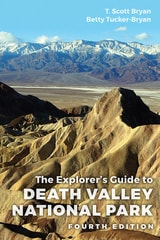
Explorer's Guide to Death Valley National Park, Fourth Edition
T. Scott Bryan
University Press of Colorado, 2020
Originally published in 1995, soon after Death Valley National Park became the fifty-third park in the US park system, The Explorer’s Guide to Death Valley National Park was the first complete guidebook available for this spectacular area. Now in its fourth edition, this is still the only book that includes all aspects of the park. Much more than just a guidebook, it covers the park’s cultural history, botany and zoology, hiking and biking opportunities, and more. Information is provided for all of Death Valley’s visitors, from first-time travelers just learning about the area to those who are returning for in-depth explorations.
This new edition features a number of important changes—including information on the boundary and wilderness changes that resulted from the Dingell Act of 2019, the reopened Keane Wonder Mine area, the devastating flash flooding of Scotty’s Castle, scenic river designations, the Inn and Ranch resorts, renovated and now operated as the Oasis at Death Valley—as well as new maps and updated color photos. With extensive input from National Park Service resource management, law enforcement, and interpretive personnel, as well as a thorough bibliography for suggested reading, The Explorer’s Guide to Death Valley National Park, Fourth Edition is the most up-to-date, accurate, and comprehensive guide available for this national treasure.
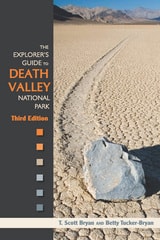
Explorer's Guide to Death Valley National Park, Third Edition
T. Scott Bryan and Betty Tucker Bryan
University Press of Colorado, 2015
Originally published in 1995, soon after Death Valley National Park became the fifty-third park in the U.S. park system, The Explorer's Guide to Death Valley National Park was the first complete guidebook available for this spectacular area.
Now in its third edition, this is still the only book that includes all aspects of the park. Much more than just a guidebook, it covers the park's cultural history, botany and zoology, hiking and biking opportunities, and more. Information is provided for all of Death Valley's visitors, from first-time travelers just learning about the area to those who are returning for in-depth explorations.
The book includes updated point-to-point logs for every road within and around the park, as well as more accurate map than those in any other publication. With extensive input from National Park Service resource management, law enforcement, and interpretive personnel, as well as a thorough bibliography for suggested reading, The Explorer's Guide to Death Valley National Park, Third Edition is the most up-to-date, accurate, and comprehensive guide available for this national treasure.
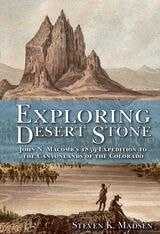
Exploring Desert Stone
John N. Macomb's 1859 Expedition to the Canyonlands of the ColoradoSteven K. Madsen
Utah State University Press, 2022
The soldiers and scientists followed in part the Old Spanish Trail, whose location they documented and verified. Seeking to find the confluence of the Colorado and the Green and looking for alternative routes into Utah, which was of particular interest in the wake of the Utah War, they produced a substantial documentary record, most of which is published for the first time in this volume. Theirs is also the first detailed map of the region, and it is published in Exploring Desert Stone, as well.
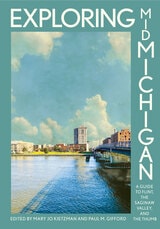
Exploring Mid-Michigan
A Guide to Flint, the Saginaw Valley, and the ThumbMary Jo Kietzman
Michigan State University Press, 2026
Inspired by the iconic American Guide Series published by the Federal Writers Project in the 1930s, this new guide to Flint, the Saginaw Valley, and the Thumb showcases the industrial-agricultural heart of Michigan, which has been beating irregularly for the last three decades, but whose importance to its people has lasted millennia. The ten counties featured in the book have lost population, industries, small farms, natural resources, and clean water. Instead of focusing on loss, the authors uncover the region’s unique history and culture, characterized by the productive tension between factories and farms, urban and rural spaces, labor and management, migrants and the mainstream, conservatives and progressives. The book documents the genesis of an ecological awareness that grew out of deforestation, habitat and species loss, and a succession of water crises. Encyclopedic in scope like their WPA forebears, the book is a functional guide that offers suggestions and strategies for enriching travel while celebrating the tenacity of those who came, worked, and stayed: lumberjacks, farmers, foundry workers, labor activists, judges, Indigenous peoples, African Americans, artists, poets, and environmental warriors.
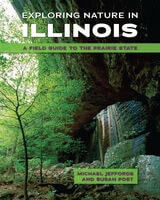
Exploring Nature in Illinois
A Field Guide to the Prairie StateMichael Jeffords and Susan Post
University of Illinois Press, 2014
From the colorful variety of birds at War Bluff Valley Audubon Sanctuary to the exposed bedrock and cliff faces of Apple River Canyon, Exploring Nature in Illinois will inspire readers to explore wonders hidden from urban sprawl and cultivated farmland. Maps and descriptions help travelers access even hard-to-find sites while a wealth of detail and photography offers nature-lovers insights into the flora, fauna, and other aspects of vibrant settings and ecosystems. The authors also include diary entries describing their own impressions of and engagement with the sites.
A unique and much-needed reference, Exploring Nature in Illinois will entertain and enlighten hikers, cyclers, students and scouts, morning walkers, weekend drivers, and anyone else seeking to get back to nature in the Prairie State.
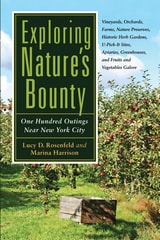
Exploring Nature's Bounty
One Hundred Outings Near New York CityRosenfeld, Lucy D
Rutgers University Press, 2012
When lifelong friends Lucy D. Rosenfeld and Marina Harrison set off on their outings in the region, they are always on the lookout for the gifts that nature offers. Exploring Nature’s Bounty, their ninth collaboration, invites us to share the rich array of agricultural delights they’ve discovered within a two-hour radius of New York City—from beautiful vineyards to the latest in hydroponic greenhouses to peach-filled orchards to community farms and historic sites.
The places chosen all welcome visitors who will see first hand the art of agriculture, pick their own produce, help out on the farm, or simply enjoy being outdoors so close to the city. Many of them are off-the-beaten-track locations where readers and their families can walk among rows of grapes, cornstalks, apple trees, and so much more. The sites range from traditional fruit orchards to greenhouses filled with water-grown tomatoes and basil to neatly ordered herb gardens in historic settings. Local vineyards make wineries fun and glamorous places to visit, whether on the North Fork of Long Island or in the Hudson Valley. Some venues focus on crop preservation—the American chestnut, for example—while others introduce readers to honey making and maple sugaring. Those interested in taking classes or seeing demonstrations will find places to do just that, and many activities are geared toward children, from corn mazes to hayrides to pumpkin picking.
Rosenfeld and Harrison provide a list of festivals featuring local produce and, at the end of the book, a guide to choosing an outing that will best fit readers, their families, and their taste buds. Directions are provided in each write-up as well as information on schedules, guided tours, and walks within many of the sites.
Exploring Nature’s Bounty focuses on the natural, the organic, the sustainable, and the close-at-hand. By avoiding places overrun with commercialism, it helps readers create their own adventures, enjoy time with family and friends, and connect to the farms that nourish us all.
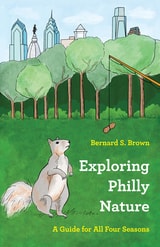
Exploring Philly Nature
A Guide for All Four SeasonsBernard S. Brown
Temple University Press, 2022
Do snakes and salamanders fascinate you or make you squeamish? Have you ever listened closely to the birds chirping in your neighborhood? Can you identify the flowers growing in Philadelphia’s urban parks? (Moreover, are the mushrooms safe to eat?) Exploring Philly Nature is amateur naturalist, urban herper,* and Grid contributor Bernard Brown’s handy guide to experiencing the flora and fauna in Philly.
This compact illustrated volume contains 52 activities from birding, (squirrel) fishing, and basement bug-hunting to joining a frog call survey and visiting a mussel hatchery. Brown encourages kids (as well as their parents) to connect with the natural world close to home. Each entry contains information on where and when to participate, what you will need (even if it is only patience), and tips on clubs and organizations to contact for access.
The city and its environs contain a multitude of species from the lichen that grows on gravestones or trees to nocturnal animals like opossums, bats, and raccoons. Exploring Philly Nature is designed to get readers eager to discover, observe, and learn more about the concrete jungle that is Philadelphia.
Exploring The Beloved Country
American Society And CultureWilbur Zelinsky
University of Iowa Press, 1994
For fifty years geographer Wilbur Zelinsky has charted the social, cultural, and historical map of the American experience. A self-confessed incurable landscape voyeur, he has produced order and pattern from massive amounts of data, zestfully finding societal meaning in the terra incognita of our postmodern existence. Now he has gathered his most original and exciting explorations into a volume that captures the nature and dynamics of this remarkable phenomenon we call the United States of America. Each the product of Zelinsky's joyous curiosity, these energetic essays trace the innermost contours of our bewildering American reality.
Exploring the Boundary Waters
A Trip Planner and Guide to the BWCAWDaniel Pauly
University of Minnesota Press, 2005
Exploring the Land of Lincoln
The Essential Guide to Illinois Historic SitesCharles Titus
University of Illinois Press, 2021
Discovering Illinois through twenty of the state's most important places
A one-of-a-kind travel guide, Exploring the Land of Lincoln invites road-trippers and history buffs to explore the Prairie State's most extraordinary historic sites. Charles Titus blends storytelling with in-depth research to highlight twenty must-see destinations selected for human drama, historical and cultural relevance, and their far-reaching impact on the state and nation. Maps, illustrations, and mileage tables encourage readers to create personal journeys of exploration to, and beyond, places like Cahokia, the Lincoln sites, Nauvoo, and Chicago's South Side Community Art Center.
Detailed and user-friendly, Exploring the Land of Lincoln is the only handbook you need for the sights and stories behind the names on the map of Illinois.
Exploring the Little Rivers of New Jersey
James and Margaret Cawley
Rutgers University Press, 1993
In this fourth edition, the Little Rivers Club has brought the Cawleys' work up to date. This group of experienced canoeists dedicated themselves to re-exploring familiar waterways and adding new ones. Faithful to the Cawley spirit, this edition includes new maps, many new photographs, a directory of canoe liveries, tips of planning a trip, a loving portrait of the Cawleys, and, best of all, twenty-four beautiful waterways to discover.
Featuring 166 photos, 22 maps, and these rivers:
- Batsto
- Cedar Creek
- Delaware and Raritan Canal
- Great Egg Harbor River
- Hackensack
- Manasquan River and Inlet
- Maurice
- Millstone
- Mullica
- Musconetcong
- Oswego River and Lake
- Passaic
- Paulins Kill
- Pequest
- Ramapo-Pompton
- Rancocas
- South and North Branches of the Raritan
- Toms
- Wading
- Black-Lamington
- Cohansey River, Raceway, and Sunset Lake
- Crosswicks Creek
- Metedeconk
- Stony Brook
Exploring the World of J. S. Bach
A Traveler's GuideRobert L. Marshall
University of Illinois Press, 2016
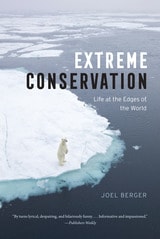
Extreme Conservation
Life at the Edges of the WorldJoel Berger
University of Chicago Press, 2018
On the Tibetan Plateau, there are wild yaks with blood cells thinner than those of horses’ by half, enabling the endangered yaks to survive at 40 below zero and in the lowest oxygen levels of the mountaintops. But climate change is causing the snow patterns here to shift, and with the snows, the entire ecosystem. Food and water are vaporizing in this warming environment, and these beasts of ice and thin air are extraordinarily ill-equipped for the change. A journey into some of the most forbidding landscapes on earth, Joel Berger’s Extreme Conservation is an eye-opening, steely look at what it takes for animals like these to live at the edges of existence. But more than this, it is a revealing exploration of how climate change and people are affecting even the most far-flung niches of our planet.
Berger’s quest to understand these creatures’ struggles takes him to some of the most remote corners and peaks of the globe: across Arctic tundra and the frozen Chukchi Sea to study muskoxen, into the Bhutanese Himalayas to follow the rarely sighted takin, and through the Gobi Desert to track the proboscis-swinging saiga. Known as much for his rigorous, scientific methods of developing solutions to conservation challenges as for his penchant for donning moose and polar bear costumes to understand the mindsets of his subjects more closely, Berger is a guide par excellence. He is a scientist and storyteller who has made his life working with desert nomads, in zones that typically require Sherpas and oxygen canisters. Recounting animals as charismatic as their landscapes are extreme, Berger’s unforgettable tale carries us with humor and expertise to the ends of the earth and back. But as his adventures show, the more adapted a species has become to its particular ecological niche, the more devastating climate change can be. Life at the extremes is more challenging than ever, and the need for action, for solutions, has never been greater.
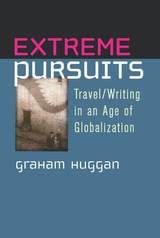
Extreme Pursuits
Travel/Writing in an Age of GlobalizationGraham Huggan
University of Michigan Press, 2009
Recent figures suggest that there will be 1.6 billion arrivals at world airports by the year 2020. Extreme Pursuits looks at the new conditions of global travel and the unease, even paranoia, that underlies them---at the opportunities they offer for alternative identities and their oscillation between remembered and anticipated states. Graham Huggan offers a provocative account of what is happening to travel at a time characterized by extremes of social and political instability in which adrenaline-filled travelers appear correspondingly determined to take risks. It includes discussions of the links between tourism and terrorism, of contemporary modes of disaster tourism, and of the writing that derives from these; but it also confirms the existence of more responsible forms of travel/writing that demonstrate awareness of a chronically endangered world.
Extreme Pursuits is the first study of its kind to link travel writing explicitly with structural changes in the global tourist industry. The book makes clear that travel writing can no longer take refuge in the classic distinctions (traveler versus tourist, foreigner versus native) on which it previously depended. Such distinctions---which were dubious in the first place---no longer make sense in an increasingly globalized world. Huggan argues accordingly that the category "travel writing" must include experimental ethnography and prose fiction; that it should concern itself with other kinds of travel practices, such as those related to Holocaust deportation and migrant labor; and that it should encompass representations of travelers and "traveling cultures" that appear in popular media, especially TV and film.
Graham Huggan is Professor of Commonwealth and Postcolonial Literatures at the University of Leeds. He is the coauthor, with Patrick Holland, of Tourists with Typewriters: Critical Reflections on Contemporary Travel Writing (University of Michigan Press) and coauthor, with Helen Tiffin, of Postcolonial Ecocriticism (Routledge).
Illustration: "Shadow Wall," 2006 © Shaun Tan.