Results by title
476 books match the query 'World War, 1939-1945' and 10 start with e
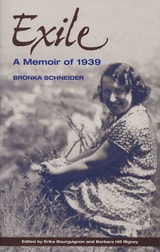
EXILE
A MEMOIR OF 1939Bronka Schneider Edited with forewords by Erika Bourguignon and Barbara Hill Rigney
The Ohio State University Press, 1998
Bronka Schneider and her husband, Joseph, were two of the thirty thousand Austrian Jews admitted as refugees to Great Britain between March 1938 and 2 September 1939. It was not until 1960, however, that Schneider wrote her memoir about the year she spent as a housekeeper, with Joseph as a butler, in a Scottish castle.
Schneider tells of daily encounters—with her employers, the English lady and her husband, a retired British civil servant who had spent many years in India; the village locals; other refugees; and a family of evacuees from the slums of Glasgow.
The editors have divided this memoir into chapters, adding headlines from the London Times as epigraphs. These headlines, reporting the escalating events of World War II, are in stark contrast to daily activities of the residents of this isolated region of Scotland. A commentary by Erika Bourguignon provides historical, political, and cultural background of this period.
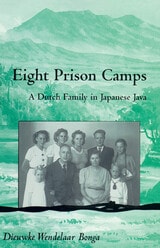
Eight Prison Camps
A Dutch Family in Japanese JavaDieuwke Wendelaar Bonga
Ohio University Press, 1996
Eldest daughter of eight children, the author grew up in Surakarta, Java, in what is now Indonesia. In the months following the bombing of Pearl Harbor, however, Dutch nationals were rounded up by Japanese soldiers and put in internment camps. Her father and brother were sent to separate men’s camps, leaving the author, her mother, and the five younger children in the women’s camp. In this and later seven other prison camps in central Java, their lives gradually deteriorated from early days of fear and crowding to near starvation, forced labor, beatings, and seeing others disappear or die. On the family’s return to Holland after the war, they found a nation recovering from German occupation and largely ignorant of the horror of the Far East experience.

Embodied Memory
Theatre Of George TabonAnat Feinberg
University of Iowa Press, 1999
Making use of invaluable archival material, Feinberg's biographical account is followed by a study of Tabori's experimental theatre work. As did prominent avant-gardists such as Grotowski or Chaikin, Tabori sought to open up new vistas in an otherwise mainstream theatre system. Feinberg pays special attention to Tabori's theatrical innovations, most movingly found in his Holocaust plays. There Feinberg shows the ways in which Tabori's theatre becomes a locus of remembrance (Gedächtnisort) and of unique, engaging memory-work (Erinnerungsarbeit).
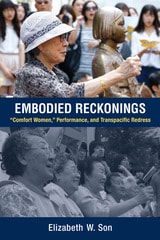
Embodied Reckonings
“Comfort Women,” Performance, and Transpacific RedressElizabeth W. Son
University of Michigan Press, 2018
Based on extensive archival and ethnographic research, the study argues for the central role of performance in how Korean survivors, activists, and artists have redressed the histories—and erasures—of this sexual violence. Merging cultural studies and performance theory with a transnational, feminist analysis, the book illuminates the actions of ordinary people, thus offering ways of reconceptualizing legal and political understandings of redress that tend to concentrate on institutionalized forms of state-based remediation.
Emergency Writing
Irish Literature, Neutrality, and the Second World WarAnna Teekell
Northwestern University Press, 2018
Taking seriously Ireland’s euphemism for World War II, “the Emergency,” Anna Teekell’s Emergency Writing asks both what happens to literature written during a state of emergency and what it means for writing to be a response to an emergency.
Anchored in close textual analysis of works by Samuel Beckett, Elizabeth Bowen, Flann O’Brien, Louis MacNeice, Denis Devlin, and Patrick Kavanagh, and supported by archival material and historical research, Emergency Writing shows how Irish late modernism was a response to the sociopolitical conditions of a newly independent Irish Free State and to a fully emerged modernism in literature and art. What emerges in Irish writing in the wake of Independence, of the Gaelic Revival, of Yeats and of Joyce, is a body of work that invokes modernism as a set of discursive practices with which to counter the Free State’s political pieties.
Emergency Writing provides a new approach to literary modernism and to the literature of conflict, considering the ethical dilemma of performing neutrality—emotionally, politically, and rhetorically—in a world at war.
Escape Through the Pyrenees
Lisa Fittko
Northwestern University Press, 2000
Escape Via Berlin
Eluding Franco In Hitler's EuropeJose Antonio Aguirre
University of Nevada Press, 1991
Escape to Manila
From Nazi Tyranny to Japanese TerrorFrank Ephraim. Foreword by Stanley A. Karnow
University of Illinois Press, 2002
A harrowing account of Jewish refugees in the Philippines
With the rise of Nazism in the 1930s more than a thousand European Jews sought refuge in the Philippines, joining the small Jewish population of Manila. When the Japanese invaded the islands in 1941, the peaceful existence of the barely settled Jews filled with the kinds of uncertainties and oppression they thought they had left behind.
In this book Frank Ephraim, who fled to Manila with his parents, gathers the testimonies of thirty-six refugees, who describe the difficult journey to Manila, the lives they built there upon their arrival, and the events surrounding the Japanese invasion. Combining these accounts with historical and archival records, Manila newspapers, and U.S. government documents, Ephraim constructs a detailed account of this little-known chapter of world history.
Evans Carlson, Marine Raider
The Man Who Commanded America's First Special ForcesDuane Schultz
Westholme Publishing, 2014
In Evans Carlson, Marine Raider: The Man Who Commanded America’s First Special Forces, psychologist and acclaimed history writer Duane Schultz presents a fascinating and absorbing portrait of this complex officer. Son of a Congregational preacher, Carlson left home at an early age, and when he was just seventeen, the tall, lanky underage teenager bluffed his way into the army. He began his eventful military career against Pancho Villa, and continued through World War I and the unrest in Central America and in China. Despite Carlson’s personal bravery, loyalty, and long service, Schultz reveals that his active career was cut short by the Marine command who were envious of the attention he and his men received from the press and public; foreshadowing the paranoia of the McCarthy era, he was also rumored to be a communist. His raiders remained staunchly loyal to their former commander, and when he died in 1947, they ensured he would be buried in Arlington National Cemetery. Famed army and political cartoonist Bill Mauldin said, “There were only two brass hats whom ordinary GIs respected: Dwight Eisenhower and Evans Carlson.” This is Carlson’s story.
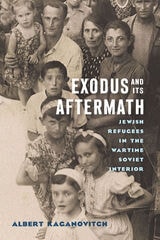
Exodus and Its Aftermath
Jewish Refugees in the Wartime Soviet InteriorAlbert Kaganovitch
University of Wisconsin Press, 2023
Albert Kaganovitch reconstructs the conditions that gave rise to this upsurge in antisemitic sentiment and provides new statistical data on the number of Jewish refugees who lived in the Urals, Siberia, and Middle Volga areas. The book’s insights into the regional distribution and concentration of these émigrés offer a behind-the-scenes look at the largest and most intensive Jewish migration in history.