Results by title
991 books match the query 'Writing' and 38 start with e
Early Holistic Scoring of Writing
A Theory, a History, a ReflectionRichard Haswell
Utah State University Press, 2019
Early Holistic Scoring of Writing addresses the history of holistic essay assessment in the United Kingdom and the United States from the mid-1930s to the mid-1980s—and newly conceptualizes holistic scoring by philosophically and reflectively reinterpreting the genre’s origin, development, and significance.
The book chronicles holistic scoring from its initial origin in the United Kingdom to the beginning of its heyday in the United States. Chapters cover little-known history, from the holistic scoring of school certificate examination essays written by Blitz evacuee children in Devon during WWII to teacher adaptations of holistic scoring in California schools during the 1970s. Chapters detail the complications, challenges, and successes of holistic scoring from British high-stakes admissions examinations to foundational pedagogical research by Bay Area Writing Project scholars. The book concludes with lessons learned, providing a guide for continued efforts to assess student writing through evidence models.
Exploring the possibility of actionable history, Early Holistic Scoring of Writing reconceptualizes writing assessment. Here is a new history that retells the origins of our present body of knowledge in writing studies.
Early Native Literacies in New England
A Documentary and Critical AnthologyKristina Bross
University of Massachusetts Press, 2008
Designed as a corrective to colonial literary histories that have excluded Native voices, this anthology brings together a variety of primary texts produced by the Algonquian peoples of New England during the seventeenth, eighteenth, and very early nineteenth centuries. Included among these written materials and objects are letters, signatures, journals, baskets, pictographs, confessions, wills, and petitions, each of which represents a form of authorship. Together they demonstrate the continuing use of traditional forms of memory and communication and the lively engagement of Native peoples with alphabetic literacy during the colonial period. Each primary text is accompanied by an essay that places it in context and explores its significance.
Written by leading scholars in the field, these readings draw on recent trends in literary analysis, history, and anthropology to provide an excellent overview of the field of early Native studies. They are also intended to provoke discussion and open avenues for further exploration by students and other interested readers. Above all, the texts and commentaries gathered in this volume provide an opportunity to see Native American literature as a continuity of expression that reflects choices made long before contact and colonization, rather than as a nineteenth—or even twentieth-century invention.
Contributors include Heidi Bohaker, Heather Bouwman, Joanna Brooks, Kristina Bross, Stephanie Fitzgerald, Sandra Gustafson, Laura Arnold Leibman, Kevin McBride, David Murray, Laura Murray, Jean O'Brien, Ann Marie Plane, Philip Round, Jodi Schorb, David Silverman, and Hilary E. Wyss.
Economical Writing, Third Edition
Thirty-Five Rules for Clear and Persuasive ProseDeirdre Nansen McCloskey
University of Chicago Press, 2019
Economics is not a field that is known for good writing. Charts, yes. Sparkling prose, no.
Except, that is, when it comes to Deirdre Nansen McCloskey. Her conversational and witty yet always clear style is a hallmark of her classic works of economic history, enlivening the dismal science and engaging readers well beyond the discipline. And now she’s here to share the secrets of how it’s done.
Economical Writing is itself economical: a collection of thirty-five pithy rules for making your writing clear, concise, and effective. Proceeding from big-picture ideas to concrete strategies for improvement at the level of the paragraph, sentence, or word, McCloskey shows us that good writing, after all, is not just a matter of taste—it’s a product of adept intuition and a rigorous revision process. Debunking stale rules, warning us that “footnotes are nests for pedants,” and offering an arsenal of readily applicable tools and methods, she shows writers of all levels of experience how to rethink the way they approach their work, and gives them the knowledge to turn mediocre prose into magic.
At once efficient and digestible, hilarious and provocative, Economical Writing lives up to its promise. With McCloskey as our guide, it’s impossible not to see how any piece of writing—on economics or any other subject—can be a pleasure to read.
Economies of Writing
Revaluations in Rhetoric and CompositionBruce Horner
Utah State University Press, 2016
Economies of Writing advances scholarship on political economies of writing and writing instruction, considering them in terms of course subject, pedagogy, technology, and social practice. Taking the "economic" as a necessary point of departure and contention for the field, the collection insists that writing concerns are inevitably participants in political markets in their consideration of forms of valuation, production, and circulation of knowledge with labor and with capital.
Approaching the economic as plural, contingent, and political, chapters explore complex forces shaping the production and valuation of literacies, languages, identities, and institutions and consider their implications for composition scholarship, teaching, administration, and public rhetorics. Chapters engage a range of issues, including knowledge transfer, cyberpublics, graduate writing courses, and internationalized web domains.
Economies of Writing challenges dominant ideologies of writing, writing skills, writing assessment, language, writing technology, and public rhetoric by revealing the complex and shifting valuations of writing practices as they circulate within and across different economies. The volume is a significant contribution to rhetoric and composition’s understanding of and ways to address its seemingly perennial unease about its own work.
Contributors: Anis Bawarshi, Deborah Brandt, Jenn Fishman, T. R. Johnson, Jay Jordan, Kacie Kiser, Steve Lamos, Donna LeCourt, Rebecca Lorimer Leonard, Samantha Looker, Katie Malcolm, Paul Kei Matsuda, Joan Mullin, Jason Peters, Christian J. Pulver, Kelly Ritter, Phyllis Mentzell Ryder, Tony Scott, Scott Wible, Yuching Jill Yang, James T. Zebroski
Editing and Advocacy
Patrick Barry
Michigan Publishing Services, 2022
This book— which is based on a popular course taught at the University of Chicago Law School, the University of Michigan Law School, and the UCLA School of Law— is designed to help you become one of those editors. You’ll learn how to edit with empathy. You’ll learn how to edit with statistics. You’ll learn, in short, a wide range of compositional skills you can use to elevate your advocacy and better champion the causes you care about the most.
Educating the New Southern Woman
Speech, Writing, and Race at the Public Women's Colleges, 1884-1945David Gold and Catherine L. Hobbs
Southern Illinois University Press, 2014
From the end of Reconstruction through World War II, a network of public colleges for white women flourished throughout the South. Founded primarily as vocational colleges to educate women of modest economic means for life in the emerging “new” South, these schools soon transformed themselves into comprehensive liberal arts–industrial institutions, proving so popular that they became among the largest women’s colleges in the nation. In this illuminating volume, David Gold and Catherine L. Hobbs examine rhetorical education at all eight of these colleges, providing a better understanding of not only how women learned to read, write, and speak in American colleges but also how they used their education in their lives beyond college.
With a collective enrollment and impact rivaling that of the Seven Sisters, the schools examined in this study—Mississippi State College for Women (1884), Georgia State College for Women (1889), North Carolina College for Women (1891), Winthrop College in South Carolina (1891), Alabama College for Women (1896), Texas State College for Women (1901), Florida State College for Women (1905), and Oklahoma College for Women (1908)—served as important centers of women’s education in their states, together educating over a hundred thousand students before World War II and contributing to an emerging professional class of women in the South. After tracing the establishment and evolution of these institutions, Gold and Hobbs explore education in speech arts and public speaking at the colleges and discuss writing instruction, setting faculty and departmental goals and methods against larger institutional, professional, and cultural contexts. In addition to covering the various ways the public women’s colleges prepared women to succeed in available occupations, the authors also consider how women’s education in rhetoric and writing affected their career choices, the role of race at these schools, and the legacy of public women’s colleges in relation to the history of women’s education and contemporary challenges in the teaching of rhetoric and writing.
The experiences of students and educators at these institutions speak to important conversations among scholars in rhetoric, education, women’s studies, and history. By examining these previously unexplored but important institutional sites, Educating the New Southern Woman provides a richer and more complex history of women’s rhetorical education and experiences.
Effective Teaching of Technical Communication
Theory, Practice, and ApplicationMichael J. Klein
University Press of Colorado, 2021
Drawn from quantitative and qualitative work of practitioners in the field, this edited collection provides an update to the Staples and Ornatowski's influential Foundations of Teaching Technical Communication (1997). The collection is organized around the broad themes of expanding pedagogy, shaping curriculum, incorporating technology, and engaging community. In each section, authors illustrate their experiences with teaching in the university technical communication classroom, addressing topics such as rethinking the role of internships, redesigning student learning outcomes for assessment practices, incorporating ethics into the technical communication classroom, using visual communication in community context, and engaging plain language. These sixteen chapters, taken as a whole or individually, provide readers with insights and examples into teaching technical communication in the 21st century.
Elements of Rhetoric
Comprising an Analysis of the Laws of Moral Evidence and of Persuasion, with Rules for Argumentative Composition and ElocutionRichard Whately. Edited with a Critical Introduction by Douglas Ehninger. Foreword by David Potter.
Southern Illinois University Press, 1963
Direct, comprehensive, well organized, simple in statement, Elements of Rhetoric is in all respects well fitted to fulfill its assigned role as a textbook. The remarks on practical problems and the examples and analogies confirm contemporary reports that Whately was himself a talented and stimulating teacher.
The modern field of speech was born near the beginning of the twentieth century, some seventy years after Whately wrote. But influential leaders in the new field endorsed Whately’s judgments, and courses and textbooks in public address have remained strongly influenced by his ideas. Whately’s views on a number of major questions in rhetoric have proved sound and fruitful during many decades of practice, and his book remains one of the most influential works on the subject.

Elusion Aforethought
The Life and Writing of Anthony Berkeley CoxMalcolm J. Turnbull
University of Wisconsin Press, 1996
Embodied Literacies
Imageword and a Poetics of TeachingKristie S. Fleckenstein
Southern Illinois University Press, 2003
Embodied Literacies: Imageword and a Poetics of Teaching is a response to calls to enlarge the purview of literacy to include imagery in its many modalities and various facets. Kristie S. Fleckenstein asserts that all meaning, linguistic or otherwise, is a result of the transaction between image and word. She implements the concept of imageword—a mutually constitutive fusion of image and word—to reassess language arts education and promote a double vision of reading and writing. Utilizing an accessible fourfold structure, she then applies the concept to the classroom, reconfiguring what teachers do when they teach, how they teach, what they teach with, and how they teach ethically.
Fleckenstein does not discount the importance of text in the quest for literacy. Instead, she places the language arts classroom and teacher at the juncture of image and word to examine the ways imagery enables and disables the teaching of and the act of reading and writing. Learning results from the double play of language and image, she argues. Helping teachers and students dissolve the boundaries between text and image, the volume outlines how to see reading and writing as something more than words and language and to disestablish our definitions of literacy as wholly linguistic.
Embodied Literacies: Imageword and a Poetics of Teaching comes at a critical time in our cultural history. Echoing the opinion that postmodernity is a product of imagery rather than textuality, Fleckenstein argues that we must evolve new literacies when we live in a culture saturated by images on computer screens, televisions, even billboards. Decisively and clearly, she demonstrates the importance of incorporating imagery—which is inextricably linked to our psychological, social, and textual lives—into our epistemologies and literacy teaching.
Embodied Playbook
Writing Practices of Student-AthletesJ. Michael Rifenburg
Utah State University Press, 2018
The Embodied Playbook discovers a new approach to understanding student literacy in a surprising place: the university athletics department. Through analysis of a yearlong case study of the men’s basketball team at the University of North Georgia, J. Michael Rifenburg shows that a deeper and more refined understanding of how humans learn through physical action can help writing instructors reach a greater range of students.
Drawing from research on embodiment theory, the nature and function of background knowledge, jazz improvisation, and other unexpected domains, The Embodied Playbook examines a valuable but unexplored form of literacy: the form used by student-athletes when learning and using scripted plays. All students’ extracurricular prior knowledge is vital for the work they undertake in the classroom, and student-athletes understand the strengths and constraints of written text much as they understand the text of game plays: through embodying text and performing it in a competitive space. The book focuses on three questions: What are plays and what do they do? How do student-athletes learn plays? How can teachers of composition and rhetoric better connect with student-athletes?
The Embodied Playbook reveals the literacy of the body as a rich and untapped resource for writing instruction. Given the numbers of students who are involved in athletics, whether intramural, community-related, or extracurricular, Rifenburg’s conclusions hold important implications not only for how we define literacy but also for how writing programs can serve all of their students most effectively.
Embodied Rhetorics
Disability in Language and CultureEdited by James C. Wilson and Cynthia Lewiecki-Wilson
Southern Illinois University Press, 2001
Presenting thirteen essays, editors James C. Wilson and Cynthia Lewiecki-Wilson unite the fields of disability studies and rhetoric to examine connections between disability, education, language, and cultural practices. Bringing together theoretical and analytical perspectives from rhetorical studies and disability studies, these essays extend both the field of rhetoric and the newer field of disability studies.
The contributors span a range of academic fields including English, education, history, and sociology. Several contributors are themselves disabled or have disabled family members. While some essays included in this volume analyze the ways that representations of disability construct identity and attitudes toward the disabled, other essays use disability as a critical modality to rethink economic theory, educational practices, and everyday interactions. Among the disabilities discussed within these contexts are various physical disabilities, mental illness, learning disabilities, deafness, blindness, and diseases such as multiple sclerosis and AIDS.
Emerging Writing Research from the Middle East-North Africa Region
Lisa Arnold
University Press of Colorado, 2017
While events in the Middle East-North Africa region dominate world news, it is an area little understood by the rest of the world—not only historically, politically, and culturally but also within the discipline of Rhetoric and Composition and Second Language Writing. The editors and contributors to this collection share scholarship that addresses how writing programs and writing-across-the-curriculum initiatives—in the region and outside of it—are responding to the increasing globalization of higher education and contributing to international discussions about World Englishes and other language varieties as well as translingual approaches to writing and writing pedagogy.
Contributors: Samer Annous, James P. Austin, William DeGenaro, Rula Diab, Michele Eodice, Juheina Fakhreddine, Aneta Hayes, Tom Highley, Amy Hodges, Rima Iskandarani, Najla Jarkas, Holly Johnson, Brenda Kent, Malakeh Raif Khoury-Khayat, Nasser Mansour, Ryan T. Miller, Maureen O’Day Nicolas, Saman Hussein Omar, Silvia Pessoa, Mysti Rudd, Zane Siraj Sinno, Michael Telafici, Connie Kendall Theado, Martha Townsend, Hacer Hande Uysal, Margaret Willard-Traub
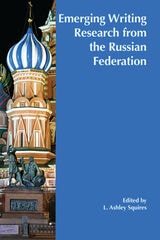
Emerging Writing Research from the Russian Federation
edited by L. Ashley Squires
University Press of Colorado, 2022
This book is also available as an open access ebook through the WAC Clearinghouse.
Empathy and the Other
Difference, Connection, and the Teaching of WritingLisa Blankenship
Utah State University Press, 2026
Empathy and the Other: Difference, Connection, and the Teaching of Writing focuses on the theoretical basis for empathy as a pedagogical concern, adding to important conversations happening in writing studies about how to foster empathetic understanding and practices for teachers and students. It offers ways for higher education classrooms to become sites for the cultivation of a critical form of empathy that can help address the most important challenges of our time.
Drawing on the study of empathy in rhetorical theory and related fields, teacher-scholars from a variety of institutions and backgrounds offer pedagogical rationales and approaches for fostering empathetic, inclusive, and antiracist pedagogies centered around five key themes related to empathetic teaching: difference, citizenship, storytelling, assessment, and process. A reflective and critical approach to empathetic teaching—as presented by the authors in this collection—can begin to address forces of social division, particularly in the ways we read and write about others. Teaching grounded in empathetic principles can offer students ways of relating to one another across cultural, religious, class, ethnic, political, and ideological differences.
Empathy and the Other is a companion volume to Enacting Empathy: Stories and Strategies from the Writing Classroom, which features vignettes and praxis pieces focused on classroom experiences and reflections on teaching empathy. The two collections may stand alone or be read together and are of great interest to writing teachers and graduate students invested in social justice in the classroom.
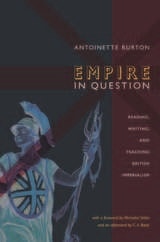
Empire in Question
Reading, Writing, and Teaching British ImperialismAntoinette Burton
Duke University Press, 2011
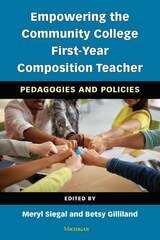
Empowering the Community College First-Year Composition Teacher
Pedagogies and PoliciesMeryl Siegal and Betsy Gilliland
University of Michigan Press, 2021
This volume is an inquiry into community college first-year pedagogy and policy at a time when change has not only been called for but also mandated by state lawmakers who financially control public education. It also acknowledges new policies that are eliminating developmental and remedial writing courses while keeping mind that, for most community college students, first-year composition serves as the last course they will take in the English department toward their associate’s degree.
Chapters focusing on pedagogy and policy are integrated within cohesively themed parts: (1) refining pedagogy; (2) teaching toward acceleration; (3) considering programmatic change; and (4) exploring curriculum through research and policy. The volume concludes with the editors’ reflections regarding future work; a glossary and reflection questions are included.
This volume also serves as a call to action to change the way community colleges attend to faculty concerns. Only by listening to teachers can the concerns discussed in the volume be addressed; it is the teachers who see how societal changes intersect with campus policies and students’ lives on a daily basis.
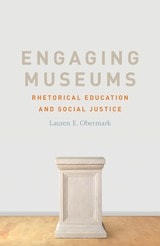
Engaging Museums
Rhetorical Education and Social JusticeLauren E. Obermark
Southern Illinois University Press, 2022
Museums offer an opportunity to reenvision rhetorical education through their address of hard, discomforting histories that challenge visitors to confront traumatic events and work toward a better future. While both museum studies and rhetoric center the audience in their scholarship and practices, this volume engages across and between these disciplines, allowing for a fuller theorization and enactment of rhetorical education’s connections to social justice. Engaging Museums works to fill gaps between the fields of rhetoric and social justice by going beyond classrooms to sites of public memory represented in museums.
This volume presents three distinct, diverse case studies of recently established historical museums taking on the rhetorically complex tasks of representing traumatic events: the National Underground Railroad Freedom Center, the National World War I Museum, and the Oklahoma City National Memorial Museum. Through rhetorical and comparative analysis of data collected from the museums and intersectional transdisciplinary frameworks, each chapter theorizes aspects of rhetoric—namely identification, collectivity, and memory—bringing rhetorical theory more firmly into current conversations surrounding civic engagement and social justice.
Obermark’s weave of voices and perspectives concludes with a critical focus on how memory may serve as a generative pedagogical topos for both public rhetoric and university-based rhetoric and writing classrooms. This book helps scholars, students, and teachers bring what museums do—difficult, complicated pedagogical work representing hard history—back inside the classroom and further into our civic discourse.
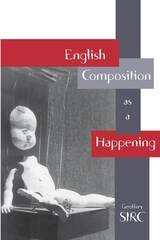
English Composition As A Happening
Geoffrey Sirc
Utah State University Press, 2002
"Contemporary Composition is still inflected by the epistemic turn taken in the 1980s, convincing me that we need to remember what we've forgotten—namely, how impassioned resolves and thrilling discoveries were abandoned and why. I'd like to retrace the road not taken in Composition Studies, to salvage what can still be recovered... I want to inspect the wreckage, in order to show what was the promise of the Happenings for Composition, as well as the huge gray longueur of its pale replacement, Eighties Composition. In so doing, I hope to begin a reconfiguration of our field's pre- and after history."
What happened to the bold, kicky promise of writing instruction in the 1960s? The current conservative trend in composition is analyzed allegorically by Geoffrey Sirc in this book-length homage to Charles Deemer's 1967 article, in which the theories and practices of Happenings artists (multi-disciplinary performance pioneers) were used to invigorate college writing. Sirc takes up Deemer's inquiry, moving through the material and theoretical concerns of such pre- and post-Happenings influences as Duchamp and Pollock, situationists and punks, as well as many of the Happenings artists proper.
English across the Curriculum
Voices from around the WorldBruce Morrison
University Press of Colorado, 2021
English in Today's Research World
A Writing GuideJohn M. Swales and Christine B. Feak
University of Michigan Press, 2000
In addition to instruction on writing for publication, English in Today's Research World provides needed advice on applications, recommendations, and requests--types of communications that are particularly vulnerable to influences from national cultural expectations and conventions and that, therefore, place the NNS writer at increased disadvantage.
The text is both a reference manual and a course book, so that researchers can continue to use the book after they have completed their formal education. New ESL/EFL teachers can use English in Today's Research World as a reference book for themselves or as a teaching aid in the classroom.
Environmental Preservation and the Grey Cliffs Conflict
Negotiating Common Narratives, Values, and EthosKristin D. Pickering
Utah State University Press, 2024
Though environmental degradation and unauthorized use threatened the Grey Cliffs recreational lake area to the point that the Corps considered closure, community members valued it highly and wanted to keep it open. The community near this damaged and crime-ridden area needed help rejuvenating its landscape and image, but the Corps and community were sharply divided on how to maintain this beloved geographic space because of the stakeholders’ different cultural backgrounds and values, as well as the narratives used to discuss them. By co-constructing and aligning narratives, values, and ethos over time—a difficult and lengthy process—the Corps and community succeeded, and Grey Cliffs remains open to all. Focusing on field notes, participant interviews, and analysis of various texts created throughout the conflict, Pickering applies rhetorical analysis and a grounded theory approach to regulation, identity, sustainability, and community values to analyze this communication process.
Illustrating the positive change that can occur when governmental organizations and rural communities work together to construct shared values and engage in a rhetoric of relationship that preserves the environment, Environmental Preservation and the Grey Cliffs Conflict provides key recommendations for resolving environmental conflicts within local communities, especially for those working in technical and professional communication, organizational communication, environmental science, and public policy.
Equipping Technical Communicators for Social Justice Work
Theories, Methodologies, and PedagogiesRebecca Walton
Utah State University Press, 2021
For the field of technical and professional communication to maintain its commitment to this work, how social justice intersects with inclusivity through UX, technological, civic, and legal literacies, as well as through community engagement, must be acknowledged. Equipping Technical Communicators for Social Justice Work will be of significance to established scholar-teachers and graduate students, as well as to newcomers to the field.
Contributors: Kehinde Alonge, Alison Cardinal, Erin Brock Carlson, Oriana Gilson, Laura Gonzales, Keith Grant-Davie, Angela Haas, Mark Hannah, Kimberly Harper, Sarah Beth Hopton, Natasha Jones, Isidore Kafui Dorpenyo, Liz Lane, Emily Legg, Nicole Lowman, Kristen Moore, Emma Rose, Fernando Sanchez, Jennifer Sano-Franchini, Adam Strantz, Cana Uluak Itchuaqiyaq, Josephine Walwema, Miriam Williams, Han Yu

Escaping Into Words
A Creative Writing WorkbookVicente Concilio and Caroline Vetori, translated by Ashley Lucas
Michigan Publishing Services, 2025
Since 2016, the prison theatre program at UDESC has been a part of an international exchange program with the University of Michigan’s Prison Creative Arts Project (PCAP). Faculty and students visit classes at each other’s universities and visit theatre workshops in prisons in both nations. Ashley Lucas’s translation of Escaping Into Words extends this exchange and makes this text available to writers in Michigan prisons through PCAP.
The open access version of this book makes it possible for anyone with an interest in creative writing to explore the world and their own thoughts using this innovative and beautiful text. Those with incarcerated loved ones using the book can access the online edition or purchase a paperback edition to share this experience.
Essays on Classical Rhetoric and Modern Discourse
Edited by Robert J. Connors, Lisa S. Ede, and Andrea A. Lunsford
Southern Illinois University Press, 1984
Eighteen essays by leading scholars in English, speech communication, education, and philosophy explore the vitality of the classical rhetorical tradition and its influence on both contemporary discourse studies and the teaching of writing.
Some of the essays investigate theoretical and historical issues. Others show the bearing of classical rhetoric on contemporary problems in composition, thus blending theory and practice. Common to the varied approaches and viewpoints expressed in this volume is one central theme: the 20th-century revival of rhetoric entails a recovery of the classical tradition, with its marriage of a rich and fully articulated theory with an equally efficacious practice. A preface demonstrates the contribution of Edward P. J.Corbett to the 20th-century revival, and a last chapter includes a bibliography of his works.
Essential Actions for Academic Writing
A Genre-Based ApproachNigel A. Caplan and Ann M. Johns
University of Michigan Press, 2022
Part I:
- Introduces students to rhetorical situation, genre, register, source use, and a framework for understanding how to approach any new writing task.
- Demonstrates that all writing responds to a context that includes the writer’s identity, the reader’s expectations, the purpose of the text, and the conventions that shape it.
- Explores the essential actions of academic writing (explain, summarize, synthesize, report and interpret data, argue, respond, and analyze).
- Provides examples of the genres and language that support each action.
- Offers four extended projects that combine the essential actions in different genres and contexts.
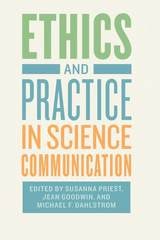
Ethics and Practice in Science Communication
Edited by Susanna Priest, Jean Goodwin, and Michael F. Dahlstrom
University of Chicago Press, 2018
In three sections—how ethics matters, professional practice, and case studies—contributors to this volume explore the many complex questions surrounding the communication of scientific results to nonscientists. Has the science been shared clearly and accurately? Have questions of risk, uncertainty, and appropriate representation been adequately addressed? And, most fundamentally, what is the purpose of communicating science to the public: Is it to inform and empower? Or to persuade—to influence behavior and policy? By inspiring scientists and science communicators alike to think more deeply about their work, this book reaffirms that the integrity of the communication of science is vital to a healthy relationship between science and society today.
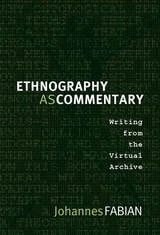
Ethnography as Commentary
Writing from the Virtual ArchiveJohannes Fabian
Duke University Press, 2008
In his commentary, Fabian reconstructs his meeting with the healer Kahenga Mukonkwa Michel, in which the two discussed the ritual that Kahenga performed to protect Fabian’s home from burglary. Fabian reflects on the expectations and terminology that shape his description of Kahenga’s ritual and meditates on how ethnographic texts are made, considering the settings, the participants, the technologies, and the linguistic medium that influence the transcription and translation of a recording and thus fashion ethnographic knowledge. Turning more directly to Kahenga—as a practitioner, a person, and an ethnographic subject—and to the questions posed to him, Fabian reconsiders questions of ethnic identity, politics, and religion. While Fabian hopes that emerging anthropologists will share their fieldwork through virtual archives, he does not suggest that traditional ethnography will disappear. It will become part of a broader project facilitated by new media.
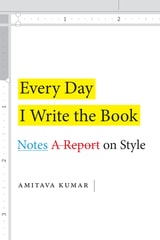
Every Day I Write the Book
Notes on StyleAmitava Kumar
Duke University Press, 2020
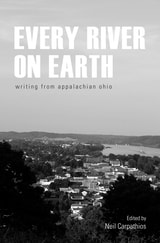
Every River on Earth
Writing from Appalachian OhioNeil Carpathios
Ohio University Press, 2015
Every River on Earth: Writing from Appalachian Ohio includes some of the best regional poetry, fiction, and creative nonfiction from forty contemporary writers, both established and up-and-coming. The wide range of material from authors such as David Baker, Don Bogen, Michelle Burke, Richard Hague, Donald Ray Pollock, and others, offers the reader a window into daily life in the region. The people, the landscape, the struggles, and the deepest undercurrents of what it means to be from and of a place are revealed in these original, deeply moving, and sometimes shocking pieces.
The book is divided into four sections: Family & Folks, The Land, The Grind, and Home & Away, each of which explores a different aspect of the place that these authors call home. The sections work together beautifully to capture what it means to live, to love, and to die in this particular slice of Appalachia. The writing is accessible and often emotionally raw; Every River on Earth invites all types of readers and conveys a profound appreciation of the region’s character.
The authors also offer personal statements about their writing, allowing the reader an intimate insight into their processes, aesthetics, and inspirations. What is it to be an Appalachian? What is it to be an Appalachian in Ohio? This book vividly paints that picture.
Every River on Earth
David Lee Garrison
I look out the window and see
through the neighbor’s window
to an Amish buggy
where three children are peeping back,
and in their eyes I see the darkness
of plowed earth hiding seed.
Wind pokes the land in winter,
trying to waken it,
and in the melting snow
I see rainbows and in them
every river on earth. I see all the way
to the ocean, where sand and stones
embrace each falling wave
and reach back to gather it in.
Everyday Genres
Writing Assignments across the DisciplinesMary Soliday
Southern Illinois University Press, 2011
Soliday provides an overview of the contemporary theory and research in Writing across the Curriculum programs, focusing specifically on the implementation of the Writing Fellows Program at the City College of New York. Drawing on her direct observations of colleagues and students at the school, she addresses the everyday challenges that novice writers face, such as developing an appropriate "stance" in one's writing, and the intricacies of choosing and developing content.
The volume then goes on to address some of the most pressing questions being asked by teachers of composition: To what extent can writing be separated from its situation? How can rhetorical expertise be shared across fields? And to what degree is writing ability local rather than general? Soliday argues that, while writing is closely connected to situation, general rhetorical principles can still be capably applied if those situations are known. The key to improving writing instruction, she maintains, is to construct contexts that expose writers to the social actions that genres perform for readers.
Supplementing the author's case study are six appendixes, complete with concrete examples and helpful teaching tools to establish effective classroom practices and exercises in Writing across the Curriculum programs. Packed with useful information and insight, Everyday Genres is an essential volume for both students and teachers seeking to expand their understanding of the nature of writing.
Excellence in First-Year Writing
2019/2020Dana Nichols
Michigan Publishing Services, 2020
Excellence in Upper-Level Writing
2019/2020Dana Nichols
Michigan Publishing Services, 2020
Explanation Points
Publishing in Rhetoric and CompositionJohn R Gallagher
Utah State University Press, 2019
Rhetoric and composition is a uniquely democratic field, made of a group of scholars who, rather than competing with one another, lift each other up and work together to move the field forward. This lively, engaging, story-anchored book offers advice from a range of authors—including emeritus faculty, prolific authors, and early career researchers. Organized by various stages in the writing and publishing process, Explanation Points presents the advice shared between colleagues, passed along from professor to student, or offered online in abbreviated tweets and updates.
The best advice book on writing and publishing in the field, Explanation Points is a useful resource for rhetoric and composition scholars including faculty, graduate students, and advanced undergraduate students; writing center administrators, staff, and consultants; graduate pratica and seminars; writing workshop classes; and editors, associate editors, assistant editors, and other academic journal staff.
Contributors:
Tim Amidon, Chris Anson, Nancy G. Barron, Ellen Barton, Michael Baumann, Steve Bernhardt, Kristine L. Blair, David Blakesley, Lynn Z. Bloom, Marcia Bost, James Brown, Amber Buck, Rebecca Burnett, Joyce Carter, Kate Comer, Janice Cools, Marilyn Cooper, Craig Cotich, Ellen Cushman, Gabriel Cutrufello, Courtney Danforth, Sid Dobrin, William Duffy, Norbert Elliot, Jessica Enoch, Doug Eyman, Michael Faris, Jenn Fishman, Linda Flower, Brenda Glasscot, Laura Gonzales, Jeffrey T. Grabill, Laurie Gries, Bump Halbritter, Joseph Harris, Byron Hawk, Douglas Hesse, Troy Hicks, Bruce Horner, Asao Inoue, Darin L. Jensen, Erin Jensen, Johndan Johnson-Eilola, Gesa E. Kirsch, Sarah Kornfield, Ashanka Kumari, Christina M. LaVecchia, Donna LeCourt, Barbara L’Eplattenier, Heather Lettner-Rust, Justin Lewis, Julie Lindquist, Tara Lockhart, Andrea Abernethy Lunsford, Katie Manthey, Lisa Mastrangelo, Ben McCorkle, Heidi McKee, Cruz Medina, Laura R. Micciche, Holly Middleton, Lilian Mina, Janine Morris, Joan Mullin, Kim Hensley Owens, Jason Palmeri, Mike Palmquist, Steve Parks, Juli Parrish, Staci Perryman-Clark, Mya Poe, Jacqueline Rhodes, Jeff Rice, Jim Ridolfo, Shirley K Rose, Stuart A. Selber, Jody Shipka, Naomi Silver, Ryan Skinnell, Trixie Long Smith, Kyle Stedman, Patrick Sullivan, Carrie Strand Tebeau, Christie Toth, John Trimbur, Chris Warnick, Kathleen Blake Yancey
Exploded Views
Speculative Form and the Labor of InquiryJonathan Eburne
University of Minnesota Press, 2025
Idiosyncratic essays use their “exploded” forms to examine how inquiry functions
Insect galls, time, memory systems, orgone energy, and a bookstore that doesn’t yet exist. These disparate topics have persistently fascinated scholar Jonathan P. Eburne, yet each defied his previous efforts at classification through scholarly writing, resulting in five essays suspended in process. In Exploded Views, Eburne returns to these essays with the metaphorical tool of the exploded-view diagram, expanding them into entirely new, hybrid forms that unpack their inspirations and trace the wayward paths they followed.
An experiment into the nature of inquiry that spelunks, rather than shies from, the rabbit holes of scholarly curiosity, each essay gives way to sidelights and dilations to reveal the palimpsest of knowledge hiding beneath the surface of the academic form. A book about process—the process of turning ideas into things, and vice versa, as well as the particular tendency for research, scholarly inquiry, and critical writing to come apart and go awry—Exploded Views is a refreshing exploration of how the tools of creative critical thinking work at their most basic level.
Reflecting on the methods of scholarly knowledge production and the contextual factors that shape new ideas, Eburne boldly replaces the seamlessness of the finished manuscript with the friction and even messiness of the incomplete, inviting readers to think in new and invigorating ways.
Exploring Composition Studies
Sites, Issues, PerspectivesKelly Ritter and Paul Matsuda
Utah State University Press, 2012
Kelly Ritter and Paul Kei Matsuda have created an essential introduction to the field of composition studies for graduate students and instructors new to the study of writing. The book offers a careful exploration of this diverse field, focusing specifically on scholarship of writing and composing. Within this territory, the authors draw the boundaries broadly, to include allied sites of research such as professional and technical writing, writing across the curriculum programs, writing centers, and writing program administration.
Importantly, they represent composition as a dynamic, eclectic field, influenced by factors both within the academy and without. The editors and their sixteen seasoned contributors have created a comprehensive and thoughtful exploration of composition studies as it stands in the early twenty-first century. Given the rapid growth of this field and the evolution of it research and pedagogical agendas over even the last ten years, this multi-vocal introduction is long overdue.
Exploring Options in Academic Writing
Effective Vocabulary and Grammar UseJan Frodesen and Margi Wald
University of Michigan Press, 2016
Following a unit on using resources for vocabulary development, the contents are divided into three parts: Showing Relationships within Sentences, Connecting and Focusing across Sentences, and Qualifying Statements and Reporting Research. Part 1 focuses on verbs and modifiers that express increases and decreases, verbs and abstract nouns that describe change, connectors and verbs describing causal relationships, and parallel structures. Part 2 explores the words that help connect ideas and add cohesion. Part 3 discusses how to express degrees of certainty and accuracy and the use of reporting verbs.
ePortfolios@edu
What We Know, What We Don’t Know, and Everything In-BetweenMary Ann Dellinger
University Press of Colorado, 2021
This book is also available as an open access ebook through the WAC Clearinghouse.