295 books match the query 'Zoology' and 28 start with e

cover of East African Mammals: An Atlas of Evolution in Africa, Volume 2, Part A: Insectivores and Bats

East African Mammals

An Atlas of Evolution in Africa, Volume 2, Part A: Insectivores and Bats

Jonathan Kingdon

University of Chicago Press, 1984

Acclaimed and coveted by both naturalists and lovers of wildlife illustration, Jonathan Kingdon's seven-volume East African Mammals has become a classic of modern natural history. This paperback edition makes Kingdon's remarkable artistic and scientific achievement—his hundreds of drawings and perceptive study of all the mammals in East Africa's species-rich fauna—available to the wide audience it deserves. 

Volume IIA of East African Mammals begins a two-part study of East Africa's smallest and least conspicuous mammals. It deals with bats and insectivores, including tenrecs, moles, hedgehogs, and shrews.

In each volume Kingdon combines his text with hundreds of finished drawings and quick sketches, the latter a form of field note that provides an incomparable description of the animal's movements and personality. Kingdom explains his drawings "as a wordless questioning of form. . . . The probing pencil is like the dissecting scalpel, seeking to expose relevant structures that may not be immediately obvious and are certainly hidden from the shadowy world of the camera lens." As an artist, Kingdon's achievement has been compared with Audubon's; as a scientist, his work has made these volumes indispensable to any serious student of East African mammals.
[more]
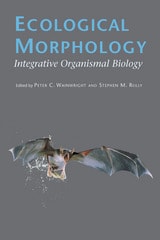
cover of Ecological Morphology: Integrative Organismal Biology

Ecological Morphology

Integrative Organismal Biology

Edited by Peter C. Wainwright and Stephen M. Reilly

University of Chicago Press, 1994

Ecological morphology examines the relation between an animal's anatomy and physiology—its form and function—and how the animal has evolved in and can inhabit a particular environment. Within the past few years, research in this relatively new area has exploded. Ecological Morphology is a synthesis of major concepts and a demonstration of the ways in which this integrative approach can yield rich and surprising results.

Through this interdisciplinary study, scientists have been able to understand, for instance, how bat wing design affects habitat use and bat diet; how the size of a predator affects its ability to capture and eat certain prey; and how certain mosquitoes have evolved physiologically and morphologically to tolerate salt-water habitats. Ecological Morphology also covers the history of the field, the role of the comparative method in studying adaptation, and the use of data from modern organisms for understanding the ecology of fossil communities.

This book provides an overview of the achievements and potential of ecological morphology for all biologists and students interested in the way animal design, ecology, and evolution interact.

[more]
cover of Ecological and Evolutionary Physiology, volume 97 number 1 (January/February 2024)

Ecological and Evolutionary Physiology, volume 97 number 1 (January/February 2024)

The University of Chicago Press

University of Chicago Press Journals, 2024

This is volume 97 issue 1 of Ecological and Evolutionary Physiology. Ecological and Evolutionary Physiology primarily publishes original research in physiological ecology, ecophysiology, comparative physiology, and evolutionary physiology. Studies at all levels of biological organization from the molecular to the whole organism are welcome, and work that integrates across levels of organization is particularly encouraged. Studies that focus on behavior or morphology are welcome, so long as they include ties to physiology or biochemistry, in addition to having an ecological or evolutionary context. Subdisciplines of interest include nutrition and digestion, salt and water balance, epithelial and membrane transport, gas exchange and transport, acid-base balance, temperature adaptation, energetics, structure and function of macromolecules, chemical coordination and signal transduction, nitrogen metabolism and excretion, locomotion and muscle function, biomechanics, circulation, behavioral, comparative and mechanistic endocrinology, sensory physiology, neural coordination, and ecotoxicology ecoimmunology.
[more]
cover of Ecological and Evolutionary Physiology, volume 97 number 2 (March/April 2024)

Ecological and Evolutionary Physiology, volume 97 number 2 (March/April 2024)

The University of Chicago Press

University of Chicago Press Journals, 2024
This is volume 97 issue 2 of Ecological and Evolutionary Physiology. Ecological and Evolutionary Physiology primarily publishes original research in physiological ecology, ecophysiology, comparative physiology, and evolutionary physiology. Studies at all levels of biological organization from the molecular to the whole organism are welcome, and work that integrates across levels of organization is particularly encouraged. Studies that focus on behavior or morphology are welcome, so long as they include ties to physiology or biochemistry, in addition to having an ecological or evolutionary context. Subdisciplines of interest include nutrition and digestion, salt and water balance, epithelial and membrane transport, gas exchange and transport, acid-base balance, temperature adaptation, energetics, structure and function of macromolecules, chemical coordination and signal transduction, nitrogen metabolism and excretion, locomotion and muscle function, biomechanics, circulation, behavioral, comparative and mechanistic endocrinology, sensory physiology, neural coordination, and ecotoxicology ecoimmunology.
[more]
cover of Ecological and Evolutionary Physiology, volume 97 number 3 (May/June 2024)

Ecological and Evolutionary Physiology, volume 97 number 3 (May/June 2024)

The University of Chicago Press

University of Chicago Press Journals, 2024
This is volume 97 issue 3 of Ecological and Evolutionary Physiology. Ecological and Evolutionary Physiology primarily publishes original research in physiological ecology, ecophysiology, comparative physiology, and evolutionary physiology. Studies at all levels of biological organization from the molecular to the whole organism are welcome, and work that integrates across levels of organization is particularly encouraged. Studies that focus on behavior or morphology are welcome, so long as they include ties to physiology or biochemistry, in addition to having an ecological or evolutionary context. Subdisciplines of interest include nutrition and digestion, salt and water balance, epithelial and membrane transport, gas exchange and transport, acid-base balance, temperature adaptation, energetics, structure and function of macromolecules, chemical coordination and signal transduction, nitrogen metabolism and excretion, locomotion and muscle function, biomechanics, circulation, behavioral, comparative and mechanistic endocrinology, sensory physiology, neural coordination, and ecotoxicology ecoimmunology.
[more]
cover of Ecological and Evolutionary Physiology, volume 97 number 4 (July/August 2024)

Ecological and Evolutionary Physiology, volume 97 number 4 (July/August 2024)

The University of Chicago Press

University of Chicago Press Journals, 2024

This is volume 97 issue 4 of Ecological and Evolutionary Physiology. Ecological and Evolutionary Physiology primarily publishes original research in physiological ecology, ecophysiology, comparative physiology, and evolutionary physiology. Studies at all levels of biological organization from the molecular to the whole organism are welcome, and work that integrates across levels of organization is particularly encouraged. Studies that focus on behavior or morphology are welcome, so long as they include ties to physiology or biochemistry, in addition to having an ecological or evolutionary context. Subdisciplines of interest include nutrition and digestion, salt and water balance, epithelial and membrane transport, gas exchange and transport, acid-base balance, temperature adaptation, energetics, structure and function of macromolecules, chemical coordination and signal transduction, nitrogen metabolism and excretion, locomotion and muscle function, biomechanics, circulation, behavioral, comparative and mechanistic endocrinology, sensory physiology, neural coordination, and ecotoxicology ecoimmunology.
[more]
cover of Ecological and Evolutionary Physiology, volume 97 number 5 (September/October 2024)

Ecological and Evolutionary Physiology, volume 97 number 5 (September/October 2024)

The University of Chicago Press

University of Chicago Press Journals, 2024
This is volume 97 issue 5 of Ecological and Evolutionary Physiology. Ecological and Evolutionary Physiology primarily publishes original research in physiological ecology, ecophysiology, comparative physiology, and evolutionary physiology. Studies at all levels of biological organization from the molecular to the whole organism are welcome, and work that integrates across levels of organization is particularly encouraged. Studies that focus on behavior or morphology are welcome, so long as they include ties to physiology or biochemistry, in addition to having an ecological or evolutionary context. Subdisciplines of interest include nutrition and digestion, salt and water balance, epithelial and membrane transport, gas exchange and transport, acid-base balance, temperature adaptation, energetics, structure and function of macromolecules, chemical coordination and signal transduction, nitrogen metabolism and excretion, locomotion and muscle function, biomechanics, circulation, behavioral, comparative and mechanistic endocrinology, sensory physiology, neural coordination, and ecotoxicology ecoimmunology.
[more]
cover of Ecological and Evolutionary Physiology, volume 97 number 6 (November/December 2024)

Ecological and Evolutionary Physiology, volume 97 number 6 (November/December 2024)

The University of Chicago Press

University of Chicago Press Journals, 2024
This is volume 97 issue 6 of Ecological and Evolutionary Physiology. Ecological and Evolutionary Physiology primarily publishes original research in physiological ecology, ecophysiology, comparative physiology, and evolutionary physiology. Studies at all levels of biological organization from the molecular to the whole organism are welcome, and work that integrates across levels of organization is particularly encouraged. Studies that focus on behavior or morphology are welcome, so long as they include ties to physiology or biochemistry, in addition to having an ecological or evolutionary context. Subdisciplines of interest include nutrition and digestion, salt and water balance, epithelial and membrane transport, gas exchange and transport, acid-base balance, temperature adaptation, energetics, structure and function of macromolecules, chemical coordination and signal transduction, nitrogen metabolism and excretion, locomotion and muscle function, biomechanics, circulation, behavioral, comparative and mechanistic endocrinology, sensory physiology, neural coordination, and ecotoxicology ecoimmunology.
[more]
cover of Ecological and Evolutionary Physiology, volume 98 number 1 (January/February 2025)

Ecological and Evolutionary Physiology, volume 98 number 1 (January/February 2025)

The University of Chicago Press

University of Chicago Press Journals, 2025
This is volume 98 issue 1 of Ecological and Evolutionary Physiology. Ecological and Evolutionary Physiology primarily publishes original research in physiological ecology, ecophysiology, comparative physiology, and evolutionary physiology. Studies at all levels of biological organization from the molecular to the whole organism are welcome, and work that integrates across levels of organization is particularly encouraged. Studies that focus on behavior or morphology are welcome, so long as they include ties to physiology or biochemistry, in addition to having an ecological or evolutionary context. Subdisciplines of interest include nutrition and digestion, salt and water balance, epithelial and membrane transport, gas exchange and transport, acid-base balance, temperature adaptation, energetics, structure and function of macromolecules, chemical coordination and signal transduction, nitrogen metabolism and excretion, locomotion and muscle function, biomechanics, circulation, behavioral, comparative and mechanistic endocrinology, sensory physiology, neural coordination, and ecotoxicology ecoimmunology.
[more]
cover of Ecological and Evolutionary Physiology, volume 98 number 2 (March/April 2025)

Ecological and Evolutionary Physiology, volume 98 number 2 (March/April 2025)

The University of Chicago Press

University of Chicago Press Journals, 2025

This is volume 98 issue 2 of Ecological and Evolutionary Physiology. Ecological and Evolutionary Physiology primarily publishes original research in physiological ecology, ecophysiology, comparative physiology, and evolutionary physiology. Studies at all levels of biological organization from the molecular to the whole organism are welcome, and work that integrates across levels of organization is particularly encouraged. Studies that focus on behavior or morphology are welcome, so long as they include ties to physiology or biochemistry, in addition to having an ecological or evolutionary context. Subdisciplines of interest include nutrition and digestion, salt and water balance, epithelial and membrane transport, gas exchange and transport, acid-base balance, temperature adaptation, energetics, structure and function of macromolecules, chemical coordination and signal transduction, nitrogen metabolism and excretion, locomotion and muscle function, biomechanics, circulation, behavioral, comparative and mechanistic endocrinology, sensory physiology, neural coordination, and ecotoxicology ecoimmunology.
[more]
cover of Ecological and Evolutionary Physiology, volume 98 number 3 (May/June 2025)

Ecological and Evolutionary Physiology, volume 98 number 3 (May/June 2025)

The University of Chicago Press

University of Chicago Press Journals, 2025

This is volume 98 issue 3 of Ecological and Evolutionary Physiology. Ecological and Evolutionary Physiology primarily publishes original research in physiological ecology, ecophysiology, comparative physiology, and evolutionary physiology. Studies at all levels of biological organization from the molecular to the whole organism are welcome, and work that integrates across levels of organization is particularly encouraged. Studies that focus on behavior or morphology are welcome, so long as they include ties to physiology or biochemistry, in addition to having an ecological or evolutionary context. Subdisciplines of interest include nutrition and digestion, salt and water balance, epithelial and membrane transport, gas exchange and transport, acid-base balance, temperature adaptation, energetics, structure and function of macromolecules, chemical coordination and signal transduction, nitrogen metabolism and excretion, locomotion and muscle function, biomechanics, circulation, behavioral, comparative and mechanistic endocrinology, sensory physiology, neural coordination, and ecotoxicology ecoimmunology.
[more]
cover of Ecological and Evolutionary Physiology, volume 98 number 4 (July/August 2025)

Ecological and Evolutionary Physiology, volume 98 number 4 (July/August 2025)

The University of Chicago Press

University of Chicago Press Journals, 2025
This is volume 98 issue 4 of Ecological and Evolutionary Physiology. Ecological and Evolutionary Physiology primarily publishes original research in physiological ecology, ecophysiology, comparative physiology, and evolutionary physiology. Studies at all levels of biological organization from the molecular to the whole organism are welcome, and work that integrates across levels of organization is particularly encouraged. Studies that focus on behavior or morphology are welcome, so long as they include ties to physiology or biochemistry, in addition to having an ecological or evolutionary context. Subdisciplines of interest include nutrition and digestion, salt and water balance, epithelial and membrane transport, gas exchange and transport, acid-base balance, temperature adaptation, energetics, structure and function of macromolecules, chemical coordination and signal transduction, nitrogen metabolism and excretion, locomotion and muscle function, biomechanics, circulation, behavioral, comparative and mechanistic endocrinology, sensory physiology, neural coordination, and ecotoxicology ecoimmunology.
[more]
cover of Ecological and Evolutionary Physiology, volume 98 number 5 (September/October 2025)

Ecological and Evolutionary Physiology, volume 98 number 5 (September/October 2025)

The University of Chicago Press

University of Chicago Press Journals, 2025

This is volume 98 issue 5 of Ecological and Evolutionary Physiology. Ecological and Evolutionary Physiology primarily publishes original research in physiological ecology, ecophysiology, comparative physiology, and evolutionary physiology. Studies at all levels of biological organization from the molecular to the whole organism are welcome, and work that integrates across levels of organization is particularly encouraged. Studies that focus on behavior or morphology are welcome, so long as they include ties to physiology or biochemistry, in addition to having an ecological or evolutionary context. Subdisciplines of interest include nutrition and digestion, salt and water balance, epithelial and membrane transport, gas exchange and transport, acid-base balance, temperature adaptation, energetics, structure and function of macromolecules, chemical coordination and signal transduction, nitrogen metabolism and excretion, locomotion and muscle function, biomechanics, circulation, behavioral, comparative and mechanistic endocrinology, sensory physiology, neural coordination, and ecotoxicology ecoimmunology.
[more]
cover of Ecological and Evolutionary Physiology, volume 98 number 6 (November/December 2025)

Ecological and Evolutionary Physiology, volume 98 number 6 (November/December 2025)

The University of Chicago Press

University of Chicago Press Journals, 2025
This is volume 98 issue 6 of Ecological and Evolutionary Physiology. Ecological and Evolutionary Physiology primarily publishes original research in physiological ecology, ecophysiology, comparative physiology, and evolutionary physiology. Studies at all levels of biological organization from the molecular to the whole organism are welcome, and work that integrates across levels of organization is particularly encouraged. Studies that focus on behavior or morphology are welcome, so long as they include ties to physiology or biochemistry, in addition to having an ecological or evolutionary context. Subdisciplines of interest include nutrition and digestion, salt and water balance, epithelial and membrane transport, gas exchange and transport, acid-base balance, temperature adaptation, energetics, structure and function of macromolecules, chemical coordination and signal transduction, nitrogen metabolism and excretion, locomotion and muscle function, biomechanics, circulation, behavioral, comparative and mechanistic endocrinology, sensory physiology, neural coordination, and ecotoxicology ecoimmunology.
[more]
cover of Ecological and Evolutionary Physiology, volume 99 number 1 (January/February 2026)

Ecological and Evolutionary Physiology, volume 99 number 1 (January/February 2026)

The University of Chicago Press

University of Chicago Press Journals, 2026

This is volume 99 issue 1 of Ecological and Evolutionary Physiology. Ecological and Evolutionary Physiology primarily publishes original research in physiological ecology, ecophysiology, comparative physiology, and evolutionary physiology. Studies at all levels of biological organization from the molecular to the whole organism are welcome, and work that integrates across levels of organization is particularly encouraged. Studies that focus on behavior or morphology are welcome, so long as they include ties to physiology or biochemistry, in addition to having an ecological or evolutionary context. Subdisciplines of interest include nutrition and digestion, salt and water balance, epithelial and membrane transport, gas exchange and transport, acid-base balance, temperature adaptation, energetics, structure and function of macromolecules, chemical coordination and signal transduction, nitrogen metabolism and excretion, locomotion and muscle function, biomechanics, circulation, behavioral, comparative and mechanistic endocrinology, sensory physiology, neural coordination, and ecotoxicology ecoimmunology.
[more]
cover of Ecological and Evolutionary Physiology, volume 99 number 2 (March/April 2026)

Ecological and Evolutionary Physiology, volume 99 number 2 (March/April 2026)

The University of Chicago Press

University of Chicago Press Journals, 2026
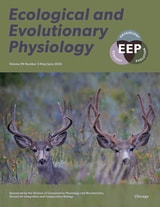
This is volume 99 issue 2 of Ecological and Evolutionary Physiology. Ecological and Evolutionary Physiology primarily publishes original research in physiological ecology, ecophysiology, comparative physiology, and evolutionary physiology. Studies at all levels of biological organization from the molecular to the whole organism are welcome, and work that integrates across levels of organization is particularly encouraged. Studies that focus on behavior or morphology are welcome, so long as they include ties to physiology or biochemistry, in addition to having an ecological or evolutionary context. Subdisciplines of interest include nutrition and digestion, salt and water balance, epithelial and membrane transport, gas exchange and transport, acid-base balance, temperature adaptation, energetics, structure and function of macromolecules, chemical coordination and signal transduction, nitrogen metabolism and excretion, locomotion and muscle function, biomechanics, circulation, behavioral, comparative and mechanistic endocrinology, sensory physiology, neural coordination, and ecotoxicology ecoimmunology.
[more]
cover of Ecological and Evolutionary Physiology, volume 99 number 3 (May/June 2026)

Ecological and Evolutionary Physiology, volume 99 number 3 (May/June 2026)

The University of Chicago Press

University of Chicago Press Journals, 2026
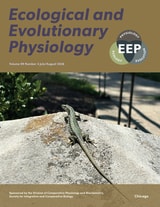
This is volume 99 issue 3 of Ecological and Evolutionary Physiology. Ecological and Evolutionary Physiology primarily publishes original research in physiological ecology, ecophysiology, comparative physiology, and evolutionary physiology. Studies at all levels of biological organization from the molecular to the whole organism are welcome, and work that integrates across levels of organization is particularly encouraged. Studies that focus on behavior or morphology are welcome, so long as they include ties to physiology or biochemistry, in addition to having an ecological or evolutionary context. Subdisciplines of interest include nutrition and digestion, salt and water balance, epithelial and membrane transport, gas exchange and transport, acid-base balance, temperature adaptation, energetics, structure and function of macromolecules, chemical coordination and signal transduction, nitrogen metabolism and excretion, locomotion and muscle function, biomechanics, circulation, behavioral, comparative and mechanistic endocrinology, sensory physiology, neural coordination, and ecotoxicology ecoimmunology.
[more]
cover of Ecological and Evolutionary Physiology, volume 99 number 4 (July/August 2026)

Ecological and Evolutionary Physiology, volume 99 number 4 (July/August 2026)

The University of Chicago Press

University of Chicago Press Journals, 2026
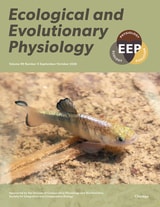
This is volume 99 issue 4 of Ecological and Evolutionary Physiology. Ecological and Evolutionary Physiology primarily publishes original research in physiological ecology, ecophysiology, comparative physiology, and evolutionary physiology. Studies at all levels of biological organization from the molecular to the whole organism are welcome, and work that integrates across levels of organization is particularly encouraged. Studies that focus on behavior or morphology are welcome, so long as they include ties to physiology or biochemistry, in addition to having an ecological or evolutionary context. Subdisciplines of interest include nutrition and digestion, salt and water balance, epithelial and membrane transport, gas exchange and transport, acid-base balance, temperature adaptation, energetics, structure and function of macromolecules, chemical coordination and signal transduction, nitrogen metabolism and excretion, locomotion and muscle function, biomechanics, circulation, behavioral, comparative and mechanistic endocrinology, sensory physiology, neural coordination, and ecotoxicology ecoimmunology.
[more]
cover of Ecological and Evolutionary Physiology, volume 99 number 5 (September/October 2026)

Ecological and Evolutionary Physiology, volume 99 number 5 (September/October 2026)

The University of Chicago Press

University of Chicago Press Journals, 2026
This is volume 99 issue 5 of Ecological and Evolutionary Physiology. Ecological and Evolutionary Physiology primarily publishes original research in physiological ecology, ecophysiology, comparative physiology, and evolutionary physiology. Studies at all levels of biological organization from the molecular to the whole organism are welcome, and work that integrates across levels of organization is particularly encouraged. Studies that focus on behavior or morphology are welcome, so long as they include ties to physiology or biochemistry, in addition to having an ecological or evolutionary context. Subdisciplines of interest include nutrition and digestion, salt and water balance, epithelial and membrane transport, gas exchange and transport, acid-base balance, temperature adaptation, energetics, structure and function of macromolecules, chemical coordination and signal transduction, nitrogen metabolism and excretion, locomotion and muscle function, biomechanics, circulation, behavioral, comparative and mechanistic endocrinology, sensory physiology, neural coordination, and ecotoxicology ecoimmunology.
[more]
cover of Ecology and Evolution in the Tropics: A Herpetological Perspective

Ecology and Evolution in the Tropics

A Herpetological Perspective

Edited by Maureen A. Donnelly, Brian I. Crother, Craig Guyer, Marvalee H. Wake,

University of Chicago Press, 2005
In these essays that survey the burgeoning field of tropical herpetology, former students and associates pay tribute to Jay Savage's four decades of mentoring. The result is a book unlike any other available in tropical herpetology. Covering a wide array of subjects, Ecology and Evolution in the Tropics is the first book in more than two decades to broadly review research on tropical amphibians and reptiles. A tribute to Savage and an invaluable addition to the herpetological literature, this work will be cited for years to come.
[more]
cover of Ecology and Evolution of Poeciliid Fishes

Ecology and Evolution of Poeciliid Fishes

Edited by Jonathan P. Evans, Andrea Pilastro, and Ingo Schlupp

University of Chicago Press, 2011

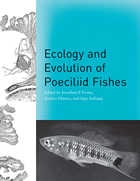
The history of biology is populated by numerous model species or organisms. But few vertebrate groups have aided evolutionary and ecological research more than the live-bearing fishes of the family Poeciliidae. Found throughout tropical and subtropical waters, poeciliids exhibit a fascinating variety of reproductive specializations, including viviparity, matrotrophy, unisexual reproduction, and alternative mating strategies, making them ideal models for research on patterns and processes in ecology, behavior, and evolution.


Ecology and Evolution of Poeciliid Fishes
is a much-needed overview of the scientific potential and understanding of these live-bearing fishes. Chapters by leading researchers take up a wide range of topics, including the evolution of unisexual reproduction, life in extreme environments, life-history evolution, and genetics. Designed to provide a single and highly approachable reference, Ecology and Evolution of Poeciliid Fishes will appeal to students and specialists interested in all aspects of evolutionary ecology.
[more]
cover of Ecology and Management of the North American Moose, Second Edition

Ecology and Management of the North American Moose, Second Edition

Charles C. Schwartz

University Press of Colorado, 2007

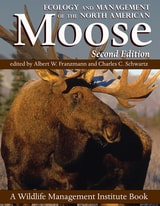
Back in print as a University Press of Colorado edition, this abundantly illustrated volume with field sketch illustrations by William D. Berry fully explains moose biology and ecology and assesses the increasingly complex enterprise of managing moose. Twenty-one of the world's authorities on the species discuss its taxonomy, reproduction and growth, feeding habits, behavior, population dynamics, relationships with predators, incidental mortality, seasonal migration patterns, and habitat and harvest management.

Contributors include Warren B. Ballard, Arnold H. Boer, Anthony B. Bubenik, M. E. Buss, Kenneth N. Child, Vincent F.J. Crichton, Albert W. Franzmann, Kris J. Hundertmark, Patrick D. Karns, Murray W. Lankester, Richard E. McCabe, James M. Peek, Henry M. Reeves, Wayne L. Regelin, Lyle A. Renecker, William M. Samuel, Charles C. Schwartz, Robert W. Stewart, Ian D. Thompson, H. R. Timmermann, and Victor Van Ballenberghe. A Wildlife Management Institute book
[more]
cover of Elephant Don: The Politics of a Pachyderm Posse

Elephant Don

The Politics of a Pachyderm Posse

Caitlin O'Connell

University of Chicago Press, 2015

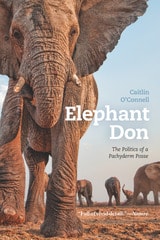
Meet Greg. He’s a stocky guy with an outsized swagger. He’s been the intimidating yet sociable don of his posse of friends—including Abe, Keith, Mike, Kevin, Torn Trunk, and Willie. But one arid summer the tide begins to shift and the third-ranking Kevin starts to get ambitious, seeking a higher position within this social club. But this is no ordinary tale of gangland betrayal—Greg and his entourage are bull elephants in Etosha National Park, Namibia, where, for the last twenty-three years, Caitlin O’Connell has been a keen observer of their complicated friendships.

In Elephant Don, O’Connell, one of the leading experts on elephant communication and social behavior, offers a rare inside look at the social world of African male elephants. Elephant Don tracks Greg and his group of bulls as O’Connell tries to understand the vicissitudes of male friendship, power struggles, and play. A frequently heart-wrenching portrayal of commitment, loyalty, and affection between individuals yearning for companionship, it vividly captures an incredible repertoire of elephant behavior and communication.  Greg, O’Connell shows, is sometimes a tyrant and other times a benevolent dictator as he attempts to hold onto his position at the top. Though Elephant Don is Greg’s story, it is also the story of O’Connell and the challenges and triumphs of field research in environs more hospitable to lions and snakes than scientists.

Readers will be drawn into dramatic tales of an elephant society at once exotic and surprisingly familiar, as O’Connell’s decades of close research reveal extraordinary discoveries about a male society not wholly unlike our own. Surely we’ve all known a Greg or two, and through this book we may come to know them in a whole new light.
[more]
cover of Elton's Ecologists: A History of the Bureau of Animal Population

Elton's Ecologists

A History of the Bureau of Animal Population

Peter Crowcroft

University of Chicago Press, 1991

From its creation by Charles Elton in 1932 to its demise when he retired in 1967, the Bureau of Animal Population at Oxford was a mecca for ecologists from around the world. Crowcroft provides an anecdotal history of this small research institute that so strongly influenced the development of modern animal ecology.

"[This] is a very good account of the work and personal interactions of a group that played an important part in the development of animal ecology in the period 1930-60."—John Krebs, TREE

[more]
cover of Evolution of Vertebrate Design

Evolution of Vertebrate Design

Leonard B. Radinsky

University of Chicago Press, 1987

The Evolution of Vertebrate Design is a solid introduction to vertebrate evolution, paleontology, vertebrate biology, and functional, comparative anatomy. Its lucid style also makes it ideal for general readers intrigued by fossil history. Clearly drawn diagrams illustrate biomechanical explanations of the evolution of fins, jaws, joints, and body shapes among vertebrates. A glossary of terms is included.

"A luminous text is matched by lucid drawings rationally placed. . . . A great teaching monograph, the book will charm lay readers of fossil history. For virtually every college & public collection."—Scitech Book News
[more]
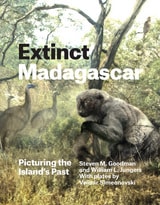
cover of Extinct Madagascar: Picturing the Island's Past

Extinct Madagascar

Picturing the Island's Past

Steven M. Goodman and William L. Jungers

University of Chicago Press, 2014

The landscapes of Madagascar have long delighted zoologists, who have discovered, in and among the island’s baobab trees and thickets, a dizzying array of animals, including something approaching one hundred species of lemur. Madagascar’s mammal fauna, for example, is far more diverse, and more endemic, than early explorers and naturalists ever dreamed of. But in the past 2,500 or so years—a period associated with natural climatic shifts and ecological change, as well as partially coinciding with the arrival of the island’s first human settlers—a considerable proportion of Madagascar’s forests have disappeared; and in the wake of this loss, a number of species unique to Madagascar have vanished forever into extinction.

In Extinct Madagascar, noted scientists Steven M. Goodman and William L. Jungers explore the recent past of these land animal extinctions. Beginning with an introduction to the geologic and ecological history of Madagascar that provides context for the evolution, diversification, and, in some cases, rapid decline of the Malagasy fauna, Goodman and Jungers then seek to recapture these extinct mammals in their environs. Aided in their quest by artist Velizar Simeonovski’s beautiful and haunting digital paintings—images of both individual species and ecosystem assemblages reproduced here in full color—Goodman and Jungers reconstruct the lives of these lost animals and trace their relationships to those still living.

Published in conjunction with an exhibition of Simeonovski’s artwork set to open at the Field Museum, Chicago, in the fall of 2014, Goodman and Jungers’s awe-inspiring book will serve not only as a sobering reminder of the very real threat of extinction, but also as a stunning tribute to Madagascar’s biodiversity and a catalyst for further research and conservation.
[more]
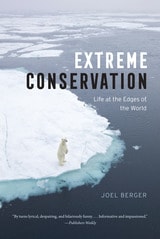
cover of Extreme Conservation: Life at the Edges of the World

Extreme Conservation

Life at the Edges of the World

Joel Berger

University of Chicago Press, 2018

"Extraordinary. . . . Berger is a hero of biology who deserves the highest honors that science can bestow."—Tim Flannery, New York Review of Books

On the Tibetan Plateau, there are wild yaks with blood cells thinner than those of horses’ by half, enabling the endangered yaks to survive at 40 below zero and in the lowest oxygen levels of the mountaintops. But climate change is causing the snow patterns here to shift, and with the snows, the entire ecosystem. Food and water are vaporizing in this warming environment, and these beasts of ice and thin air are extraordinarily ill-equipped for the change. A journey into some of the most forbidding landscapes on earth, Joel Berger’s Extreme Conservation is an eye-opening, steely look at what it takes for animals like these to live at the edges of existence. But more than this, it is a revealing exploration of how climate change and people are affecting even the most far-flung niches of our planet.

Berger’s quest to understand these creatures’ struggles takes him to some of the most remote corners and peaks of the globe: across Arctic tundra and the frozen Chukchi Sea to study muskoxen, into the Bhutanese Himalayas to follow the rarely sighted takin, and through the Gobi Desert to track the proboscis-swinging saiga. Known as much for his rigorous, scientific methods of developing solutions to conservation challenges as for his penchant for donning moose and polar bear costumes to understand the mindsets of his subjects more closely, Berger is a guide par excellence. He is a scientist and storyteller who has made his life working with desert nomads, in zones that typically require Sherpas and oxygen canisters. Recounting animals as charismatic as their landscapes are extreme, Berger’s unforgettable tale carries us with humor and expertise to the ends of the earth and back. But as his adventures show, the more adapted a species has become to its particular ecological niche, the more devastating climate change can be. Life at the extremes is more challenging than ever, and the need for action, for solutions, has never been greater.
[more]
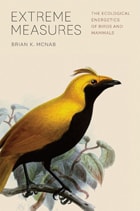
cover of Extreme Measures: The Ecological Energetics of Birds and Mammals

Extreme Measures

The Ecological Energetics of Birds and Mammals

Brian K. McNab

University of Chicago Press, 2012

Along with reproduction, balancing energy expenditure with the limits of resource acquisition is essential for both a species and a population to survive. But energy is a limited resource, as we know well, so birds and mammals—the most energy-intensive fauna on the planet—must reduce energy expenditures to maintain this balance, some taking small steps, and others extreme measures.

Here Brian K. McNab draws on his over sixty years in the field to provide a comprehensive account of the energetics of birds and mammals, one fully integrated with their natural history. McNab begins with an overview of thermal rates—much of our own energy is spent maintaining our 98.6?F temperature—and explains how the basal rate of metabolism drives energy use, especially in extreme environments. He then explores those variables that interact with the basal rate of metabolism, like body size and scale and environments, highlighting their influence on behavior, distribution, and even reproductive output. Successive chapters take up energy and population dynamics and evolution. A critical central theme that runs through the book is how the energetic needs of birds and mammals come up against rapid environmental change and how this is hastening the pace of extinction.

[more]