Results by title
28164 books match the query 'History' and 842 start with e
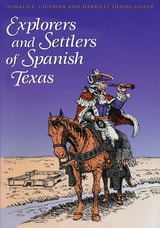
Explorers and Settlers of Spanish Texas
By Donald E. Chipman and Harriett Denise Joseph
University of Texas Press, 2001
In Notable Men and Women of Spanish Texas, Donald Chipman and Harriett Joseph combined dramatic, real-life incidents, biographical sketches, and historical background to reveal the real human beings behind the legendary figures who discovered, explored, and settled Spanish Texas from 1528 to 1821. Drawing from their earlier book and adapting the language and subject matter to the reading level and interests of middle and high school students, the authors here present the men and women of Spanish Texas for young adult readers and their teachers.
These biographies demonstrate how much we have in common with our early forebears. Profiled in this book are:
- Alvar Núñez Cabeza de Vaca: Ragged Castaway
- Francisco Vázquez de Coronado: Golden Conquistador
- María de Agreda: Lady in Blue
- Alonso de León: Texas Pathfinder
- Domingo Terán de los Ríos / Francisco Hidalgo: Angry Governor and Man with a Mission
- Louis St. Denis / Manuela Sánchez: Cavalier and His Bride
- Antonio Margil de Jesús: God's Donkey
- Marqués de San Miguel de Aguayo: Chicken War Redeemer
- Felipe de Rábago y Terán: Sinful Captain
- José de Escandón y Elguera: Father of South Texas
- Athanase de Mézières: Troubled Indian Agent
- Domingo Cabello: Comanche Peacemaker
- Marqués de Rubí / Antonio Gil Ibarvo: Harsh Inspector and Father of East Texas
- Bernardo Gutiérrez de Lara / Joaquín de Arredondo: Rebel Captain and Vengeful Royalist
- Women in Colonial Texas: Pioneer Settlers
- Women and the Law: Rights and Responsibilities
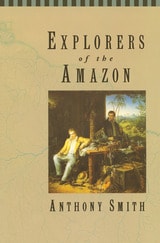
Explorers of the Amazon
Anthony Smith
University of Chicago Press, 1993
"The history of Amazonian exploration, wonderfully told by Anthony Smith, is awash with madness—an extravagant mixture of the malevolent and the miraculous."—Stephen Mills, Times Literary Supplement
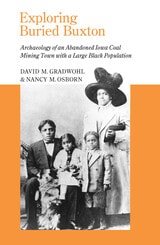
Exploring Buried Buxton
Archaeology of an Abandoned Iowa Coal Mining Town with a Large Black PopulationDavid M. Gradwohl
University of Iowa Press, 1984
Few sources before have dealt with the archaeology of African American settlements outside the Atlantic seaboard and the southern states. This book describes in detail the archaeological investigations conducted at the town site of Buxton, Iowa, a coal mining community inhabited by a significantly large population of blacks between 1900 and 1925.
David Gradwohl and Nancy Osborn present the archaeology of Buxton from “the group up” to articulate the material remains with the data acquired from archival studies and oral history interviews. They also examine the broader significance of the Buxton experience in terms of those who lived there and their children and grandchildren who have heard about Buxton all their lives.
Exploring Cause and Explanation
Historical Ecology, Demography, and Movement in the American SouthwestCynthia L. Herhahn
University Press of Colorado, 2016
Each thematic section is introduced by an established author who sets the framework for the chapters that follow. Some contributors adopt regional perspectives in which both classical regions (the central San Juan or lower Chama basins) and peripheral zones (the Alamosa basin or the upper San Juan) are represented. Chapters are also broad temporally, ranging from the Younger Dryas Climatic interval (the Clovis-Folsom transition) to the Protohistoric Pueblo world and the eighteenth-century ethnogenesis of a unique Hispanic identity in northern New Mexico. Others consider methodological issues, including the burden of chronic health afflictions at the level of the community and advances in estimating absolute population size. Whether emphasizing time, space, or methodology, the authors address the processes, steps, and interactions that affect current understanding of change or stability of cultural traditions.
Exploring Cause and Explanation considers themes of perennial interest but demonstrates that archaeological knowledge in the Southwest continues to expand in directions that could not have been predicted fifty years ago.
Contributors: Kirk C. Anderson, Jesse A. M. Ballenger, Jeffery Clark, J. Andrew Darling, B. Sunday Eiselt, Mark D. Elson, Mostafa Fayek, Jeffrey R. Ferguson, Severin Fowles, Cynthia Herhahn, Vance T. Holliday, Sharon Hull, Deborah L. Huntley, Emily Lena Jones, Kathryn Kamp, Jeremy Kulisheck, Karl W. Laumbach, Toni S. Laumbach, Stephen H. Lekson, Virginia T. McLemore, Frances Joan Mathien, Michael H. Ort, Scott G. Ortman, Mary Ownby, Mary M. Prasciunas, Ann F. Ramenofsky, Erik Simpson, Ann L. W. Stodder, Ronald H. Towner
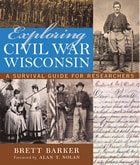
Exploring Civil War Wisconsin
A Survival Guide for ResearchersBrett Barker
Wisconsin Historical Society Press, 2003
The innovative format of Exploring Civil War Wisconsin makes it easy for Civil War buffs, genealogists, and students to find and effectively use the vast array of historical materials about the Civil War found in archives, military and census records, published firsthand accounts, newspapers, and even on the Internet. This lively, illustrated guide focuses on Wisconsin in the Civil War, but is broadly applicable to Civil War research anywhere. Images of original documents and historic photographs illustrate every chapter, acquainting readers with both the Civil War and its sources. The easy-to-use and informative text is unlike anything else currently on the market.
Throughout the book, boxed features and sidebars provide background information and tips on how to do research. Author Brett Barker explains how to uncover the history of an individual soldier, his regiment, and his role in the Union Army using rosters, military records, pension files, and memoirs. And, he shows how to explore the home front during the war using the census, newspapers, city directories, and government records.
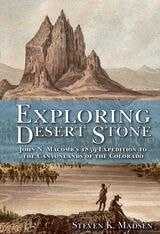
Exploring Desert Stone
John N. Macomb's 1859 Expedition to the Canyonlands of the ColoradoSteven K. Madsen
Utah State University Press, 2022
The soldiers and scientists followed in part the Old Spanish Trail, whose location they documented and verified. Seeking to find the confluence of the Colorado and the Green and looking for alternative routes into Utah, which was of particular interest in the wake of the Utah War, they produced a substantial documentary record, most of which is published for the first time in this volume. Theirs is also the first detailed map of the region, and it is published in Exploring Desert Stone, as well.
Exploring Federalism
Daniel J. Elazar
University of Alabama Press, 1987
CHOICE OUTSTANDING ACADEMIC BOOK
A definitive exploration of the ideas, institutions, and principles that shape federal government.
Exploring Federalism is a seminal study by political scientist Daniel J. Elazar that examines the origins, evolution, and enduring significance of federal systems of government. Widely regarded as one of the leading scholars of federalism, Elazar offers a comprehensive analysis of how federal principles have shaped political institutions across diverse societies and historical periods. Rather than limiting his discussion to the United States, he adopts a global and comparative perspective, exploring how federal arrangements provide workable solutions for nations seeking to balance unity with diversity, shared governance with local autonomy, and collective action with individual liberty.
Drawing on history, constitutional theory, and political philosophy, Elazar investigates the covenantal foundations of federalism and explains how federal systems distribute authority, protect regional identities, and promote democratic participation. He also examines contemporary trends toward both centralization and decentralization, arguing that federalism remains one of the most effective frameworks for governing pluralistic societies. Exploring Federalism remains an essential resource for students, scholars, policymakers, and anyone interested in constitutional government and democratic institutions.
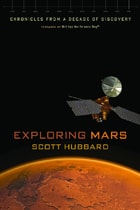
Exploring Mars
Chronicles from a Decade of DiscoveryScott Hubbard; Foreword by Bill Nye
University of Arizona Press, 2012
The Red Planet has been a subject of fascination for humanity for thousands of years, becoming part of our folklore and popular culture. The most Earthlike of the planets in our solar system, Mars may have harbored some form of life in the past and may still possess an ecosystem in some underground refuge. The mysteries of this fourth planet from our Sun make it of central importance to NASA and its science goals for the twenty-first century.
In the wake of the very public failures of the Mars Polar Lander and the Mars Climate Orbiter in 1999, NASA embarked on a complete reassessment of the Mars Program. Scott Hubbard was asked to lead this restructuring in 2000, becoming known as the "Mars Czar." His team's efforts resulted in a very successful decade-long series of missions—each building on the accomplishments of those before it—that adhered to the science adage "follow the water" when debating how to proceed. Hubbard's work created the Mars Odyssey mission, the twin rovers Spirit and Opportunity, the Mars Reconnaissance Orbiter, the Phoenix mission, and most recently the planned launch of the Mars Science Laboratory.
Now for the first time Scott Hubbard tells the complete story of how he fashioned this program, describing both the technical and political forces involved and bringing to life the national and international cast of characters engaged in this monumental endeavor. Blending the exciting stories of the missions with the thrills of scientific discovery, Exploring Mars will intrigue anyone interested in the science, the engineering, or the policy of investigating other worlds.
Exploring Mid-Michigan
A Guide to Flint, the Saginaw Valley, and the ThumbMary Jo Kietzman
Michigan State University Press, 2026
Inspired by the iconic American Guide Series published by the Federal Writers Project in the 1930s, this new guide to Flint, the Saginaw Valley, and the Thumb showcases the industrial-agricultural heart of Michigan, which has been beating irregularly for the last three decades, but whose importance to its people has lasted millennia. The ten counties featured in the book have lost population, industries, small farms, natural resources, and clean water. Instead of focusing on loss, the authors uncover the region’s unique history and culture, characterized by the productive tension between factories and farms, urban and rural spaces, labor and management, migrants and the mainstream, conservatives and progressives. The book documents the genesis of an ecological awareness that grew out of deforestation, habitat and species loss, and a succession of water crises. Encyclopedic in scope like their WPA forebears, the book is a functional guide that offers suggestions and strategies for enriching travel while celebrating the tenacity of those who came, worked, and stayed: lumberjacks, farmers, foundry workers, labor activists, judges, Indigenous peoples, African Americans, artists, poets, and environmental warriors.
Exploring Other Worlds
Margaret Fox, Elisha Kent Kane, and the Antebellum Culture of CuriosityDavid Chapin
University of Massachusetts Press, 2004
Exploring Other Worlds tells the intertwined stories of the Arctic explorer Elisha Kent Kane and the spiritualist medium Margaret Fox and examines their unlikely relationship. Kane, from a prominent Philadelphia family, became one of the most renowned and honored explorers of the antebellum era. Fox grew up in rural upstate New York and, as one of the Fox Sisters, became a famed and somewhat notorious “spirit raper” whose strange “knocks” were said to be communications from the dead. The two were rumored to have had a love affair, and they may even have been secretly married.
In their separate professional lives, Kane and Fox each revealed something new and strange (though not necessarily true) to their audiences—the unknown worlds of the globe and the spirit. They brought experiences to their listeners that were exotic and delightful. The bourgeoning commercial mass culture of antebellum America provided a natural venue for tales of huge icebergs, fierce polar bears, and messages from the dead. Their public careers bridged the gaps between the scientific investigations of an earlier Enlightenment age and a newer form of sensational inquiry growing up in a democratic marketplace.
Though Kane and Fox began by generating curiosity about geography and the nature of the human soul, in time their personal relationship became the basis for what newspaperman Horace Greeley would call an “impertinent curiosity.” Newspapers printed letters about their supposed romance, and eventually a book purporting to be the famous explorer's love-letters to the notorious spiritualist was published. Curiosity about the Arctic and curiosity about the fate of the soul after death were transformed into curiosity about the private affairs of a new kind of media-driven public celebrity.
Exploring and Mapping Alaska
The Russian America Era, 1741-1867Alexey Postnikov and Marvin Falk
University of Alaska Press, 2015
Exploring and Mapping Alaska focuses on this foundational period in Arctic cartography. Russia spurred a golden era of cartographic exploration, while shrouding their efforts in a veil of secrecy. They drew both on old systems developed by early fur traders and new methodologies created in Europe. With Great Britain, France, and Spain following close behind, their expeditions led to an astounding increase in the world’s knowledge of North America.
Through engrossing descriptions of the explorations and expert navigators, aided by informative illustrations, readers can clearly trace the evolution of the maps of the era, watching as a once-mysterious region came into sharper focus. The result of years of cross-continental research, Exploring and Mapping Alaska is a fascinating study of the trials and triumphs of one of the last great eras of historic mapmaking.
Exploring the Architecture of Place in America’s Farmers Markets
Kathryn Clarke Albright
University of Minnesota Press, 2020
Architect, teacher, and founder of the Friends of the Farmers Market, Katheryn Clarke Albright combines historically informed architectural observation with interview material and images drawn from conversations with farmers, vendors, market managers and shoppers.
Using eight scales of interaction and interface, Albright presents in-depth case studies to demonstrate how architectural elements and spatial conditions foster social and economic exchange between vendors, shoppers, and the community at large. Albright looks ahead to an emerging typology—the mobile market—bringing local farmers and healthy foods to underserved neighborhoods.
The impact farmers markets make on their local communities inspires place-making, improves the local economy, and preserves rural livelihoods. Developed organically and distinctively out of the space they occupy, these markets create and revitalize communities as rich as the produce they sell.
Exploring the Johnson Years
Edited by Robert A. Divine
University of Texas Press, 1981
More than a decade after LBJ left office, researchers began to open up the Johnson administration as an important area of scholarly study. Exploring the Johnson Years is an invaluable introduction to that administration and to the LBJ Library’s more than thirty million separate documents. The contributors cover every major aspect of the Johnson presidency, from Vietnam (George C. Herring) to the War on Poverty (Mark I. Gelfand), including coverage of Latin American policy (Walter LaFeber), education (Hugh Davis Graham), civil rights (Steven F. Lawson), the nature of the White House staff (Larry Berman), and Johnson’s stormy relationship with the media (David Culbert).
The essays illuminate some of the most important files and show how they can be used to further historical understanding of the Johnson years. As a result, scholars who plan to use the library will have a useful guide before they begin, while general readers will be able to discover the ways in which the library’s holdings relate to the existing body of literature on the Johnson administration.
Exploring the Land of Lincoln
The Essential Guide to Illinois Historic SitesCharles Titus
University of Illinois Press, 2021
Discovering Illinois through twenty of the state's most important places
A one-of-a-kind travel guide, Exploring the Land of Lincoln invites road-trippers and history buffs to explore the Prairie State's most extraordinary historic sites. Charles Titus blends storytelling with in-depth research to highlight twenty must-see destinations selected for human drama, historical and cultural relevance, and their far-reaching impact on the state and nation. Maps, illustrations, and mileage tables encourage readers to create personal journeys of exploration to, and beyond, places like Cahokia, the Lincoln sites, Nauvoo, and Chicago's South Side Community Art Center.
Detailed and user-friendly, Exploring the Land of Lincoln is the only handbook you need for the sights and stories behind the names on the map of Illinois.
Exploring the Little Rivers of New Jersey
James and Margaret Cawley
Rutgers University Press, 1993
In this fourth edition, the Little Rivers Club has brought the Cawleys' work up to date. This group of experienced canoeists dedicated themselves to re-exploring familiar waterways and adding new ones. Faithful to the Cawley spirit, this edition includes new maps, many new photographs, a directory of canoe liveries, tips of planning a trip, a loving portrait of the Cawleys, and, best of all, twenty-four beautiful waterways to discover.
Featuring 166 photos, 22 maps, and these rivers:
- Batsto
- Cedar Creek
- Delaware and Raritan Canal
- Great Egg Harbor River
- Hackensack
- Manasquan River and Inlet
- Maurice
- Millstone
- Mullica
- Musconetcong
- Oswego River and Lake
- Passaic
- Paulins Kill
- Pequest
- Ramapo-Pompton
- Rancocas
- South and North Branches of the Raritan
- Toms
- Wading
- Black-Lamington
- Cohansey River, Raceway, and Sunset Lake
- Crosswicks Creek
- Metedeconk
- Stony Brook
Exploring the Scientific Method
Cases and QuestionsEdited by Steven Gimbel
University of Chicago Press, 2011
From their grade school classrooms forward, students of science are encouraged to memorize and adhere to the “scientific method”—a model of inquiry consisting of five to seven neatly laid-out steps, often in the form of a flowchart. But walk into the office of a theoretical physicist or the laboratory of a biochemist and ask “Which step are you on?” and you will likely receive a blank stare. This is not how science works. But science does work, and here award-winning teacher and scholar Steven Gimbel provides students the tools to answer for themselves this question: What actually is the scientific method?
Exploring the Scientific Method pairs classic and contemporary readings in the philosophy of science with milestones in scientific discovery to illustrate the foundational issues underlying scientific methodology. Students are asked to select one of nine possible fields—astronomy, physics, chemistry, genetics, evolutionary biology, psychology, sociology, economics, or geology—and through carefully crafted case studies trace its historical progression, all while evaluating whether scientific practice in each case reflects the methodological claims of the philosophers. This approach allows students to see the philosophy of science in action and to determine for themselves what scientists do and how they ought to do it.
Exploring the Scientific Method will be a welcome resource to introductory science courses and all courses in the history and philosophy of science.
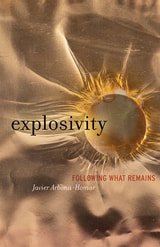
Explosivity
Following What RemainsJavier Arbona-Homar
University of Minnesota Press, 2025
How explosions across history reveal the violence embedded in San Francisco’s landscape
Offering a novel approach to contemporary landscape studies, Explosivity unearths the hidden legacies of violence that have shaped the physical and cultural environment of the San Francisco Bay area. As he sifts through the historical debris of previous centuries, Javier Arbona-Homar analyzes a series of explosions that took place between 1866 and 2011 to call attention to the scattered remnants of militarism and racialized capitalism embedded in the region’s geography.
From incidents involving nineteenth-century explosives manufacturing and World War II munitions loading to radical activism and contemporary television productions, Arbona-Homar locates a pattern of historical violence that refocuses the broader racial and colonial context. Citing the material, social, and political conditions that gave rise to these disparate episodes, he reviews the historic erasure of those driving forces and puts forth alternative possibilities for how such disasters might be memorialized.
Synthesizing a diverse set of field research methods, including oral histories and site visits, and supplemented by specially commissioned landscape photographs by Andrea Gaffney, Explosivity presents a radical exercise in the exposition of public memory.
Retail e-book files for this title are screen-reader friendly with images accompanied by short alt text and/or extended descriptions.
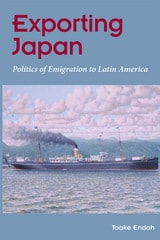
Exporting Japan
Politics of Emigration to Latin AmericaToake Endoh
University of Illinois Press, 2008
Exporting Japan examines the domestic origins of the Japanese government's policies to promote the emigration of approximately three hundred thousand native Japanese citizens to Latin America between the 1890s and the 1960s. This imperialist policy, spanning two world wars and encompassing both the pre-World War II authoritarian government and the postwar conservative regime, reveals strategic efforts by the Japanese state to control its populace while building an expansive nation beyond its territorial borders.
Toake Endoh compellingly argues that Japan's emigration policy embodied the state's anxieties over domestic political stability and its intention to remove marginalized and radicalized social groups by relocating them abroad. Documenting the disproportionate focus of the southwest region of Japan as a source of emigrants, Endoh considers the state's motivations in formulating emigration policies that selected certain elements of the Japanese population for "export." She also recounts the situations migrants encountered once they reached Latin America, where they were often met with distrust and violence in the "yellow scare" of the pre-World War II period.
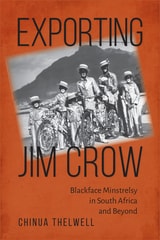
Exporting Jim Crow
Blackface Minstrelsy in South Africa and BeyondChinua Thelwell
University of Massachusetts Press, 2020
Chinua Thelwell brings blackface minstrelsy and performance culture into the discussion of apartheid's nineteenth-century origins and afterlife, employing a broad archive of South African newspapers and magazines, memoirs, minstrel songs and sketches, diaries, and interview transcripts. Exporting Jim Crow highlights blackface minstrelsy's cultural and social impact as it became a dominant form of entertainment, moving from its initial appearances on music hall stages to its troubling twentieth-century resurgence on movie screens and at public events. This carefully researched and highly original study demonstrates that the performance of race in South Africa was inherently political, contributing to racism and shoring up white racial identity.
Exporting Perilous Pauline
Pearl White and Serial Film CrazeEdited by Marina Dahlquist
University of Illinois Press, 2013
Exporting Revolution
Cuba's Global SolidarityMargaret Randall
Duke University Press, 2017
Exports and Local Development
Mexico's New MaquiladorasBy Patricia A. Wilson
University of Texas Press, 1992
Mexico's export assembly industry has been the object of an intensely polarized debate. While some observers laud the maquiladora industry as a source of much-needed employment and foreign exchange for Mexico, others berate it as a vehicle for exploitation and pollution. Exports and Local Development attempts to transcend the dichotomy by taking a practical look at how this export industry could be better utilized to promote local development.
Using data gathered from a field survey of more than seventy maquiladora plants, Patricia A. Wilson compares the Mexican industry with its more successful Asian counterparts to determine how policy initiatives might help Mexico use local linkages to tap the potential of both local and foreign-owned assembly plants.
The study grounds its analysis of the maquiladora industry in leading-edge issues including the rise of free trade, changing corporate sourcing strategies, the competitiveness of U.S. manufacturing, the Japanese challenge, the spread of flexible technology and management methods, the impacts of export-led development strategies, the importance of business networking, and the role of small business. It will be of interest to a wide audience in international business, economic development planning, public policy, and economic geography.
Exposed Memories
Family Pictures in Private and Collective MemoryHedvig Turai
Central European University Press, 2010
Expressions of Sufi Culture in Tajikistan
Benjamin Gatling
University of Wisconsin Press, 2018
Gatling demonstrates how Sufis transcend the oppressive religious politics of contemporary Tajikistan by using these forms to inhabit multiple times: the paradoxical present, the Persian sacred past, and the Soviet era. In a world consumed with the supposed political dangers of Islam, Gatling shows the intricate, ground-level ways that Muslim expressive culture intersects with authoritarian politics, not as artful forms of resistance but rather as a means to shape Sufi experiences of the present.
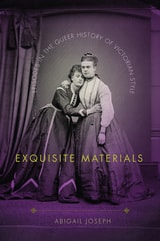
Exquisite Materials
Episodes in the Queer History of Victorian StyleAbigail Joseph
University of Delaware Press, 2011
Published by University of Delaware Press. Distributed worldwide by Rutgers University Press.
Extending the Borders of Russian History
Essays in Honor of Alfred J. RieberMarsha Siefert
Central European University Press, 2003
The borders of Russian history, whether chronological, geographical, political or intellectual, have always been patrolled, have sometimes been evaded, but have never been invisible. This volume attempts to extend those borders in several ways. The articles stress continuity rather than ruptures and their organization emphasizes persistent factors over time, particularly across the 1917 divide. Geographical dimensions are explored not through conquest but through regional responses to the center: local variants of eighteenth- and nineteenth-century colonial policies in the Caucasus and Turkestan are complemented by Central Asian petitions for citizenship in the 1930s and Siberian healing in the 1990s. Ukrainian aspirations take a special focus, from Kyivan Rus’ to Ruthenian dreams.
Politically, of course, Marxist–Leninist ideology attempted to extend its own frontiers of Russian history. Several studies here attempt to assess the meaning of the Soviet period in terms of ideology, practices, processes and memory. It is fitting too that the now accepted boundaries of the Soviet era—the revolutionary decade and the first decade of transition—are subject to detailed attention and analysis. The intellectual borders of Russian and Soviet history, long policed from within and without, have been breached by the creative and wide-ranging use of newly accessible archival sources that form the basis for these articles. The sense of community exhibited by this collection, however, is not artificial nor is it wholly imagined. It derives from the honoree, whose scholarly life has exhibited the blurring of traditional boundaries, whether disciplinary, generational, or national, that is represented by the contributors to this volume.
Exterminate Them
Written Accounts of the Murder, Rape, and Enslavement of Native Americans during the California Gold RushClifford E. Trafzer
Michigan State University Press, 1999
Popular media depict miners as a rough-and-tumble lot who diligently worked the placers along scenic rushing rivers while living in roaring mining camps in the foothills of the Sierra Nevada Mountains. Trafzer and Hyer destroy this mythic image by offering a collection of original newspaper articles that describe in detail the murder, rape, and enslavement perpetrated by those who participated in the infamous gold rush. "It is a mercy to the Red Devils," wrote an editor of the Chico Courier, "to exterminate them." Newspaper accounts of the era depict both the barbarity and the nobility in human nature, but while some protested the inhumane treatment of Native Americans, they were not able to end the violence. Native Americans fought back, resisting the invasion, but they could not stop the tide of white miners and settlers. They became "strangers in a stolen land."

Extra! Extra! Eat All About It!
Recipes and Culinary Curiosities from Historic Wisconsin NewspapersRandi Julia Ramsden
Wisconsin Historical Society Press, 2024
A blend of cookbook and bite-size history, Extra! Extra! Eat All About It! offers a unique glimpse into the culinary landscape of the late nineteenth and early twentieth centuries. Fifty recipes selected from Wisconsin newspapers are served alongside brief essays that dig into the stories behind the food trends of the time.
In lively prose, Jane Conway and Randi Julia Ramsden reveal how coconuts and oysters made their way to 1800s Wisconsin, how bakers gauged the temperatures of their wood-burning stoves, and how our predecessors really did slip on banana peels, among other flavorful facts. In addition to capturing quirky food fashions, like breakfast parties and paper-bag cooking, the recipes provide insights into regional cooking traditions.
Each original recipe appears alongside the authors’ easy-to-follow updated version. Mouthwatering modern photographs showcase the revived dishes for the first time in their long history, and newspaper clippings, ads, and illustrations give the book a charming vintage feel. Featuring a variety of recipes, ranging from trendy (Barbecued Ham with Bananas) and tempting (Pickled Walnuts) to traditional (Pumpernickel) and tantalizing (Apple de Luxe), Extra! Extra! Eat All About It! will satisfy the appetites of history lovers and home chefs alike.
“Such a fun and fascinating book! Extra! Extra! Eat All About It! deftly delves into Wisconsin’s long-ago food fads, evolutions, and absurdities. Don’t be surprised if this book inspires new trends that are riffs on some of these century-old ideas. Pickled walnuts, anyone? Or mock pumpkin pie, with prunes?” — Mary Bergin, author of Wisconsin Supper Club Cookbook
“Both cookbook and chronicle, Extra! Extra! Eat All About It! is an ingenious, illuminating tasting menu of our culinary past. Sourced from nineteenth and early twentieth century Wisconsin newspapers, its fifty vignettes serve up historical insights, forgotten fads and bygone recipes. From paper bag cookery and ‘oyster saloons’ to fire-baked eggs and maple taffy, I ate this book right up.” — Terese Allen, coauthor of The Flavor of Wisconsin
“This beautiful, fun, and informative book is a masterclass in how historical cooking opens a window onto wider historical themes, including mechanization, the impacts of war, immigration, globalization, and changing nutritional advice.” — Eleanor Barrett, author of Leftovers: A History of Food Waste and Preservation
“Conway and Ramsden do a great job of using historical documents to demonstrate what people were eating and how they entertained. They describe recipes as interaction and community, as well as how food trends change over time. The writing is smart and clever. A wonderful read.” — Kimberly Wilmot Voss, author of The Food Section: Newspaper Women and the Culinary Community
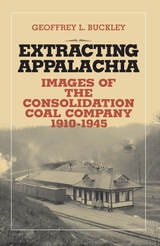
Extracting Appalachia
Images of the Consolidation Coal Company, 1910–1945Geoffrey L. Buckley
Ohio University Press, 2004
As a function of its corporate duties, the Consolidation Coal Company, one of the largest coal-mining operations in the United States during the first half of the twentieth century, had photographers take hundreds of pictures of nearly every facet of its operations. Whether for publicity images, safety procedures, or archival information, these photographs create a record that goes far beyond the purpose the company intended.
In Extracting Appalachia, geographer Geoffrey L. Buckley examines the company’s photograph collection housed at the Smithsonian Institution’s National Museum of American History. Included in the collection are images of mine openings, mining equipment, and mine accidents, as well as scenes of the company towns, including schools, churches, recreational facilities, holiday celebrations, and company stores.
Although the photographs in the collection provide us with valuable insights, they tell only part of the story. Using company records, state and federal government documents, contemporary newspaper accounts, and other archival materials, Professor Buckley shows that these photographs reveal much more than meets the eye.
Extracting Appalachia places these historic mining images in their social, cultural, and historical context, uncovering the true value and meaning of this rare documentary record.
Extradition Politics & Human Rights
Christopher Pyle
Temple University Press, 2001
In this readable and compelling history of extradition in America, Christopher Pyle remedies that ignorance. Using American constitutional law and drawing on a wealth of historical cases, he describes the collision of law and politics that occurs when a foreign country demands the surrender of individuals held to be terrorists by some and freedom fighters by others. He shows how U.S. policymakers have attempted to substitute deportation for extradition and turn the surrender of a foreign national (or even an American citizen) into a political rather than a judicial process.
Beginning with the New England Puritans' refusal to surrender the "regicides" who had signed the death warrant of Charles I, he traces the attitudes and ideologies that have shaped American extradition practice, culminating in the efforts by the Reagan and Bush administrations to turn the legal extradition process into an executive tool of state policy. Along the way we meet such luminaries as James Madison and John Stuart Mill, William Rehnquist and Oliver North, as well as pirates and fugitive slaves, anarchists and refugees, drug lords and runaway sailors.
Woven throughout this story is the author's belief that current developments in extradition law ignore or actually violate the principles of individual liberty, due process, and humanity on which we claim our country was built. As he remarks in the Introduction, "Extradition involves the surrender of human beings -- persons under the protection of our Constitution -- to foreign regimes, many of which are unjust. This reality was well understood in the eighteenth and nineteenth centuries, when the United States was a refuge for the victims of European oppression, but it has been disregarded frequently in the twentieth century as we have sought to stem the tide of immigration and develop advantageous economic and political relations with autocratic regimes of every stripe."
Extraordinary Ordinariness
Everyday Heroism in the United States, Germany, and Britain, 1800-2015Edited by Simon Wendt
Campus Verlag, 2016
Extraordinary Racial Politics
Four Events in the Informal Constitution of the United StatesFred Lee
Temple University Press, 2018
Extraordinary racial politics rupture out of and reset everyday racial politics. In his cogent book, Fred Lee examines four unusual, episodic, and transformative moments in U.S. history: the 1830s–1840s southeastern Indian removals, the Japanese internment during World War II, the post-war civil rights movement, and the 1960s–1970s racial empowerment movements. Lee helps us connect these extraordinary events to both prior and subsequent everyday conflicts.
Extraordinary Racial Politics brings about an intellectual exchange between ethnic studies, which focuses on quotidian experiences and negotiations, and political theory, which emphasizes historical crises and breaks. In ethnic studies, Lee draws out the extraordinary moments in Michael Omi and Howard Winant’s as well as Charles Mills’s accounts of racial formation. In political theory, Lee considers the strengths and weaknesses of using Carl Schmitt’s and Hannah Arendt’s accounts of public constitution to study racial power.
Lee concludes that extraordinary racial politics represent both the promises of social emancipation and the perils of state power. This promise and peril characterizes our contentious racial present.
Extraterritorial Dreams
European Citizenship, Sephardi Jews, and the Ottoman Twentieth CenturySarah Abrevaya Stein
University of Chicago Press, 2016
Sarah Abrevaya Stein traces the experiences of Mediterranean Jewish women, men, and families who lived through a tumultuous series of wars, border changes, genocides, and mass migrations, all in the shadow of the collapse of the Ottoman Empire and the ascendance of the modern passport regime. Moving across vast stretches of Europe, the Middle East, Asia, and the Americas, she tells the intimate stories of people struggling to find a legal place in a world ever more divided by political boundaries and competing nationalist sentiments. From a poor youth who reached France as a stowaway only to be hunted by the Parisian police as a spy to a wealthy Baghdadi-born man in Shanghai who willed his fortune to his Eurasian Buddhist wife, Stein tells stories that illuminate the intertwined nature of minority histories and global politics through the turbulence of the modern era.
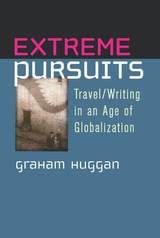
Extreme Pursuits
Travel/Writing in an Age of GlobalizationGraham Huggan
University of Michigan Press, 2009
Recent figures suggest that there will be 1.6 billion arrivals at world airports by the year 2020. Extreme Pursuits looks at the new conditions of global travel and the unease, even paranoia, that underlies them---at the opportunities they offer for alternative identities and their oscillation between remembered and anticipated states. Graham Huggan offers a provocative account of what is happening to travel at a time characterized by extremes of social and political instability in which adrenaline-filled travelers appear correspondingly determined to take risks. It includes discussions of the links between tourism and terrorism, of contemporary modes of disaster tourism, and of the writing that derives from these; but it also confirms the existence of more responsible forms of travel/writing that demonstrate awareness of a chronically endangered world.
Extreme Pursuits is the first study of its kind to link travel writing explicitly with structural changes in the global tourist industry. The book makes clear that travel writing can no longer take refuge in the classic distinctions (traveler versus tourist, foreigner versus native) on which it previously depended. Such distinctions---which were dubious in the first place---no longer make sense in an increasingly globalized world. Huggan argues accordingly that the category "travel writing" must include experimental ethnography and prose fiction; that it should concern itself with other kinds of travel practices, such as those related to Holocaust deportation and migrant labor; and that it should encompass representations of travelers and "traveling cultures" that appear in popular media, especially TV and film.
Graham Huggan is Professor of Commonwealth and Postcolonial Literatures at the University of Leeds. He is the coauthor, with Patrick Holland, of Tourists with Typewriters: Critical Reflections on Contemporary Travel Writing (University of Michigan Press) and coauthor, with Helen Tiffin, of Postcolonial Ecocriticism (Routledge).
Illustration: "Shadow Wall," 2006 © Shaun Tan.
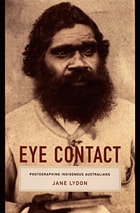
Eye Contact
Photographing Indigenous AustraliansJane Lydon
Duke University Press, 2005
Lydon shows how the photographic portrayals of the Aboriginal residents of Coranderrk changed over time, reflecting various ideas of the colonial mission—from humanitarianism to control to assimilation. In the early twentieth century, the images were used on stereotypical postcards circulated among the white population, showing what appeared to be compliant, transformed Aboriginal subjects. The station closed in 1924 and disappeared from public view until it was rediscovered by scholars years later. Aboriginal Australians purchased the station in 1998, and, as Lydon describes, today they are using the Coranderrk photographic archive in new ways, to identify family members and tell stories of their own.
Eye on the Future
Popular Culture Scholarship into the Twenty-First Century in Honor of Ray B. BrowneMarilyn F. Motz
University of Wisconsin Press, 1994
This collection includes essays by scholars from around the world and five of Ray Browne's essays which he considers signal. The purpose of this book is to chart Popular Culture Studies into the next century.
EyeMinded
Living and Writing Contemporary ArtKellie Jones
Duke University Press, 2011
Eyes Without Country
Searching for a Palestinian Strategy of LiberationSouad R. Dajani
Temple University Press, 1994
Since Israel's occupation of the West Bank and Gaza Strip in 1967, the quest for just and lasting peace has been a fountainhead of debate, negotiation, and violent friction. Souad Dajani traces the Palestinians' struggle and argues for a strategy of nonviolent civilian resistance based on deterrence and defense. This strategy would defeat Israel's political will to maintain their occupation and prepare Palestinians for a time beyond the interim period of self-rule agreed upon by Israel and the PLO in September 19932.
Dajani's formulation of nonviolent civilian resistance is examined against a backdrop of early developments in Mandate Palestine, the impact of Zionist ideology, and the realities of life for Palestinians under occupation. Her assessment of the role of the PLO, objectives of the Palestinian National Movement, developments since the Gulf War, and other factors crucial to an effective strategy raises critical questions surrounding the operation of nonviolent techniques for the Palestinian community, Israeli politics, and international actors, most prominently the United States.

Eyes like Mine
A Memoir between Blindness and SightTalea Anderson
Temple University Press, 2027
Talea Anderson is a person with low vision. Although she passes as sighted, she feels she has a “blind identity.” Eyes like Mine is her candid and revealing memoir detailing her experience grappling with partial vision and the isolation and loneliness that this often brings. Anderson expresses a longing for connection and community, especially with those who live in the space between sight and blindness.
Eyes like Mine examines ideas of disability as Anderson understands the nature of her blindness and sight and how that has evolved over her life. She relates her experiences to historical figures with low or partial vision, including painter Claude Monet, disability advocate Helen Keller, and musician and composer Maria Theresia von Paradis, among others.
Writing eloquently about her surgeries, and others’ efforts to “fix her,” Anderson captures her experience with disability with confidence and self-reflexive humor. Eyes like Mine does not speak for all blind people or others with partial vision. Instead, Anderson investigates how disabled people think about their relationship with disability and how they identify.

Eyes on Amazonia
Transnational Perspectives on the Rubber Boom FrontierJessica Carey-Webb
Vanderbilt University Press, 2024
Eyes on Amazonia operates in cultural geography, ecocriticism, and visual cultural analysis. The diverse and intriguing documents and images examined in this book capture the modernizing project of this region at a crucial juncture in its long history: the early twentieth-century rubber boom.
Eyesight Alone
Clement Greenberg's Modernism and the Bureaucratization of the SensesCaroline A. Jones
University of Chicago Press, 2006
Caroline Jones's magisterial study widens Greenberg's fundamental tenet of "opticality"-the idea that modernist art is apprehended through "eyesight alone"-to a broader arena, examining how the critic's emphasis on the specular resonated with a society increasingly invested in positivist approaches to the world. Greenberg's modernist discourse, Jones argues, developed in relation to the rationalized procedures that gained wide currency in the United States at midcentury, in fields ranging from the sense-data protocols theorized by scientific philosophy to the development of cultural forms, such as hi-fi, that targeted specific senses, one by one. Greenberg's attempt to isolate and celebrate the visual was one manifestation of a large-scale segmentation-or bureaucratization-of the body's senses. Working through these historical developments, Jones brings Greenberg's theories into contemporary philosophical debates about agency and subjectivity.
Eyesight Alone offers artists, art historians, philosophers, and all those interested in the arts a critical history of this generative figure, bringing his work fully into dialogue with the ideas that shape contemporary critical discourse and shedding light not only on Clement Greenberg but also on the contested history of modernism itself.
Ezra Pound's Confucian Translations
Mary Paterson Cheadle
University of Michigan Press, 1997