Results by title
1116 books match the query 'Africa' and 53 start with e
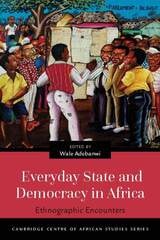
Everyday State and Democracy in Africa
Ethnographic EncountersWale Adebanwi
Ohio University Press, 2022
Bottom-up case studies, drawn from the perspective of ordinary Africans’ experiences with state bureaucracies, structures, and services, reveal how citizens and states define each other.
This volume examines contemporary citizens’ everyday encounters with the state and democratic processes in Africa. The contributions reveal the intricate and complex ways in which quotidian activities and experiences—from getting an identification card (genuine or fake) to sourcing black-market commodities to dealing with unreliable waste collection—both (re)produce and (re)constitute the state and democracy. This approach from below lends gravity to the mundane and recognizes the value of conceiving state governance not in terms of its stated promises and aspirations but rather in accordance with how people experience it.
Both new and established scholars based in Africa, Europe, and North America cover a wide range of examples from across the continent, including
- bureaucratic machinery in South Sudan, Nigeria, and Kenya
- infrastructure and shortages in Chad and Nigeria
- disciplinarity, subjectivity, and violence in Rwanda, South Africa, and Nigeria
- the social life of democracy in the Congo, Cameroon, and Mozambique
- education, welfare, and health in Ethiopia, the Democratic Republic of Congo, and Burkina Faso
Everyday State and Democracy in Africa demonstrates that ordinary citizens’ encounters with state agencies and institutions define the meanings, discourses, practices, and significance of democratic life, as well its distressing realities.
Contributors:
- Daniel Agbiboa
- Victoria Bernal
- Jean Comaroff
- John L. Comaroff
- E. Fouksman
- Fred Ikanda
- Lori Leonard
- Rose Løvgren
- Ferenc Dávid Markó
- Ebenezer Obadare
- Rogers Orock
- Justin Pearce
- Katrien Pype
- Edoardo Quaretta
- Jennifer Riggan
- Helle Samuelsen
- Nicholas Rush Smith
- Eric Trovalla
- Ulrika Trovalla
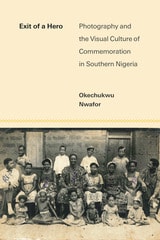
Exit of a Hero
Photography and the Visual Culture of Commemoration in Southern NigeriaOkechukwu Nwafor
University of Michigan Press, 2026
In Exit of a Hero, Okechukwu Nwafor explores the cultural, political, and socioeconomic implications of photography in commemorative practices in southern Nigeria from the nineteenth century to the present. Focusing on obituary and commemorative photographs of late nineteenth and early twentieth-century Lagos to contemporary funeral posters, booklets, and social media posts, Nwafor tracks the historical evolution of the iconic and heroic image. He argues that the quest to produce an ideal memorial body is not just a personal aesthetic choice but a deliberate photographic project that resonates with the Igbo aspirations for heroic achievement.
Exit of a Hero asserts that the visual canonization transforms the deceased from a fallible being to an unimpeachable character who transcends underachievement, imperfection, and failed social performance to emerge as a saintly icon of the Igbo public sphere. In seeking an alternative, hyper-visible public self, social media reclaims the lost hero image of the deceased, reconstituting the contested Igbo public space as a lived reality where heroes and icons are actively and eternally commemorated. Nwafor unveils the creative imaginations of colonial subjects and postcolonial citizens as memorialization has become entangled within the intersecting discursive spaces of print culture and the public sphere.

Experiments in the Dark
Visualizing Capital Art Studio, ZanzibarPamila Gupta
University of Michigan Press, 2027
What kind of history are photographs? Experiments in the Dark explores this question through the lens of a twentieth-century East African Indian Ocean photo studio collection, Capital Arts Studio (CAS), and its proprietors Ranchhod and Rohit Oza in Stone Town, Zanzibar. Pamila Gupta gathers and reads a range of photographs and genres from the studio, exploring how they relate to Zanzibar’s vibrant visual cultures during the Omani sultanate, British colonial, and postrevolution periods. Gupta’s reading of this little-known photographic archive brings the work into a broader historical context of the Indian Ocean in a visual archive that has endured despite the forces of history.
Through a blend of archival reconstruction and curation, personal reflection, and interviews with Rohit Oza, the son of the studio’s founder Ranchhod Oza, Gupta focuses on the construction and curation of the CAS collection and what this archive can tell us about the South Asian and Goan diasporas, the wider Indian Ocean world, African fashion, urban lives, and image making in Zanzibar from 1930 to 2024.