Results by title
28164 books match the query 'History' and 842 start with e
Early Native Literacies in New England
A Documentary and Critical AnthologyKristina Bross
University of Massachusetts Press, 2008
Designed as a corrective to colonial literary histories that have excluded Native voices, this anthology brings together a variety of primary texts produced by the Algonquian peoples of New England during the seventeenth, eighteenth, and very early nineteenth centuries. Included among these written materials and objects are letters, signatures, journals, baskets, pictographs, confessions, wills, and petitions, each of which represents a form of authorship. Together they demonstrate the continuing use of traditional forms of memory and communication and the lively engagement of Native peoples with alphabetic literacy during the colonial period. Each primary text is accompanied by an essay that places it in context and explores its significance.
Written by leading scholars in the field, these readings draw on recent trends in literary analysis, history, and anthropology to provide an excellent overview of the field of early Native studies. They are also intended to provoke discussion and open avenues for further exploration by students and other interested readers. Above all, the texts and commentaries gathered in this volume provide an opportunity to see Native American literature as a continuity of expression that reflects choices made long before contact and colonization, rather than as a nineteenth—or even twentieth-century invention.
Contributors include Heidi Bohaker, Heather Bouwman, Joanna Brooks, Kristina Bross, Stephanie Fitzgerald, Sandra Gustafson, Laura Arnold Leibman, Kevin McBride, David Murray, Laura Murray, Jean O'Brien, Ann Marie Plane, Philip Round, Jodi Schorb, David Silverman, and Hilary E. Wyss.
Early Puebloan Occupations at Tesuque By-Pass and in the Upper Rio Grande Valley
Charles H. McNutt
University of Michigan Press, 1969
Early Puerto Rican Cinema and Nation Building
National Sentiments, Transnational Realities, 1897-1940Naida García-Crespo
Bucknell University Press, 2019
Published by Bucknell University Press. Distributed worldwide by Rutgers University Press.

Early Royko
Up Against It in ChicagoMike Royko
University of Chicago Press, 2010
Combining the incisive pen of a newspaperman and the compassionate soul of a poet, Mike Royko became a Chicago institution—in Jimmy Breslin’s words, "the best journalist of his time." Early Royko: Up Against It in Chicago will restore to print the legendary columnist’s earliest writings, which chronicle 1960s Chicago with the moral vision, ironic sense, and razor-sharp voice that would remain Royko’s trademark.
This collection of early columns from the Chicago Daily News ranges from witty social commentary to politically astute satire. Some of the pieces are falling-down funny and others are tenderly nostalgic, but all display Royko’s unrivaled skill at using humor to tell truth to power. From machine politicians and gangsters to professional athletes, from well-heeled Chicagoans to down-and-out hoodlums, no one escapes Royko’s penetrating gaze—and resounding judgment. Early Royko features a memorable collection of characters, including such well-known figures as Hugh Hefner, Mayor Richard J. Daley, and Dr. Martin Luther King. But these boldfaced names are juxtaposed with Royko’s beloved lesser knowns from the streets of Chicago: Mrs. Peak, Sylvester "Two-Gun Pete" Washington, and Fats Boylermaker, who gained fame for leaning against a corner light pole from 2 a.m. Saturday until noon Sunday, when his neighborhood tavern reopened for business.
Accompanied by a foreword from Rick Kogan, this new edition will delight Royko’s most ardent fans and capture the hearts of a new generation of readers. As Kogan writes, Early Royko "will remind us how a remarkable relationship began—Chicago and Royko, Royko and Chicago—and how it endures."
Early Settlement and Subsistence in the Casma Valley, Peru
Shelia Pozorski
University of Iowa Press, 1987
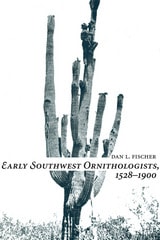
Early Southwest Ornithologists, 1528-1900
Dan Fischer
University of Arizona Press, 2001
With its colorful landscape and wonderful diversity of plant and animal communities, the southwestern borderlands have attracted naturalists for centuries. As Col. Thomas Henry noted in 1853, there “are to be found many curious birds, peculiar to the country.” This book identifies more than 100 early ornithologists and explorers who entered the Southwest from 1528 to 1900, all of whom have contributed in significant ways to our understanding of the region’s avian life.
Dan Fischer identifies those individuals who documented the natural history of the Southwest and summarizes their contributions to our knowledge about the region’s birds—particularly through discovering and naming them. He tells why the ornithologists came to the region, what they saw, who described and named the new discoveries, and who were the first to sketch or paint new birds.
Beginning with accounts of the earliest Spanish explorers such as Cabeza de Vaca and Coronado, Fischer considers all who visited the region through the end of the nineteenth century, including such renowned naturalists as William Gambel, John McCown, Adolphus Heermann, Elliott Coues, Charles Bendire, and Henry Henshaw. In between, he recalls English mining speculators, French traders, army explorers, railroad surveyors, and more—all of whom contributed to ornithological knowledge.
Although focusing on ornithologists, Fischer’s text reveals the wonderful variety of avian species in the region and their relationship with human history. Featuring a comprehensive bibliography, illustrations, and maps that portray the westward march of exploration, it is a major sourcebook for southwestern ornithology and an essential volume for anyone interested in birds.
Early State Formation in Central Madagascar
An Archaeological Survey of Western AvaradranoEdited by Henry T. Wright
University of Michigan Press, 2007

Early Syriac Theology
Chorbishop Seely Joseph Beggiani
Catholic University of America Press, 2014
Early Tahiti As the Explorers Saw It, 1767–1797
Edwin N. Ferdon
University of Arizona Press, 1981
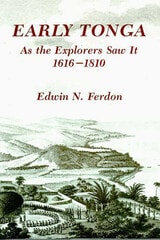
Early Tonga As the Explorers Saw It, 1616–1810
Edwin N. Ferdon
University of Arizona Press, 1987
The ethnohistorical approach to early Tongan culture offers not only a fascinating glimpse into a world long past but also a basis for the comparative study of European acculturation throughout Polynesia.
Edwin N. Ferdon first became interested in early Polynesia while serving as an archaeologist with Thor Heyerdahl’s 1955 expedition to Easter Island. He is also the author of Early Tahiti As the Explorers Saw It, 1767–1797.

Early Village Life at Beidha, Jordan
Neolithic spatial organization and vernacular architectureBrian Byrd
Council for British Research in the Levant, 2005
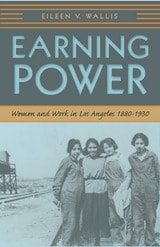
Earning Power
Women and Work in Los Angeles, 1880-1930Eileen Wallis
University of Nevada Press, 2010
The half-century between 1880 and 1930 saw rampant growth in many American cities and an equally rapid movement of women into the work force. In Los Angeles, the city not only grew from a dusty cow town to a major American metropolis but also offered its residents myriad new opportunities and challenges.Earning Power examines the role that women played in this growth as they attempted to make their financial way in a rapidly changing world. Los Angeles during these years was one of the most ethnically diverse and gender-balanced American cities. Moreover, its accelerated urban growth generated a great deal of economic, social, and political instability. In Earning Power, author Eileen V. Wallis examines how women negotiated issues of gender, race, ethnicity, and class to gain access to professions and skilled work in Los Angeles. She also discusses the contributions they made to the region’s history as political and social players, employers and employees, and as members of families. Wallis reveals how the lives of women in the urban West differed in many ways from those of their sisters in more established eastern cities. She finds that the experiences of women workers force us to reconsider many assumptions about the nature of Los Angeles’s economy, as well as about the ways women participated in it. The book also considers how Angelenos responded to the larger national social debate about women’s work and the ways that American society would have to change in order to accommodate working women. Earning Power is a major contribution to our understanding of labor in the urban West during this transformative period and of the crucial role that women played in shaping western cities, economies, society, and politics.
Earth Beings
Ecologies of Practice across Andean WorldsMarisol de la Cadena
Duke University Press, 2015
Earth Diplomacy
Indigenous American Art, Ecological Crisis, and the Cold WarJessica L. Horton
Duke University Press, 2024
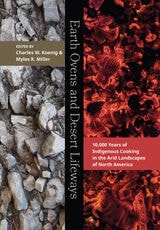
Earth Ovens and Desert Lifeways
10,000 Years of Indigenous Cooking in the Arid Landscapes of North AmericaEdited by Charles W. Koenig and Myles R. Miller
University of Utah Press, 2023
For over 10,000 years, earth ovens (semi-subterranean, layered arrangements of heated rocks, packing material, and food stuffs capped by earth) have played important economic and social roles for Indigenous peoples living across the arid landscapes of western North America. From hunter-gatherers to formative horticulturalists, sedentary farmers, and contemporary Indigenous groups, earth ovens have been used to convert inedible plants into digestible food, fiber, and beverages.
The remains of earth ovens range from tight, circular clusters of burned rocks, generally labeled “hearths” by archaeologists, to the massive accumulations of fire-cracked rock referred to as earth oven facilities, roasting pits, or burned rock middens. Remnants of these oven forms are common across the arid and semi-arid landscapes that stretch from Texas to California and south into Mexico. Despite the ubiquity of earth ovens from late Paleoindian times until today, and their broad spatial and cultural distribution, these features remain an under-studied aspect of Indigenous lifeways.
This edited volume explores the longevity and diversity of earth oven baking and examines the subsistence strategies, technological paradigms, and social contexts within which earth ovens functioned. It is the first study to cover such a broad geographic area, reflecting an array of promising research that highlights ongoing efforts to understand the archaeological record of earth ovens.
Earth Politics
Religion, Decolonization, and Bolivia's Indigenous IntellectualsWaskar Ari
Duke University Press, 2014
Earth Shapers
How We Mapped and Mastered the World, from the Panama Canal to the Baltic WayMaxim Samson
University of Chicago Press, 2025
Mountains, meridians, rivers, and borders—these are some of the features that divide the world on our maps and in our minds. But geography is far less set in stone than we might believe, and, as Maxim Samson’s Earth Shapers contends, in our relatively short time on this planet, humans have become experts at fundamentally reshaping our surroundings.
From the Qhapaq Ñan, the Inca’s “great road,” and Mozambique’s colonial railways to a Saudi Arabian smart city, and from Korea’s sacred Baekdu-daegan mountain range and the Great Green Wall in Africa to the streets of Chicago, Samson explores how we mold the world around us. And how, as we etch our needs onto the natural landscape, we alter the course of history. These fascinating stories of connectivity show that in our desire to make geographical connections, humans have broken through boundaries of all kinds, conquered treacherous terrain, and carved up landscapes. We crave linkages, and though we do not always pay attention to the in-between, these pathways—these ways of “earth shaping,” in Samson’s words—are key to understanding our relationship with the planet we call home.
An immense work of cultural geography touching on ecology, sociology, history, and politics, Earth Shapers argues that, far from being constrained by geography, we are instead its creators.
Earth Shapers
How We Mapped and Mastered the World, from the Panama Canal to the Baltic WayMaxim Samson
University of Chicago Press, 2025
The globetrotting story of how humans have harnessed the geographical landscape and written ourselves onto our surroundings.
Mountains, meridians, rivers, and borders—these are some of the features that divide the world on our maps and in our minds. But geography is far less set in stone than we might believe, and, as Maxim Samson’s Earth Shapers contends, in our relatively short time on this planet, humans have become experts at fundamentally reshaping our surroundings.
From the Qhapaq Ñan, the Inca’s “great road,” and Mozambique’s colonial railways to a Saudi Arabian smart city, and from Korea’s sacred Baekdu-daegan mountain range and the Great Green Wall in Africa to the streets of Chicago, Samson explores how we mold the world around us. And how, as we etch our needs onto the natural landscape, we alter the course of history. These fascinating stories of connectivity show that in our desire to make geographical connections, humans have broken through boundaries of all kinds, conquered treacherous terrain, and carved up landscapes. We crave linkages, and though we do not always pay attention to the in-between, these pathways—these ways of “earth shaping,” in Samson’s words—are key to understanding our relationship with the planet we call home.
An immense work of cultural geography touching on ecology, sociology, history, and politics, Earth Shapers argues that, far from being constrained by geography, we are instead its creators.
Earth Wisdom
A California Chumash WomanYolanda Broyles-González and Pilulaw Khus
University of Arizona Press, 2011
The 1978 Point Conception Occupation was a turning point in Pilulaw Khus’s life. In that year excavation began for a new natural gas facility at Point Conception, near Santa Barbara, California. To the Chumash tribal people of the central California coast, this was desecration of sacred land. In the Chumash cosmology, it was the site of the Western Gate, a passageway for spirits to enter the next world. Frustrated by unfavorable court hearings, the Chumash and their allies mobilized a year-long occupation of the disputed site, eventually forcing the energy company to abandon its plan. The Point Conception Occupation was a landmark event in the cultural revitalization of the Chumash people and a turning point in the life of Pilulaw Khus, the Chumash activist and medicine woman whose firsthand narrations comprise this volume.
Scholar Yolanda Broyles-González provides an extensive introductory analysis of Khus’s narrative. Her analysis explores “re-Indianization” and highlights the newly emergent Chumash research of the last decade.
In the world of book publishing, this volume from a traditional Chumash woman elder is a first. It puts a 20th (and 21st) century face, name, identity, humanity, personality, and living voice on the term Chumash.
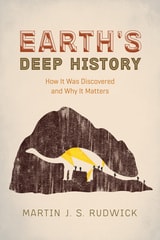
Earth's Deep History
How It Was Discovered and Why It MattersMartin J. S. Rudwick
University of Chicago Press, 2014
Rudwick begins in the seventeenth century with Archbishop James Ussher, who famously dated the creation of the cosmos to 4004 BC. His narrative later turns to the crucial period of the late eighteenth and early nineteenth centuries, when inquisitive intellectuals, who came to call themselves “geologists,” began to interpret rocks and fossils, mountains and volcanoes, as natural archives of Earth’s history. He then shows how this geological evidence was used—and is still being used—to reconstruct a history of the Earth that is as varied and unpredictable as human history itself. Along the way, Rudwick rejects the popular view of this story as a conflict between science and religion and shows how the modern scientific account of the Earth’s deep history retains strong roots in Judaeo-Christian ideas.
Extensively illustrated, Earth’s Deep History is an engaging and impressive capstone to Rudwick’s distinguished career. Though the story of the Earth is inconceivable in length, Rudwick moves with grace from the earliest imaginings of our planet’s deep past to today’s scientific discoveries, proving that this is a tale at once timeless and timely.
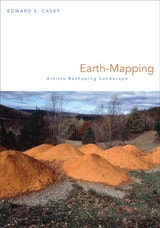
Earth-Mapping
Artists Reshaping LandscapeEdward S. Casey
University of Minnesota Press, 2005
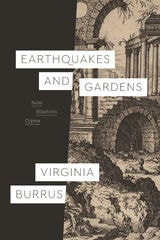
Earthquakes and Gardens
Saint Hilarion’s CyprusVirginia Burrus
University of Chicago Press, 2023
In Jerome’s Life of Saint Hilarion, a fourth-century saint briefly encounters the ruins of an earthquake-toppled city and a haunted garden in Cyprus. From these two fragmentary passages, Virginia Burrus delivers a series of sweeping meditations on our experience of place and the more-than-human worlds—the earth and its gods—that surround us. Moving between the personal and geological, Earthquakes and Gardens ruminates on destruction and resilience, ruination and resurgence, grief and consolation in times of disaster and loss. Ultimately, Burrus’s close readings reimagine religion as a practice that unsettles certainty and develops mutual flourishing.
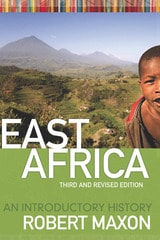
East Africa
An Introductory HistoryRobert Maxon
West Virginia University Press, 2009
In this third edition of East Africa: An Introductory History, Robert M. Maxon revisits the diverse eastern region of Africa, including the modern nations of Kenya, Tanzania, and Uganda. With revised sections and a new preface, this comprehensive text surveys East Africa’s political, economic, and social history from pre-colonial to modern times. Maxon reveals the physical movement and societal development of and between ethnic groups before the 1890s; the capitalistic impact of European colonialism in the early nineteenth century; and the achievement and aftermath of independence in East Africa during the later part of this century.
East Africa: An Introductory History, 3rd and Revised Edition offers the student and scholar:
• the only revision of this title in over a decade
• a complete index and glossary of African terms that promote an effortless navigation of the complex history of this region
• over twenty maps and diagrams that provide visual depictions of the development of eastern Africa
• detailed geographical and topographical analysis that supplement the historical scope and investigation of this region
East Africa: An Introductory History documents the transformation of East Africa from the Stone Age to the first decade of the twenty-first century. The book is ideal for any reader interested in unraveling the intricate history of this East Africa, and especially for students coming to the study of this region for the first time.
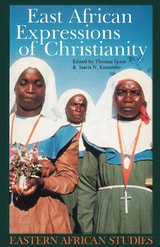
East African Expressions of Christianity
Of ChristianityThomas Spear
Ohio University Press, 1998
Christianity has been spread in Africa by Africans. It is the story of peoples seizing control of their own spiritual destinies—rather than the commonplace notion that the continent’s Christian churches represent colonial and capitalist powers that helped subdue Africans to European domination. In short, once introduced, Christianity took on a powerful life of its own and spun out of the control of those who would retain ownership of doctrine and practice. East African Expressions of Christianity examines the experiences of African Christians as they explored the new faith, interpreted it in the context of their own values, appropriated it for themselves, and forged their own distinctive churches. Prominent Tanzanian and American historians, anthropologists, political scientists, and church people examine the translation of religious meanings across cultural boundaries; the religious and social appeal of the new faith; and the vital roles played by African evangelists, teachers, and translators in the spread of Christianity and the development of an African church.
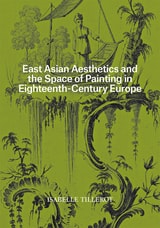
East Asian Aesthetics and the Space of Painting in Eighteenth-Century Europe
Isabelle Tillerot
J. Paul Getty Trust, The, 2024
This volume offers the first critical account of how European imports of East Asian textiles, porcelain, and lacquers, along with newly published descriptions of the Chinese garden, inspired a revolution in the role of painting in early modern Europe. With particular focus on French interiors, Isabelle Tillerot reveals how a European enthusiasm for East Asian culture and a demand for novelty transformed the dynamic between painting and decor. Models of space, landscape, and horizon, as shown in Chinese and Japanese objects and their ornamentation, disrupted prevailing design concepts in Europe. With paintings no longer functioning as pictorial windows, they began to be viewed as discrete images displayed on a wall—and with that, their status changed from decorative device to autonomous work of art.
This study presents a detailed history of this transformation, revealing how an aesthetic free from the constraints of symmetry and geometrized order upended paradigms of display, enabling European painting to come into its own.
East Central and Eastern Europe in the Early Middle Ages
Florin Curta, Editor
University of Michigan Press, 2005

East India Company at Home, 1757-1857
Edited by Margot Finn and Kate Smith
University College London, 2018
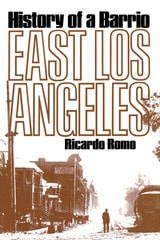
East Los Angeles
History of a BarrioBy Ricardo Romo
University of Texas Press, 1983
This is the story of the largest Mexican-American community in the United States, the city within a city known as "East Los Angeles." How did this barrio of over one million men and women—occupying an area greater than Manhattan or Washington D.C.—come to be?
Although promoted early in this century as a workers' paradise, Los Angeles fared poorly in attracting European immigrants and American blue-collar workers. Wages were low, and these workers were understandably reluctant to come to a city which was also troubled by labor strife. Mexicans made up the difference, arriving in the city in massive numbers.
Who these Mexicans were and the conditions that caused them to leave their own country are revealed in East Los Angeles. The author examines how they adjusted to life in one of the fastest-growing cities in the United States, how they fared in this country's labor market, and the problems of segregation and prejudice they confronted.
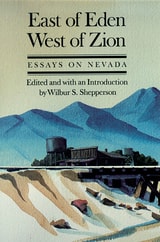
East Of Eden, West Of Zion
Essays On NevadaWilbur S. Shepperson
University of Nevada Press, 1989
A collection of essays in which a dozen historians and novelists present their impressions and concerns about "end of the century Nevada." Human expectations and illusions are seen as a backdrop for today's Nevada as a new human frontier. As an overview of Nevada society, this study deals with culture as well as economics, with tradition as well as rapid population growth. The essayists inquire whether the friction between acquisition and preservation, quick wealth and refined sensitivity, will build a more humane and enlightened society.
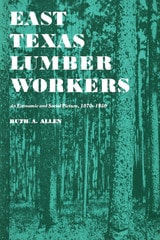
East Texas Lumber Workers
An Economic and Social Picture, 1870-1950By Ruth A. Allen
University of Texas Press, 1961
In 1950 a million Texans—more than a tenth of the entire population of the state—lived in a region where one family in every two earned less than $2,000 a year. Composing that region are the thirty-two counties of northeastern Texas in which the lumber industry is concentrated. In eleven of these counties, 70 percent of family incomes were less than $2,000.
Until 1930 the Texas lumber industry furnished employment for more workers than any other manufacturing in the state. Though displaced in that year by oil refining, it still ranks near the top in the number of workers it hires. The aim of this study is to show how these people whose economic life has been dominated by a single industry have fared for eighty years in comparison with their fellow Texans and with lumber workers in the Pacific Northwest and the Lakes states.
Texas lumber workers have always been in many ways a peculiar people, conditioned by their historical roots, by isolation from the mainstream of national life, and by the deeply rural nature of their environment. A typical group portrait would show two of each three persons to be adult white males. One of three would be African American. It would not show any women. Here and there a face would bear the marks of alien birth. Most of the figures, however, would be natives not only of America but of East Texas.
In family background, in work experience, and in social and economic environment these people have been uniquely homogeneous. In the early 1950s the Congressional Committee on the Economic Report of the President designated the area as one of “deep poverty” and pinpointed it as one which had failed notably to reach the level of living achieved by the state and the nation. Its economic status has been lower than that of any other group in Texas except household servants, and its education level has been well below that of the state and nation and increasingly below the level of acceptance in any jobs other than those requiring a minimum of training and competence. The immediate past has shown not only no improvement but a positive deterioration.
Drawing upon personal investigation and state and federal reports, the author has put the contemporary situation in a historical setting. Her delineation is principally in terms of figures that weave a social fabric from which definite patterns emerge—insecure wages, illiteracy and inefficient production, unsuccessful attempts to achieve effective organization. Though the book is directed primarily toward those who should feel concern at its revelations, it also suggests a wealth of untapped sources for the ethnographer and the folklorist.
East of East
The Making of Greater El MonteRomeo Guzmán
Rutgers University Press, 2020

East-West Divan
In Memory of Werner Mark LinzEdited by Aran Byrne
Gingko, 2014
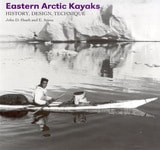
Eastern Arctic Kayaks
History, Design, TechniqueJohn Heath
University of Alaska Press, 2004
Eastern Arctic Kayaks is the product of years of kayak study by two of the world's experts. Combining analyses of form and function with historical background and illustrations of kayaking techniques, this volume is a storehouse of information for recreational kayakers and scholarly readers alike.
Drawing from his vast practical experience and extensive study of museum specimens, John D. Heath offers a comprehensive overview of the evolution and construction of Greenland kayaks supplemented with an illustrated series of rolling and sculling techniques. E. Arima examines kayaks of the eastern Canadian Arctic, covering woodworking tools, construction techniques, and the treatment of skins for the kayak cover.
Core chapters on Greenland and eastern Canada are accompanied by essential articles by Greg Stamer on the use of the Greenland paddle and two studies of kayaks in European museums by Harvey Golden and Hugh Collings. A valuable excerpt from John Brand's Little Kayak Book series makes this British publication available to American readers for the first time.
Lavishly illustrated with drawings and historic photographs, Eastern Arctic Kayaks is a landmark study in the history of watercraft--an essential resource for recreational kayakers and maritime historians and for anyone interested in northern Native material culture.
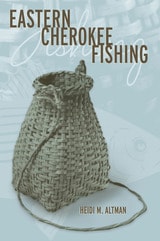
Eastern Cherokee Fishing
Heidi M. Altman
University of Alabama Press, 2006
Interviewees include a great range of informants, from native speakers of Cherokee with extensive knowledge of traditional fishing methods to Euro-American English speakers whose families have lived in North Carolina for many generations and know about contemporary fishing practices in the area. The topic of fishing thus offers perspective on the Cherokee language, the vigor of the Cherokee system of native knowledge, and the history of the relationship between Cherokee people and the local environment. Heidi Altman also examines the role of fishing as a tourist enterprise and how fishing practices affect tribal waters.
Eastern Europe 1740-1985
Feudalism to CommunismRobin Okey
University of Minnesota Press, 1987

Easy Living
The Rise of the Home OfficeElizabeth A Patton
Rutgers University Press, 2020
Easy Money
American Puritans and the Invention of Modern CurrencyDror Goldberg
University of Chicago Press, 2023
A sweeping history of the American invention of modern money.
Economists endlessly debate the nature of legal tender monetary systems—coins and bills issued by a government or other authority. Yet the origins of these currencies have received little attention.
Dror Goldberg tells the story of modern money in North America through the Massachusetts colony during the seventeenth century. As the young settlement transitioned to self-governance and its economy grew, the need to formalize a smooth exchange emerged. Printing local money followed.
Easy Money illustrates how colonists invented contemporary currency by shifting its foundation from intrinsically valuable goods—such as silver—to the taxation of the state. Goldberg traces how this structure grew into a worldwide system in which, monetarily, we are all Massachusetts. Weaving economics, law, and American history, Easy Money is a new touchstone in the story of monetary systems.
Easy Money
American Puritans and the Invention of Modern CurrencyDror Goldberg
University of Chicago Press, 2023
This is an auto-narrated audiobook edition of this book.
A sweeping history of the American invention of modern money.
Economists endlessly debate the nature of legal tender monetary systems—coins and bills issued by a government or other authority. Yet the origins of these currencies have received little attention.
Dror Goldberg tells the story of modern money in North America through the Massachusetts colony during the seventeenth century. As the young settlement transitioned to self-governance and its economy grew, the need to formalize a smooth exchange emerged. Printing local money followed.
Easy Money illustrates how colonists invented contemporary currency by shifting its foundation from intrinsically valuable goods—such as silver—to the taxation of the state. Goldberg traces how this structure grew into a worldwide system in which, monetarily, we are all Massachusetts. Weaving economics, law, and American history, Easy Money is a new touchstone in the story of monetary systems.
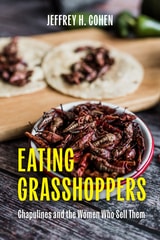
Eating Grasshoppers
Chapulines and the Women Who Sell ThemJeffrey H. Cohen
University of Texas Press, 2025
An approachable ethnography of how grasshoppers are harvested, sold, and consumed in Oaxaca.
Chapulines (toasted grasshoppers) are not a delicacy in Oaxaca. They are just food—good food—and a protein-rich seasonal snack that is the product of a long-standing industry based overwhelmingly on the labor of women. Jeffrey Cohen has interviewed dozens of these chapulineras, who harvest insects from corn and alfalfa fields, prepare them, and sell them in urban and rural marketplaces. An accessible ethnography, Eating Grasshoppers tells their story alongside the broader history of chapulines.
For tourists, chapulines are an experience—a gateway to the “real” Oaxaca. For locals, they are ordinary fare, but also a reminder of Indigenous stability and rural survival. In a sense, eating chapulines is a declaration of independence from a government that has condemned eating insects as backward. Yet, while chapulines are a generations-old favorite, eating them is not an act of preservation. Cohen shows that the business of this traditional food is thoroughly modern and ever evolving, with entrepreneurial chapulineras responding nimbly to complex and dynamic markets. From alfalfa fields to online markets, Eating Grasshoppers takes readers inside one of the world’s most fascinating food cultures.
Eating Her Curries and Kway
A Cultural History of Food in SingaporeNicole Tarulevicz
University of Illinois Press, 2013
Discovering Singaporean identity through cooking and cuisine
While eating is a universal experience, for Singaporeans it carries strong national connotations. The popular Singaporean-English phrase "Die die must try" is not so much hyperbole as it is a reflection of the lengths that Singaporeans will go to find great dishes.
In Eating Her Curries and Kway: A Cultural History of Food in Singapore, Nicole Tarulevicz argues that in a society that has undergone substantial change in a relatively short amount of time, food serves Singaporeans as a poignant connection to the past. Eating has provided a unifying practice for a diverse society, a metaphor for multiracialism and recognizable national symbols for a fledgling state. Covering the period from British settlement in 1819 to the present and focusing on the post–1965 postcolonial era, Tarulevicz tells the story of Singapore through the production and consumption of food.
Analyzing a variety of sources that range from cookbooks to architectural and city plans, Tarulevicz offer a thematic history of this unusual country, which was colonized by the British and operated as a port within Malaya. Connecting food culture to the larger history of Singapore, she discusses various topics including domesticity and home economics, housing and architecture, advertising, and the regulation of food-related manners and public behavior such as hawking, littering, and chewing gum. Moving away from the predominantly political and economic focus of other histories of Singapore, Eating Her Curries and Kway provides an important alternative reading of Singaporean society.

Eating Right in America
The Cultural Politics of Food and HealthCharlotte Biltekoff
Duke University Press, 2013
Eating and Being
A History of Ideas about Our Food and OurselvesSteven Shapin
University of Chicago Press, 2024
Eating and Being is a history of Western thinking about food, eating, knowledge, and ourselves. In modern thought, eating is about what is good for you, not about what is good. Eating is about health, not about virtue. Yet this has not always been the case. For a great span of the past—from antiquity through about the middle of the eighteenth century—one of the most pervasive branches of medicine was known as dietetics, prescribing not only what people should eat but also how they should order many aspects of their lives, including sleep, exercise, and emotional management. Dietetics did not distinguish between the medical and the moral, nor did it acknowledge the difference between what was good for you and what was good. Dietetics counseled moderation in all things, where moderation was counted as a virtue as well as the way to health. But during the nineteenth century, nutrition science began to replace the language of traditional dietetics with the vocabulary of proteins, fats, carbohydrates, and calories, and the medical and the moral went their separate ways. Steven Shapin shows how much depended upon that shift, and he also explores the extent to which the sensibilities of dietetics have been lost.
Throughout this rich history, he evokes what it felt like to eat during another historical period and invites us to reflect on what it means to feel about food as we now do. Shapin shows how the change from dietetics to nutrition science fundamentally altered how we think about our food and its powers, our bodies, and our minds.
Eating on the Wild Side
The Pharmacologic, Ecologic and Social Implications of Using NoncultigensEdited by Nina L. Etkin
University of Arizona Press, 2000
Drawing on nonhuman primate studies, evidence from prehistoric human populations, and field research among contemporary peoples practicing a range of subsistence strategies, the book focuses on the processes and human ecological implications of gathering, semidomestication, and cultivation of plants that are unfamiliar to most of us. Contributions by distinguished cultural and biological anthropologists, paleobotanists, primatologists, and ethnobiologists explore a number of issues such as the consumption of unpalatable and famine foods, the comparative assessment of aboriginal diets with those of colonists and later arrivals, and the apparent self-treatment by sick chimpanzees with leaves shown to be pharmacologically active.
Collectively, these articles offer a theoretical framework emphasizing the cultural evolutionary processes that transform plants from wild to domesticated—with many steps in between—while placing wild plant use within current discussions surrounding biodiversity and its conservation. Eating on the Wild Side makes an important contribution to our understanding of the links between biology and culture, describing the interface between diet, medicine, and natural products. By showing how various societies have successfully utilized wild plants, it underscores the growing concern for preserving genetic diversity as it reveals a fascinating chapter in the human ecology.
CONTENTS
1. The Cull of the Wild, Nina L. Etkin
2. Agriculture and the Acquisition of Medicinal Plant Knowledge, Michael H. Logan & Anna R. Dixon
3. Ambivalence to the Palatability Factors in Wild Food Plants, Timothy Johns
4. Wild Plants as Cultural Adaptations to Food Stress, Rebecca Huss-Ashmore & Susan L. Johnston
Physiologic Implications of Wild Plant Consumption
5. Pharmacologic Implications of "Wild" Plants in Hausa Diet, Nina L. Etkin & Paul J. Ross
6. Wild Plants as Food and Medicine in Polynesia, Paul Alan Cox
7. Characteristics of "Wild" Plant Foods Used by Indigenous Populations in Amazonia, Darna L. Dufour & Warren M. Wilson
8. The Health Significance of Wild Plants for the Siona and Secoya, William T. Vickers
9. North American Food and Drug Plants, Daniel M. Moerman
Wild Plants in Prehistory
10. Interpreting Wild Plant Foods in the Archaeological Record, Frances B. King
11. Coprolite Evidence for Prehistoric Foodstuffs, Condiments, and Medicines, Heather B. Trigg, Richard I. Ford, John G. Moore & Louise D. Jessop
Plants and Nonhuman Primates
12. Nonhuman Primate Self-Medication with Wild Plant Foods, Kenneth E. Glander
13. Wild Plant Use by Pregnant and Lactating Ringtail Lemurs, with Implications for Early Hominid Foraging, Michelle L. Sauther
Epilogue
14. In Search of Keystone Societies, Brien A. Meilleur
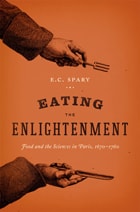
Eating the Enlightenment
Food and the Sciences in Paris, 1670-1760E. C. Spary
University of Chicago Press, 2012

Eating to Learn, Learning to Eat
The Origins of School Lunch in the United StatesA. R. Ruis
Rutgers University Press, 2017
Eavesdropping on Texas History
Mary L. Scheer
University of North Texas Press, 2016
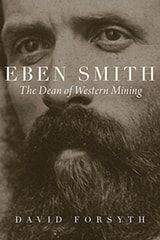
Eben Smith
The Dean of Western MiningDavid Forsyth
University Press of Colorado, 2021
The mining teams Smith formed with Chaffee and with industrialist David Moffat were among the most successful and respected in Colorado, and many in the state held Smith in high regard. Yet despite the credit he received during his lifetime for establishing Colorado’s mining industry, Smith has not received much attention from historians, perhaps because he was content to leave public-facing duties to his partners while he concerned himself with managing mine operations.
From Smith’s early years and his labor in the mines to his rise to prominence as an investor and developer, Forsyth shows how Smith used the mining and milling knowledge he acquired in California to become a leader in technological innovation in Colorado’s mining industry.
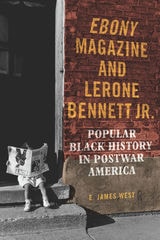
Ebony Magazine and Lerone Bennett Jr.
Popular Black History in Postwar AmericaE. James West
University of Illinois Press, 2020
E. James West's fresh and fascinating exploration of Ebony’s political, social, and historical content illuminates the intellectual role of the iconic magazine and its contribution to African American scholarship. He also uncovers a paradox. Though Ebony provided Bennett with space to promote a militant reading of black history and protest, the magazine’s status as a consumer publication helped to mediate its representation of African American identity in both past and present.
Mixing biography, cultural history, and popular memory, West restores Ebony and Bennett to their rightful place in African American intellectual, commercial, and political history.
Ecclesial Exegesis
A Synthesis of Ancient and Modern Approaches to ScriptureGregory Vall
Catholic University of America Press, 2022
Ecclesiastical History, Books 1–5
Catholic University of America Press, 1953