Results by title
2018 books match the query 'Political aspects' and 53 start with e

Extra/Ordinary
Craft and Contemporary ArtMaria Elena Buszek, ed.
Duke University Press, 2011
Contributors. Elissa Auther, Anthea Black, Betty Bright, Nicole Burisch, Maria Elena Buszek, Jo Dahn, M. Anna Fariello, Betsy Greer, Andrew Jackson, Janis Jefferies, Louise Mazanti, Paula Owen, Karin E. Peterson, Lacey Jane Roberts, Kirsty Robertson, Dennis Stevens, Margaret Wertheim
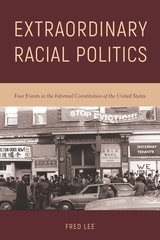
Extraordinary Racial Politics
Four Events in the Informal Constitution of the United StatesFred Lee
Temple University Press, 2018
Extraordinary racial politics rupture out of and reset everyday racial politics. In his cogent book, Fred Lee examines four unusual, episodic, and transformative moments in U.S. history: the 1830s–1840s southeastern Indian removals, the Japanese internment during World War II, the post-war civil rights movement, and the 1960s–1970s racial empowerment movements. Lee helps us connect these extraordinary events to both prior and subsequent everyday conflicts.
Extraordinary Racial Politics brings about an intellectual exchange between ethnic studies, which focuses on quotidian experiences and negotiations, and political theory, which emphasizes historical crises and breaks. In ethnic studies, Lee draws out the extraordinary moments in Michael Omi and Howard Winant’s as well as Charles Mills’s accounts of racial formation. In political theory, Lee considers the strengths and weaknesses of using Carl Schmitt’s and Hannah Arendt’s accounts of public constitution to study racial power.
Lee concludes that extraordinary racial politics represent both the promises of social emancipation and the perils of state power. This promise and peril characterizes our contentious racial present.
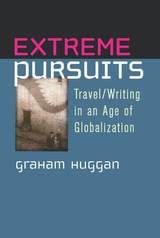
Extreme Pursuits
Travel/Writing in an Age of GlobalizationGraham Huggan
University of Michigan Press, 2009
Recent figures suggest that there will be 1.6 billion arrivals at world airports by the year 2020. Extreme Pursuits looks at the new conditions of global travel and the unease, even paranoia, that underlies them---at the opportunities they offer for alternative identities and their oscillation between remembered and anticipated states. Graham Huggan offers a provocative account of what is happening to travel at a time characterized by extremes of social and political instability in which adrenaline-filled travelers appear correspondingly determined to take risks. It includes discussions of the links between tourism and terrorism, of contemporary modes of disaster tourism, and of the writing that derives from these; but it also confirms the existence of more responsible forms of travel/writing that demonstrate awareness of a chronically endangered world.
Extreme Pursuits is the first study of its kind to link travel writing explicitly with structural changes in the global tourist industry. The book makes clear that travel writing can no longer take refuge in the classic distinctions (traveler versus tourist, foreigner versus native) on which it previously depended. Such distinctions---which were dubious in the first place---no longer make sense in an increasingly globalized world. Huggan argues accordingly that the category "travel writing" must include experimental ethnography and prose fiction; that it should concern itself with other kinds of travel practices, such as those related to Holocaust deportation and migrant labor; and that it should encompass representations of travelers and "traveling cultures" that appear in popular media, especially TV and film.
Graham Huggan is Professor of Commonwealth and Postcolonial Literatures at the University of Leeds. He is the coauthor, with Patrick Holland, of Tourists with Typewriters: Critical Reflections on Contemporary Travel Writing (University of Michigan Press) and coauthor, with Helen Tiffin, of Postcolonial Ecocriticism (Routledge).
Illustration: "Shadow Wall," 2006 © Shaun Tan.