Results by title
4038 books match the query 'Social aspects' and 128 start with e

Everyday Reading
Print Culture and Collective Identity in the Rio de la Plata, 1780-1910William Garrett Acree
Vanderbilt University Press, 2011
Starting in the late nineteenth century, the region of South America known as the Rio de la Plata (containing modern-day Uruguay and Argentina) boasted the highest literacy rates in Latin America. In Everyday Reading, William Acree explores the history, events, and culture that gave rise to the region's remarkable progress. With a specific focus on its print culture, in the form of newspapers, political advertisements and documents, schoolbooks, and even stamps and currency, Acree creates a portrait of a literary culture that permeated every aspect of life.
Everyday Reading argues that the introduction of the printing press into the Rio de la Plata in the 1780s hastened the collapse of Spanish imperial control and played a major role in the transition to independence some thirty years later. After independence, print culture nurtured a new identity and helped sustain the region through the tumult of civil war in the mid-1800s. Acree concludes by examining the role of reading in formal education, which had grown exponentially by the early twentieth century as schoolchildren were taught to fulfill traditional roles in society.
Ultimately, Everyday Reading humanizes literary culture, demonstrating its unrecognized and unexpected influence in everyday lives.

Everyday Revolutionaries
Gender, Violence, and Disillusionment in Postwar El SalvadorIrina Carlota Silber
Rutgers University Press, 2011
Winner of the 2013 International Latino Book Awards in the Best First Book, Nonfiction category
Everyday Revolutionaries provides a longitudinal and rigorous analysis of the legacies of war in a community racked by political violence. By exploring political processes in one of El Salvador's former war zones-a region known for its peasant revolutionary participation-Irina Carlota Silber offers a searing portrait of the entangled aftermaths of confrontation and displacement, aftermaths that have produced continued deception and marginalization.
Silber provides one of the first rubrics for understanding and contextualizing postwar disillusionment, drawing on her ethnographic fieldwork and research on immigration to the United States by former insurgents. With an eye for gendered experiences, she unmasks how community members are asked, contradictorily and in different contexts, to relinquish their identities as "revolutionaries" and to develop a new sense of themselves as productive yet marginal postwar citizens via the same "participation" that fueled their revolutionary action. Beautifully written and offering rich stories of hope and despair, Everyday Revolutionaries contributes to important debates in public anthropology and the ethics of engaged research practices.
Everyday Ruptures
Children, Youth, and Migration in Global PerspectiveCati Coe
Vanderbilt University Press, 2011
The book is organized around four themes:
• how children's agency is affected by institutions, families, and beliefs
• how families and individuals create and maintain kin ties in conditions of rupture
• how emotion and affect are linked to global divisions and flows
• how the actions of states create ruptures and continuities
Everyday State and Democracy in Africa
Ethnographic EncountersWale Adebanwi
Ohio University Press, 2022
Bottom-up case studies, drawn from the perspective of ordinary Africans’ experiences with state bureaucracies, structures, and services, reveal how citizens and states define each other.
This volume examines contemporary citizens’ everyday encounters with the state and democratic processes in Africa. The contributions reveal the intricate and complex ways in which quotidian activities and experiences—from getting an identification card (genuine or fake) to sourcing black-market commodities to dealing with unreliable waste collection—both (re)produce and (re)constitute the state and democracy. This approach from below lends gravity to the mundane and recognizes the value of conceiving state governance not in terms of its stated promises and aspirations but rather in accordance with how people experience it.
Both new and established scholars based in Africa, Europe, and North America cover a wide range of examples from across the continent, including
- bureaucratic machinery in South Sudan, Nigeria, and Kenya
- infrastructure and shortages in Chad and Nigeria
- disciplinarity, subjectivity, and violence in Rwanda, South Africa, and Nigeria
- the social life of democracy in the Congo, Cameroon, and Mozambique
- education, welfare, and health in Ethiopia, the Democratic Republic of Congo, and Burkina Faso
Everyday State and Democracy in Africa demonstrates that ordinary citizens’ encounters with state agencies and institutions define the meanings, discourses, practices, and significance of democratic life, as well its distressing realities.
Contributors:
- Daniel Agbiboa
- Victoria Bernal
- Jean Comaroff
- John L. Comaroff
- E. Fouksman
- Fred Ikanda
- Lori Leonard
- Rose Løvgren
- Ferenc Dávid Markó
- Ebenezer Obadare
- Rogers Orock
- Justin Pearce
- Katrien Pype
- Edoardo Quaretta
- Jennifer Riggan
- Helle Samuelsen
- Nicholas Rush Smith
- Eric Trovalla
- Ulrika Trovalla
Everyday Utopias
The Conceptual Life of Promising SpacesDavina Cooper
Duke University Press, 2013
Everyone Is NOT Doing It
Abstinence and Personal IdentityJamie L. Mullaney
University of Chicago Press, 2005
Based on interviews with individuals who abstain from habits as diverse as sex, cigarettes, sugar, and technology, Everyone Is NOT Doing It identifies four different types of abstainers: quitters; those who have never done something and never will; those who haven't done something yet, but might in the future; and those who are not doing something temporarily. Mullaney assesses the commonalities that bind abstainers, as well as how perceptions of abstinence change according to social context, age, and historical era. In contrast to such earlier forms of abstinence as social protest, entertainment, or an instrument of social stratification, not doing something now gives people a more secure sense of self by offering a more affordable and manageable identity in a world of ever-expanding options.

Everyone Loves Live Music
A Theory of Performance InstitutionsFabian Holt
University of Chicago Press, 2020
For decades, millions of music fans have gathered every summer in parks and fields to hear their favorite bands at festivals such as Lollapalooza, Coachella, and Glastonbury. How did these and countless other festivals across the globe evolve into glamorous pop culture events, and how are they changing our relationship to music, leisure, and public culture? In Everyone Loves Live Music, Fabian Holt looks beyond the marketing hype to show how festivals and other institutions of musical performance have evolved in recent decades, as sites that were once meaningful sources of community and culture are increasingly subsumed by corporate giants.
Examining a diverse range of cases across Europe and the United States, Holt upends commonly-held ideas of live music and introduces a pioneering theory of performance institutions. He explores the fascinating history of the club and the festival in San Francisco and New York, as well as a number of European cities. This book also explores the social forces shaping live music as small, independent venues become corporatized and as festivals transform to promote mainstream Anglophone culture and its consumerist trappings. The book further provides insight into the broader relationship between culture and community in the twenty-first century. An engaging read for fans, industry professionals, and scholars alike, Everyone Loves Live Music reveals how our contemporary enthusiasm for live music is more fraught than we would like to think.
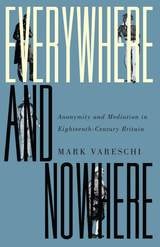
Everywhere and Nowhere
Anonymity and Mediation in Eighteenth-Century BritainMark Vareschi
University of Minnesota Press, 2018
A fascinating analysis of anonymous publication centuries before the digital age
Everywhere and Nowhere considers the ubiquity of anonymity and mediation in the publication and circulation of eighteenth-century British literature—before the Romantic creation of the “author”—and what this means for literary criticism. Anonymous authorship was typical of the time, yet literary scholars and historians have been generally unable to account for it as anything more than a footnote or curiosity.
Mark Vareschi shows the entangled relationship between mediation and anonymity, revealing the nonhuman agency of the printed text. Drawing richly on quantitative analysis and robust archival work, Vareschi brings together philosophy, literary theory, and media theory in a trenchant analysis, uncovering a history of textual engagement and interpretation that does not hinge on the known authorial subject.
In discussing anonymous poetry, drama, and the novel along with anonymously published writers such as Daniel Defoe, Frances Burney, and Walter Scott, he unveils a theory of mediation that renews broader questions about agency and intention. Vareschi argues that textual intentionality is a property of nonhuman, material media rather than human subjects alone, allowing the anonymous literature of the eighteenth century to speak to contemporary questions of meaning in the philosophy of language. Vareschi closes by exploring dubious claims about the death of anonymity and the reexplosion of anonymity with the coming of the digital. Ultimately, Everywhere and Nowhere reveals the long history of print anonymity so central to the risks and benefits of the digital culture.

Evita, Inevitably
Performing Argentina's Female Icons Before and After Eva PerónJean Graham-Jones
University of Michigan Press, 2014
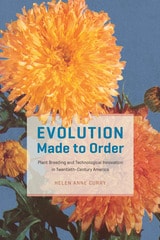
Evolution Made to Order
Plant Breeding and Technological Innovation in Twentieth-Century AmericaHelen Anne Curry
University of Chicago Press, 2016
In Evolution Made to Order, Helen Anne Curry traces the history of America’s pursuit of tools that could intervene in evolution. An immersive journey through the scientific and social worlds of midcentury genetics and plant breeding and a compelling exploration of American cultures of innovation, Evolution Made to Order provides vital historical context for current worldwide ethical and policy debates over genetic engineering.

Ex Ante
Power and Prediction in the Real-Time FutureJohn Cheney-Lippold
University of Chicago Press, 2027
An incisive framework for understanding how predictive AI has reshaped our relationship with time.
Ex Ante argues that AI systems draw us into a new experience of time, a continuous stream of machine-generated futures that reshapes our relationship to ourselves, to capitalism, and to infrastructure. Unlike other predictive tools that help us prepare for what might come, these projections—produced by algorithms and sourced by massive flows of data—calibrate our actions moment by moment, second by second.
In this book, John Cheney-Lippold offers a framework he calls the ex ante, Latin for “before the event,” as a way to consider how the future has become capitalism’s latest resource for exploitation. Through case studies spanning TikTok beauty filters that have fueled a surge in plastic surgery consultations, chess engines that redefine how the game is played, online sports betting platforms that commodify probability itself, hospital sepsis algorithms that transform the labor of nursing, and coordinated vehicle networks that collectively anticipate their surroundings to function, Ex Ante offers an exploration and powerful critique of our algorithmic present and the powers behind it.
Excommunication
Three Inquiries in Media and MediationAlexander R. Galloway, Eugene Thacker, and McKenzie Wark
University of Chicago Press, 2013

Exhibiting Blackness
African Americans and the American Art MuseumBridget R. Cooks
University of Massachusetts Press, 2011
In Exhibiting Blackness, art historian Bridget R. Cooks analyzes the curatorial strategies, challenges, and critical receptions of the most significant museum exhibitions of African American art. Tracing two dominant methodologies used to exhibit art by African Americans—an ethnographic approach that focuses more on artists than their art, and a recovery narrative aimed at correcting past omissions—Cooks exposes the issues involved in exhibiting cultural difference that continue to challenge art history, historiography, and American museum exhibition practices. By further examining the unequal and often contested relationship between African American artists, curators, and visitors, she provides insight into the complex role of art museums and their accountability to the cultures they represent.

Exit Zero
Family and Class in Postindustrial ChicagoChristine J. Walley
University of Chicago Press, 2012
In 1980, Christine J. Walley’s world was turned upside down when the steel mill in Southeast Chicago where her father worked abruptly closed. In the ensuing years, ninety thousand other area residents would also lose their jobs in the mills—just one example of the vast scale of deindustrialization occurring across the United States. The disruption of this event propelled Walley into a career as a cultural anthropologist, and now, in Exit Zero, she brings her anthropological perspective home, examining the fate of her family and that of blue-collar America at large.
This book is part of a project that also includes a documentary film.
Expelling Public Schools
How Antiracist Politics Enable School Privatization in NewarkJohn Arena
University of Minnesota Press, 2023
Exploring the role of identitarian politics in the privatization of Newark’s public school system
In Expelling Public Schools, John Arena explores the more than two-decade struggle to privatize public schools in Newark, New Jersey—a conflict that is raging in cities across the country—from the vantage point of elites advancing the pro-privatization agenda and their grassroots challengers.
Analyzing the unsuccessful effort of Cory Booker—Newark’s leading pro-privatization activist and mayor—to generate popular support for the agenda, and Booker’s rival and ultimate successor Ras Baraka’s eventual galvanization of the charter movement, Arena argues that Baraka’s black radical politics cloaked a revanchist agenda of privatization.
Expelling Public Schools reveals the political rise of Booker and Baraka, their one-time rivalry and subsequent alliance, and what this particular case study illuminates about contemporary post–civil rights Black politics. Ultimately, Expelling Public Schools is a critique of Black urban regime politics and the way in which antiracist messaging obscures real class divisions, interests, and ideological diversity.
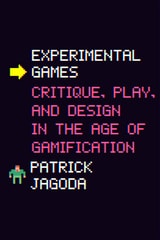
Experimental Games
Critique, Play, and Design in the Age of GamificationPatrick Jagoda
University of Chicago Press, 2020
Drawing from his own experience as a game designer, Patrick Jagoda argues that games need not be synonymous with gamification. He studies experimental games that intervene in the neoliberal project from the inside out, examining a broad variety of mainstream and independent games, including StarCraft, Candy Crush Saga, Stardew Valley, Dys4ia, Braid, and Undertale. Beyond a diagnosis of gamification, Jagoda imagines ways that games can be experimental—not only in the sense of problem solving, but also the more nuanced notion of problem making that embraces the complexities of our digital present. The result is a game-changing book on the sociopolitical potential of this form of mass entertainment.
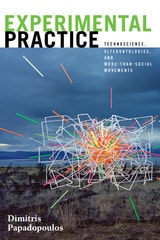
Experimental Practice
Technoscience, Alterontologies, and More-Than-Social MovementsDimitris Papadopoulos
Duke University Press, 2018
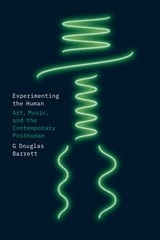
Experimenting the Human
Art, Music, and the Contemporary PosthumanG Douglas Barrett
University of Chicago Press, 2023
In Experimenting the Human, G Douglas Barrett argues that experimental music speaks to the contemporary posthuman, a condition in which science and technology decenter human agency amid the uneven temporality of postwar global capitalism. Time moves forward for some during this period, while it seems to stand still or even move backward for others. Some say we’re already posthuman, while others endure the extended consequences of never having been considered fully human in the first place. Experimental music reflects on this state, Barrett contends, through its interdisciplinary involvements in postwar science, technology, and art movements.
Rather than pursuing the human's beyond, experimental music addresses the social and technological conditions that support such a pursuit. Barrett locates this tendency of experimentalism throughout its historical entanglements with cybernetics, and in his intimate analysis of Alvin Lucier’s neurofeedback music, Pamela Z’s BodySynth performances, Nam June Paik’s musical robotics, Pauline Oliveros’s experiments with radio astronomy, and work by Laetitia Sonami, Yasunao Tone, and Jerry Hunt. Through a unique meeting of music studies, media theory, and art history, Experimenting the Human provides fresh insights into what it means to be human.
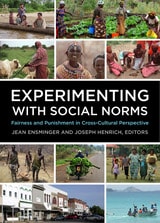
Experimenting with Social Norms
Fairness and Punishment in Cross-Cultural PerspectiveJean Ensminger
Russell Sage Foundation, 2014
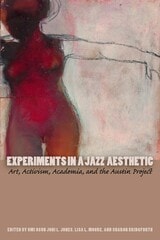
Experiments in a Jazz Aesthetic
Art, Activism, Academia, and the Austin ProjectEdited by Omi Osun Joni L. Jones, Lisa L. Moore, and Sharon Bridgforth
University of Texas Press, 2010
In Austin, Texas, in 2002, a group of artists, activists, and academics led by performance studies scholar Omi Osun Joni L. Jones formed the Austin Project (tAP), which meets annually in order to provide a space for women of color and their allies to build relationships based on trust, creativity, and commitment to social justice by working together to write and perform work in the jazz aesthetic.
Inspired by this experience, this book is both an anthology of new writing and a sourcebook for those who would like to use creative writing and performance to energize their artistic, scholarly, and activist practices. Theoretical and historical essays by Omi Osun Joni L. Jones describe and define the African American tradition of art-making known as the jazz aesthetic, and explain how her own work in this tradition inspired her to start tAP.
Key artists in the tradition, from Bessie Award–winning choreographer Laurie Carlos and writer/performer Robbie McCauley to playwrights Daniel Alexander Jones and Carl Hancock Rux, worked with the women of tAP as mentors and teachers. This book brings together never-before-published, must-read materials by these nationally known artists and the transformative writing of tAP participants. A handbook for workshop leaders by Lambda Literary Award–winning writer Sharon Bridgforth, tAP's inaugural anchor artist, offers readers the tools for starting similar projects in their own communities. A full-length script of the 2005 tAP performance is an original documentation of the collaborative, breath-based, body work of the jazz aesthetic in theatre, and provides both a script for use by theatre artists and an invaluable documentation of a major transformative movement in contemporary performance.
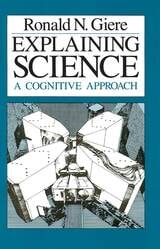
Explaining Science
A Cognitive ApproachRonald N. Giere
University of Chicago Press, 1990
"The writing is delightfully clear and accessible. On balance, few books advance our subject as well."—Paul Teller, Philosophy of Science

Exploring Degrowth
A Critical GuideVincent Liegey
Pluto Press, 2020
As politicians and corporations obsess over growth objectives, the degrowth movement demands that we must slow down the economy by transforming our economies, our politics and our cultures to live within the Earth's limits.
This book navigates the practice and strategies of the movement, looking at its strengths and weaknesses. Covering horizontal democracy, local economies and the reduction of work, it shows us why degrowth is a compelling and realistic project.
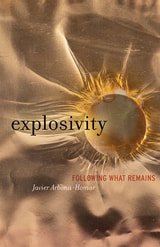
Explosivity
Following What RemainsJavier Arbona-Homar
University of Minnesota Press, 2025
How explosions across history reveal the violence embedded in San Francisco’s landscape
Offering a novel approach to contemporary landscape studies, Explosivity unearths the hidden legacies of violence that have shaped the physical and cultural environment of the San Francisco Bay area. As he sifts through the historical debris of previous centuries, Javier Arbona-Homar analyzes a series of explosions that took place between 1866 and 2011 to call attention to the scattered remnants of militarism and racialized capitalism embedded in the region’s geography.
From incidents involving nineteenth-century explosives manufacturing and World War II munitions loading to radical activism and contemporary television productions, Arbona-Homar locates a pattern of historical violence that refocuses the broader racial and colonial context. Citing the material, social, and political conditions that gave rise to these disparate episodes, he reviews the historic erasure of those driving forces and puts forth alternative possibilities for how such disasters might be memorialized.
Synthesizing a diverse set of field research methods, including oral histories and site visits, and supplemented by specially commissioned landscape photographs by Andrea Gaffney, Explosivity presents a radical exercise in the exposition of public memory.
Retail e-book files for this title are screen-reader friendly with images accompanied by short alt text and/or extended descriptions.
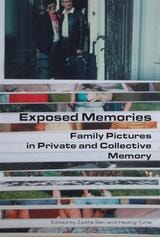
Exposed Memories
Family Pictures in Private and Collective MemoryHedvig Turai
Central European University Press, 2010
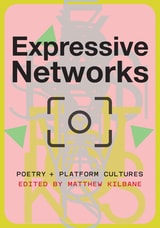
Expressive Networks
Poetry and Platform CulturesEdited by Matthew Kilbane
Amherst College Press, 2025
Though contributors write from a variety of methodological positions and address themselves to a range of archives, they share the primary conviction that the impact of Web 2.0 on literary practice is far-reaching, far from self-evident, and far more variegated and unpredictable than easy summations of social media’s influence suggest. Expressive Networks asks after poetry’s present and future by examining what poems themselves express about the social make-up of networked platforms.
Edited by Matthew Kilbane with contributions from Cameron Awkward-Rich, Micah Bateman, Andrew Campana, Sumita Chakraborty, Scott Challener, C.R. Grimmer, Tess McNulty, Michael Nardone, Seth Perlow, Anna Preus, Susanna Sacks, Carly Schnitzler, Melanie Walsh, and Samuel Caleb Wee.

Exterminate Them
Written Accounts of the Murder, Rape, and Enslavement of Native Americans during the California Gold RushClifford E. Trafzer
Michigan State University Press, 1999
Popular media depict miners as a rough-and-tumble lot who diligently worked the placers along scenic rushing rivers while living in roaring mining camps in the foothills of the Sierra Nevada Mountains. Trafzer and Hyer destroy this mythic image by offering a collection of original newspaper articles that describe in detail the murder, rape, and enslavement perpetrated by those who participated in the infamous gold rush. "It is a mercy to the Red Devils," wrote an editor of the Chico Courier, "to exterminate them." Newspaper accounts of the era depict both the barbarity and the nobility in human nature, but while some protested the inhumane treatment of Native Americans, they were not able to end the violence. Native Americans fought back, resisting the invasion, but they could not stop the tide of white miners and settlers. They became "strangers in a stolen land."

Extra/Ordinary
Craft and Contemporary ArtMaria Elena Buszek, ed.
Duke University Press, 2011
Contributors. Elissa Auther, Anthea Black, Betty Bright, Nicole Burisch, Maria Elena Buszek, Jo Dahn, M. Anna Fariello, Betsy Greer, Andrew Jackson, Janis Jefferies, Louise Mazanti, Paula Owen, Karin E. Peterson, Lacey Jane Roberts, Kirsty Robertson, Dennis Stevens, Margaret Wertheim

Extraordinarily Ordinary
Us Weekly and the Rise of Reality Television CelebrityErin A. Meyers
Rutgers University Press, 2020