Results by title
5550 books match the query 'Biography & Autobiography' and 172 start with e
Everything to Gain
Making the Most of the Rest of Your LifeJimmy Carter
University of Arkansas Press, 1995
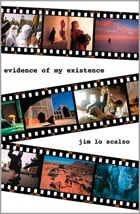
Evidence of My Existence
Jim Lo Scalzo
Ohio University Press, 2007
From a leper colony in India to an American research station on the Antarctic Peninsula, from the back rooms of the White House to the battlefields of Iraq and Afghanistan, Evidence of My Existence tells a unique and riveting story of seventeen years spent racing from one photo assignment to the next. It is also a story of photojournalism and theconsequences of obsessive wanderlust.
When the book opens, Jim Lo Scalzo is a blur to his wife, her remarkable tolerance wearing thin. She is heading to the hospital with her second miscarriage, and Jim is heading to Baghdad to cover the American invasion of Iraq. He hates himself for this—for not giving her a child, for deserting her when she soobviously needs him, for being consumed by his job—but how to stop moving? Sure, there have been some tough trips. He’s been spit on by Mennonites in Missouri, by heroin addicts in Pakistan, and by the KKK in South Carolina. He’s contracted hepatitis on the Navajo Nation, endured two bouts of amoebic dysentery in India and Burma and four cases of giardia in Nepal, Peru, Afghanistan, and Cuba. He’s been shot with rubber bullets in Seattle, knocked to the ground by a water cannon in Quebec, and sprayed with more teargas than he cares to recall. But photojournalism is his career, and travel is his compulsivecraving.
We follow Lo Scalzo through the maze of airports and crowds and countries as he chases the career he has always wanted, struggles with his family problems, and reveals the pleasures of a life singularly focused. For him, as for so many photojournalists, it is always about the going.
Evolution of Desire
A Life of René GirardCynthia L Haven
Michigan State University Press, 2018
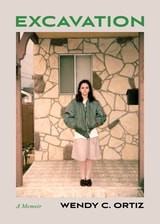
Excavation
A MemoirWendy C. Ortiz
Northwestern University Press, 2025
A darkly vibrant and daring memoir, Wendy C. Ortiz’s Excavation challenged the standard telling of abuse narratives when first published in 2014; over a decade later, it remains deeply prescient. Set in Los Angeles’s San Fernando Valley in the late 1980s, the narrative follows the spiraling entanglement between Wendy and her eighth-grade English teacher as she becomes both victim to and participant in a simultaneously predatorial and impassioned relationship. Baited by initial praise and a false sense of control, Wendy tumbles into a dangerous dynamic that spans the duration of her teens. Artfully constructed from her own journals and decades of personal excavation, the story of this secret relationship has imprinted on Wendy and readers alike. A stunningly honest look at memory, agency, and power, Excavation will claim your whole heart.
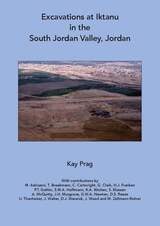
Excavations at Iktanu in the South Jordan Valley, Jordan
Kay Prag
Council for British Research in the Levant, 2024
Excellent Things in Women
A Memoir of Postcolonial PakistanSara Suleri Goodyear
University of Chicago Press, 1989
Sometimes, only the most heartbreaking memories possess the capacity—in their elegiac immediacy—to take our breath away. With Excellent Things in Women, Sara Suleri offers the reader a delicately wrought memoir of life in postcolonial Pakistan. Suleri intertwines the violent history of Pakistan's independence with her own intimate experiences—relating the tumult of growing up female during a time of fierce change in the Middle East in the 1960s and ’70s. In the two selections presented here, “Excellent Things in Women” and “Meatless Days,” we watch as Suleri re-encounters the relationships that inform her voyage from adolescence to womanhood—with her Welsh mother; her Pakistani father, prominent political journalist Z. A. Suleri; and her tenacious grandmother, Dadi, along with her five siblings—as she comes to terms with the difficulties of growing up and her own complicated passage to the West.
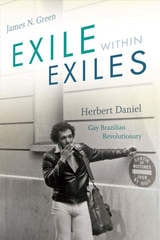
Exile within Exiles
Herbert Daniel, Gay Brazilian RevolutionaryJames N. Green
Duke University Press, 2018
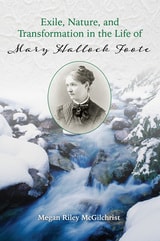
Exile, Nature, and Transformation in the Life of Mary Hallock Foote
Megan Riley McGilchrist
University of Nevada Press, 2021
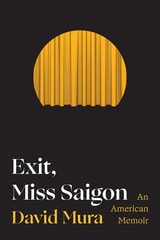
Exit, Miss Saigon
An American MemoirDavid Mura
University of Minnesota Press, 2026
A profound memoir of coming to terms with a lost racial identity
David Mura was well into his twenties when he began to explore his Asian American identity. His Japanese American parents had been incarcerated in internment camps during World War II, and in response to their traumatic experience, they abandoned their Japanese roots to try to assimilate into white, middle-class America. As a result, Mura was raised to consider himself as a white person, and his journey toward understanding and accepting his Asianness was a fraught road—one that left many fractured relationships in its wake. In Exit, Miss Saigon, Mura writes with frank openness about his personal experiences and the irrevocable ways they are rooted in the internalized, systemic racism that permeates American culture.
Starting out as a young poet in Minneapolis working toward a PhD, Mura avoided reading “minority literature,” yearning instead to be like famed poets in their ivory towers—Robert Lowell, Randall Jarrell, John Berryman, artists tortured by their families and personal demons rather than by politics or race. As Mura began to read more widely, his conceptions of race and its societal construction began to broaden. When the Ordway Theater in St. Paul, Minnesota, staged a presentation of Miss Saigon in 1992, Mura published “Secrets and Anger” in Mother Jones, a scathing critique of the play’s racist undertones and the arguments he’d been having with white artist friends about it. As a result, Mura was ostracized from the local, dominantly white writing community, yet in its place he found a deeper connection with other BIPOC writers and eventually started an Asian American arts organization in the Twin Cities.
Far more than a personal memoir, Exit, Miss Saigon is a clear-eyed examination of issues affecting Asian Americans: anti-Asian hate crimes during the pandemic, affirmative action, racial and sexual stereotypes in the media, interracial relationships and raising mixed-race children, the legacy of Japanese American internment, and the shortfalls of therapy in addressing race. Mura excavates the deep-seated racist stereotypes thrust on those perceived as “other” (read: nonwhite people) and works to uncover a more authentic, liberatory path to defining personal identity.
Retail e-book files for this title are screen-reader friendly.
Expecting Teryk
An Exceptional Path to ParenthoodDawn Prince-Hughes
Ohio University Press, 2005
“Expecting Teryk is a rich and sumptuous work that speaks to the deeper realities and represents a unique viewpoint of experiences shared by all individuals who choose the path to parenthood.”—Disability, Pregnancy, and Parenthood
The period just prior to the birth of a child is a time of profound personal transformation for expectant parents. Expecting Teryk: An Exceptional Path to Parenthood is an intimate exploration, written in the form of a letter from a parent to her future son, that reclaims a rite of passage that modern society would strip of its magic.
Dawn Prince-Hughes, renowned author of Songs of the Gorilla Nation: My Journey through Autism, considers the ways being autistic might inform her parenting. She also candidly narrates her experience of becoming a parent as part of a lesbian couple—from meeting her partner to the questions they ask about their readiness to become parents and the practical considerations of choosing a sperm donor.
Expecting Teryk is viewed through the lens of autism as Prince-Hughes shares the unique way she sees and experiences the world—as well as her aching will to be fully present for her son. Contemplating the evolutionary traditions of parenting from both animal and human perspectives and the reassurances that nature offers, Expecting Teryk is a work of sensuous wonder that speaks to the deeper realities and archetypal experiences shared by all who embark on the journey of parenthood.
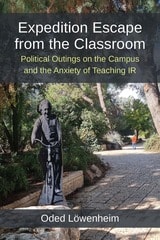
Expedition Escape from the Classroom
Political Outings on the Campus and the Anxiety of Teaching IROded Löwenheim
University of Michigan Press, 2024
Expedition Escape from the Classroom offers a unique narrative where teaching and its inherent challenges intersect with the intricacies of global politics, history, and identity. While recounting his academic experiment, Löwenheim grapples with the changing landscape of academia in a neoliberal age, while illustrating how personal vulnerabilities can transform into powerful tools for growth, exploration, and enlightenment. Whether you’re an educator, student, or just a curious reader, Expedition Escape from the Classroom promises a journey of reflection, critical thinking, and profound revelations.

Expedition of Hernando de Soto West of the Mississippi, 1541–1543
Proceedings of the de Soto Symposia, 1988 and 1990Gloria Young
University of Arkansas Press, 1999
Back by popular demand and new in paperback, this spirited collection of nearly twenty papers celebrates the 450th anniversary of Hernando de Soto’s epic expedition across the Southeast and West.
Originally presented at two symposia conducted by the University Museum at the University of Arkansas, the collection offers an array of viewpoints and diverse approaches to de Soto scholarship. Archaeologists, anthropologists, historians, museum curators, and folklorists all contribute to this lively debate on the Spanish explorer and his travels.
The book focuses on research that challenges traditional interpretation of de Soto’s entrada and travel route, particularly after the expedition crossed the Mississippi River. David H. Dye hypothesizes a route across the river and the alluvial plain by linking the narrative accounts with geography and archaeological knowledge. Phyllis A. Morse asserts that the Parkin site is the location of the capital of Casqui, one of the polities visited by de Soto. Charles M. Hudson repostulates his version of the expedition route, which in 1988 severely challenged the De Soto Commission theory of 1939. Ann M. Early redraws the trail in the uplands of the Ouachita Mountains And Frank E. Schambach tests the possibility that the expedition wandered through Caddoan territory in east Texas after de Soto’s death.
Several chapters examine the Native Americans whom de Soto and his expedition encountered in their journey; other contributions provide a fresh look at the chronicles of the expedition that have survived. What emerges is a redrawn map of de Soto’s exploration—and a deeper understanding of the impact of European contact on the New World.
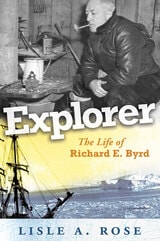
Explorer
The Life of Richard E. ByrdLisle A. Rose
University of Missouri Press, 2008
“Danger was all that thrilled him,” Dick Byrd’s mother once remarked, and from his first pioneering aviation adventures in Greenland in 1925, through his daring flights to the top and bottom of the world and across the Atlantic, Richard E. Byrd dominated the American consciousness during the tumultuous decades between the world wars. He was revered more than Charles Lindbergh, deliberately exploiting the public’s hunger for vicarious adventure. Yet some suspected him of being a poseur, and a handful reviled him as a charlatan who claimed great deeds he never really accomplished.
Then he overreached himself, foolishly choosing to endure a blizzard-lashed six-month polar night alone at an advance weather observation post more than one hundred long miles down a massive Antarctic ice shelf. His ordeal proved soul-shattering, his rescue one of the great epics of polar history. As his star began to wane, enemies grew bolder, and he struggled to maintain his popularity and political influence, while polar exploration became progressively bureaucratized and militarized. Yet he chose to return again and again to the beautiful, hateful, haunted secret land at the bottom of the earth, claiming, not without justification, that he was “Mayor of this place.”
Lisle A. Rose has delved into Byrd’s recently available papers together with those of his supporters and detractors to present the first complete, balanced biography of one of recent history’s most dynamic figures. Explorer covers the breadth of Byrd’s astonishing life, from the early days of naval aviation through his years of political activism to his final efforts to dominate Washington’s growing interest in Antarctica. Rose recounts with particular care Byrd’s two privately mounted South Polar expeditions, bringing to bear new research that adds considerable depth to what we already know. He offers views of Byrd’s adventures that challenge earlier criticism of him—including the controversy over his claim to being the first to have flown over the North Pole in 1926—and shows that the critics’ arguments do not always mesh with historical evidence.
Throughout this compelling narrative, Rose offers a balanced view of an ambitious individual who was willing to exaggerate but always adhered to his principles—a man with a vision of himself and the world that inspired others, who cultivated the rich and famous, and who used his notoriety to espouse causes such as world peace. Explorer paints a vivid picture of a brilliant but flawed egoist, offering the definitive biography of the man and armchair adventure of the highest order.
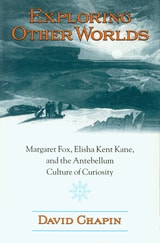
Exploring Other Worlds
Margaret Fox, Elisha Kent Kane, and the Antebellum Culture of CuriosityDavid Chapin
University of Massachusetts Press, 2004
Exploring Other Worlds tells the intertwined stories of the Arctic explorer Elisha Kent Kane and the spiritualist medium Margaret Fox and examines their unlikely relationship. Kane, from a prominent Philadelphia family, became one of the most renowned and honored explorers of the antebellum era. Fox grew up in rural upstate New York and, as one of the Fox Sisters, became a famed and somewhat notorious “spirit raper” whose strange “knocks” were said to be communications from the dead. The two were rumored to have had a love affair, and they may even have been secretly married.
In their separate professional lives, Kane and Fox each revealed something new and strange (though not necessarily true) to their audiences—the unknown worlds of the globe and the spirit. They brought experiences to their listeners that were exotic and delightful. The bourgeoning commercial mass culture of antebellum America provided a natural venue for tales of huge icebergs, fierce polar bears, and messages from the dead. Their public careers bridged the gaps between the scientific investigations of an earlier Enlightenment age and a newer form of sensational inquiry growing up in a democratic marketplace.
Though Kane and Fox began by generating curiosity about geography and the nature of the human soul, in time their personal relationship became the basis for what newspaperman Horace Greeley would call an “impertinent curiosity.” Newspapers printed letters about their supposed romance, and eventually a book purporting to be the famous explorer's love-letters to the notorious spiritualist was published. Curiosity about the Arctic and curiosity about the fate of the soul after death were transformed into curiosity about the private affairs of a new kind of media-driven public celebrity.
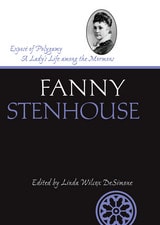
Exposé of Polygamy
A Lady's Life Among the MormonsFanny Stenhouse
Utah State University Press, 2008
After the 1872 publication of Exposé,Fanny Stenhouse became a celebrity in the cultural wars between Mormons and much of America. An English convert, she had grown disillusioned with the Mormon Church and polygamy, which her husband practiced before associating with a circle of dissident Utah intellectuals and merchants. Stenhouse’s critique of plural marriage, Brigham Young, and Mormonism was also a sympathetic look at Utah’s people and honest recounting of her life. She later created a new edition, titled "Tell It All," which ensured her notoriety in Utah and popularity elsewhere but turned her thoughtful memoir into a more polemical, true exposé of Polygamy. Since 1874, it has stayed in print, in multiple, varying editions. The original book, meanwhile, is less known, though more readable. Tracing the literary history of Stenhouse’s important piece of Americana, Linda DeSimone rescues an important autobiographical and historical record from the baggage notoriety brought to it.
Eye Trouble
A Memoir of Imperfect MaculasAlice Mattison
Northwestern University Press, 2027
A candid and enlightening account of life with flawed vision
Alice Mattison observes the world differently: Her sight has been altered by a progressive eye disease. Mattison had hints early in life of something amiss when reading became difficult, and she was diagnosed in her forties with a rare form of macular degeneration—a disease that gradually destroyed her central vision in one eye. Years later, another form of the same disease threatened her other eye, further altering her sight. Her eye ailments affect relationships with friends, students, doctors, her partner—and especially with herself. Mattison asks questions that apply to all of us, whether or not we live with imperfect vision: What can we learn from a medical problem? How do we determine how bad it is? Who gets to decide that—our family and friends, our doctors, or we ourselves? And, perhaps most challenging of all, what good can come of disease?
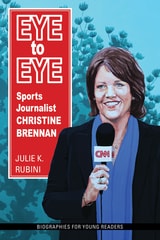
Eye to Eye
Sports Journalist Christine BrennanJulie K. Rubini
Ohio University Press, 2019
Christine Brennan, the USA Today sports columnist, author, and commentator, uses her voice to advocate for diversity and equality in the world of sports, and her wisdom to encourage future journalists. Her passion for sports was sparked by her dad, who encouraged her to participate in athletics and, as he said, “smell the game”—go watch baseball and football games together.
As a child, Christine wrote daily entries in her diary and listened to play-by-play coverage on her radio. She pursued this love of words through journalism school and applied her passion for sports by reporting on them for various newspapers. Since then, she has portrayed the setbacks and triumphs of athletes, all the while fighting her own battles for success—and respect—as a female journalist.
From knocking down barriers in NFL locker rooms to covering every Olympics since 1984 to being the go-to commentator whenever scandal occurs in the sports world, Christine Brennan has done it all. Eye to Eye invites young readers to learn more about this remarkable journalist and perhaps to nurture their own dreams of investigating and telling important stories.
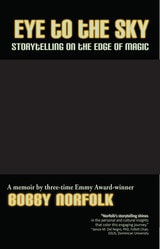
Eye to the Sky
Storytelling on the Edge of MagicBobby Norfolk
Parkhurst Brothers, Inc., 2016
Nobody knows how to tell a story like Bobby Norfolk, and here he tells his own life story. Norfolk grew up in hardscrabble neighborhoods of Saint Louis, Missouri, during the 1950s and 60s, sometimes walking to elementary school from an apartment his parents could not afford to heat. Lifting himself up by force of will and God-given talent, Norfolk defeated a childhood stutter to become a high school dramatist and later an exceptional college student. The path was never easy—and often frightening. With men of color being killed all-too-frequently in America, Norfolk sought a personal identity based upon talent and hard work, but also upon where safety and justice might be found. He tells these stories—some heartwarming or humorous, some frightful and treacherous—honestly, with a graceful mindfulness that all would do well to emulate.

Eyes like Mine
A Memoir between Blindness and SightTalea Anderson
Temple University Press, 2027
Talea Anderson is a person with low vision. Although she passes as sighted, she feels she has a “blind identity.” Eyes like Mine is her candid and revealing memoir detailing her experience grappling with partial vision and the isolation and loneliness that this often brings. Anderson expresses a longing for connection and community, especially with those who live in the space between sight and blindness.
Eyes like Mine examines ideas of disability as Anderson understands the nature of her blindness and sight and how that has evolved over her life. She relates her experiences to historical figures with low or partial vision, including painter Claude Monet, disability advocate Helen Keller, and musician and composer Maria Theresia von Paradis, among others.
Writing eloquently about her surgeries, and others’ efforts to “fix her,” Anderson captures her experience with disability with confidence and self-reflexive humor. Eyes like Mine does not speak for all blind people or others with partial vision. Instead, Anderson investigates how disabled people think about their relationship with disability and how they identify.

Ezra Pound - American Writers 26
University of Minnesota Pamphlets on American WritersWilliam Van O’Connor
University of Minnesota Press, 1963
Ezra Pound - American Writers 26 was first published in 1963. Minnesota Archive Editions uses digital technology to make long-unavailable books once again accessible, and are published unaltered from the original University of Minnesota Press editions.

Ezra Pound and Margaret Cravens
A Tragic Friendship, 1910–1912Omar Pound and Robert Spoo, editors
Duke University Press, 1988
Pound was deeply affected by her death, as was the poet H. D., who had recently come to know her. Pound's letters to Cravens, extensively annotated, are published here for the first time; her suicide note to him is also included. Ezra Pound and Margaret Cravens contains photographs and previously unpublished material by Pound and H.D., as well as an excerpt from H.D.'s autobiographical novel Asphodel, in which Cravens figures prominently. This portrait of a friendship provides insight into the literary achievements of Pound and H.D. and tells the unknown story of Margaret Cravens's tragic life.

e-mail trouble
love and addiction @ the matrixBy S. Paige Baty
University of Texas Press, 1999
"This is about a society of isolates who all communicate with one another from terminal sites. This is about being disembodied, distanced, distinct, and that sort of boundary-thing. It is not about being present. It is not about being there. It is not about a shared history, or a shared meal, or a shared story, or any kind of mutuality. It is about contact between virtual strangers. . . . It happens when you feel that you are so alone that you need anybody to talk to—anybody at all—because you believe that your connections have failed you. This kind of connection leaves you cold and dead inside, because it lacks history and a language of belonging."
In this daring, postmodern autobiography, S. Paige Baty recounts her search for love and community on the Internet. Taking Jack Kerouac's On the Road as a point of departure, Baty describes both an actual road trip to meet the object of an e-mail romance and the cyber-search for connection that draws so many people into the matrix of the Internet. Writing in a bold, experimental style that freely mixes e-mails, poems, fragments of quotations, and puns into expository text, she convincingly links e-mail trouble with "female trouble" in the displacement of embodied love and accountable human relationships to opaque screens and alienated identities. Her book stands as a vivid feminist critique of our culture's love affair with technology and its dehumanizing effect on personal relationships.