4917 books match the query 'Philosophy' and 231 start with e

cover of Ethics, Nationalism, and Just War: Medieval and Contemporary Perspectives

Ethics, Nationalism, and Just War

Medieval and Contemporary Perspectives

Henrik Syse

Catholic University of America Press, 2007
The book covers a wide range of topics and raises issues rarely touched on in the ethics-of-war literature, such as environmental concerns and the responsibility of bystanders.
[more]
cover of Ethics, volume 131 number 4 (July 2021)

Ethics, volume 131 number 4 (July 2021)

The University of Chicago Press

University of Chicago Press Journals, 2021
This is volume 131 issue 4 of Ethics. Ethics features scholarly work that covers a range of topics pertaining to moral, political, and legal philosophy from a variety of intellectual perspectives, including social and political theory, law, and economics. Articles in the journal present new theories, apply theory to contemporary moral issues, and focus on historical works that have significant implications for contemporary theory. In addition to major articles, Ethics publishes critical discussions, symposia, review essays, and book reviews.
[more]
cover of Ethics, volume 132 number 1 (October 2021)

Ethics, volume 132 number 1 (October 2021)

The University of Chicago Press

University of Chicago Press Journals, 2021
This is volume 132 issue 1 of Ethics. Ethics features scholarly work that covers a range of topics pertaining to moral, political, and legal philosophy from a variety of intellectual perspectives, including social and political theory, law, and economics. Articles in the journal present new theories, apply theory to contemporary moral issues, and focus on historical works that have significant implications for contemporary theory. In addition to major articles, Ethics publishes critical discussions, symposia, review essays, and book reviews.
[more]
cover of Ethics, volume 132 number 2 (January 2022)

Ethics, volume 132 number 2 (January 2022)

The University of Chicago Press

University of Chicago Press Journals, 2022
This is volume 132 issue 2 of Ethics. Ethics features scholarly work that covers a range of topics pertaining to moral, political, and legal philosophy from a variety of intellectual perspectives, including social and political theory, law, and economics. Articles in the journal present new theories, apply theory to contemporary moral issues, and focus on historical works that have significant implications for contemporary theory. In addition to major articles, Ethics publishes critical discussions, symposia, review essays, and book reviews.
[more]
cover of Ethics, volume 132 number 3 (April 2022)

Ethics, volume 132 number 3 (April 2022)

The University of Chicago Press

University of Chicago Press Journals, 2022
This is volume 132 issue 3 of Ethics. Ethics features scholarly work that covers a range of topics pertaining to moral, political, and legal philosophy from a variety of intellectual perspectives, including social and political theory, law, and economics. Articles in the journal present new theories, apply theory to contemporary moral issues, and focus on historical works that have significant implications for contemporary theory. In addition to major articles, Ethics publishes critical discussions, symposia, review essays, and book reviews.
[more]
cover of Ethics, volume 132 number 4 (July 2022)

Ethics, volume 132 number 4 (July 2022)

The University of Chicago Press

University of Chicago Press Journals, 2022
This is volume 132 issue 4 of Ethics. Ethics features scholarly work that covers a range of topics pertaining to moral, political, and legal philosophy from a variety of intellectual perspectives, including social and political theory, law, and economics. Articles in the journal present new theories, apply theory to contemporary moral issues, and focus on historical works that have significant implications for contemporary theory. In addition to major articles, Ethics publishes critical discussions, symposia, review essays, and book reviews.
[more]
cover of Ethics, volume 133 number 1 (October 2022)

Ethics, volume 133 number 1 (October 2022)

The University of Chicago Press

University of Chicago Press Journals, 2022
This is volume 133 issue 1 of Ethics. Ethics features scholarly work that covers a range of topics pertaining to moral, political, and legal philosophy from a variety of intellectual perspectives, including social and political theory, law, and economics. Articles in the journal present new theories, apply theory to contemporary moral issues, and focus on historical works that have significant implications for contemporary theory. In addition to major articles, Ethics publishes critical discussions, symposia, review essays, and book reviews.
[more]
cover of Ethics, volume 133 number 2 (January 2023)

Ethics, volume 133 number 2 (January 2023)

The University of Chicago Press

University of Chicago Press Journals, 2023
This is volume 133 issue 2 of Ethics. Ethics features scholarly work that covers a range of topics pertaining to moral, political, and legal philosophy from a variety of intellectual perspectives, including social and political theory, law, and economics. Articles in the journal present new theories, apply theory to contemporary moral issues, and focus on historical works that have significant implications for contemporary theory. In addition to major articles, Ethics publishes critical discussions, symposia, review essays, and book reviews.
[more]
cover of Ethics, volume 133 number 3 (April 2023)

Ethics, volume 133 number 3 (April 2023)

The University of Chicago Press

University of Chicago Press Journals, 2023
This is volume 133 issue 3 of Ethics. Ethics features scholarly work that covers a range of topics pertaining to moral, political, and legal philosophy from a variety of intellectual perspectives, including social and political theory, law, and economics. Articles in the journal present new theories, apply theory to contemporary moral issues, and focus on historical works that have significant implications for contemporary theory. In addition to major articles, Ethics publishes critical discussions, symposia, review essays, and book reviews.
[more]
cover of Ethics, volume 133 number 4 (July 2023)

Ethics, volume 133 number 4 (July 2023)

The University of Chicago Press

University of Chicago Press Journals, 2023
This is volume 133 issue 4 of Ethics. Ethics features scholarly work that covers a range of topics pertaining to moral, political, and legal philosophy from a variety of intellectual perspectives, including social and political theory, law, and economics. Articles in the journal present new theories, apply theory to contemporary moral issues, and focus on historical works that have significant implications for contemporary theory. In addition to major articles, Ethics publishes critical discussions, symposia, review essays, and book reviews.
[more]
cover of Ethics, volume 134 number 1 (October 2023)

Ethics, volume 134 number 1 (October 2023)

The University of Chicago Press

University of Chicago Press Journals, 2023
This is volume 134 issue 1 of Ethics. Ethics features scholarly work that covers a range of topics pertaining to moral, political, and legal philosophy from a variety of intellectual perspectives, including social and political theory, law, and economics. Articles in the journal present new theories, apply theory to contemporary moral issues, and focus on historical works that have significant implications for contemporary theory. In addition to major articles, Ethics publishes critical discussions, symposia, review essays, and book reviews.
[more]
cover of Ethics, volume 134 number 2 (January 2024)

Ethics, volume 134 number 2 (January 2024)

The University of Chicago Press

University of Chicago Press Journals, 2024
This is volume 134 issue 2 of Ethics. Ethics features scholarly work that covers a range of topics pertaining to moral, political, and legal philosophy from a variety of intellectual perspectives, including social and political theory, law, and economics. Articles in the journal present new theories, apply theory to contemporary moral issues, and focus on historical works that have significant implications for contemporary theory. In addition to major articles, Ethics publishes critical discussions, symposia, review essays, and book reviews.
[more]
cover of Ethics, volume 134 number 3 (April 2024)

Ethics, volume 134 number 3 (April 2024)

The University of Chicago Press

University of Chicago Press Journals, 2024
This is volume 134 issue 3 of Ethics. Ethics features scholarly work that covers a range of topics pertaining to moral, political, and legal philosophy from a variety of intellectual perspectives, including social and political theory, law, and economics. Articles in the journal present new theories, apply theory to contemporary moral issues, and focus on historical works that have significant implications for contemporary theory. In addition to major articles, Ethics publishes critical discussions, symposia, review essays, and book reviews.
[more]
cover of Ethics, volume 134 number 4 (July 2024)

Ethics, volume 134 number 4 (July 2024)

The University of Chicago Press

University of Chicago Press Journals, 2024
This is volume 134 issue 4 of Ethics. Ethics features scholarly work that covers a range of topics pertaining to moral, political, and legal philosophy from a variety of intellectual perspectives, including social and political theory, law, and economics. Articles in the journal present new theories, apply theory to contemporary moral issues, and focus on historical works that have significant implications for contemporary theory. In addition to major articles, Ethics publishes critical discussions, symposia, review essays, and book reviews.
[more]
cover of Ethics, volume 135 number 1 (October 2024)

Ethics, volume 135 number 1 (October 2024)

The University of Chicago Press

University of Chicago Press Journals, 2024
This is volume 135 issue 1 of Ethics. Ethics features scholarly work that covers a range of topics pertaining to moral, political, and legal philosophy from a variety of intellectual perspectives, including social and political theory, law, and economics. Articles in the journal present new theories, apply theory to contemporary moral issues, and focus on historical works that have significant implications for contemporary theory. In addition to major articles, Ethics publishes critical discussions, symposia, review essays, and book reviews.
[more]
cover of Ethics, volume 135 number 2 (January 2025)

Ethics, volume 135 number 2 (January 2025)

The University of Chicago Press

University of Chicago Press Journals, 2025
This is volume 135 issue 2 of Ethics. Ethics features scholarly work that covers a range of topics pertaining to moral, political, and legal philosophy from a variety of intellectual perspectives, including social and political theory, law, and economics. Articles in the journal present new theories, apply theory to contemporary moral issues, and focus on historical works that have significant implications for contemporary theory. In addition to major articles, Ethics publishes critical discussions, symposia, review essays, and book reviews.
[more]
cover of Ethics, volume 135 number 3 (April 2025)

Ethics, volume 135 number 3 (April 2025)

The University of Chicago Press

University of Chicago Press Journals, 2025
This is volume 135 issue 3 of Ethics. Ethics features scholarly work that covers a range of topics pertaining to moral, political, and legal philosophy from a variety of intellectual perspectives, including social and political theory, law, and economics. Articles in the journal present new theories, apply theory to contemporary moral issues, and focus on historical works that have significant implications for contemporary theory. In addition to major articles, Ethics publishes critical discussions, symposia, review essays, and book reviews.
[more]
cover of Ethics, volume 135 number 4 (July 2025)

Ethics, volume 135 number 4 (July 2025)

The University of Chicago Press

University of Chicago Press Journals, 2025
This is volume 135 issue 4 of Ethics. Ethics features scholarly work that covers a range of topics pertaining to moral, political, and legal philosophy from a variety of intellectual perspectives, including social and political theory, law, and economics. Articles in the journal present new theories, apply theory to contemporary moral issues, and focus on historical works that have significant implications for contemporary theory. In addition to major articles, Ethics publishes critical discussions, symposia, review essays, and book reviews.
[more]
cover of Ethics, volume 136 number 1 (October 2025)

Ethics, volume 136 number 1 (October 2025)

The University of Chicago Press

University of Chicago Press Journals, 2025
This is volume 136 issue 1 of Ethics. Ethics features scholarly work that covers a range of topics pertaining to moral, political, and legal philosophy from a variety of intellectual perspectives, including social and political theory, law, and economics. Articles in the journal present new theories, apply theory to contemporary moral issues, and focus on historical works that have significant implications for contemporary theory. In addition to major articles, Ethics publishes critical discussions, symposia, review essays, and book reviews.
[more]
cover of Ethics, volume 136 number 2 (January 2026)

Ethics, volume 136 number 2 (January 2026)

The University of Chicago Press

University of Chicago Press Journals, 2026
This is volume 136 issue 2 of Ethics. Ethics features scholarly work that covers a range of topics pertaining to moral, political, and legal philosophy from a variety of intellectual perspectives, including social and political theory, law, and economics. Articles in the journal present new theories, apply theory to contemporary moral issues, and focus on historical works that have significant implications for contemporary theory. In addition to major articles, Ethics publishes critical discussions, symposia, review essays, and book reviews.
[more]
cover of Ethics, volume 136 number 3 (April 2026)

Ethics, volume 136 number 3 (April 2026)

The University of Chicago Press

University of Chicago Press Journals, 2026
This is volume 136 issue 3 of Ethics. Ethics features scholarly work that covers a range of topics pertaining to moral, political, and legal philosophy from a variety of intellectual perspectives, including social and political theory, law, and economics. Articles in the journal present new theories, apply theory to contemporary moral issues, and focus on historical works that have significant implications for contemporary theory. In addition to major articles, Ethics publishes critical discussions, symposia, review essays, and book reviews.
[more]
cover of Ethics, volume 136 number 4 (July 2026)

Ethics, volume 136 number 4 (July 2026)

The University of Chicago Press

University of Chicago Press Journals, 2026
This is volume 136 issue 4 of Ethics. Ethics features scholarly work that covers a range of topics pertaining to moral, political, and legal philosophy from a variety of intellectual perspectives, including social and political theory, law, and economics. Articles in the journal present new theories, apply theory to contemporary moral issues, and focus on historical works that have significant implications for contemporary theory. In addition to major articles, Ethics publishes critical discussions, symposia, review essays, and book reviews.
[more]
cover of Ethics, volume 137 number 1 (October 2026)

Ethics, volume 137 number 1 (October 2026)

The University of Chicago Press

University of Chicago Press Journals, 2026

This is volume 137 issue 1 of Ethics. Ethics features scholarly work that covers a range of topics pertaining to moral, political, and legal philosophy from a variety of intellectual perspectives, including social and political theory, law, and economics. Articles in the journal present new theories, apply theory to contemporary moral issues, and focus on historical works that have significant implications for contemporary theory. In addition to major articles, Ethics publishes critical discussions, symposia, review essays, and book reviews.
[more]
cover of Ethnographies of Youth and Temporality: Time Objectified

Ethnographies of Youth and Temporality

Time Objectified

Anne Line Dalsgard

Temple University Press, 2014

As we experience and manipulate time—be it as boredom or impatience—it becomes an object: something materialized and social, something that affects perception, or something that may motivate reconsideration and change. The editors and contributors to this important new book, Ethnographies of Youth and Temporality, have provided a diverse collection of ethnographic studies and theoretical explorations of youth experiencing time in a variety of contemporary socio-cultural settings.
 
The essays in this volume focus on time as an external and often troubling factor in young people’s lives, and shows how emotional unrest and violence but also creativity and hope are responses to troubling times. The chapters discuss notions of time and its and its “objectification” in diverse locales including the Georgian Republic, Brazil, Denmark and Uganda.
 
Based on long-term ethnographic fieldwork, the essays in Ethnographies of Youth and Temporality use youth as a prism to understand time and its subjective experience. 

In the series Global Youth, edited by Craig Jeffrey and Jane Dyson
[more]
cover of Ethnography and Human Development: Context and Meaning in Social Inquiry

Ethnography and Human Development

Context and Meaning in Social Inquiry

Edited by Richard Jessor, Anne Colby, and Richard A. Shweder

University of Chicago Press, 1996

Studies of human development have taken an ethnographic turn in the 1990s. In this volume, leading anthropologists, psychologists, and sociologists discuss how qualitative methodologies have strengthened our understanding of cognitive, emotional, and behavioral development, and of the difficulties of growing up in contemporary society.

Part 1, informed by a post-positivist philosophy of science, argues for the validity of ethnographic knowledge. Part 2 examines a range of qualitative methods, from participant observation to the hermeneutic elaboration of texts. In Part 3, ethnographic methods are applied to issues of human development across the life span and to social problems including poverty, racial and ethnic marginality, and crime.

Restoring ethnographic methods to a central place in social inquiry, these twenty-two lively essays will interest everyone concerned with the epistemological problems of context, meaning, and subjectivity in the behavioral sciences.

[more]
cover of Ethnological Imagination: A Cross-Cultural Critique Of Modernity

Ethnological Imagination

A Cross-Cultural Critique Of Modernity

Fuyuki Kurasawa

University of Minnesota Press, 2004

A significant intervention in contemporary debates about cross-cultural understanding

Fuyuki Kurasawa unearths what he terms “the ethnological imagination,” a substantial countercurrent of thought that interprets and contests Western modernity’s existing social order through comparison and contrast to a non-Western other. Accordingly, Kurasawa traces and critiques, through this prism of cultural alterity, the writings of some of the key architects of this way of thinking: Jean-Jacques Rousseau, Karl Marx, Max Weber, Émile Durkheim, Claude Lévi-Strauss, and Michel Foucault.

In the work of these thinkers, Kurasawa finds little justification for two of the most prevalent claims about social theory: the wholesale “postmodern” dismissal of the social-theoretical enterprise because of its supposedly intractable ethnocentrism and imperialism, or, on the other hand, the traditionalist and historicist revival of a canon stripped of its intercultural foundations. Rather, Kurasawa’s book defends a cultural perspective that eschews both the false universalism of “end of history” scenarios and the radical particularism embodied in the vision of “the clash of civilizations.” It contends that the ethnological imagination can invigorate critical social theory by informing its response to an increasingly multicultural world—a response that calls for a reconsideration of the identity and boundaries of the West as well of modernity itself.

[more]
cover of Etienne Gilson: An Intellectual and Political Biography

Etienne Gilson

An Intellectual and Political Biography

Florian Michel

Catholic University of America Press, 2023

Étienne Gilson (1884-1978) was a French philosopher and historian of philosophy, as well as a scholar of medieval philosophy. In 1946 he attained the distinction of being elected an "Immortal" (member) of the Académie française. He was nominated for the Nobel Prize in Literature in 1959 and 1964. This major biography of Gilson was first published in France in 2018, and now arrives in a long-anticipated English translation. Florian Michel traces Gilson’s life through his time as a professor at the College de France and member of the French Academy. Gilson was a prisoner of war in Germany, was one of the first to describe the horrors of the famine in Ukraine (1922), created an institute of medieval studies in Toronto, published hundreds of articles in the French daily press and took part in the founding conferences of the United Nations.He was neither for Sartre nor for Aron, and advocated, when the NATO agreements were signed, the neutrality and non-alignment of Europe. Gilson did not hesitate to engage in quarrels with the bishops and allows us to understand how one passes from a critical modernism before the First World War to a liberal Thomism and to the Vatican Council II. James G. Colbert, who translated Gilson’s The Metamorphosis of the City of God, offers a careful and measured translation to bring this important work to an English speaking audience.
[more]
cover of Etty Hillesum and the Flow of Presence: A Voegelinian Analysis

Etty Hillesum and the Flow of Presence

A Voegelinian Analysis

Meins G. S. Coetsier

University of Missouri Press, 2008

Although she died cruelly at Auschwitz at the age of twenty-nine, Etty Hillesum left a lasting legacy of mystical thought in her letters and diaries. Hillesum was a complex and powerful witness to the openness of the human spirit to the call of God, even under the most harrowing circumstances. Her life was as much shaped by Hitler’s regime as was that of philosopher Eric Voegelin, and as Meins Coetsier reveals, her thought lends itself to interpretation from a uniquely Voegelinian perspective.

Etty Hillesum and the Flow of Presence analyzes the life and writings of Hillesum from the standpoint of Voegelin’s views on consciousness—especially his philosophy of luminous participation in the transcendent ground of being. Through a careful reading of her letters and diaries, Coetsier reveals the inner development of Hillesum’s mystically grounded resistance to Nazism as he guides readers through the symbolism of her spiritual journey, making effective use of Voegelin’s analytics of experience and symbolization to trace her path to spiritual truth.

Intertwining the lives, works, and visions of these two mystical thinkers, Coetsier demonstrates his mastery of both Voegelin’s philosophy and Hillesum’s Dutch-language materials. He shows how mystical attunement to the “flow of presence”—Voegelin’s designation for human responsiveness to the divine—is the key to the development of Hillesum’s life and writings. He displays a special affinity for the suffering and grace-filled transformation that she underwent as she approached the end of her life and gained insight into the ultimate purpose of each individual’s contribution to the well-being and maintenance of the human spirit.

Retrieving one of the lesser-known but most compelling figures of the Holocaust, Etty Hillesum and the Flow of Presence is an original contribution to both Voegelin and Hillesum scholarship that reflects these writers’ strong valuation of the human person. It presents Hillesum’s life and work in an original and provocative context, shedding new light on her experiences and their symbolizations while further broadening the application of Voegelin’s thought

[more]
cover of Etymologies and Genealogies: A Literary Anthropology of the French Middle Ages

Etymologies and Genealogies

A Literary Anthropology of the French Middle Ages

R. Howard Bloch

University of Chicago Press, 1983

"Mr. Bloch has attempted to establish what he calls a 'literary anthropology.' The project is important and ambitious. It seems to me that Mr. Bloch has completely achieved this ambition." –Michel Foucault

"Bloch's Study is a genuinely interdisciplinary one, bringing together elements of history, ethnology, philology, philosophy, economics and literature, with the undoubted ambition of generating a new synthesis which will enable us to read the Middle Ages in a different light.

Stated simply, and in terms which do justice neither to the density nor the subtlety of his argument, Bloch's thesis is this: that medieval society perceived itself in terms of a vertical mode of descent from origins. This model is articulated etymologically in medieval theories of grammar and language, and is consequently reflected in historical and theological writings; it is also latent in the genealogical structure of the aristocratic family as it began to be organized in France in the twelfth century, and is made manifest in such systems of signs as heraldry and the adoption of patronymns. . . .

It is an ingenious and compelling synthesis which no medievalist, even on this side of the Atlantic, can afford to ignore." –Nicholas Mann, Times Literary Supplement

[more]
cover of Euclid and His Twentieth Century Rivals: Diagrams in the Logic of Euclidean Geometry

Euclid and His Twentieth Century Rivals

Diagrams in the Logic of Euclidean Geometry

Nathaniel Miller

CSLI, 2007

Twentieth-century developments in logic and mathematics have led many people to view Euclid’s proofs as inherently informal, especially due to the use of diagrams in proofs. In Euclid and His Twentieth-Century Rivals, Nathaniel Miller discusses the history of diagrams in Euclidean Geometry, develops a formal system for working with them, and concludes that they can indeed be used rigorously. Miller also introduces a diagrammatic computer proof system, based on this formal system. This volume will be of interest to mathematicians, computer scientists, and anyone interested in the use of diagrams in geometry.
[more]
cover of Europe's Indians: Producing Racial Difference, 1500–1900

Europe's Indians

Producing Racial Difference, 1500–1900

Vanita Seth

Duke University Press, 2010

Europe’s Indians forces a rethinking of key assumptions regarding difference—particularly racial difference—and its centrality to contemporary social and political theory. Tracing shifts in European representations of two different colonial spaces, the New World and India, from the late fifteenth century through the late nineteenth, Vanita Seth demonstrates that the classification of humans into racial categories or binaries of self–other is a product of modernity. Part historical, part philosophical, and part a history of science, her account exposes the epistemic conditions that enabled the thinking of difference at distinct historical junctures. Seth’s examination of Renaissance, Classical Age, and nineteenth-century representations of difference reveals radically diverging forms of knowing, reasoning, organizing thought, and authorizing truth. It encompasses stories of monsters, new worlds, and ancient lands; the theories of individual agency expounded by Hobbes, Locke, and Rousseau; and the physiological sciences of the nineteenth century. European knowledge, Seth argues, does not reflect a singular history of Reason, but rather multiple traditions of reasoning, of historically bounded and contingent forms of knowledge. Europe’s Indians shows that a history of colonialism and racism must also be an investigation into the historical production of subjectivity, agency, epistemology, and the body.
[more]
cover of European Review of Philosophy, 6: The Structure of Nonconceptual Content

European Review of Philosophy, 6

The Structure of Nonconceptual Content

Edited by Christine van Geen and Frédérique de Vignemont

CSLI, 2006

Can concepts represent subtleties in emotions, bodily sensations, and perceptions? What is the nature of mental representations in nonlinguistic and prelinguistic creatures? The European Review of Philosophy, Volume 6 tackles issues such as these by asking how far the analogy between conceptual and nonconceptual content can be carried. By bringing together contributions from both conceptualists and nonconceptualists, this volume sheds new light on an issue sure to interest cognitive scientists and philosophers of mind.
 
 
[more]
cover of Evaluating Art

Evaluating Art

George Dickie

Temple University Press, 1989
"Those who think they know George Dickie's views should be sure to read this book. They are in for some interesting surprises. Of course, those unfamiliar with Dickie's views will also learn a lot." --Anita Silvers, San Francisco State University In this book George Dickie presents a theory about how to judge a work of art--as opposed to a theory that explains why a particular work is defined as art. Focusing mainly on the writings of Monroe Beardsley and critically examining the views of seven other philosophers and art critics--Paul Ziff, Frank Sibley, Nelson Goodman, Nicholas Wolterstorff, David Hume, Bruce Vermazen, and J. O. Urmson--Dickie synthesizes their insights to discover what can be derived from their theories. On this basis, he attempts to work out a theory of art evaluation--the first such book on this topic by a contemporary philosopher. Initially, the author outlines all possible theories of art evaluation, assuming that traditional evaluative notions are used. He identifies seven theory-types that fall under four general headings: imitation value theory, objective intrinsic value theories, subjective intrinsic value theory, and instrumental value theories. Dickie then discusses the historical development of the theory of art evaluation, examining the ways in which eighteenth- and nineteenth-century philosophers treated representation and other cognitive dimensions of art as artistic values. His thorough analysis of the work of other contemporary theorists argues for a theory of art evaluation derived from various strands of thought.
[more]
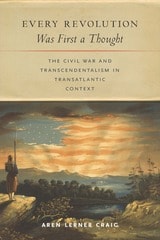
cover of Every Revolution Was First a Thought: The Civil War and Transcendentalism in Transatlantic Context

Every Revolution Was First a Thought

The Civil War and Transcendentalism in Transatlantic Context

Aren Lerner Craig

University of Massachusetts Press, 2025

Tracing the impact of transcendental philosophy on Union soldiers and their loved ones during the American Civil War

Scholars of the American Civil War have long wondered about the seemingly earnest and sincere sentimental commitment that most Northern soldiers had to their nation and the North’s cause. Unlike many others in other wars, Union soldiers appeared to embrace the war with an unusual conviction and sacrificed their lives with a rare nobility. Their grieving relatives were also buoyed up by their steadfast beliefs in the righteousness of the cause. What was so different about this war, and this period of American history, and what encouraged such an outlook?

In Every Revolution Was First a Thought, Aren Lerner Craig argues that in the Civil War era the American Transcendentalist movement provided a coherent worldview that fostered powerful idealism around issues of character, gender, race, and nationhood, even in the worst of times. Through an exploration of diaries, newspaper editorials, popular songs, and more, Craig demonstrates how Transcendentalist thought moved from elite intellectual circles to the public, providing people a firm belief in the power of individual agency to shape the world and a view of spirituality in which each person was divine, and thus beyond death and destruction. Transcendentalist tenets proved strong enough to withstand the devastation of war and inspired high levels of faith and optimism in soldiers and civilians alike throughout the conflict.

Craig traces the origins of Transcendentalism across the Atlantic, to ideas from Scottish Realism and German Idealism, and connects these philosophies to writings and speeches of major figures like Ralph Waldo Emerson, Henry David Thoreau, and Margaret Fuller. This intellectual history offers a new interpretation of Transcendental thought and its role in the Civil War.

[more]
cover of Every Tub Must Sit on Its Own Bottom: The Philosophy and Politics of Zora Neale Hurston

Every Tub Must Sit on Its Own Bottom

The Philosophy and Politics of Zora Neale Hurston

Deborah G. Plant

University of Illinois Press, 1995

     "Plant's study is sorely
        needed at this point in the evolving critical assessment of Hurston. It
        is a paradigm for the study of individual African American women writers."
        -- Alice Deck, University of Illinois at Urbana-Champaign
      In a ground-breaking study
        of Zora Neale Hurston, Deborah Plant takes issue with current notions
        of Hurston as a feminist and earlier impressions of her as an intellectual
        lightweight who disregarded serious issues of race in American culture.
        Instead, Plant calls Hurston a "writer of resistance" who challenged
        the politics of domination both in her life and in her work. One of the
        great geniuses of the Harlem Renaissance, Hurston stands out as a strong
        voice for African-American women. Her anthropological inquiries as well
        as her evocative prose provide today's readers with a rich history of
        African American folk culture, a folk culture through which Hurston expressed
        her personal and political strategy of resistance and self-empowerment.
      Through readings of Hurston's
        fiction and autobiographical writings, Plant offers one of the first book-length
        discussions of Hurston's personal philosophy of individualism and self-preservation.
        From a discussion of Hurston's preacher father and influential mother,
        whose guiding philosophy is reflected in the title of this book, to the
        influence of Spinoza and Nietzsche, Plant puts into perspective the driving
        forces behind Hurston's powerful prose.
      This fresh look at one of
        the most important writers of the twentieth century is sure to shape future
        study of Hurston and her work.

 
[more]
cover of Everything Flirts: Philosophical Romances

Everything Flirts

Philosophical Romances

Sharon Wahl

University of Iowa Press, 2024

2025 Carol Shields Prize for Fiction, longlist
At the heart of the stories in Everything Flirts are some of life’s trickiest questions: Why is it so hard to make the first move on a date? How do we find the person we will love? If you finally find a person to love, how do you convince them to love you back?
         With a mixture of humor and reverence, Sharon Wahl hijacks classic works of philosophy and turns their focus to love. The philosopher Wittgenstein helps us consider the limits of language: Does there exist an argument, a logical deduction, that will cause another person to love us? The philosopher Zeno’s laws of motion stipulate that we can only ever cross half of any distance. This principle is applied to a first date, where making a first move becomes more and more impossible because the movie this couple goes to see is a depressing mood-killer. A woman afraid of love applies Bentham’s utilitarian principles to find her perfect match, testing every man she meets until she finds one who aces every one of her tests. Nonetheless, she wonders: Is he right for her? Is she ready to fall in love forever? The sublime and the ridiculous come together to playfully examine why love just might be a topic too hard for philosophers to explain.

 
[more]
cover of Everything is Police

Everything is Police

Tia Trafford

University of Minnesota Press, 2024

How institutional and interpersonal policing have been central to worldmaking

Policing is constitutive of colonial modernity: normalizing, internalizing, and legalizing anti-Black violence as the ongoing condition for white life and freedom. The result, Tia Trafford argues here, is a situation where we cannot practically experience or even imagine worlds free from policing. From the plantation to the prison, global apartheid, and pandemic control, this book examines why and how policing has become the most ingrained, commonsense—and insidious—way of managing our world.
[more]
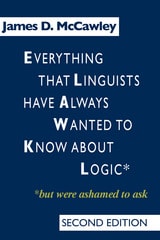
cover of Everything that Linguists have Always Wanted to Know about Logic . . . But Were Ashamed to Ask

Everything that Linguists have Always Wanted to Know about Logic . . . But Were Ashamed to Ask

James D. McCawley

University of Chicago Press, 1993

McCawley supplements his earlier book—which covers such topics as presuppositional logic, the logic of mass terms and nonstandard quantifiers, and fuzzy logic—with new material on the logic of conditional sentences, linguistic applications of type theory, Anil Gupta's work on principles of identity, and the generalized quantifier approach to the logical properties of determiners.
[more]
cover of Everything to Gain: Making the Most of the Rest of Your Life

Everything to Gain

Making the Most of the Rest of Your Life

Jimmy Carter

University of Arkansas Press, 1995
Everything to Gain, first published in 1987, is the warm account of Jimmy and Rosalynn Carter’s life after their years in the White House. They discuss their marriage and health issues, their work with Habitat for Humanity and the Carter Center, and much more.
[more]
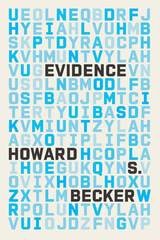
cover of Evidence

Evidence

Howard S. Becker

University of Chicago Press, 2017

Howard S. Becker is a master of his discipline. His reputation as a teacher, as well as a sociologist, is supported by his best-selling quartet of sociological guidebooks: Writing for Social Scientists, Tricks of the Trade, Telling About Society, and What About Mozart? What About Murder? It turns out that the master sociologist has yet one more trick up his sleeve—a fifth guidebook, Evidence.

Becker has for seventy years been mulling over the problem of evidence. He argues that social scientists don’t take questions about the usefulness of their data as evidence for their ideas seriously enough. For example, researchers have long used the occupation of a person’s father as evidence of the family’s social class, but studies have shown this to be a flawed measure—for one thing, a lot of people answer that question too vaguely to make the reasoning plausible. The book is filled with examples like this, and Becker uses them to expose a series of errors, suggesting ways to avoid them, or even to turn them into research topics in their own right. He argues strongly that because no data-gathering method produces totally reliable information, a big part of the research job consists of getting rid of error. Readers will find Becker’s newest guidebook a valuable tool, useful for social scientists of every variety.

[more]
cover of Evidence and Inference in History and Law: Interdisciplinary Dialogues

Evidence and Inference in History and Law

Interdisciplinary Dialogues

William Twining and Ian Hampsher-Monk

Northwestern University Press, 2003

Northwestern University Press co-published William Twining's Rethinking Evidence in 1994 and Analysis of Evidence in 1998. This new volume, Evidence and Inference, is an interdisciplinary volume exploring the application of techniques of evidence and inference across a variety of fields.

Coedited by Twining, one of the world's outstanding evidence scholars, and Iain Hampsher-Monk, a leading political theorist, the volume considers intriguing questions from Assyriology, theater iconography, musicology, criminology, the history of ideas, and colonial history as it reveals how particular concepts, lines of questioning, and techniques of reasoning and analysis developed in one context can be fruitfully applied in others. Did cuneiform languages really die out in the second or third century B.C.? Was Schubert responsible for any of the guitar arrangements for some of his lieder? In these cases and others, the authors' work demonstrates that, regardless of the field or the problem, all such projects involve drawing inferences from evidence, and that the logic of this kind of inquiry is always governed by the same principles.
[more]
cover of Evidence for God from Physics and Philosophy: Extending the Legacy of Monsignor George Lemaître and St. Thomas Aquinas

Evidence for God from Physics and Philosophy

Extending the Legacy of Monsignor George Lemaître and St. Thomas Aquinas

Robert J. Spitzer, S.J.

St. Augustine's Press, 2015
[more]
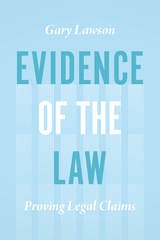
cover of Evidence of the Law: Proving Legal Claims

Evidence of the Law

Proving Legal Claims

Gary Lawson

University of Chicago Press, 2017

How does one prove the law? If your neighbor breaks your window, the law regulates how you can show your claim to be true or false; but how do you prove that in breaking your window your neighbor has broken the law? American jurisprudence devotes an elaborate body of doctrine—and an equally elaborate body of accompanying scholarly commentary—to worrying about how to prove facts. It establishes rules for the admissibility of evidence, creates varying standards of proof, and assigns burdens of proof that determine who wins or loses when the facts are unclear. But the law is shockingly inexplicit when addressing these issues with respect to the proof of legal claims. Indeed, the entire language of evidentiary proof, so sophisticated when it comes to questions of fact, is largely absent from the American legal system with respect to questions of law.

As Gary Lawson shows, legal claims are inherently objects of proof, and whether or not the law acknowledges the point openly, proof of legal claims is just a special case of the more general norms governing proof of any claim. As a result, similar principles of evidentiary admissibility, standards of proof, and burdens of proof operate, and must operate, in the background of claims about the law. This book brings these evidentiary principles for proving law out of the shadows so that they can be analyzed, clarified, and discussed. Viewing legal problems through this lens of proof illuminates debates about everything from constitutional interpretation to the role of stipulations in litigation. Rather than prescribe resolutions to any of those debates, Evidence of the Law instead provides a set of tools that can be used to make those debates more fruitful, whatever one’s substantive views may be. As lawyers, judges, and legal subjects confront uncertainty about what the law is, they can, should, and must, Lawson argues, be guided by the same kinds of abstract considerations, structures, and doctrines long used to make determinations about questions of fact.
[more]
cover of Evil & the Evidence For God: The Challenge of John Hick's Theodicy

Evil & the Evidence For God

The Challenge of John Hick's Theodicy

R. Geivett

Temple University Press, 1995

"By appealing to recent scientific opinion that the universe may well have had an absolute beginning, Geivett develops an interesting, forceful argument for the rationality of belief in God. He then expounds the Augustinian free will theodicy and defends it against Hick's criticisms." --William L. Rowe How to reconcile the existence of evil with the belief in a benevolent God has long posed a philosophical problem to the system of Christian theism. John Hick's book, Evil and the Love of God, is perhaps the best known work to redress this difficulty in modern terms. Sharing Hick's interest in responding to the question of evil, R. Douglas Geivett constructs his own new "theodicy for today." But Geivett departs from Hick by embracing the Augustinian tradition of free will and returning the responsibility for evil to human beings themselves. Reviews "Moving from a comparison of the Irenaean and Augustinian traditions in theodicy to a powerfully original critique of Hick's influential 'soul-making' theodicy, Geivett presents a richly developed natural theology drawing on contemporary scientific opinion in support of an ex nihilo creation. Geivett's writing on natural theology is lucid and informed, honestly engaging many of that tradition's critics....This work is notable for its exceptionally thorough documentation and references, making it a valuable sourcebook for reflection on God and evil. A stimulating afterword by Hick himself significantly enriches this book's provocative analyses." --Religious Studies Review "Geivett details a natural theology and develops a way of understanding the existence of evil that places the fact of evil within, rather than in opposition to, a theistic view. Both the natural theology and the theodicy are rich and complex." --Keith E. Yandell, University of Wisconsin "In this interesting and worthwhile work, Geivett's statement of arguments in natural theology is fuller and fairer than that given by Hick in his writings. This book is an outstanding contribution to the field." --Richard L. Purtill, Western Washington University Contents Preface Part I: Two Traditions 1. The Problem of Evil 2. The Augustinian Tradition 3. John Hick's Theodicy Part II: Religious Epistemology 4. The Value of Natural Theology 5. The Danger of Dismissing Natural Theology 6. The Possibility of Natural Theology, Part 1: The Argument for a Non-Natural Reality 7. The Possibility of Natural Theology, Part 2: Personality, Power, and Providence 8. Explanation and Religious Ambiguity Part III: Theodicy Proper 9. John Hick's View of Divine Purpose 10. The Augustinian View of Divine Purpose 11. Free Will and Evil 12. Evil and the Afterlife Afterword by John Hick Notes Index About the Author(s) R. Douglas Geivett is Associate Professor of Philosophy at Biola University in La Mirada, California.
[more]
cover of Evolution As Entropy: Toward a Unified Theory of Biology

Evolution As Entropy

Toward a Unified Theory of Biology

Daniel R. Brooks and E. O. Wiley

University of Chicago Press, 1988

"By combining recent advances in the physical sciences with some of the novel ideas, techniques, and data of modern biology, this book attempts to achieve a new and different kind of evolutionary synthesis. I found it to be challenging, fascinating, infuriating, and provocative, but certainly not dull."—James H, Brown, University of New Mexico

"This book is unquestionably mandatory reading not only for every living biologist but for generations of biologists to come."—Jack P. Hailman, Animal Behaviour, review of the first edition

"An important contribution to modern evolutionary thinking. It fortifies the place of Evolutionary Theory among the other well-established natural laws."—R.Gessink,TAXON
[more]
cover of Evolution and the Machinery of Chance: Philosophy, Probability, and Scientific Practice in Biology

Evolution and the Machinery of Chance

Philosophy, Probability, and Scientific Practice in Biology

Marshall Abrams

University of Chicago Press, 2023

An innovative view of the role of fitness concepts in evolutionary theory.
 
Natural selection is one of the factors responsible for changes in biological populations. Some traits or organisms are fitter than others, and natural selection occurs when there are changes in the distribution of traits in populations because of fitness differences. Many philosophers of biology insist that a trait’s fitness should be defined as an average of the fitnesses of individual members of the population that have the trait.
 
Marshall Abrams argues convincingly against this widespread approach. As he shows, it conflicts with the roles that fitness is supposed to play in evolutionary theory and with the ways that evolutionary biologists use fitness concepts in empirical research. The assumption that a causal kind of fitness is fundamentally a property of actual individuals has resulted in unnecessary philosophical puzzles and years of debate. Abrams came to see that the fitnesses of traits that are the basis of natural selection cannot be defined in terms of the fitnesses of actual members of populations, as philosophers of biology often claim. Rather, it is an overall population-environment system—not actual, particular organisms living in particular environmental conditions—that is the basis of trait fitnesses. Abrams argues that by distinguishing different classes of fitness concepts and the roles they play in the practice of evolutionary biology, we can see that evolutionary biologists’ diverse uses of fitness concepts make sense together and are consistent with the idea that fitness differences cause evolution.
 
Abrams’s insight has broad significance, for it provides a general framework for thinking about the metaphysics of biological evolution and its relations to empirical research. As such, it is a game-changing book for philosophers of biology, biologists who want deeper insight into the nature of evolution, and anyone interested in the applied philosophy of probability.

[more]
cover of Evolution of Desire: A Life of René Girard

Evolution of Desire

A Life of René Girard

Cynthia L Haven

Michigan State University Press, 2018
René Girard (1923–2015) was one of the leading thinkers of our era—a provocative sage who bypassed prevailing orthodoxies to offer a bold, sweeping vision of human nature, human history, and human destiny. His oeuvre, offering a “mimetic theory” of cultural origins and human behavior, inspired such writers as Milan Kundera and J. M. Coetzee, and earned him a place among the forty “immortals” of the Académie Française. Too often, however, his work is considered only within various academic specializations. This first-ever biographical study takes a wider view. Cynthia L. Haven traces the evolution of Girard’s thought in parallel with his life and times. She recounts his formative years in France and his arrival in a country torn by racial division, and reveals his insights into the collective delusions of our technological world and the changing nature of warfare. Drawing on interviews with Girard and his colleagues, Evolution of Desire: A Life of René Girard provides an essential introduction to one of the twentieth century’s most controversial and original minds.
[more]
cover of Evolutionary Theory: A Hierarchical Perspective

Evolutionary Theory

A Hierarchical Perspective

Edited by Niles Eldredge, Telmo Pievani, Emanuele Serrelli, and Ilya Temkin

University of Chicago Press, 2016

The natural world is infinitely complex and hierarchically structured, with smaller units forming the components of progressively larger systems: molecules make up cells, cells comprise tissues and organs that are, in turn, parts of individual organisms, which are united into populations and integrated into yet more encompassing ecosystems. In the face of such awe-inspiring complexity, there is a need for a comprehensive, non-reductionist evolutionary theory. Having emerged at the crossroads of paleobiology, genetics, and developmental biology, the hierarchical approach to evolution provides a unifying perspective on the natural world and offers an operational framework for scientists seeking to understand the way complex biological systems work and evolve.

Coedited by one of the founders of hierarchy theory and featuring a diverse and renowned group of contributors, this volume provides an integrated, comprehensive, cutting-edge introduction to the hierarchy theory of evolution. From sweeping historical reviews to philosophical pieces, theoretical essays, and strictly empirical chapters, it reveals hierarchy theory as a vibrant field of scientific enterprise that holds promise for unification across the life sciences and offers new venues of empirical and theoretical research. Stretching from molecules to the biosphere, hierarchy theory aims to provide an all-encompassing understanding of evolution and—with this first collection devoted entirely to the concept—will help make transparent the fundamental patterns that propel living systems.

[more]
cover of Evolving God: A Provocative View on the Origins of Religion, Expanded Edition

Evolving God

A Provocative View on the Origins of Religion, Expanded Edition

Barbara J. King

University of Chicago Press, 2017

 
Religion has been a central part of human experience since at least the dawn of recorded history. The gods change, as do the rituals, but the underlying desire remains—a desire to belong to something larger, greater, most lasting than our mortal, finite selves.
 
But where did that desire come from? Can we explain its emergence through evolution? Yes, says biological anthropologist Barbara J. King—and doing so not only helps us to understand the religious imagination, but also reveals fascinating links to the lives and minds of our primate cousins. Evolving God draws on King’s own fieldwork among primates in Africa and paleoanthropology of our extinct ancestors to offer a new way of thinking about the origins of religion, one that situates it in a deep need for emotional connection with others, a need we share with apes and monkeys. Though her thesis is provocative, and she’s not above thoughtful speculation, King’s argument is strongly rooted in close observation and analysis. She traces an evolutionary path that connects us to other primates, who, like us, display empathy, make meanings through interaction, create social rules, and display imagination—the basic building blocks of the religious imagination. With fresh insights, she responds to recent suggestions that chimpanzees are spiritual—or  even religious—beings, and that our ancient humanlike cousins carefully disposed of their dead well before the time of Neandertals.
 
King writes with a scientist’s appreciation for evidence and argument, leavened with a deep empathy and admiration for the powerful desire to belong, a desire that not only brings us together with other humans, but with our closest animal relations as well.

 
[more]
cover of Ex Ante: Power and Prediction in the Real-Time Future

Ex Ante

Power and Prediction in the Real-Time Future

John Cheney-Lippold

University of Chicago Press, 2027

An incisive framework for understanding how predictive AI has reshaped our relationship with time.

Ex Ante argues that AI systems draw us into a new experience of time, a continuous stream of machine-generated futures that reshapes our relationship to ourselves, to capitalism, and to infrastructure. Unlike other predictive tools that help us prepare for what might come, these projections—produced by algorithms and sourced by massive flows of data—calibrate our actions moment by moment, second by second. 

In this book, John Cheney-Lippold offers a framework he calls the ex ante, Latin for “before the event,” as a way to consider how the future has become capitalism’s latest resource for exploitation. Through case studies spanning TikTok beauty filters that have fueled a surge in plastic surgery consultations, chess engines that redefine how the game is played, online sports betting platforms that commodify probability itself, hospital sepsis algorithms that transform the labor of nursing, and coordinated vehicle networks that collectively anticipate their surroundings to function, Ex Ante offers an exploration and powerful critique of our algorithmic present and the powers behind it.

[more]