Results by title
4917 books match the query 'Philosophy' and 231 start with e
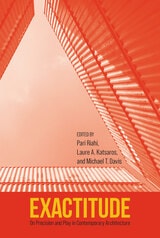
Exactitude
On Precision and Play in Contemporary ArchitectureEdited by Pari Riahi, Laure Katsaros, and Michael T. Davis
University of Massachusetts Press, 2022
Precision is necessary in the field of architecture, and new technologies have increased demands for accuracy, particularly when the smallest errors can have outsized consequences. However, the importance of precision, or exactitude, has not received the consideration it merits. While themes of sustainability, performance, and formal innovation have been at the forefront of architectural scholarship for the past twenty years, this book moves beyond these concerns to explore the theoretical and practical demands exactitude makes on architecture as a field.
The eleven essays collected here investigate the possibilities and shortcomings of exactitude and delve into current debates about the state of contemporary architecture as both a technological craft and artistic creation. Featuring new work by leading theorists, historians, editors, architects, and scholars, this volume brings theory and practice into insightful and productive conversations. In addition to the editors, contributors include Mark Wigley, Alejandro Zaera-Polo, Eric Höweler, Christopher Benfey, Sunil Bald, Ada Tolla and Giuseppe Lignano with Thomas de Monchaux, Alicia Imperiale, Francesca Hughes, Teresa Stoppani, and Cynthia Davidson.
Excommunication
Three Inquiries in Media and MediationAlexander R. Galloway, Eugene Thacker, and McKenzie Wark
University of Chicago Press, 2013
Exercises in the Elements
Essays, Speeches, NotesJosef Pieper
St. Augustine's Press, 2016
A fundamental issue for Pieper is “createdness.” He sees this as the fundamental truth of our being – all being – and the fundamental virtue we can practise is the striving to live according to our perception of real truth in any given situation.
The strength and attraction of Pieper’s writing is its direct and intuitive character which is independent of abstract systematization. He advocates staying in touch with the “real” as we experience it deep within ourselves. Openness to the totality of being – in no matter what context being reveals itself – and the affirmation of all that is founded in this totality are central pillars of all his thinking. Given the “simplicity” of this stance, it is no surprise that much of it is communicated – and successfully – through his gift for illustration by anecdote. Like Plato, this philosopher is a story-teller and, like him, very readable.
Exiles in the City
Hannah Arendt and Edward W. Said in CounterpointWilliam V. Spanos
The Ohio State University Press, 2012
Exiling the Poets
The Production of Censorship in Plato's RepublicRamona A. Naddaff
University of Chicago Press, 2002
Censorship, Nadaff argues, is not merely a mechanism of silencing but also provokes new ways of speaking about controversial and crucial cultural and artistic events. It functions philosophically in the Republic to subvert Plato's most crucial arguments about politics, epistemology, metaphysics, and ethics. Naddaff develops this stunning argument through an extraordinary reading of Plato's work. In books 2 and 3, the first censorship of poetry, she finds that Plato constitutes the poet as a rival with whom the philosopher must vie agonistically. In other words, philosophy does not replace poetry, as most commentators have suggested; rather, the philosopher becomes a worthy and ultimately victorious poetic competitor. In book 10's second censorship, Plato exiles the poets as a mode of self-subversion, rethinking and revising his theory of mimesis, of the immortality of the soul, and, most important, the first censorship of poetry. Finally, in a subtle and sophisticated analysis of the myth of Er, Naddaff explains how Plato himself censors his own censorships of poetry, thus producing the unexpected result of a poetically animated and open-ended dialectical philosophy.

Existential Cognition
Computational Minds in the WorldRon McClamrock
University of Chicago Press, 1995
Arguing that the mind is essentially embedded in the external world, Ron McClamrock provides a schema that allows cognitive scientists to address such long-standing problems in artificial intelligence as the "frame" problem and the issue of "bounded" rationality. Extending this schema to cover progress in other studies of behavior, including language, vision, and action, McClamrock reinterprets the importance of the organism/environment distinction. McClamrock also considers the broader philosophical question of the place of mind in the world, particularly with regard to questions of intentionality, subjectivity, and phenomenology.
With implications for philosophy, cognitive and computer science, AI, and psychology, this book synthesizes state-of-the-art work in philosophy and cognitive science on how the mind interacts with the world to produce thoughts, ideas, and actions.
Exotics at Home
Anthropologies, Others, and American ModernityMicaela di Leonardo
University of Chicago Press, 1998
"An impressive work of scholarship that is mordantly witty, passionately argued, and takes no prisoners."—Lesley Gill, News Politics
"[Micaela] di Leonardo eloquently argues for the importance of empirical, interdisciplinary social science in addressing the tragedy that is urban America at the end of the century."—Jonathan Spencer, Times Literary Supplement
"In her quirky new contribution to the American culture brawl, feminist anthropologist Micaela di Leonardo explains how anthropologists, 'technicians of the sacred,' have distorted American popular debate and social life."—Rachel Mattson, Voice Literary Supplement
"At the end of di Leonardo's analyses one is struck by her rare combination of rigor and passion. Simply, [she] is a marvelous iconoclast."—Matthew T. McGuire, Boston Book Review
Expanding Hermeneutics
Visualism in ScienceDon Ihde
Northwestern University Press, 1999
Expanding the Palace of Torah
Orthodoxy and FeminismTamar Ross
Brandeis University Press, 2004
This new edition brings this acclaimed and classic text back into print with a new essay by Tamar Ross which examines new developments in feminist thought since the book was first published in 2004.
Expedition Escape from the Classroom
Political Outings on the Campus and the Anxiety of Teaching IROded Löwenheim
University of Michigan Press, 2024
Expedition Escape from the Classroom offers a unique narrative where teaching and its inherent challenges intersect with the intricacies of global politics, history, and identity. While recounting his academic experiment, Löwenheim grapples with the changing landscape of academia in a neoliberal age, while illustrating how personal vulnerabilities can transform into powerful tools for growth, exploration, and enlightenment. Whether you’re an educator, student, or just a curious reader, Expedition Escape from the Classroom promises a journey of reflection, critical thinking, and profound revelations.
Experience and Empiricism
Hegel, Hume, and the Early DeleuzeRussell Ford
Northwestern University Press, 2023
A clarifying examination of Gilles Deleuze’s first book shows how he would later transform the problem of immanence into the problem of difference
Despite the wide reception Gilles Deleuze has received across the humanities, research on his early work has remained scant. Experience and Empiricism remedies that gap with a detailed study of Deleuze’s first book, Empiricism and Subjectivity, which is devoted to the philosophical project of David Hume. Russell Ford argues that this work is poorly understood when read simply as a stand-alone study on Hume. Its significance only becomes apparent within the context of a larger problematic that dominated, and continues to inform, modern European philosophy: the conceptual constitution of a purely immanent account of existence. While the importance of this debate is recognized in contemporary scholarship, its genealogy—including Deleuze’s place within it—has been underappreciated. This book shows how Deleuze directly engages in an ongoing debate between his teachers Jean Wahl and Jean Hyppolite over experience and empiricism, an intervention that restages the famous encounter between rationalism and empiricism that yielded Kant’s critical philosophy. What, Deleuze effectively asks, might have happened had Hume been the one roused from his empirical dogmatic slumber by the rationalist challenge of Kant?
Experience and Judgment
Edmund Husserl
Northwestern University Press, 1973
Experience and Value
Essays on John Dewey & Pragmatic NaturalismS. Morris Eames. Edited by Elizabeth R. Eames and Richard W. Field
Southern Illinois University Press, 2002
Experience and Value: Essays on John Dewey and Pragmatic Naturalism brings together twelve philosophical essays spanning the career of noted Dewey scholar, S. Morris Eames. The volume includes both critiques and interpretations of important issues in John Dewey’s value theory as well as the application of Eames’s pragmatic naturalism in addressing contemporary problems in social theory, education, and religion.
The collection begins with a discussion of the underlying principles of Dewey’s pragmatic naturalism, including the concepts of nature, experience, and philosophic method. Essays “Experience and Philosophical Method in John Dewey” and “Primary Experience in the Philosophy of John Dewey” develop what Eames believed to be a central theme in Dewey’s thought and provide a theoretical framework for subsequent discussion.
The volume continues with specific applications of this framework in the areas of value theory, moral theory, social philosophy, and the philosophy of religion. Eames’s analysis of value exposes the connection between the immediately felt values of experience and the more sophisticated judgments of value that are the product of reflection. From this basis in moral theory, Eames considers the derivation of judgments of obligation from judgments of fact. This discussion provides a grounding for a consideration of contemporary social issues directed by naturalistic and scientific principles.
In the third section, with regard to educational theory, Eames considers possible resolutions of the current dichotomy between the factual worldview of science and the humanistic worldview of the liberal arts. The comprehensive article, “Dewey’s Views of Truth, Beauty, and Goodness,” connects the essays of the first and second sections and explores the placement of Dewey’s value theory with respect to morals and aesthetics. With “Creativity and Democracy,” in the fourth section, Eames also considers the concept of democracy from the standpoint of current and historical issues faced by society. This article hints at a major project of Eames’s intellectual life—the theory of democracy.
The volume concludes with a discussion of the difficulty of maintaining the values of religious experience in a scientifically and technologically sophisticated world, the very topic that first brought Eames to philosophy—the meaning of religion and the religious life. Suggested solutions are offered in “The Lost Individual and Religious Unity.”
Experience and Value: Essays on John Dewey and Pragmatic Naturalism illuminates Eames’ life of inquiry, a life that included moral, social, aesthetic, and religious dimensions of value—all suffused with the influence of John Dewey.
Experience, Reason, and God
Eugene Thomas Long
Catholic University of America Press, 2018
Experience
Thinking, Writing, Language, and ReligionNorman Fischer
University of Alabama Press, 2015
An exploration of how language, creativity, and spiritual practice shape human experience.
By what narrow path is the ineffable silence of Zen cleft by the scratch of a pen? The distilled insights of forty years, Norman Fischer’s Experience: Thinking, Writing, Language, and Religion is a collection of essays by Zen master Fischer about experimental writing as a spiritual practice.
Raised in a Conservative Jewish family, Fischer embraced the twin practices of Zen Buddhism and innovative poetics in San Francisco in the early 1970s. His work includes original poetry, descriptions of Buddhist practice, translations of the Hebrew psalms, and eclectic writings on a range of topics from Homer to Heidegger to Kabbalah. Both Buddhist priest and participant in avant-garde poetry’s Language movement, Fischer has limned the fertile affinities and creative contradictions between Zen and writing, accumulating four decades of rich insights he shares in Experience.
Fischer’s work has been deeply enriched through his collaborations with leading rabbis, poets, artists, esteemed Zen Buddhist practitioners, Trappist monks, and renowned Buddhist leaders, among them the Dalai Lama. Alone and with others, he has carried on a deep and sustained investigation into the intersection of writing and consciousness as informed by meditation.
The essays in this artfully curated collection range across divers, fascinating topics such as time, the Heart Sutra, God in the Hebrew psalms, the supreme “uselessness” of art making, “late work” as a category of poetic appreciation, and the subtle and dubious notion of “religious experience.” From the theoretical to the revealingly personal, Fischer’s essays, interviews, and notes point toward a dramatic expansion of the sense of religious feeling in writing.
Readers who join Fischer on this path in Experience can discover how language is not a description of experience, but rather an experience itself: shifting, indefinite, and essential.
Experiencing and the Creation of Meaning
A Philosophical and Psychological Approach to the SubjectiveEugene Gendlin
Northwestern University Press, 1997
Experiencing and the Creation of Meaning addressed the unavoidable variety of conceptual formulations and other questions that have now become central.
Experiments in Mystical Atheism
Godless Epiphanies from Daoism to Spinoza and BeyondBrook Ziporyn
University of Chicago Press, 2024
Western philosophy is stuck in an irresolvable conflict between two approaches to the spiritual malaise of our times: either we need more God (the “turn to religion”) or less religion (the New Atheism). In this book, Brook Ziporyn proposes an alternative that avoids both totalizing theomania and atomizing reductionism. What we need, he argues, is a deeper, more thoroughgoing, even religious rejection of God: an affirmative atheism without either a creator to provide meaning or finite creatures in need of it—a mystical atheism.
In the legacies of Daoism and Buddhism as well as Spinoza, Nietzsche, and Bataille, Ziporyn discovers a critique of theism that develops into a new, positive sensibility—at once deeply atheist and richly religious. Experiments in Mystical Atheism argues that these “godless epiphanies” hold the key to renewing philosophy today.
Explaining Science
A Cognitive ApproachRonald N. Giere
University of Chicago Press, 1990
"The writing is delightfully clear and accessible. On balance, few books advance our subject as well."—Paul Teller, Philosophy of Science

Explanation and Power
The Control of Human BehaviorMorse Peckham
University of Minnesota Press, 1988
Explanation and Power was first published in 1988. Minnesota Archive Editions uses digital technology to make long-unavailable books once again accessible, and are published unaltered from the original University of Minnesota Press editions.
The meaning of any utterance or any sign is the response to that utterance or sign: this is the fundamental proposition behind Morse Peckham's Explanation and Power. Published in 1979 and now available in paperback for the first time, Explanation and Power grew out of Peckham's efforts, as a scholar of Victorian literature, to understand the nature of Romanticism. His search ultimately led back to—and built upon—the tradition of signs developed by the American Pragmatists. Since, in Peckham's view, meaning is not inherent in word or sign, only in response, human behavior itself must depend upon interaction, which in turn relies upon the stability of verbal and nonverbal signs. In the end, meaning can be stabilized only by explanation, and when explanation fails, by force. Peckham's semiotic account of human behavior, radical in its time, contends with the same issues that animate today's debates in critical theory — how culture is produced, how meaning is arrived at, the relation of knowledge to power and of society to its institutions. Readers across a wide range of disciplines, in the humanities and social sciences, will welcome its reappearance.

Exploring Phenomenology
A Guide to the Field & Its LiteratureDavid Stewart
Ohio University Press, 1990
Existential philosophy has perhaps captured the public imagination more completely than any other philosophical movement in the twentieth century. But less is known about the phenomenological method lying behind existentialism. In this solid introduction to phenomenological philosophy, authors David Stewart and Algis Mickunas show that phenomenology is neither new nor bizarre but is a contemporary way of raising afresh the major problems of philosophy that have dominated the traditions of Western thought. The authors carefully lead the reader trough the maze of terminology, explaining the major problems phenomenology has treated and showing how these are a consistent extension of the traditional concerns of philosophy.
In concise, uncluttered, and straightforward terms, the history, development, and contemporary status of phenomenology is explained with a copiously annotated bibliography following each chapter. Nothing in print combines the extensive introductory materials with a guide to the massive literature that has been produced by phenomenological and existential studies.
Exploring the Nature of Law
Thomistic Juridical Realism and the Elements of Law's OntologyPetar Popovic
Catholic University of America Press, 2025
Exploring the Roots of Digital and Media Literacy through Personal Narrative
Renee Hobbs
Temple University Press, 2016
Exploring the Roots of Digital and Media Literacy through Personal Narrative provides a wide-ranging look at the origins, concepts, theories, and practices of the field. This unique, exciting collection of essays by a range of distinguished scholars and practitioners offers insights into the scholars and thinkers who fertilized the minds of those who helped shape the theory and practice of digital and media literacy education.
Each chapter describes an individual whom the author considers to be a type of “grandparent.” By weaving together two sets of personal stories—that of the contributing author and that of the key ideas and life history of the historical figure under their scrutiny—major concepts of digital media and learning emerge.
Exploring the Scientific Method
Cases and QuestionsEdited by Steven Gimbel
University of Chicago Press, 2011
From their grade school classrooms forward, students of science are encouraged to memorize and adhere to the “scientific method”—a model of inquiry consisting of five to seven neatly laid-out steps, often in the form of a flowchart. But walk into the office of a theoretical physicist or the laboratory of a biochemist and ask “Which step are you on?” and you will likely receive a blank stare. This is not how science works. But science does work, and here award-winning teacher and scholar Steven Gimbel provides students the tools to answer for themselves this question: What actually is the scientific method?
Exploring the Scientific Method pairs classic and contemporary readings in the philosophy of science with milestones in scientific discovery to illustrate the foundational issues underlying scientific methodology. Students are asked to select one of nine possible fields—astronomy, physics, chemistry, genetics, evolutionary biology, psychology, sociology, economics, or geology—and through carefully crafted case studies trace its historical progression, all while evaluating whether scientific practice in each case reflects the methodological claims of the philosophers. This approach allows students to see the philosophy of science in action and to determine for themselves what scientists do and how they ought to do it.
Exploring the Scientific Method will be a welcome resource to introductory science courses and all courses in the history and philosophy of science.
Exploring the World of Human Practice
Readings in and about the Philosophy of Aurel KolnaiZoltán Balázs
Central European University Press, 2005
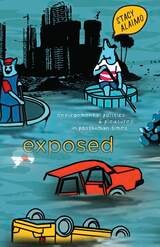
Exposed
Environmental Politics and Pleasures in Posthuman TimesStacy Alaimo
University of Minnesota Press, 2016
Opening with the statement “The anthropocene is no time to set things straight,” Stacy Alaimo puts forth potent arguments for a material feminist posthumanism in the chapters that follow.
From trans-species art and queer animals to naked protesting and scientific accounts of fishy humans, Exposed argues for feminist posthumanism immersed in strange agencies and scale-shifting ethics. Including such divergent topics as landscape art, ocean ecologies, and plastic activism, Alaimo explores our environmental predicaments to better understand feminist occupations of transcorporeal subjectivity.
She puts scientists, activists, artists, writers, and theorists in conversation, revealing that the state of the planet in the twenty-first century has radically transformed ethics, politics, and what it means to be human. Ultimately, Exposed calls for an environmental stance in which, rather than operating from an externalized perspective, we think, feel, and act as the very stuff of the world.
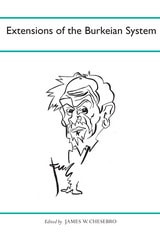
Extensions of the Burkeian System
James W. Chesebro
University of Alabama Press, 1993
Extensions of the Burkeian System constitutes one of the first projects to meet the requirements Burke has established for his operation benchmark. This volume its origins in the scholarly contributions of Kenneth Burke. All of the authors of the chapters in this volume adopt stances that defer to Burke’s initial contributions, ultimately casting their work as extensions of ideas and claims posited by Burke. Yet, all of the authors also make significant departures from positions Burke has articulated. The range of these reactions varies tremendously. Several of the authors cast their positions as augmentations. They offer supplements to Burke's claims that constitute logical additions to Burke's initial observations, but even these authors provide adjustments to the Burkeian system that make a difference in how the system is perceived and understood. Other essays are cast in a more challenging mode, arguing explicitly for alternative viewpoints. Displeased with Burke's analysis at a given point for one reason or another, they posit positions different than those advanced by Burke.
Externalism and Self-Knowledge
Edited by Peter Ludlow and Norah Martin
CSLI, 1998
The selected works presented in this volume, some previously published, some new, are representative of this debate and open up new questions and issues for philosophical investigation, including the connection between externalism, self-knowledge, epistemic warrant, and memory.
Extimacy
Nadia Bou Ali; Surti Singh
Northwestern University Press, 2024
Bringing together theorists and practitioners of psychoanalysis to interrogate Lacan’s notion of extimité
In 1960, Jacques Lacan coined the neologism extimité (extimacy) to denote a structure of subjectivity in which the most intimate, internal core is already external, thus complicating the traditional philosophical dualisms and binaries that have informed traditional notions of subjectivity. This collection is the first sustained interrogation of the concept of extimacy, comprising contributions on various topics by leading and emerging philosophers and scholars of psychoanalytic theory from around the world. This international collection also includes key perspectives from practicing psychoanalysts and presents a variety of critical inquiries into the concept of extimacy for application in multiple disciplines beyond philosophy and in an array of methodological and thematic frameworks.
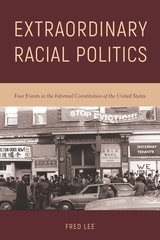
Extraordinary Racial Politics
Four Events in the Informal Constitution of the United StatesFred Lee
Temple University Press, 2018
Extraordinary racial politics rupture out of and reset everyday racial politics. In his cogent book, Fred Lee examines four unusual, episodic, and transformative moments in U.S. history: the 1830s–1840s southeastern Indian removals, the Japanese internment during World War II, the post-war civil rights movement, and the 1960s–1970s racial empowerment movements. Lee helps us connect these extraordinary events to both prior and subsequent everyday conflicts.
Extraordinary Racial Politics brings about an intellectual exchange between ethnic studies, which focuses on quotidian experiences and negotiations, and political theory, which emphasizes historical crises and breaks. In ethnic studies, Lee draws out the extraordinary moments in Michael Omi and Howard Winant’s as well as Charles Mills’s accounts of racial formation. In political theory, Lee considers the strengths and weaknesses of using Carl Schmitt’s and Hannah Arendt’s accounts of public constitution to study racial power.
Lee concludes that extraordinary racial politics represent both the promises of social emancipation and the perils of state power. This promise and peril characterizes our contentious racial present.
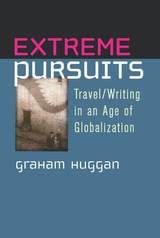
Extreme Pursuits
Travel/Writing in an Age of GlobalizationGraham Huggan
University of Michigan Press, 2009
Recent figures suggest that there will be 1.6 billion arrivals at world airports by the year 2020. Extreme Pursuits looks at the new conditions of global travel and the unease, even paranoia, that underlies them---at the opportunities they offer for alternative identities and their oscillation between remembered and anticipated states. Graham Huggan offers a provocative account of what is happening to travel at a time characterized by extremes of social and political instability in which adrenaline-filled travelers appear correspondingly determined to take risks. It includes discussions of the links between tourism and terrorism, of contemporary modes of disaster tourism, and of the writing that derives from these; but it also confirms the existence of more responsible forms of travel/writing that demonstrate awareness of a chronically endangered world.
Extreme Pursuits is the first study of its kind to link travel writing explicitly with structural changes in the global tourist industry. The book makes clear that travel writing can no longer take refuge in the classic distinctions (traveler versus tourist, foreigner versus native) on which it previously depended. Such distinctions---which were dubious in the first place---no longer make sense in an increasingly globalized world. Huggan argues accordingly that the category "travel writing" must include experimental ethnography and prose fiction; that it should concern itself with other kinds of travel practices, such as those related to Holocaust deportation and migrant labor; and that it should encompass representations of travelers and "traveling cultures" that appear in popular media, especially TV and film.
Graham Huggan is Professor of Commonwealth and Postcolonial Literatures at the University of Leeds. He is the coauthor, with Patrick Holland, of Tourists with Typewriters: Critical Reflections on Contemporary Travel Writing (University of Michigan Press) and coauthor, with Helen Tiffin, of Postcolonial Ecocriticism (Routledge).
Illustration: "Shadow Wall," 2006 © Shaun Tan.
Eyes Without Country
Searching for a Palestinian Strategy of LiberationSouad R. Dajani
Temple University Press, 1994
Since Israel's occupation of the West Bank and Gaza Strip in 1967, the quest for just and lasting peace has been a fountainhead of debate, negotiation, and violent friction. Souad Dajani traces the Palestinians' struggle and argues for a strategy of nonviolent civilian resistance based on deterrence and defense. This strategy would defeat Israel's political will to maintain their occupation and prepare Palestinians for a time beyond the interim period of self-rule agreed upon by Israel and the PLO in September 19932.
Dajani's formulation of nonviolent civilian resistance is examined against a backdrop of early developments in Mandate Palestine, the impact of Zionist ideology, and the realities of life for Palestinians under occupation. Her assessment of the role of the PLO, objectives of the Palestinian National Movement, developments since the Gulf War, and other factors crucial to an effective strategy raises critical questions surrounding the operation of nonviolent techniques for the Palestinian community, Israeli politics, and international actors, most prominently the United States.