Results by title
28164 books match the query 'History' and 842 start with e
Embodied Protests
Emotions and Women's Health in BoliviaMaria Tapias
University of Illinois Press, 2015
Evocative and compassionate, Embodied Protests gives voice to the human costs of the ongoing neoliberal experiment.
Embodied Reckonings
“Comfort Women,” Performance, and Transpacific RedressElizabeth W. Son
University of Michigan Press, 2018
Based on extensive archival and ethnographic research, the study argues for the central role of performance in how Korean survivors, activists, and artists have redressed the histories—and erasures—of this sexual violence. Merging cultural studies and performance theory with a transnational, feminist analysis, the book illuminates the actions of ordinary people, thus offering ways of reconceptualizing legal and political understandings of redress that tend to concentrate on institutionalized forms of state-based remediation.
Embodied
Victorian Literature and the SensesWilliam A. Cohen
University of Minnesota Press, 2008
Making sense of the body in Victorian literature
What does it mean to be human? British writers in the Victorian period found a surprising answer to this question. What is human, they discovered, is nothing more or less than the human body itself. In literature of the period, as well as in scientific writing and journalism, the notion of an interior human essence came to be identified with the material existence of the body. The organs of sensory perception were understood as crucial routes of exchange between the interior and the external worlds.
Anatomizing Victorian ideas of the human, William A. Cohen considers the meaning of sensory encounters in works by writers including Charles Dickens, Charlotte Brontë, Anthony Trollope, Thomas Hardy, and Gerard Manley Hopkins. Rather than regarding the bodily exterior as the primary location in which identity categories—such as gender, sexuality, race, and disability—are expressed, he focuses on the interior experience of sensation, whereby these politics come to be felt. In these elegant engagements with literary works, cultural history, and critical theory, Cohen advances a phenomenological approach to embodiment, proposing that we encounter the world not through our minds or souls but through our senses.
Embodying Honor
Fertility, Foreignness, and Regeneration in Eastern SudanAmal Hassan Fadlalla
University of Wisconsin Press, 2007
In Embodying Honor Amal Hassan Fadlalla finds that the female body is the locus of anxieties about foreign dangers and diseases, threats perceived to be disruptive to morality, feminine identities, and social well-being. As a “northern Sudanese” viewed as an outsider in this region of her native country, Fadlalla presents an intimate portrait and thorough analysis that offers an intriguing commentary on the very notion of what constitutes the “foreign.” Fadlalla shows how Muslim Hadendowa women manage health and reproductive suffering in their quest to become “responsible” mothers and valued members of their communities. Her historically grounded ethnography delves into women’s reproductive histories, personal narratives, and ritual logics to reveal the ways in which women challenge cultural understandings of gender, honor, and reproduction.
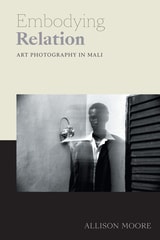
Embodying Relation
Art Photography in MaliAllison Moore
Duke University Press, 2020
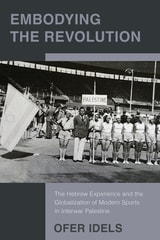
Embodying the Revolution
The Hebrew Experience and the Globalization of Modern Sports in Interwar PalestineOfer Idels
Rutgers University Press, 2026
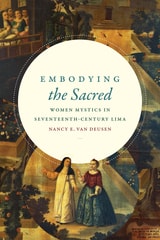
Embodying the Sacred
Women Mystics in Seventeenth-Century LimaNancy E. van Deusen
Duke University Press, 2018
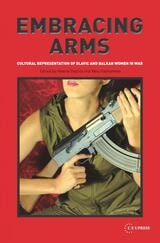
Embracing Arms
Cultural Representation of Slavic and Balkan Women in WarYana Hashamova
Central European University Press, 2012
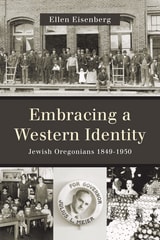
Embracing a Western Identity
Jewish Oregonians, 1849-1950Ellen Eisenberg
Oregon State University Press, 2015
In Embracing a Western Identity, Ellen Eisenberg places Jewish history in the larger context of western narratives, challenging the traditional view that the “authentic” North American Jewish experience stems from New York. The westward paths of Jewish Oregonians and their experiences of place shaped the communities, institutions, and identities they created, distinguishing them from other American Jewish communities. Eisenberg traces the Oregon Jewish experience from its pioneer beginnings in the mid-nineteenth century to the highly concentrated Portland communities of the mid-twentieth century.
Drawing on extensive archival resources at the Oregon Jewish Museum, this historical commentary explores patterns of migration and settlement, the place of Jews in the state’s ethnic landscape, their engagement in politics, the development of institutions, and their relationship to Zionism. Departing from familiar treatments of the Jewish experience, Embracing a Western Identity provides a critical look at the impact of place and opportunity upon the identities of migrants both as Oregonians and as American Jews. Readers and scholars interested in western history—religious, ethnic, expansionist, and otherwise—will enjoy Eisenberg’s accessible writing style and rich photograph collection.

Emergency Broadcasting & 1930'S Am Radio
Edward Miller
Temple University Press, 2002
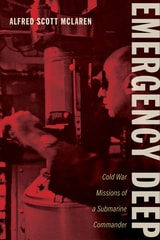
Emergency Deep
Cold War Missions of a Submarine CommanderAlfred Scott McLaren
University of Alabama Press, 2021
A compelling naval memoir of Arctic submarine duty—operations, engineering realities, and split‑second leadership choices in Emergency Deep.
Captain Alfred Scott McLaren served as commander of the USS Queenfish (SSN 651) from September 1969 to May 1973, the very height of the Cold War. As commander, McLaren led at least six major clandestine operations, including the first-ever exploration of the entire Siberian Continental Shelf: a perilous voyage detailed in his previous book Unknown Waters.
Emergency Deep: Cold War Missions of a Submarine Commander conveys the entire spectrum of Captain McLaren’s experiences commanding the USS Queenfish, mainly in the waters of the Russian Far East and also off Vietnam. McLaren offers a riveting and deeply human story that illuminates the intensity and pressures of commanding a nuclear attack submarine in some of the most difficult circumstances imaginable.
Relying on his own notes and records, as well as discussions with former officers and shipmates, McLaren focuses on operational matters both great and small. He recounts his unique perspectives on attack-submarine tactics and exploratory techniques in high-risk or uncharted areas, matters of leadership and team-building and the morale of his crews, and the innumerable and often unforeseen ways his philosophy of command played out on a day-to-day basis, with consequences that ran the gamut from the mundane to the dire and life-threatening.
Readers are also treated to significant new information and insight on submarine strategy, maneuvers, and culture. Such details illuminate and bring to life, with both great humor and gravitas, the intensity and pressures on those engaged in covert missions on nuclear attack submarines.
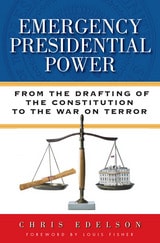
Emergency Presidential Power
From the Drafting of the Constitution to the War on TerrorChris Edelson; Foreword by Louis Fisher
University of Wisconsin Press, 2013
Winner, Crader Family Book Prize in American Values, Department of History and Crader Family Endowment for American Values, Southeast Missouri State University
Emergency
Reading the Popol Vuh in a Time of CrisisEdgar Garcia
University of Chicago Press, 2022
Written during the lockdown in Chicago in the depths of the COVID-19 pandemic, these essays consider the Popol Vuh as a work that was also written during a time of feverish social, political, and epidemiological crisis as Spanish missionaries and colonial military deepened their conquest of indigenous peoples and cultures in Mesoamerica. What separates the Popol Vuh from many other creation texts is the disposition of the gods engaged in creation. Whereas the book of Genesis is declarative in telling the story of the world’s creation, the Popol Vuh is interrogative and analytical: the gods, for example, question whether people actually need to be created, given the many perfect animals they have already placed on earth.
Emergency uses the historical emergency of the Popol Vuh to frame the ongoing emergencies of colonialism that have surfaced all too clearly in the global health crisis of COVID-19. In doing so, these essays reveal how the authors of the Popol Vuh—while implicated in deep social crisis—nonetheless insisted on transforming emergency into scenes of social, political, and intellectual emergence, translating crisis into creativity and world creation.
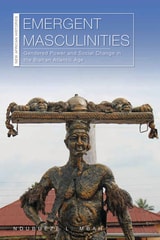
Emergent Masculinities
Gendered Power and Social Change in the Biafran Atlantic AgeNdubueze L. Mbah
Ohio University Press, 2019
In Emergent Masculinities, Ndubueze L. Mbah argues that the Bight of Biafra region’s Atlanticization—or the interaction between regional processes and Atlantic forces such as the slave trade, colonialism, and Christianization—between 1750 and 1920 transformed gender into the primary mode of social differentiation in the region. He incorporates over 250 oral narratives of men and women across a range of social roles and professions with material culture practices, performance traditions, slave ship data, colonial records, and more to reveal how Africans channeled the socioeconomic forces of the Atlantic world through their local ideologies and practices. The gendered struggles over the means of social reproduction conditioned the Bight of Biafra region’s participation in Atlantic systems of production and exchange, and defined the demography of the region’s forced diaspora. By looking at male and female constructions of masculinity and sexuality as major indexes of social change, Emergent Masculinities transforms our understanding of the role of gender in precolonial Africa and fills a major gap in our knowledge of a broader set of theoretical and comparative issues linked to the slave trade and the African diaspora.
Emerson and the Defense of Equality
Greg Garvey
University of Massachusetts Press, 2025
Arguing for equality as the necessary foundation of liberty
During Ralph Waldo Emerson’s lifetime, the idea of universal human equality was under intensive assault. Repeatedly—in contexts ranging from slavery, to marriage, to politics and workers’ rights—Americans of the time were being told that equality was an obsolete ideal and that the future would belong to those who accepted the hard truth that liberty lies not in egalitarian values but in hierarchies of domination and submission. Greg Garvey’s Emerson and the Defense of Equality focuses on Emerson as a real-time defender of equality during the antebellum culture wars.
In contrast to studies that treat individual liberty as Emerson’s primary concern, Garvey argues that Emerson’s works define a broad and sustained defense of equality as the necessary foundation of liberty. When read as part of a debate about equality, Emerson’s Nature is a treatise on individuality and the common weal; his anti-slavery speeches and English Traits advance evolutionary theories to rebut polygenesist arguments for white supremacy; the essays “Love” and “Domestic Life” challenge gender spheres and explore equality in marriage, friendship, and citizenship. As Emerson speculates on the future, “Politics” and “The Young American” anticipate a “beneficent socialism” in which human rights will always have priority over property rights. In his career-long effort to defend a threatened ideal, Emerson develops an aspirational vision of society that understands equality to be a fundamental aspect of liberty.
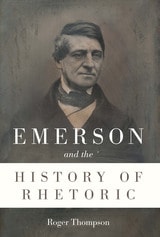
Emerson and the History of Rhetoric
Roger Thompson
Southern Illinois University Press, 2017
Moving beyond dominant literary critical thinking, Thompson argues that for Emerson, rhetoric was both imaginative and nonsystematic. This book covers the influences of rhetoricians from a range of periods on Emerson’s model of rhetoric. Drawing on Emerson’s manuscript notes, journal entries, and some of his rarely discussed essays and lectures as well as his more famous works, the author bridges the divide between literary and rhetorical studies, expanding our understanding of this iconic nineteenth-century man of letters.
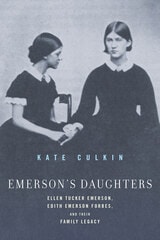
Emerson’s Daughters
Ellen Tucker Emerson, Edith Emerson Forbes, and Their Family LegacyKate Culkin
University of Massachusetts Press, 2025
Longlisted for the 2026 Plutarch Award
Ellen Tucker Emerson and Edith Emerson Forbes, the daughters of Lidian Jackson and Ralph Waldo Emerson, grew up in the heart of Concord, Massachusetts’s famed literary community. In a culture that celebrated self-reliance, Ellen and Edith formed a partnership that only strengthened as their paths diverged, with Ellen remaining in the family home and Edith marrying William Forbes, moving to Milton, Massachusetts, and having eight children. The partnership allowed them to tend to the demands and opportunities created by their father’s career, including serving as his secretaries and editors, and helped them shape his posthumous image. It also enabled them to adapt to historical developments stretching from the Civil War to American imperialism as well as personal ones, including Edith’s growing family and travel and study abroad, and inevitable ones brought on by the aging processes of their parents and themselves.
Emerson’s Daughters is a biography of a sisterhood, the first full-length study of Ellen’s and Edith’s lives. Building on archival research into the extensive correspondence between the sisters, it adds to the growing body of work on women’s contribution to Transcendentalism while opening a window onto the rich, and understudied, family life of the “Sage of Concord.”
Emerson’s Liberalism
Neal Dolan
University of Wisconsin Press, 2009
Neal Dolan offers the first comprehensive and historically informed exposition of all of Ralph Waldo Emerson’s writings as a contribution to the theory and practice of liberal culture. Rather than projecting twentieth-century viewpoints onto the past, he restores Emerson’s great body of work to the classical liberal contexts that most decisively shaped its general political-cultural outlook—the libertarian-liberalism of John Locke, the Scottish Enlightenment, the American founders, and the American Whigs.
In addition to in-depth consideration of Emerson’s journals and lectures, Dolan provides original commentary on many of Emerson’s most celebrated published works, including Nature, the “Divinity School Address,” “History,” “Compensation,” “Experience,” the political addresses of the early 1840s, “An Address . . . on . . . The Emancipation of the Negroes in the British West Indies,” Representative Men, English Traits, and The Conduct of Life. He considers Emerson’s distinctive elaborations of foundational liberal values—progress, reason, work, property, limited government, rights, civil society, liberty, commerce, and empiricism. And he argues that Emerson’s ideas are a morally bracing and spiritually inspiring resource for the ongoing sustenance of American culture and civilization, reminding us of the depth, breadth, and strength of our common liberal inheritance.

Emily Dickinson and the Labor of Clothing
Daneen Wardrop
University of New Hampshire Press, 2009

Emily Dickinson'S Gothic
Goblin With A GaugeDaneen Wardrop
University of Iowa Press, 1996
Emily Dickinson should stand as a major gothic author among her nineteenth-century American contemporaries, but two factors have previously prevented her inclusion in such company. Perhaps the most obvious is the problem of the genre: Dickinson writes gothic poetry, whereas gothic fiction defines the genre. In addition, her poetic personae have served over the decades to prompt critics to “protect” her; traditional critics concentrated on the sweet, romantic elements of her oeuvre. More recent readers, notably Sandra Gilbert and Susan Gubar, Jane Egerwein, and Cynthia Griffin Wolff, have begun studying Dickinson's gothic traits; Emily Dickinson's Gothic explores Dickinsonian gothicism with the systematic rigor it demands and deserves.
Emily Dickinson's Gothic also addresses sociohistorical concerns, from hallowed gothic conventions dating from Horace Walpole's eighteenth century to such modernist neogothic topics as rape, the void, and disjunctive language that appear in the latter nineteenth and early twentieth centuries. Wardrop recognizes the full extent to which the gothic pervades Dickinson's canon and the means by which the gothic determines her aesthetic. Such full consideration of women's gothicism allows the placement of Dickinson within a literary context, both in terms of American writers and in terms of women writers.
Emily Dickinson's Approving God
Divine Design and the Problem of SufferingPatrick J. Keane
University of Missouri Press, 2008
Emily Dickinson's Music Book and the Musical Life of an American Poet
George Boziwick
University of Massachusetts Press, 2022
After years of studying piano as a young woman in her family home in Amherst, Massachusetts, Emily Dickinson curated her music book, a common practice at the time. Now part of the Dickinson Collection in the Houghton Library of Harvard University, this bound volume of 107 pieces of published sheet music includes the poet’s favorite instrumental piano music and vocal music, ranging from theme and variation sets to vernacular music, which was also enjoyed by the family’s servants.
Offering a fresh historical perspective on a poetic voice that has become canonical in American literature, this original study brings this artifact to life, documenting Dickinson’s early years of musical study through the time her music was bound in the early 1850s, which tellingly coincided with the writing of her first poems. Using Dickinson’s letters and poems alongside newspapers and other archival sources, George Boziwick explores the various composers, music sellers, and publishers behind this music and Dickinson’s attendance at performances, presenting new insights into the multiple layers of meaning that music held for her.
Emily Dickinson
Monarch of PerceptionDomhnall Mitchell
University of Massachusetts Press, 2000
Emily Dickinson has often been pictured as a sensitive but isolated poet—someone who published very little in her lifetime and limited herself to lyrics, considered to be the kind of poems most removed from social and political life. In recent years, scholars have challenged that view, and this book extends the discussion in valuable new directions.
Domhnall Mitchell begins by focusing on three historical phenomena—the railroad, the Dickinson homestead, and horticulture—and argues that poems about trains, home, and flowers engage with their meanings in ways that extend beyond the confines of the aesthetic. He shows how Dickinson's poems and letters reveal the full complexity of her position as a woman situated within a larger social and economic class.
In the second half of the book, Mitchell considers the ideological, textual, and editorial implications of Dickinson's strategic privatization of her art. He relates the particular forms of her manuscripts' appearance, distribution, and collation to aspects of her social as well as her literary consciousness. In a chapter that is certain to provoke debate, he explores what it means to read individual poems and letters in manuscript versions rather than in printed editions. By paying close attention to textual evidence, he makes the case that various features of the manuscripts are actually matters of accident or immediate convenience rather than the visual markers of a new aesthetic principle.
Mitchell closes by using the theories of Mikhail Bakhtin to explore the contradictions of a “private” poetry that engages verbally in multiple areas of nineteenth-century life and discourse. By attending to the contemporaneous particularities of recurrent words and images, he demonstrates that Dickinson could stay at home and still be at home in history, too.
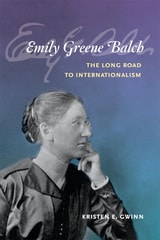
Emily Greene Balch
The Long Road to InternationalismKristen E. Gwinn
University of Illinois Press, 2010
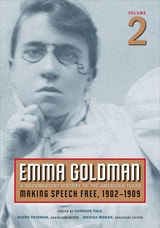
Emma Goldman, Vol. 2
A Documentary History of the American Years, Volume 2: Making Speech Free, 1902-1909Emma Goldman. Edited by Candace Falk; Barry Pateman, Assoc Ed; Jessica Moran, As
University of Illinois Press, 2007
Emma Goldman: A Documentary History of the American Years reconstructs the life of Emma Goldman through significant texts and documents. These volumes collect personal letters, lecture notes, newspaper articles, court transcripts, government surveillance reports, and numerous other documents, many of which appear here in English for the first time. Supplemented with thorough annotations, multiple appendixes, and detailed chronologies, the texts bring to life the memory of this singular, pivotal figure in American and European radical history.
Volume 2: Making Speech Free, 1902-1909 extends many of the themes introduced in the previous volume, including Goldman's evolving attitudes toward political violence and social reform, intensified now by documentary accounts of the fomenting revolution in Russia and the legal opposition toward anarchism and labor organizing in the United States. Always an impassioned defender of free expression, Goldman's launch of her magazine Mother Earth in 1906 signaled a desire to bring radical thought into wider circulation, and its pages brought together modern literary and cultural ideas with a radical social agenda, quickly becoming a platform for her feminist critique, among her many other challenges to the status quo. With abundant examples from her writings and speeches, this volume details Goldman's emergence as one of American history's most fiercely outspoken opponents of hypocrisy and pretension in politics and public life.
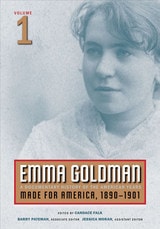
Emma Goldman
A Documentary History of the American Years, Volume 1: Made for America, 1890-1901Emma Goldman. Edited by Candace Falk; Barry Pateman, Assoc Ed; Jessica Moran, A
University of Illinois Press, 2007
Emma Goldman: A Documentary History of the American Years reconstructs the life of Emma Goldman through significant texts and documents. These volumes collect personal letters, lecture notes, newspaper articles, court transcripts, government surveillance reports, and numerous other documents, many of which appear here in English for the first time. Supplemented with thorough annotations, multiple appendixes, and detailed chronologies, the texts bring to life the memory of this singular, pivotal figure in American and European radical history.
Volume 1: Made for America, 1890-1901 introduces readers to the young Emma Goldman as she begins her association with the international anarchist movement and especially with the German, Jewish, and Italian immigrant radicals in New York City. From early on, Goldman's movement through political and intellectual circles is marked by violence, from the attempted murder of industrialist Henry Clay Frick by Goldman's lover, Alexander Berkman, to the assassination of President William McKinley, in which Goldman was falsely implicated. The documents surrounding these events illuminate Goldman's struggle to balance anarchism's positive gains and its destructive costs. This volume introduces many of the themes that would pervade much of Goldman's later writings and speeches: the untold possibilities of anarchism; the transformative power of literature; the interplay of human relationships; and the importance of free speech, education, labor, women's freedom, and radical social reform.
Emma Lee
Juanita Brooks
Utah State University Press, 1975
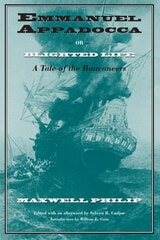
Emmanuel Appadocca; or, Blighted Life
A Tale of the BoucaneersMaxwell Philip
University of Massachusetts Press, 1997
This 1854 novel traces a mulatto son's quest for vengeance against his white father, a sugar planter who abandoned him and his mother. Intent on redeeming his mother's honor and outraged by the cruelty and greed that slavery has engendered Appadocca sails the seas with a band of ruthless pirates on a ship named the Black Schooner. The novel, written by the important activist and intellectual Michel Maxwell Philip (1829–1888) deals with themes, symbols, and literary techniques that are reminiscent of other major authors such as Melville, Douglass, and Stowe. This new edition with scholarly commentaries and annotations will reorient our understanding of the development of Caribbean literature in relation to English and American literary production.

Emo
How Fans Defined a SubcultureJudith May Fathallah
University of Iowa Press, 2020
For many, the word “emo” calls to mind angsty teenagers, shaggy black haircuts, and skinny jeans. A popular music phenomenon in the early 2000s, emo is short for “emotional hardcore,” and refers to both a music genre and a youth scene notable for its androgynous style. Judith May Fathallah pushes beyond the stereotypes and social stigma to explore how online fandom has shaped the definition of emo, with significant implications both for millennial constructs of gender and for contemporary fan studies.
First laying out the debate over what emo is, Fathallah walks superfans and newcomers through the culture surrounding thegenre’s major bands, including the emo holy trinity: My Chemical Romance, Fall Out Boy, and Panic! At the Disco. Next she examines fans’ main mode of participation in the emo subculture—online communities such as LiveJournal, Tumblr, MySpace, and band websites. Taking a hard look at the gender politics that dominated those spaces, she unearths a subculture that simultaneously defines itself by its sensitivity and resistance to traditional forms of masculinity, yet ruthlessly enforces homophobic and sexist standards. Fathallah demonstrates fandom’s key role in defining emo as a concept and genre after 2001, with probing insight into its implications for gender constructions through popular music.
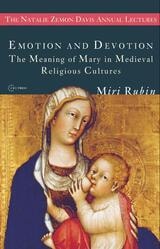
Emotion and Devotion
The Meaning of Mary in Medieval Religious CulturesMiri Rubin
Central European University Press, 2009
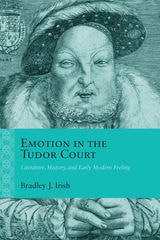
Emotion in the Tudor Court
Literature, History, and Early Modern FeelingBradley J. Irish
Northwestern University Press, 2018
Spanning the sixteenth century, Emotion in the Tudor Court explores Cardinal Thomas Wolsey and Henrician satire; Henry Howard, Earl of Surrey, and elegy; Sir Philip Sidney and Elizabethan pageantry; and Robert Devereux, Earl of Essex, and factional literature. It demonstrates how the dynamics of disgust,envy, rejection, and dread, as they are understood in the modern affective sciences, can be seen to guide literary production in the early modern court.
By combining Renaissance concepts of emotion with modern research in the social and natural sciences, Emotion in the Tudor Court takes a transdisciplinary approach to yield fascinating and robust ways to illuminate both literary studies and cultural history.
Emotion
A Comprehensive Phenomenology of Theories and Their Meanings for TherapyJames Hillman
Northwestern University Press, 1962
As James Hillman writes in his new preface to this sweeping study, he intends nothing less than "to vitalize a standard topic of academic psychology by making the theory of emotion as crucial as is emotion itself in our lives." Hillman offers an informative and readable survey of a range of theories of emotion, focusing on the twentieth century but moving also from Greek thought to early Christianity to nineteenth-century German physiology. The work challenges readers to rethink our concepts and thereby to re-experience emotional phenomena.
Hillman's study contributes to today's renewed interest in the history of the body. Furthermore, his understanding of emotions in terms of epiphany makes a stimulating contribution to phenomenology. It is equally thought-provoking for the therapist, the philosopher, the intellectual historian, and the general reader.
Emotional Bodies
The Historical Performativity of EmotionsEdited by Dolores Martín Moruno and Beatriz Pichel
University of Illinois Press, 2019
Contributors: Jon Arrizabalaga, Rob Boddice, Leticia Fernández-Fontecha, Emma Hutchison, Dolores Martín-Moruno, Piroska Nagy, Beatriz Pichel, María Rosón, Pilar León-Sanz, Bertrand Taithe, and Gian Marco Vidor.
Emotional Landscapes
Love, Gender, and MigrationEdited by Marcelo J. Borges, Sonia Cancian, and Linda Reeder
University of Illinois Press, 2020
Affecting and perceptive, Emotional Landscapes moves from war and transnational families to gender and citizenship to explore the crossroads of migration and the history of emotion.
Contributors: María Bjerg, Marcelo J. Borges, Sonia Cancian, Tyler Carrington, Margarita Dounia, Alexander Freund, Donna R. Gabaccia, A. James Hammerton, Mirjam Milharčič Hladnik, Emily Pope-Obeda, Linda Reeder, Roberta Ricucci, Suzanne M. Sinke, and Elizabeth Zanoni
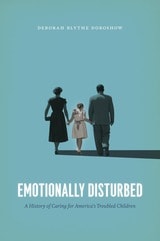
Emotionally Disturbed
A History of Caring for America's Troubled ChildrenDeborah Blythe Doroshow
University of Chicago Press, 2019
Emotionally Disturbed is the first work to examine not only the history of residential treatment but also the history of seriously mentally ill children in the United States. As residential treatment centers emerged as new spaces with a fresh therapeutic perspective, a new kind of person became visible—the emotionally disturbed child. Residential treatment centers and the people who worked there built physical and conceptual structures that identified a population of children who were alike in distinctive ways. Emotional disturbance became a diagnosis, a policy problem, and a statement about the troubled state of postwar society. But in the late twentieth century, Americans went from pouring private and public funds into the care of troubled children to abandoning them almost completely. Charting the decline of residential treatment centers in favor of domestic care–based models in the 1980s and 1990s, this history is a must-read for those wishing to understand how our current child mental health system came to be.
Emotions in History – Lost and Found
Ute Frevert
Central European University Press, 2011
Coming to terms with emotions and how they influence human behaviour, seems to be of the utmost importance to societies that are obsessed with everything "neuro." On the other hand, emotions have become an object of constant individual and social manipulation since "emotional intelligence" emerged as a buzzword of our times. Reflecting on this burgeoning interest in human emotions makes one think of how this interest developed and what fuelled it. From a historian's point of view, it can be traced back to classical antiquity. But it has undergone shifts and changes which can in turn shed light on social concepts of the self and its relation to other human beings (and nature). The volume focuses on the historicity of emotions and explores the processes that brought them to the fore of public interest and debate.
Emperor Charles IV and the Origins of the Great Schism, c. 1375–1378
Dušan Coufal
Karolinum Press, 2025
Reveals how Emperor Charles IV’s efforts to secure the imperial coronation of his son intersect with the early stages of the Great Western Schism.
Emperor Otto I the Great made history in the Holy Roman Empire with a significant dynastic achievement: in 967, he persuaded the pope to crown his son co-emperor in Rome. Two centuries later, another renowned emperor, Frederick Barbarossa, attempted a similar feat, negotiating with four different popes for the coronation of his descendant, but ultimately failed. A lesser-known parallel can be found in the life of Emperor Charles IV of the Luxembourg dynasty in the fourteenth century. After the Papal Curia returned to Rome from Avignon in early 1377, Charles made concerted efforts in Italy, France, and Germany to secure the imperial coronation of his son, Wenceslas. However, this bold ambition coincided with an unprecedented crisis in relations between the "French” cardinals and the newly elected Italian pope, Urban VI. Recognizing that the final chapter of Charles IV’s biography is deeply intertwined with the early history of the Great Western Schism offers a fresh perspective on a subject that has long captivated international scholarship.
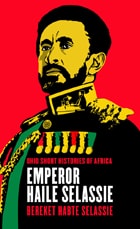
Emperor Haile Selassie
Bereket Habte Selassie
Ohio University Press, 2014
Emperor Haile Selassie was an iconic figure of the twentieth century, a progressive monarch who ruled Ethiopia from 1916 to 1974. This book, written by a former state official who served in a number of important positions in Selassie’s government, tells both the story of the emperor’s life and the story of modern Ethiopia.
After a struggle for the throne in 1916, the young Selassie emerged first as regent and then as supreme leader of Ethiopia. Over the course of his nearly six-decade rule, the emperor abolished slavery, introduced constitutional reform, and expanded educational opportunity. The Italian invasion of Ethiopia in the 1930s led to a five-year exile in England, from which he returned in time to lead his country through World War II. Selassie was also instrumental in the founding of the Organization of African Unity in 1963, but he fell short of the ultimate goal of a promised democracy in Ethiopia. The corruption that grew under his absolute rule, as well as his seeming indifference to the famine that gripped Ethiopia in the 1970s, led finally to his overthrow by the armed forces that he had created.
Haile Selassie was an enlightened monarch in many ways, but also a man with flaws like any other. This short biography is a sensitive portrayal of Selassie as both emperor and man, by one who knew him well.
Empire And Imperialism
Peter Cain
St. Augustine's Press, 1999
The 1870s is a key decade in the evolution of British thinking about the nature, purpose, and future of empire. Increasing economic competition began to disturb the complacent assumption about Britain's leadership in technology and in the world economy. The growth of other countries, most notably the United States and Germany, put in question Britain's survival as a great power. These changes set in motion a reappraisal of Britain's empire and its importance to the motherland, and a heated debated as to whether colonialism and imperialism were a burden rather than a benefit to Britain. The discussion of the 1870s set the agenda for the debates of the next half-century. This volume documents the writing central to the debate; it includes contributions by such leading British thinkers and statesmen as J. A. Froude, Robert Lowe, Edward Dicey, Frederic Seebohm, Lord Carnarvon, Gladstone, Julius Vogel, and Lord Blachford.
Empire Burlesque
The Fate of Critical Culture in Global AmericaDaniel T. O Hara
Duke University Press, 2003
Empire Burlesque presents several interrelated analyses through readings of a range of writers and cultural figures including Henry James, Freud, Said, De Man, Derrida, and Cordwainer Smith (an academic, spy, and classic 1950s and 1960s science fiction writer). It describes the debilitating effects of globalization on the university in general and the field of literary studies in particular, it critiques literary studies’ embrace of globalization theory in the name of a blind and vacant modernization, and it meditates on the ways critical reading and writing can facilitate an imaginative alternative to institutionalized practices of modernization. Drawing on Lacanian psychoanalytical theory, it diagnoses contemporary American Studies as typically driven by the mindless abjection and transference of professional identities.
A provocative commentary on contemporary cultural criticism, Empire Burlesque will inform debates on the American university across the humanities, particularly among those in literary criticism, cultural studies, and American studies.

Empire City
The Making And Meaning OfDavid Scobey
Temple University Press, 2003
Author David Scobey paints a remarkable panorama of New York's uneven development, a city-building process careening between obsessive calculation and speculative excess. Envisioning a new kind of national civilization, "bourgeois urbanists" attempted to make New York the nation's preeminent city. Ultimately, they created a mosaic of grand improvements, dynamic change, and environmental disorder. Empire City sets the stories of the city's most celebrated landmarks -- Central Park, the Brooklyn Bridge, the downtown commercial center -- within the context of this new ideal of landscape design and a politics of planned city building. Perhaps such an ambitious project for guiding growth, overcoming spatial problems, and uplifting public was bound to fail; still, it grips the imagination.

Empire State-Building
War and Welfare in Kenya, 1925–1952Joanna Lewis
Ohio University Press, 2001
This history of administrative thought and practice in colonial Kenya looks at the ways in which white people tried to engineer social change.
It asks four questions:
- Why was Kenya’s welfare operation so idiosyncratic and spartan compared with that of other British colonies?
- Why did a transformation from social welfare to community development produce further neglect of the very poor?
- Why was there no equivalent to the French tradition of community medicine?
- If there was a transformatory element of colonial rule that sought to address poverty, where and why did it fall down?
The answers offer revealing insight into the dynamics of rule in the late colonial period in Kenya.
Empire and Dissent
The United States and Latin AmericaFred Rosen, ed.
Duke University Press, 2008
Several essays provide historical perspective on contemporary U.S.–hemispheric relations. These include an analysis of the nature and dynamics of imperial domination, an assessment of financial relations between the United States and Latin America since the end of World War II, an account of Native American resistance to colonialism, and a consideration of the British government’s decision to abolish slavery in its colonies. Other essays focus on present-day conflicts in the Americas, highlighting various modes of domination and dissent, resistance and accommodation. Examining southern Mexico’s Zapatista movement, one contributor discusses dissent in the era of globalization. Other contributors investigate the surprisingly conventional economic policies of Brazil’s president, Luiz Inácio Lula da Silva; Argentina’s recovery from its massive 2001 debt default; the role of coca markets in the election of Bolivia’s first indigenous president, Evo Morales; and the possibilities for extensive social change in Venezuela. A readers’ guide offers a timeline of key events from 1823 through 2007, along with a list of important individuals, institutions, and places.
Contributors: Daniel A. Cieza, Gregory Evans Dowd, Steve Ellner, Neil Harvey, Alan Knight, Carlos Marichal, John Richard Oldfield, Silvia Rivera, Fred Rosen, Jeffrey W. Rubin

Empire and the Bomb
How the U.S. Uses Nuclear Weapons to Dominate the WorldJoseph Gerson
Pluto Press, 2007
Gerson reveals how and why the United States made more than twenty threats of nuclear attack during the Cold War---against Russia, China, Vietnam, and the Middle East. He shows how such threats continued under Presidents Bush, Clinton, and George W. Bush.
The book concludes with an appeal for the abolition of nuclear weapons and an overview of the history of the anti-nuclear movement. Drawing from a wide range of sources, including extensive government documents, this fascinating and timely account shows how the United States has used nuclear weapons to dominate the world.
Read a review of Empire and the Bomb:
http://www.jamesclayfuller.com/2007/09/terrifying-book-but-read-it-anyway.html
Empire in Africa
Angola and Its NeighborsDavid Birmingham
Ohio University Press, 2006
Empire in Question
Reading, Writing, and Teaching British ImperialismAntoinette Burton
Duke University Press, 2011
Empire of Defense
Race and the Cultural Politics of Permanent WarJoseph Darda
University of Chicago Press, 2019
From the formation of the DOD to the long wars of the twenty-first century, the United States rebranded war as the defense of Western liberalism from first communism, then crime, authoritarianism, and terrorism. Officials learned to frame state violence against Asians, Black and brown people, Arabs, and Muslims as the safeguarding of human rights from illiberal beliefs and behaviors. Through government documents, news media, and the writing and art of Joseph Heller, June Jordan, Trinh T. Minh-ha, I. F. Stone, and others, Darda shows how defense remade and sustained a weakened color line with new racial categories (the communist, the criminal, the authoritarian, the terrorist) that cast the state’s ideological enemies outside the human of human rights. Amid the rise of anticolonial and antiracist movements the world over, defense secured the future of war and white dominance.
Empire of Liberty
Power, Desire, and FreedomAnthony Bogues
Dartmouth College Press, 2010
Empire of Neglect
The West Indies in the Wake of British LiberalismChristopher Taylor
Duke University Press, 2018
Empire of Religion
Imperialism and Comparative ReligionDavid Chidester
University of Chicago Press, 2014
In developing a material history of the study of religion, Chidester documents the importance of African religion, the persistence of the divide between savagery and civilization, and the salience of mediations—imperial, colonial, and indigenous—in which knowledge about religions was produced. He then identifies the recurrence of these mediations in a number of case studies, including Friedrich Max Müller’s dependence on colonial experts, H. Rider Haggard and John Buchan’s fictional accounts of African religion, and W. E. B. Du Bois’s studies of African religion. By reclaiming these theorists for this history, Chidester shows that race, rather than theology, was formative in the emerging study of religion in Europe and North America. Sure to be controversial, Empire of Religion is a major contribution to the field of comparative religious studies.