Results by title
18284 books match the query 'United States' and 472 start with e
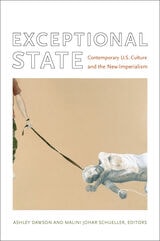
Exceptional State
Contemporary U.S. Culture and the New ImperialismAshley Dawson and Malini Johar Schueller, eds.
Duke University Press, 2007
The contributors address a range of topics, paying particular attention to the dynamics of gender and race. Their essays include a surprising reading of the ostensibly liberal movies Wag the Dog and Three Kings, an exploration of the rhetoric surrounding the plan to remake the military into a high-tech force less dependent on human bodies, a look at the significance of the popular Left Behind series of novels, and an interpretation of the Abu Ghraib prison photos. They scrutinize the national narrative created to justify the US invasions of Afghanistan and Iraq, the ways that women in those countries have responded to the invasions, the contradictions underlying calls for US humanitarian interventions, and the role of Africa in the US imperial imagination. The volume concludes on a hopeful note, with a look at an emerging anti-imperialist public sphere.
Contributors. Omar Dahbour, Ashley Dawson, Cynthia Enloe, Melani McAlister, Christian Parenti, Donald E. Pease, John Carlos Rowe, Malini Johar Schueller, Harilaos Stecopoulos
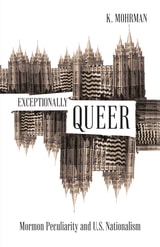
Exceptionally Queer
Mormon Peculiarity and U.S. NationalismK. Mohrman
University of Minnesota Press, 2022
How perceptions of Mormonism from 1830 to the present reveal the exclusionary, racialized practices of the U.S. nation-state
Are Mormons really so weird? Are they potentially queer? These questions occupy the heart of this powerful rethinking of Mormonism and its place in U.S. history, culture, and politics. K. Mohrman argues that Mormon peculiarity is not inherent to the Latter-day Saint faith tradition, as is often assumed, but rather a potent expression of U.S. exceptionalism.
Exceptionally Queer scrutinizes the history of Mormonism starting with its inception in the early 1830s and continuing to the present. Drawing on a wide range of historical texts and moments—from nineteenth-century battles over Mormon plural marriage; to the LDS Church’s emphases on “individual responsibility” and “family values”; to mainstream media’s coverage of the LDS Church’s racist exclusion of Black priesthood holders, its Native assimilation programs, and vehement opposition to the Equal Rights Amendment; and to much more recent legal and cultural battles over same-sex marriage and on-screen Mormon polygamy—Exceptionally Queer evaluates how Mormonism has been used to motivate and rationalize the biased, exclusionary, and colonialist policies and practices of the U.S. nation-state.
Mohrman explains that debates over Mormonism both drew on and shaped racial discourses and, in so doing, delineated the boundaries of whiteness and national belonging, largely through the consolidation of (hetero)normative ideas of sex, marriage, family, and economy. Ultimately, the author shows how discussions of Mormonism in this country have been and continue to be central to ideas of what it means to be American.
Exchange of Ideas
The Economy of Higher Education in Early AmericaAdam R. Nelson
University of Chicago Press, 2023
Exchange of Ideas launches a breathtakingly ambitious new economic history of American higher education. In this volume, Adam R. Nelson focuses on the early republic, explaining how knowledge itself became a commodity, as useful ideas became salable goods and American colleges were drawn into transatlantic commercial relations. American scholars might once have imagined that higher education could sit beyond the sphere of market activity—that intellectual exchange could transcend vulgar consumerism—but already by the end of the eighteenth century, they saw how ideas could be factored into the nation’s balance of trade. Moreover, they concluded that it was the function of colleges to oversee the complex process whereby knowledge could be priced and purchased. The history of capitalism and the history of higher education, Nelson reveals, are intimately intertwined—which raises a host of important and strikingly urgent questions. How do we understand knowledge and education as commercial goods? Who should pay for them? And, fundamentally, what is the optimal system of higher education in a capitalist democracy?
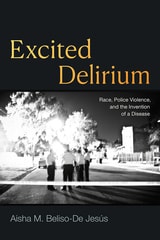
Excited Delirium
Race, Police Violence, and the Invention of a DiseaseAisha M. Beliso-De Jesús
Duke University Press, 2024
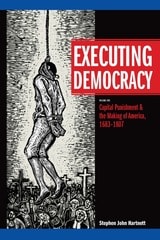
Executing Democracy
Volume One: Capital Punishment & the Making of America, 1683-1807Stephen J. Hartnett
Michigan State University Press, 2010
Executing Democracy: Capital Punishment & the Making of America, 1683-1807 is the first volume of a rhetorical history of public debates about crime, violence, and capital punishment in America. This examination begins in 1683, when William Penn first struggled to govern the rowdy indentured servants of Philadelphia, and continues up until 1807, when the Federalists sought to impose law-and-order upon the New Republic.
This volume offers a lively historical overview of how crime, violence, and capital punishment influenced the settling of the New World, the American Revolution, and the frantic post-war political scrambling to establish norms that would govern the new republic.
By presenting a macro-historical overview, and by filling the arguments with voices from different political camps and communicative genres, Hartnett provides readers with fresh perspectives for understanding the centrality of public debates about capital punishment to the history of American democracy.
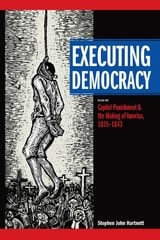
Executing Democracy
Volume Two: Capital Punishment and the Making of America, 1835-1843Stephen Hartnett
Michigan State University Press, 2024
This eye-opening and well-researched companion to the first volume of Executing Democracy enters the death-penalty discussion during the debates of 1835 and 1843, when pro-death penalty Calvinist minister George Barrell Cheever faced off against abolitionist magazine editor John O’Sullivan. In contrast to the macro-historical overview presented in volume 1, volume 2 provides micro-historical case studies, using these debates as springboards into the discussion of the death penalty in America at large. Incorporating a wide range of sources, including political poems, newspaper editorials, and warring manifestos, this second volume highlights a variety of perspectives, thus demonstrating the centrality of public debates about crime, violence, and punishment to the history of American democracy. Hartnett’s insightful assessment bears witness to a complex national discussion about the political, metaphysical, and cultural significance of the death penalty.
Executing Freedom
The Cultural Life of Capital Punishment in the United StatesDaniel LaChance
University of Chicago Press, 2016
That question is at the heart of Executing Freedom, a powerful, wide-ranging examination of the place of the death penalty in American culture and how it has changed over the years. Drawing on an array of sources, including congressional hearings and campaign speeches, true crime classics like In Cold Blood, and films like Dead Man Walking, Daniel LaChance shows how attitudes toward the death penalty have reflected broader shifts in Americans’ thinking about the relationship between the individual and the state. Emerging from the height of 1970s disillusion, the simplicity and moral power of the death penalty became a potent symbol for many Americans of what government could do—and LaChance argues, fascinatingly, that it’s the very failure of capital punishment to live up to that mythology that could prove its eventual undoing in the United States.
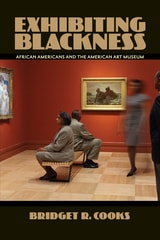
Exhibiting Blackness
African Americans and the American Art MuseumBridget R. Cooks
University of Massachusetts Press, 2011
In Exhibiting Blackness, art historian Bridget R. Cooks analyzes the curatorial strategies, challenges, and critical receptions of the most significant museum exhibitions of African American art. Tracing two dominant methodologies used to exhibit art by African Americans—an ethnographic approach that focuses more on artists than their art, and a recovery narrative aimed at correcting past omissions—Cooks exposes the issues involved in exhibiting cultural difference that continue to challenge art history, historiography, and American museum exhibition practices. By further examining the unequal and often contested relationship between African American artists, curators, and visitors, she provides insight into the complex role of art museums and their accountability to the cultures they represent.
Exhibiting Evangelicalism
Commemoration and Religion’s Presence of the PastDevin C. Manzullo-Thomas
University of Massachusetts Press, 2022
Religion is a subject often overlooked or ignored by public historians. Whether they are worried about inadvertent proselytizing or fearful of contributing to America’s ongoing culture wars, many heritage professionals steer clear of discussing religion’s formative role in the past when they build collections, mount exhibits, and develop educational programming. Yet religious communities have long been active contributors to the nation’s commemorative landscape.
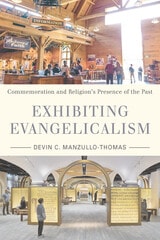
Exhibiting Evangelicalism provides the first account of the growth and development of historical museums created by white evangelical Christians in the United States over the twentieth and twenty-first centuries. Exploring the histories of the Museum of the Bible, the Billy Graham Center Museum, the Billy Sunday Home, and Park Street Church, Devin C. Manzullo-Thomas illustrates how these sites enabled religious leaders to develop a coherent identity for their fractious religious movement and to claim the centrality of evangelicalism to American history. In their zeal to craft a particular vision of the national past, evangelicals engaged with a variety of public history practices and techniques that made them major players in the field—including becoming early adopters of public history’s experiential turn.
Exhibiting Health
Public Health Displays in the Progressive EraJennifer Lisa Koslow
Rutgers University Press, 2020
Exile and Pride
Disability, Queerness, and LiberationEli Clare
Duke University Press, 2015
Exile, Nature, and Transformation in the Life of Mary Hallock Foote
Megan Riley McGilchrist
University of Nevada Press, 2021
Exiled Home
Salvadoran Transnational Youth in the Aftermath of ViolenceSusan Bibler Coutin
Duke University Press, 2016
Exiled Memories
Stories of Iranian DiasporaZohreh T. Sullivan
Temple University Press, 2001
These are the words of one Iranian emigre, driven from Tehran by the revolution of 1979. They are echoed time and again in this powerful portrayal of loss and survival. Impelled by these word and her own concerns about nationality and identity, Zohreh Sullivan has gathered together here the voices of sixty exiles and emigres. The speakers come from various ethnic and religious backgrounds and range in age from thirteen to eighty-eight. Although most are from the middle class, they work in a variety of occupations in the United States. But whatever their differences, here they engage in remembering the past, producing a discourse about their lives, and negotiating the troubled transitions from one culture to another.
Unlike man other Iranian oral history projects, Exiled Memories looks at the reconstruction of memory and identity through diasporic narratives, through a focus on the Americas rather than on Iran. The narratives included here reveal the complex ways in which events and places transform identities, how overnight radical s become conservatives, friends become enemies, the strong become weak. Indeed, the narratives themselves serve this function -- serving to transfer or transform power and establish credibility. They reveal a diverse group of people in the process of knitting the story of themselves with the story of the collective after it has been torn apart.

Exit Zero
Family and Class in Postindustrial ChicagoChristine J. Walley
University of Chicago Press, 2012
In 1980, Christine J. Walley’s world was turned upside down when the steel mill in Southeast Chicago where her father worked abruptly closed. In the ensuing years, ninety thousand other area residents would also lose their jobs in the mills—just one example of the vast scale of deindustrialization occurring across the United States. The disruption of this event propelled Walley into a career as a cultural anthropologist, and now, in Exit Zero, she brings her anthropological perspective home, examining the fate of her family and that of blue-collar America at large.
This book is part of a project that also includes a documentary film.

Exit Zero
Family and Class in Postindustrial ChicagoChristine J. Walley
University of Chicago Press, 2012
Winner of CLR James Book Prize from the Working Class Studies Association and 2nd Place for the Victor Turner Prize in Ethnographic Writing.
In 1980, Christine J. Walley’s world was turned upside down when the steel mill in Southeast Chicago where her father worked abruptly closed. In the ensuing years, ninety thousand other area residents would also lose their jobs in the mills—just one example of the vast scale of deindustrialization occurring across the United States. The disruption of this event propelled Walley into a career as a cultural anthropologist, and now, in Exit Zero, she brings her anthropological perspective home, examining the fate of her family and that of blue-collar America at large.
This book is part of a project that also includes a documentary film.
Exodus!
Religion, Race, and Nation in Early Nineteenth-Century Black AmericaEddie S. Glaude Jr.
University of Chicago Press, 2000
Exodus! shows how this biblical story inspired a pragmatic tradition of racial advocacy among African Americans in the early nineteenth century—a tradition based not on race but on a moral politics of respectability. Eddie S. Glaude, Jr., begins by comparing the historical uses of Exodus by black and white Americans and the concepts of "nation" it generated. He then traces the roles that Exodus played in the National Negro Convention movement, from its first meeting in 1830 to 1843, when the convention decided—by one vote—against supporting Henry Highland Garnet's call for slave insurrection.
Exodus! reveals the deep historical roots of debates over African-American national identity that continue to rage today. It will engage anyone interested in the story of black nationalism and the promise of African-American religious culture.
Exotics at Home
Anthropologies, Others, and American ModernityMicaela di Leonardo
University of Chicago Press, 1998
"An impressive work of scholarship that is mordantly witty, passionately argued, and takes no prisoners."—Lesley Gill, News Politics
"[Micaela] di Leonardo eloquently argues for the importance of empirical, interdisciplinary social science in addressing the tragedy that is urban America at the end of the century."—Jonathan Spencer, Times Literary Supplement
"In her quirky new contribution to the American culture brawl, feminist anthropologist Micaela di Leonardo explains how anthropologists, 'technicians of the sacred,' have distorted American popular debate and social life."—Rachel Mattson, Voice Literary Supplement
"At the end of di Leonardo's analyses one is struck by her rare combination of rigor and passion. Simply, [she] is a marvelous iconoclast."—Matthew T. McGuire, Boston Book Review
Expanding American Anthropology, 1945-1980
A Generation ReflectsEdited by Alice Beck Kehoe and Paul L. Doughty
University of Alabama Press, 2012
Expanding historical counsciousness
the development of the Holocaust Educational FoundationAnita. Weiner
Northwestern University Press, 2003
Expanding the American Mind
Books and the Popularization of KnowledgeBeth Luey
University of Massachusetts Press, 2010
Expanding the American Mind begins by comparing fiction and nonfiction—their relative respectability in the eyes of reading experts and in the opinions of readers themselves. It then traces the roots of popularization from the Middle Ages to the present, examining changes in literacy, education, and university politics. Focusing on the period since World War II, it examines the ways that curricular reform has increased interest in popularization as well as the impact of specialization and professionalization among the faculty. It looks at the motivations of academic authors and the risks and rewards that come from writing for a popular audience. It also explains how experts write for nonexperts—the rhetorical devices they use and the voices in which they communicate.
Beth Luey also looks at the readers of popularizations—their motivations for reading, the ways they evaluate nonfiction, and how they choose what to read. This is the first book to use surveys and online reader responses to study nonfiction reading. It also compares the experience of reading serious nonfiction with that of reading other genres.
Using publishers' archives and editor-author correspondence, Luey goes on to examine what editors, designers, and marketers in this very competitive business do to create and sell popularizations to the largest audience possible. In a brief afterword she discusses popularization and the Web. The result is a highly readable and engaging survey of this distinctive genre of writing.
Expanding the Strike Zone
Baseball in the Age of Free AgencyDaniel A. Gilbert
University of Massachusetts Press, 2013
Readers encounter both legendary and unheralded figures in this sweeping history, which situates Major League Baseball as part of a larger culture industry. The book examines a labor history defined at once by the growing power of big league stars—from Juan Marichal and Curt Flood to Fernando Valenzuela and Ichiro Suzuki—and the collective struggles of players working to make a living throughout the baseball world. It also explores the territorial politics that have defined baseball's development as a form of transnational popular culture, from the impact of Dominican baseball academies to the organized campaign against stadium development by members of Seattle's Asian American community.
Based on a rich body of research along with new readings of popular journalism, fiction, and film, Expanding the Strike Zone highlights the ways in which baseball's players, owners, writers, and fans have shaped and reshaped the sport as a central element of popular culture from the postwar boom to the Great Recession.
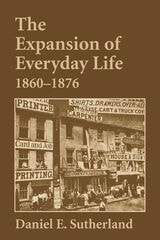
Expansion of Everyday Life, 1860–1876
Daniel Sutherland
University of Arkansas Press, 2000
Expelled to a Friendlier Place
A Study of Effective Alternative SchoolsMartin Gold and David W. Mann
University of Michigan Press, 1984
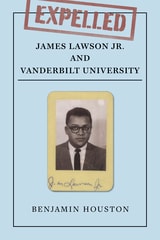
Expelled
James Lawson Jr. and Vanderbilt UniversityBenjamin Houston
Vanderbilt University Press, 2026
In February 1960, as lunch counter sit-ins began in Southern cities, national attention focused on Nashville, where demonstrations were carried out by an unusually organized and disciplined group of students tutored extensively in nonviolent direct action. Their mentor was Reverend James Lawson Jr., a graduate student at Vanderbilt University Divinity School with longstanding nonviolent credentials. His workshops with Nashville students, exploring Gandhian style philosophies and tactics, had predated the famed Greensboro sit-ins.
As demonstrations continued in Nashville and successive sit-ins saw violence erupt downtown, local Black ministers demanded an audience with Mayor Ben West. At this meeting, an exchange occurred that was misconstrued by subsequent newspaper reportage. Shortly thereafter, Lawson was summarily expelled from Vanderbilt, one semester shy of graduating.
Lawson’s ouster triggered a wave of repercussions and headlines. After extended negotiations with their superiors were rebuffed, a large contingent of Divinity School faculty resigned en masse. Simmering dissension between the university’s professors, Board of Trust, and administrators kept the crisis ongoing. Sustained criticism of Vanderbilt both within the city and nationally made for a turbulent situation as Lawson’s expulsion came to symbolize profound tensions about civil rights and racial justice.
Expelling Public Schools
How Antiracist Politics Enable School Privatization in NewarkJohn Arena
University of Minnesota Press, 2023
Exploring the role of identitarian politics in the privatization of Newark’s public school system
In Expelling Public Schools, John Arena explores the more than two-decade struggle to privatize public schools in Newark, New Jersey—a conflict that is raging in cities across the country—from the vantage point of elites advancing the pro-privatization agenda and their grassroots challengers.
Analyzing the unsuccessful effort of Cory Booker—Newark’s leading pro-privatization activist and mayor—to generate popular support for the agenda, and Booker’s rival and ultimate successor Ras Baraka’s eventual galvanization of the charter movement, Arena argues that Baraka’s black radical politics cloaked a revanchist agenda of privatization.
Expelling Public Schools reveals the political rise of Booker and Baraka, their one-time rivalry and subsequent alliance, and what this particular case study illuminates about contemporary post–civil rights Black politics. Ultimately, Expelling Public Schools is a critique of Black urban regime politics and the way in which antiracist messaging obscures real class divisions, interests, and ideological diversity.
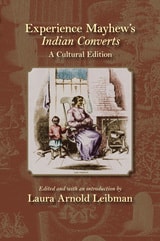
Experience Mayhew's Indian Converts
A Cultural EditionLaura Arnold Leibman
University of Massachusetts Press, 2008
First published in 1727 under the title Indian Converts, or Some account of the lives and dying speeches of a considerable number of the Christianized Indians of Martha's Vineyard, in New-England, Experience Mayhew's history of the Wampanoag Indians on Martha's Vineyard provides a rare look at the lives and culture of four generations of Native Americans in colonial America. Dividing his treatment into four sections—Indian Ministers, Good Men, Religious Women, and Pious Children—Mayhew details the books that different age groups were reading, provides insights into early New England pedagogy and childrearing practices, and describes each individual in terms of genealogy, religious practice, way of life, and place of residence.
In addition to drawing on his own firsthand knowledge of the community and transcriptions of oral testimony he and others collected, Mayhew inserts translations of Wampanoag texts that have since been lost. Although the book has been out of print since the early nineteenth century, scholars have long recognized its importance for understanding the history of New England's Native communities. In an extensive introduction to this new scholarly edition, Laura Arnold Leibman places Indian Converts in a broader cultural context and explores its significance. She shows how Mayhew's biographies illuminate the theological upheavals that rocked early eighteenth-century New England on the eve of the Great Awakening, shifts that altered not only the character of Puritanism but also the landscape of Wampanoag religious and cultural life. An accompanying online archive that includes over 600 images and documents further contextualizes Mayhew's work and provide suggestions for students' investigations of the text.

Experiencing America's Story through Fiction
Historical Novels for Grades 7-12Hilary Susan Crew
American Library Association, 2014
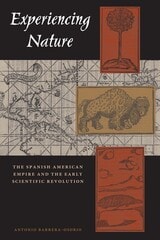
Experiencing Nature
The Spanish American Empire and the Early Scientific RevolutionBy Antonio Barrera-Osorio
University of Texas Press, 2006
As Spain colonized the Americas during the sixteenth century, Spanish soldiers, bureaucrats, merchants, adventurers, physicians, ship pilots, and friars explored the natural world, gathered data, drew maps, and sent home specimens of America's vast resources of animals, plants, and minerals. This amassing of empirical knowledge about Spain's American possessions had two far-reaching effects. It overturned the medieval understanding of nature derived from Classical texts and helped initiate the modern scientific revolution. And it allowed Spain to commodify and control the natural resources upon which it built its American empire.
In this book, Antonio Barrera-Osorio investigates how Spain's need for accurate information about its American colonies gave rise to empirical scientific practices and their institutionalization, which, he asserts, was Spain's chief contribution to the early scientific revolution. He also conclusively links empiricism to empire-building as he focuses on five areas of Spanish activity in America: the search for commodities in, and the ecological transformation of, the New World; the institutionalization of navigational and information-gathering practices at the Spanish Casa de la Contratación (House of Trade); the development of instruments and technologies for exploiting the natural resources of the Americas; the use of reports and questionnaires for gathering information; and the writing of natural histories about the Americas.
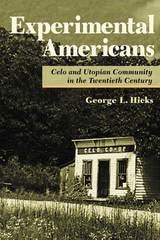
Experimental Americans
Celo and Utopian Community in the Twentieth CenturyGeorge L. Hicks
University of Illinois Press, 2001
From colonial times to the present, the United States has been home to a steady stream of utopian experimental communities. In Experimental Americans, George L. Hicks takes us inside one of the longer-lived of such communities, Celo Community in western North Carolina, to explore the dynamics of intentional communities in America.
Founded in 1937 by Arthur Morgan, first chairman of the Tennessee Valley Authority, Celo (pronounced see-lo) established its own rules of land tenure and taxation, conducted its internal business by consensus, and did not require its members to accept any particular ideology or religious creed. Drawing on extensive fieldwork in Celo and among its local neighbors, consultation of Celo's documentary records, and interviews with ex-members, Hicks traces the Community's ups and downs. Attacked for its opposition to World War II, Celo was revived by pacifists released from prisons and Civilian Public Service camps after the war; debilitated in the 1950s by bitter feuds with ex-members, it was buoyed up in the 1960s by the radical enthusiasm of new currents in the nation.
Hicks assesses the Community's success in creating alternatives to mainstream social relations and examines the interactions between Celo and its neighboring community. He considers variations in paths taken by utopian communities, with a look at a close cousin of Celo, the Macedonia Community in Georgia. He also discusses the Community's "post-utopian" phase, marked by a shift in the late 1970s from social goals to straightforward land management.
While utopian communities might hope to secede from American society in varying degrees and to institute new and improved cultural models, nonetheless they express in many ways the attempt--characteristic of the nation itself--to balance individualism and egalitarianism. By providing the context, utopian and conventional, within which Celo and other experimental communities emerge and change, Experimental Americans illuminates an ongoing encounter with persistent tensions and contradictions in America's cultural postulates.
Experimentation with Human Beings
The Authority of the Investigator, Subject, Professions, and State in the Human Experimentation ProcessJay Katz
Russell Sage Foundation, 1972
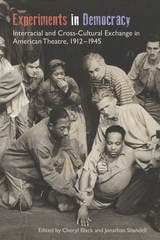
Experiments in Democracy
Interracial and Cross-Cultural Exchange in American Theatre, 1912-1945Edited by Cheryl Black and Jonathan Shandell
Southern Illinois University Press, 2016
In Experiments in Democracy, edited by Cheryl Black and Jonathan Shandell, theatre historians examine a wide range of performances—from Broadway, folk plays and dance productions to scripted political rallies and radio dramas. Contributors look at such diverse groups as the Theatre Union, La Unión Martí-Maceo, and the American Negro Theatre, as well as individual playwrights and their works, including Theodore Browne’s folk opera Natural Man, Josefina Niggli’s Soldadera, and playwright Lynn Riggs’s Cherokee Night and Green Grow the Lilacs (the basis for the musical Oklahoma!). Exploring the ways progressive artists sought to connect isolated racial and cultural groups in pursuit of a more just and democratic society, contributors take into account the blind spots, compromised methods, and unacknowledged biases at play in their practices and strategies. Essays demonstrate how the gap between the ideal of American democracy and its practice—mired in entrenched systems of white privilege, economic inequality, and social prejudice—complicated the work of these artists.
Focusing on questions of race, ethnicity, gender, and sexuality on the stage in the decades preceding the Civil Rights era, Experiments in Democracy fills an important gap in our understanding of the history of the American stage—and sheds light on these still-relevant questions in contemporary American society.
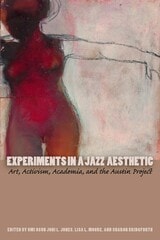
Experiments in a Jazz Aesthetic
Art, Activism, Academia, and the Austin ProjectEdited by Omi Osun Joni L. Jones, Lisa L. Moore, and Sharon Bridgforth
University of Texas Press, 2010
In Austin, Texas, in 2002, a group of artists, activists, and academics led by performance studies scholar Omi Osun Joni L. Jones formed the Austin Project (tAP), which meets annually in order to provide a space for women of color and their allies to build relationships based on trust, creativity, and commitment to social justice by working together to write and perform work in the jazz aesthetic.
Inspired by this experience, this book is both an anthology of new writing and a sourcebook for those who would like to use creative writing and performance to energize their artistic, scholarly, and activist practices. Theoretical and historical essays by Omi Osun Joni L. Jones describe and define the African American tradition of art-making known as the jazz aesthetic, and explain how her own work in this tradition inspired her to start tAP.
Key artists in the tradition, from Bessie Award–winning choreographer Laurie Carlos and writer/performer Robbie McCauley to playwrights Daniel Alexander Jones and Carl Hancock Rux, worked with the women of tAP as mentors and teachers. This book brings together never-before-published, must-read materials by these nationally known artists and the transformative writing of tAP participants. A handbook for workshop leaders by Lambda Literary Award–winning writer Sharon Bridgforth, tAP's inaugural anchor artist, offers readers the tools for starting similar projects in their own communities. A full-length script of the 2005 tAP performance is an original documentation of the collaborative, breath-based, body work of the jazz aesthetic in theatre, and provides both a script for use by theatre artists and an invaluable documentation of a major transformative movement in contemporary performance.
Expert Legal Writing
By Teresa Ross LeClercq
University of Texas Press, 1995
For many years, Terri LeClercq's "Legal Writing" column in the Texas Bar Journal helped polish the prose of lawyers and law students, judges and clerks, paralegals, writing instructors, and legal secretaries. This book collects all the advice she has given in her columns into one authoritative guide for expert legal writing. LeClercq covers everything a legal writer needs to know, from the mechanics of grammar and punctuation to the finer points of style, organization, and clarity of meaning. With her practical, readable, and often humorous advice, those who prepare legal documents can rid their prose of mind-numbing "legalese" and write with the clarity and precision that characterize the very best legal writing.
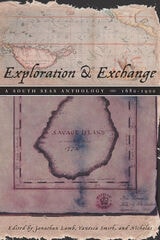
Exploration and Exchange
A South Seas Anthology, 1680-1900Edited by Jonathan Lamb, Vanessa Smith, and Nicholas Thomas
University of Chicago Press, 2001
As George Vason's anguished narrative shows, European encounters with Pacific peoples often proved as wrenching to the Europeans as to the natives. This anthology gathers some of the most vivid accounts of these cultural exchanges for the first time, placing the works of well-known figures such as Captain James Cook and Robert Louis Stevenson alongside the writings of lesser-known explorers, missionaries, beachcombers, and literary travelers who roamed the South Seas from the late seventeenth through the late nineteenth centuries.
Here we discover the stories of the British buccaneers and privateers who were lured to the Pacific by stories of fabulous wealth; of the scientists, cartographers, and natural historians who tried to fit the missing bits of terra incognita into a universal scheme of knowledge; and of the varied settlers who established a permanent European presence in Polynesia and Australia. Through their detailed commentary on each piece and their choice of selections, the editors—all respected scholars of the literature and cultures of the Pacific—emphasize the mutuality of impact of these colonial encounters and the continuity of Pacific cultures that still have the power to transform visitors today.
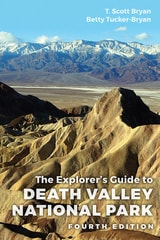
Explorer's Guide to Death Valley National Park, Fourth Edition
T. Scott Bryan
University Press of Colorado, 2020
Originally published in 1995, soon after Death Valley National Park became the fifty-third park in the US park system, The Explorer’s Guide to Death Valley National Park was the first complete guidebook available for this spectacular area. Now in its fourth edition, this is still the only book that includes all aspects of the park. Much more than just a guidebook, it covers the park’s cultural history, botany and zoology, hiking and biking opportunities, and more. Information is provided for all of Death Valley’s visitors, from first-time travelers just learning about the area to those who are returning for in-depth explorations.
This new edition features a number of important changes—including information on the boundary and wilderness changes that resulted from the Dingell Act of 2019, the reopened Keane Wonder Mine area, the devastating flash flooding of Scotty’s Castle, scenic river designations, the Inn and Ranch resorts, renovated and now operated as the Oasis at Death Valley—as well as new maps and updated color photos. With extensive input from National Park Service resource management, law enforcement, and interpretive personnel, as well as a thorough bibliography for suggested reading, The Explorer’s Guide to Death Valley National Park, Fourth Edition is the most up-to-date, accurate, and comprehensive guide available for this national treasure.
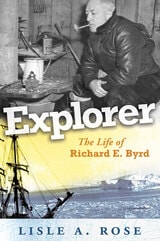
Explorer
The Life of Richard E. ByrdLisle A. Rose
University of Missouri Press, 2008
“Danger was all that thrilled him,” Dick Byrd’s mother once remarked, and from his first pioneering aviation adventures in Greenland in 1925, through his daring flights to the top and bottom of the world and across the Atlantic, Richard E. Byrd dominated the American consciousness during the tumultuous decades between the world wars. He was revered more than Charles Lindbergh, deliberately exploiting the public’s hunger for vicarious adventure. Yet some suspected him of being a poseur, and a handful reviled him as a charlatan who claimed great deeds he never really accomplished.
Then he overreached himself, foolishly choosing to endure a blizzard-lashed six-month polar night alone at an advance weather observation post more than one hundred long miles down a massive Antarctic ice shelf. His ordeal proved soul-shattering, his rescue one of the great epics of polar history. As his star began to wane, enemies grew bolder, and he struggled to maintain his popularity and political influence, while polar exploration became progressively bureaucratized and militarized. Yet he chose to return again and again to the beautiful, hateful, haunted secret land at the bottom of the earth, claiming, not without justification, that he was “Mayor of this place.”
Lisle A. Rose has delved into Byrd’s recently available papers together with those of his supporters and detractors to present the first complete, balanced biography of one of recent history’s most dynamic figures. Explorer covers the breadth of Byrd’s astonishing life, from the early days of naval aviation through his years of political activism to his final efforts to dominate Washington’s growing interest in Antarctica. Rose recounts with particular care Byrd’s two privately mounted South Polar expeditions, bringing to bear new research that adds considerable depth to what we already know. He offers views of Byrd’s adventures that challenge earlier criticism of him—including the controversy over his claim to being the first to have flown over the North Pole in 1926—and shows that the critics’ arguments do not always mesh with historical evidence.
Throughout this compelling narrative, Rose offers a balanced view of an ambitious individual who was willing to exaggerate but always adhered to his principles—a man with a vision of himself and the world that inspired others, who cultivated the rich and famous, and who used his notoriety to espouse causes such as world peace. Explorer paints a vivid picture of a brilliant but flawed egoist, offering the definitive biography of the man and armchair adventure of the highest order.
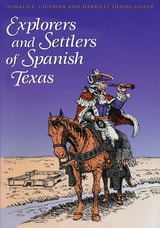
Explorers and Settlers of Spanish Texas
By Donald E. Chipman and Harriett Denise Joseph
University of Texas Press, 2001
In Notable Men and Women of Spanish Texas, Donald Chipman and Harriett Joseph combined dramatic, real-life incidents, biographical sketches, and historical background to reveal the real human beings behind the legendary figures who discovered, explored, and settled Spanish Texas from 1528 to 1821. Drawing from their earlier book and adapting the language and subject matter to the reading level and interests of middle and high school students, the authors here present the men and women of Spanish Texas for young adult readers and their teachers.
These biographies demonstrate how much we have in common with our early forebears. Profiled in this book are:
- Alvar Núñez Cabeza de Vaca: Ragged Castaway
- Francisco Vázquez de Coronado: Golden Conquistador
- María de Agreda: Lady in Blue
- Alonso de León: Texas Pathfinder
- Domingo Terán de los Ríos / Francisco Hidalgo: Angry Governor and Man with a Mission
- Louis St. Denis / Manuela Sánchez: Cavalier and His Bride
- Antonio Margil de Jesús: God's Donkey
- Marqués de San Miguel de Aguayo: Chicken War Redeemer
- Felipe de Rábago y Terán: Sinful Captain
- José de Escandón y Elguera: Father of South Texas
- Athanase de Mézières: Troubled Indian Agent
- Domingo Cabello: Comanche Peacemaker
- Marqués de Rubí / Antonio Gil Ibarvo: Harsh Inspector and Father of East Texas
- Bernardo Gutiérrez de Lara / Joaquín de Arredondo: Rebel Captain and Vengeful Royalist
- Women in Colonial Texas: Pioneer Settlers
- Women and the Law: Rights and Responsibilities
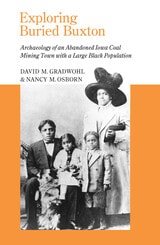
Exploring Buried Buxton
Archaeology of an Abandoned Iowa Coal Mining Town with a Large Black PopulationDavid M. Gradwohl
University of Iowa Press, 1984
Few sources before have dealt with the archaeology of African American settlements outside the Atlantic seaboard and the southern states. This book describes in detail the archaeological investigations conducted at the town site of Buxton, Iowa, a coal mining community inhabited by a significantly large population of blacks between 1900 and 1925.
David Gradwohl and Nancy Osborn present the archaeology of Buxton from “the group up” to articulate the material remains with the data acquired from archival studies and oral history interviews. They also examine the broader significance of the Buxton experience in terms of those who lived there and their children and grandchildren who have heard about Buxton all their lives.
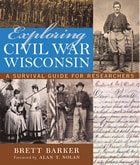
Exploring Civil War Wisconsin
A Survival Guide for ResearchersBrett Barker
Wisconsin Historical Society Press, 2003
The innovative format of Exploring Civil War Wisconsin makes it easy for Civil War buffs, genealogists, and students to find and effectively use the vast array of historical materials about the Civil War found in archives, military and census records, published firsthand accounts, newspapers, and even on the Internet. This lively, illustrated guide focuses on Wisconsin in the Civil War, but is broadly applicable to Civil War research anywhere. Images of original documents and historic photographs illustrate every chapter, acquainting readers with both the Civil War and its sources. The easy-to-use and informative text is unlike anything else currently on the market.
Throughout the book, boxed features and sidebars provide background information and tips on how to do research. Author Brett Barker explains how to uncover the history of an individual soldier, his regiment, and his role in the Union Army using rosters, military records, pension files, and memoirs. And, he shows how to explore the home front during the war using the census, newspapers, city directories, and government records.
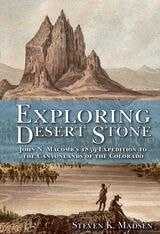
Exploring Desert Stone
John N. Macomb's 1859 Expedition to the Canyonlands of the ColoradoSteven K. Madsen
Utah State University Press, 2022
The soldiers and scientists followed in part the Old Spanish Trail, whose location they documented and verified. Seeking to find the confluence of the Colorado and the Green and looking for alternative routes into Utah, which was of particular interest in the wake of the Utah War, they produced a substantial documentary record, most of which is published for the first time in this volume. Theirs is also the first detailed map of the region, and it is published in Exploring Desert Stone, as well.
Exploring Environmental Science with Children and Teens
Eileen G. Harrington
American Library Association, 2014
Exploring Federalism
Daniel J. Elazar
University of Alabama Press, 1987
CHOICE OUTSTANDING ACADEMIC BOOK
A definitive exploration of the ideas, institutions, and principles that shape federal government.
Exploring Federalism is a seminal study by political scientist Daniel J. Elazar that examines the origins, evolution, and enduring significance of federal systems of government. Widely regarded as one of the leading scholars of federalism, Elazar offers a comprehensive analysis of how federal principles have shaped political institutions across diverse societies and historical periods. Rather than limiting his discussion to the United States, he adopts a global and comparative perspective, exploring how federal arrangements provide workable solutions for nations seeking to balance unity with diversity, shared governance with local autonomy, and collective action with individual liberty.
Drawing on history, constitutional theory, and political philosophy, Elazar investigates the covenantal foundations of federalism and explains how federal systems distribute authority, protect regional identities, and promote democratic participation. He also examines contemporary trends toward both centralization and decentralization, arguing that federalism remains one of the most effective frameworks for governing pluralistic societies. Exploring Federalism remains an essential resource for students, scholars, policymakers, and anyone interested in constitutional government and democratic institutions.
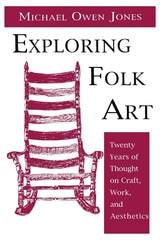
Exploring Folk Art
Michael Owen Jones
Utah State University Press, 1993
Jones explores the human impulse to create, the necessity for having aesthetically satisfying experiences, and the craving for tradition. He also considers topics such as making chairs, remodeling houses, using and preserving soda-fountain slang, preparing and eating food, and sculpting lifelike figures out of cement.
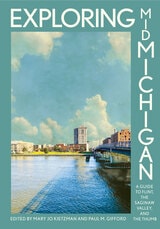
Exploring Mid-Michigan
A Guide to Flint, the Saginaw Valley, and the ThumbMary Jo Kietzman
Michigan State University Press, 2026
Inspired by the iconic American Guide Series published by the Federal Writers Project in the 1930s, this new guide to Flint, the Saginaw Valley, and the Thumb showcases the industrial-agricultural heart of Michigan, which has been beating irregularly for the last three decades, but whose importance to its people has lasted millennia. The ten counties featured in the book have lost population, industries, small farms, natural resources, and clean water. Instead of focusing on loss, the authors uncover the region’s unique history and culture, characterized by the productive tension between factories and farms, urban and rural spaces, labor and management, migrants and the mainstream, conservatives and progressives. The book documents the genesis of an ecological awareness that grew out of deforestation, habitat and species loss, and a succession of water crises. Encyclopedic in scope like their WPA forebears, the book is a functional guide that offers suggestions and strategies for enriching travel while celebrating the tenacity of those who came, worked, and stayed: lumberjacks, farmers, foundry workers, labor activists, judges, Indigenous peoples, African Americans, artists, poets, and environmental warriors.
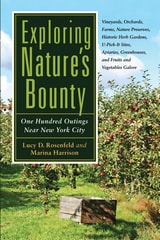
Exploring Nature's Bounty
One Hundred Outings Near New York CityRosenfeld, Lucy D
Rutgers University Press, 2012
When lifelong friends Lucy D. Rosenfeld and Marina Harrison set off on their outings in the region, they are always on the lookout for the gifts that nature offers. Exploring Nature’s Bounty, their ninth collaboration, invites us to share the rich array of agricultural delights they’ve discovered within a two-hour radius of New York City—from beautiful vineyards to the latest in hydroponic greenhouses to peach-filled orchards to community farms and historic sites.
The places chosen all welcome visitors who will see first hand the art of agriculture, pick their own produce, help out on the farm, or simply enjoy being outdoors so close to the city. Many of them are off-the-beaten-track locations where readers and their families can walk among rows of grapes, cornstalks, apple trees, and so much more. The sites range from traditional fruit orchards to greenhouses filled with water-grown tomatoes and basil to neatly ordered herb gardens in historic settings. Local vineyards make wineries fun and glamorous places to visit, whether on the North Fork of Long Island or in the Hudson Valley. Some venues focus on crop preservation—the American chestnut, for example—while others introduce readers to honey making and maple sugaring. Those interested in taking classes or seeing demonstrations will find places to do just that, and many activities are geared toward children, from corn mazes to hayrides to pumpkin picking.
Rosenfeld and Harrison provide a list of festivals featuring local produce and, at the end of the book, a guide to choosing an outing that will best fit readers, their families, and their taste buds. Directions are provided in each write-up as well as information on schedules, guided tours, and walks within many of the sites.
Exploring Nature’s Bounty focuses on the natural, the organic, the sustainable, and the close-at-hand. By avoiding places overrun with commercialism, it helps readers create their own adventures, enjoy time with family and friends, and connect to the farms that nourish us all.
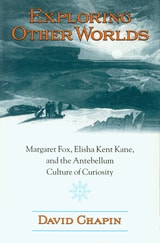
Exploring Other Worlds
Margaret Fox, Elisha Kent Kane, and the Antebellum Culture of CuriosityDavid Chapin
University of Massachusetts Press, 2004
Exploring Other Worlds tells the intertwined stories of the Arctic explorer Elisha Kent Kane and the spiritualist medium Margaret Fox and examines their unlikely relationship. Kane, from a prominent Philadelphia family, became one of the most renowned and honored explorers of the antebellum era. Fox grew up in rural upstate New York and, as one of the Fox Sisters, became a famed and somewhat notorious “spirit raper” whose strange “knocks” were said to be communications from the dead. The two were rumored to have had a love affair, and they may even have been secretly married.
In their separate professional lives, Kane and Fox each revealed something new and strange (though not necessarily true) to their audiences—the unknown worlds of the globe and the spirit. They brought experiences to their listeners that were exotic and delightful. The bourgeoning commercial mass culture of antebellum America provided a natural venue for tales of huge icebergs, fierce polar bears, and messages from the dead. Their public careers bridged the gaps between the scientific investigations of an earlier Enlightenment age and a newer form of sensational inquiry growing up in a democratic marketplace.
Though Kane and Fox began by generating curiosity about geography and the nature of the human soul, in time their personal relationship became the basis for what newspaperman Horace Greeley would call an “impertinent curiosity.” Newspapers printed letters about their supposed romance, and eventually a book purporting to be the famous explorer's love-letters to the notorious spiritualist was published. Curiosity about the Arctic and curiosity about the fate of the soul after death were transformed into curiosity about the private affairs of a new kind of media-driven public celebrity.
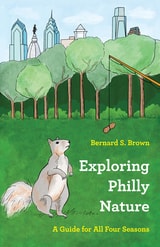
Exploring Philly Nature
A Guide for All Four SeasonsBernard S. Brown
Temple University Press, 2022
Do snakes and salamanders fascinate you or make you squeamish? Have you ever listened closely to the birds chirping in your neighborhood? Can you identify the flowers growing in Philadelphia’s urban parks? (Moreover, are the mushrooms safe to eat?) Exploring Philly Nature is amateur naturalist, urban herper,* and Grid contributor Bernard Brown’s handy guide to experiencing the flora and fauna in Philly.
This compact illustrated volume contains 52 activities from birding, (squirrel) fishing, and basement bug-hunting to joining a frog call survey and visiting a mussel hatchery. Brown encourages kids (as well as their parents) to connect with the natural world close to home. Each entry contains information on where and when to participate, what you will need (even if it is only patience), and tips on clubs and organizations to contact for access.
The city and its environs contain a multitude of species from the lichen that grows on gravestones or trees to nocturnal animals like opossums, bats, and raccoons. Exploring Philly Nature is designed to get readers eager to discover, observe, and learn more about the concrete jungle that is Philadelphia.
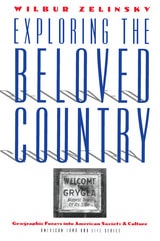
Exploring The Beloved Country
American Society And CultureWilbur Zelinsky
University of Iowa Press, 1994
For fifty years geographer Wilbur Zelinsky has charted the social, cultural, and historical map of the American experience. A self-confessed incurable landscape voyeur, he has produced order and pattern from massive amounts of data, zestfully finding societal meaning in the terra incognita of our postmodern existence. Now he has gathered his most original and exciting explorations into a volume that captures the nature and dynamics of this remarkable phenomenon we call the United States of America. Each the product of Zelinsky's joyous curiosity, these energetic essays trace the innermost contours of our bewildering American reality.
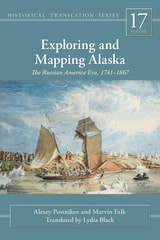
Exploring and Mapping Alaska
The Russian America Era, 1741-1867Alexey Postnikov and Marvin Falk
University of Alaska Press, 2015
Exploring and Mapping Alaska focuses on this foundational period in Arctic cartography. Russia spurred a golden era of cartographic exploration, while shrouding their efforts in a veil of secrecy. They drew both on old systems developed by early fur traders and new methodologies created in Europe. With Great Britain, France, and Spain following close behind, their expeditions led to an astounding increase in the world’s knowledge of North America.
Through engrossing descriptions of the explorations and expert navigators, aided by informative illustrations, readers can clearly trace the evolution of the maps of the era, watching as a once-mysterious region came into sharper focus. The result of years of cross-continental research, Exploring and Mapping Alaska is a fascinating study of the trials and triumphs of one of the last great eras of historic mapmaking.