Results by title
805 books match the query '18th Century' and 46 start with f
Fabricating the Antique
Neoclassicism in Britain, 1760-1800Viccy Coltman
University of Chicago Press, 2006
Looking at the theoretical foundations of neoclassicism, Coltman contends this reinvention of ancient material culture was more than a fabrication of style. Based in the strong emphasis on classical education during this time, neoclassicism, Coltman claims, could be more accurately described as a style of thought translated into material possessions. Fabricating the Antique is a new take on both well-known collections of ancient art and newly cataloged artifacts. This book also covers how these objects—once removed from their original context—were received, preserved, and displayed. Art historians, classicists, and archaeologists alike will benefit from this important examination of British eighteenth-century history.
Facing Racial Revolution
Eyewitness Accounts of the Haitian InsurrectionJeremy D. Popkin
University of Chicago Press, 2008
Numerous firsthand narratives of these events survived, but their invaluable insights into the period have long languished in obscurity—until now. In Facing Racial Revolution, Jeremy D. Popkin unearths these documents and presents excerpts from more than a dozen accounts written by white colonists trying to come to grips with a world that had suddenly disintegrated. These dramatic writings give us our most direct portrayal of the actions of the revolutionaries, vividly depicting encounters with the uprising’s leaders—Toussaint Louverture, Boukman, and Jean-Jacques Dessalines—as well as putting faces on many of the anonymous participants in this epochal moment. Popkin’s expert commentary on each selection provides the necessary background about the authors and the incidents they describe, while also addressing the complex question of the witnesses’ reliability and urging the reader to consider the implications of the narrators’ perspectives.
Along with the American and French revolutions, the birth of Haiti helped shape the modern world. The powerful, moving, and sometimes troubling testimonies collected in Facing Racial Revolution significantly expand our understanding of this momentous event.
Families in War and Peace
Chile from Colony to NationSarah C. Chambers
Duke University Press, 2015
Families of the Heart
Surrogate Relations in the Eighteenth-Century British NovelAnn Campbell
Bucknell University Press, 2023
In this innovative analysis of canonical British novels, Campbell identifies a new literary device—the surrogate family—as a signal of cultural anxieties about young women’s changing relationship to matrimony across the long eighteenth century. By assembling chosen families rather than families of origin, Campbell convincingly argues, female protagonists in these works compensate for weak family ties, explore the world and themselves, prepare for idealized marriages, or sidestep marriage altogether. Tracing the evolution of this rich convention from the female characters in Defoe’s and Richardson’s fiction who are allowed some autonomy in choosing spouses, to the more explicitly feminist work of Haywood and Burney, in which connections between protagonists and their surrogate sisters and mothers can substitute for marriage itself, this book makes an ambitious intervention by upending a traditional trope—the model of the hierarchal family—ultimately offering a new lens through which to regard these familiar works.
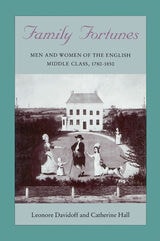
Family Fortunes
Men and Women of the English Middle Class, 1780-1850Leonore Davidoff and Catherine Hall
University of Chicago Press, 1987
"The book explores how the middle class constructed its own institutions, material culture and values during the industrial revolution, looking at two settings—urban manufacturing Birmingham and rural Essex—both centers of active capitalist development. The use of sources is dazzling: family business records, architectural designs, diaries, wills and trusts, newspapers, prescriptive literature, sermons, manuscript census tracts, the papers of philanthropic societies, popular fiction, and poetry.
"Family Fortunes occupies a place beside Mary Ryan's The Cradle of the Middle Class and Suzanne Lebsock's Free Women of Petersburg. It provides scholars with a definitive study of the middle class in England, and facilitates a comparative perspective on the history of middle-class women, property, and the family."—Judith Walkowitz, Johns Hopkins University
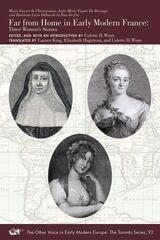
Far from Home in Early Modern France
Three Women’s StoriesMarie Guyart de l’Incarnation, Anne-Marie Fiquet du Boccage, and Henriette-Lucie Dillon de la Tour du Pin
Iter Press, 2022
This book showcases three Frenchwomen who ventured far from home at a time when such traveling was rare. In 1639, Marie de l’Incarnation embarked for New France where she founded the first Ursuline monastery in present-day Canada. In 1750, Madame du Boccage set out at the age of forty on her first “grand tour.” She visited England, the Netherlands, and Italy where she experienced firsthand the intellectual liberty offered there to educated women. As the Reign of Terror gripped France, the Marquise de la Tour du Pin fled to America with her husband and their two young children, where they ran a farm from 1794 to 1796. The writings these women left behind detailing their respective journeys abroad represent significant contributions to early modern travel literature. This book makes available to anglophone readers three texts that are rich in both historical and literary terms.
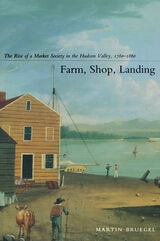
Farm, Shop, Landing
The Rise of a Market Society in the Hudson Valley, 1780–1860Martin Bruegel
Duke University Press, 2002
Combining theoretical rigor with extensive archival research, Bruegel’s account diverges from other historiographies of nineteenth-century economic development. It challenges the assumption that the coexistence of long-distance trade, private property, and entrepreneurial activity lead to one inescapable outcome: a market economy either wholeheartedly embraced or entirely rejected by its members. When Bruegel tells the story of farmer William Coventry struggling in the face of bad harvests, widow Mary Livingston battling her tenants, blacksmith Samuel Fowks perfecting the cast-iron plough, and Hannah Bushnell sending her butter to market, Bruegel shows that the social conventions of a particular community, and the real struggles and hopes of individuals, actively mold the evolving economic order. Ultimately, then, Farm, Shop, Landing suggests that the process of modernization must be understood as the result of the simultaneous and often contentious interplay of social and economic spheres.
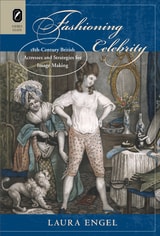
Fashioning Celebrity
Eighteenth-Century British Actresses and Strategies for Image MakingLaura Engel
The Ohio State University Press, 2011

Faust
A Tragedy, Part IEugene Stelzig
Bucknell University Press, 2019
Published by Bucknell University Press. Distributed worldwide by Rutgers University Press.
Feeding Globalization
Madagascar and the Provisioning Trade, 1600–1800Jane Hooper
Ohio University Press, 2017
Between 1600 and 1800, the promise of fresh food attracted more than seven hundred English, French, and Dutch vessels to Madagascar. Throughout this period, European ships spent months at sea in the Atlantic and Indian Oceans, but until now scholars have not fully examined how crews were fed during these long voyages. Without sustenance from Madagascar, European traders would have struggled to transport silver to Asia and spices back to Europe. Colonies in Mozambique, Mauritius, and at the Cape relied upon frequent imports from Madagascar to feed settlers and slaves.
In Feeding Globalization, Jane Hooper draws on challenging and previously untapped sources to analyze Madagascar’s role in provisioning European trading networks within and ultimately beyond the Indian Ocean. The sale of food from the island not only shaped trade routes and colonial efforts but also encouraged political centralization and the slave trade in Madagascar. Malagasy people played an essential role in supporting European global commerce, with far-reaching effects on their communities.
Feeding Globalization reshapes our understanding of Indian Ocean and global history by insisting historians should pay attention to the role that food played in supporting other exchanges.
Feminist Comedy
Women Playwrights of LondonWillow White
University of Delaware Press, 2024

Fetter'd or Free?
British Women Novelists, 1670-1815Mary Anne Schofield
Ohio University Press, 1986

Fictions of Modesty
Women and Courtship in the English NovelRuth Bernard Yeazell
University of Chicago Press, 1991
Combining evidence from conduct books and ladies' magazines with the arguments of influential theorists like Hume, Rousseau, and Wollstonecraft, this book begins by asking why writers were devoted to the anxious remaking of women's "nature" and to codifying rules for their porper behavior. Fictions of Modesty shows how the culture at once tried to regulate young women's desires and effectively opened up new possibilities of subjectivity and individual choice.
Yeazell goes on to demonstrate that modest delaying actions inform a central tradition of English narrative. On the Continent, the English believed, the jeune fille went from the artificial innocence of the convent to an arranged marriage and adultery; the natural modesty of the Englishwoman, however, enabled her to choose her own mate and to marry both prudently and with affection. Rather than taking its narrative impetus from adultery, then, English fiction concentrated on courtship and the consciousness of the young woman choosing. After paired studies of Richardson's Pamela and Cleland's Memoirs of a Woman of Pleasure (even Fanny Hill, Yeazell argues, is a modest English heroine at heart), Yeazell investigates what women novelists made of the virtues of modesty in works by Burney, Austen, Charlotte Bronte, and Gaskell.
A speculative postscript briefly addresses the discourse of late nineteenth-century science in order to show how Darwin's theory of sexual selection and Havelock Ellis's psychology of sex replicate fictions of female modesty. While those who sought to codify modest behavior in previous centuries often appealed to Nature for support, our modern understanding of the natural, Yeazell suggests, owes something to the work of the novelists.
Sharply reasoned and witty, Fictions of Modesty will appeal to all those interested in women's studies, the English novel, and the continuing history of relations between the sexes.
Fictions of Pleasure
The Putain Memoirs of Prerevolutionary FranceAlistaire Tallent
University of Delaware Press, 2024
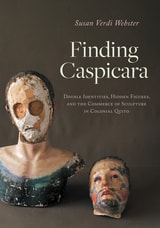
Finding Caspicara
Double Identities, Hidden Figures, and the Commerce of Sculpture in Colonial QuitoSusan Verdi Webster
University of Texas Press, 2024
2026 Eleanor Tufts Award, Society for Iberian Global Art, College Art Association
An examination of sculpture and authorship in eighteenth-century Quito that documents Caspicara as a participant in the innovative artistic production of the city’s workshops and its widespread commerce of polychrome sculptures.
Who is Caspicara? Nothing is known of Caspicara’s life, and not a single sculpture has been documented as his work. Yet traditional histories laud him as a prolific Indigenous sculptor in eighteenth-century Quito who created exquisite polychrome figures and became a national artistic icon. Drawing on extensive archival, historical, and object research, Susan Verdi Webster peels away layers of historiographical fabrication to reveal what we do and do not know about Caspicara and his work.
Rather than being a solitary master, Caspicara collaborated with other, largely Indigenous artists in Quito’s protoindustrial workshops, manufacturing sculptures now credited to him alone. The high quality of Quito sculptures produced by anonymous artists turned the city into a hub of wide-ranging commerce in religious icons. The art world and post-independence Ecuadorians have lionized the one named sculptor, Caspicara, according to the Western model of the artist-genius, amplifying the market for works bearing his name and creating a national hero on par with European masters. Lost in this process were the artists themselves. Webster returns to their world, detailing their methods and labor and, for the first time, documenting a sculpture made by Caspicara.

Finding Right Relations
Quakers, Native Americans, and Settler ColonialismMarianne O. Nielsen and Barbara M. Heather
University of Arizona Press, 2022
Centering on the relationship between Quaker colonists and the Lenape people, Finding Right Relations explores the contradictory position of the Quakers as both egalitarian, pacifist people, and as settler colonists. This book explores major challenges to Quaker beliefs and resulting relations with American Indians from the mid-seventeenth century to the late nineteenth century. It shows how the Quakers not only failed to prevent settler colonial violence against American Indians but also perpetuated it. It provides historical examples such as the French and Indian War, the massacre of the Conestoga Indians, and the American Indian boarding schools to explore the power of colonialism to corrupt even those colonists with a belief system rooted in social justice.
While this truth rubs against Quaker identity as pacifists and socially conscious, justice-minded people, the authors address how facing these truths provide ways forward for achieving restitution for the harms of the past. This book offers a path to truth telling that is essential to the healing process.

Fire on the Water
Sailors, Slaves, and Insurrection in Early American Literature, 1789-1886Warren, Lenora
Bucknell University Press, 2019
Published by Bucknell University Press. Distributed worldwide by Rutgers University Press.
First-Time
The Historical Vision of an African American PeopleRichard Price
University of Chicago Press, 2002
First-Time's unique style of presentation preserves the integrity of both its oral and documentary sources, uniting them in a profound meditation on the roles of history and memory. This second edition includes a new preface by the author, discussing First-Time's impact and recounting the continuing struggles of the Saramaka people.

Fleur de Lys and Calumet
Being the Penicaut Narrative of French Adventure in LouisianaEdited by Richebourg McWilliams
University of Alabama Press, 1988
Andre Penicaut, a carpenter, sailed with Iberville to the French province of Louisiana in 1699 and did not return to France until 1721. The book he began in the province and finished upon his return to France is an eyewitness account of the first years of the French colony, which stretched along the Gulf Coast from Florida to Texas and in the Mississippi Valley from the Balize to the Illinois country. As a ship carpenter, Penicaut was chosen as a member of several important expeditions: he accompanied Le Sueur up the Mississippi River in 1700 to present-day Minnesota, and he went with Juchereau de St. Denis on the first journey from Mobile to the Red River and overland to the Rio Grande, to open trade with the Spaniards in Mexico. Penicaut helped to build the first post in Louisiana, at Old Biloxi, and the second post on the Mobile River.
Penicaut was at his best when describing the lives and social customs of the Indians of the region. He saw them in realistic terms, showing no prejudice toward their native habits. Neither were his French colleagues cast in heroic or villainous molds—though their accomplishments must strike modern readers as truly epic.
When first published, Fleur de Lys and Calumet was a major stimulus to scholarship in the field. This new edition will be welcomed by a new generation of scholars and readers interested in the colonial history of the Deep South and the Mississippi Valley.
Florence in the Forgotten Centuries, 1527-1800
A History of Florence and the Florentines in the Age of the Grand DukesEric Cochrane
University of Chicago Press, 1976
Eric Cochrane shows that the Florentines maintained their creativity long after they had lost their position as the cultural leaders of Europe. When their political philosophy and historiography ran dry, they turned to the practical problems of civil administration. When their artists finally yielded to outside influence, they turned to music and the natural sciences. Even during the darkest days of the great economic depression of the late seventeenth and early eighteenth centuries, they succeeded in preserving—almost alone in Europe—the blessings of external peace and domestic tranquility.

For All of Humanity
Mesoamerican and Colonial Medicine in Enlightenment GuatemalaMartha Few
University of Arizona Press, 2015
For All of Humanity examines the first public health campaigns in Guatemala, southern Mexico, and Central America in the eighteenth and early nineteenth centuries. Martha Few pays close attention to Indigenous Mesoamerican medical cultures, which not only influenced the shape and scope of those regional campaigns but also affected the broader New World medical cultures. The author reconstructs a rich and complex picture of the ways colonial doctors, surgeons, Indigenous healers, midwives, priests, government officials, and ordinary people engaged in efforts to prevent and control epidemic disease.
Few’s analysis weaves medical history and ethnohistory with social, cultural, and intellectual history. She uses prescriptive texts, medical correspondence, and legal documents to provide rich ethnographic descriptions of Mesoamerican medical cultures, their practitioners, and regional pharmacopeia that came into contact with colonial medicine, at times violently, during public health campaigns.

For a Short Time Only
Itinerants and the Resurgence of Popular Culture in Early AmericaPeter Benes
University of Massachusetts Press, 2016
By the 1740s, colonists living in North America began to encounter scores of itinerant performers from England and Europe. These show people—acrobats, wire dancers, tumblers, trick riders, painters, dancing-masters, waxworks proprietors, healers, and singing and language teachers—brought novelty and culture to remote areas. Advertising in newspapers, they attracted audiences with the hook of appearing "for a short time only."
In this richly illustrated and deeply researched book, Peter Benes examines the rise of early American popular culture through the lives and work of itinerants who circulated in British North America and the United States from the late seventeenth through the early nineteenth century. Although they were frequently reviled as quacks and absconders by many provincials, these transients enjoyed a unique camaraderie and found audiences among high- and lowbrow alike. Drawing on contemporary diaries, letters, reminiscences, and hitherto inaccessible newspaper ads, broadsides, and images, Benes suggests why some elements of Europe's carnival and folklore traditions failed to gain acceptance in American society while others flourished brilliantly.
Force and Form
Philosophy of Life in the Age of GoetheStephen Klemm
Bucknell University Press, 2027
This book offers a bold rethinking of how modern ideas of life, nature, and subjectivity took shape in late-eighteenth- and early-nineteenth-century German thought. Moving beyond familiar narratives based on Kantian autonomy or Romantic irrationalism, it uncovers a vitalist tradition stretching from Herder to Schiller and Goethe, one that understood nature as dynamic, self-forming, and internally animated by life-force. Drawing on philosophy, the life sciences, and aesthetics, this innovative study reveals how these thinkers challenged mechanistic models of matter and resisted strict divisions between mind and nature. In doing so, they developed a historically contingent and embodied concept of subjectivity in which reason emerges from natural, cultural, and physiological processes rather than standing outside them. By situating this tradition within debates about epigenesis, form, and development, the book not only reshapes our understanding of German intellectual history but also sheds new light on contemporary debates about naturalism, posthumanism, and theories of life.
Published by Bucknell University Press. Distributed worldwide by Rutgers University Press.
Forging Communities in Colonial Alta California
Edited by Kathleen L. Hull and John G. Douglass
University of Arizona Press, 2018
Forging Communities in Colonial Alta California reorients understandings of this dynamic period, which challenged both Native and non-Native people to reimagine communities not only in different places and spaces but also in novel forms and practices. The contributors draw on archaeological and historical archival sources to analyze the generative processes and nature of communities of belonging in the face of rapid demographic change and perceived or enforced difference.
Contributors provide important historical background on the effects that colonialism, missions, and lives lived beyond mission walls had on Indigenous settlement, marriage patterns, trade, and interactions. They also show the agency with which Indigenous peoples make their own decisions as they construct and reconstruct their communities. With nine different case studies and an insightful epilogue, this book offers analyses that can be applied broadly across the Americas, deepening our understanding of colonialism and community.
Contributors:
Julienne Bernard
James F. Brooks
John Dietler
Stella D’Oro
John G. Douglass
John Ellison
Glenn Farris
Heather Gibson
Kathleen L. Hull
Linda Hylkema
John R. Johnson
Kent G. Lightfoot
Lee M. Panich
Sarah Peelo
Seetha N. Reddy
David W. Robinson
Tsim D. Schneider
Christina Spellman
Benjamin Vargas

Forging a Cherokee-American Alliance in the Creek War
From Creation to BetrayalSusan M. Abram
University of Alabama Press, 2015
The Creek War of 1813–1814 is studied primarily as an event that impacted its two main antagonists, the defending Creeks in what is now the State of Alabama and the expanding young American republic. Scant attention has been paid to how the United States’ Cherokee allies contributed to the war and how the war transformed their society. In Forging a Cherokee-American Alliance in the Creek War, Susan M. Abram explains in engrossing detail the pivotal changes within Cherokee society triggered by the war that ultimately ended with the Cherokees’ forced removal by the United States in 1838.
The Creek War (also known as the Red Stick War) is generally seen as a local manifestation of the global War of 1812 and a bright footnote of military glory in the dazzling rise of Andrew Jackson. Jackson’s victory, which seems destined only in historic hindsight, was greatly aided by Cherokee fighters. Yet history has both marginalized Cherokee contributions to that conflict and overlooked the fascinating ways Cherokee society changed as it strove to accommodate, rationalize, and benefit from an alliance with the expanding American republic. Through the prism of the Creek War and evolving definitions of masculinity and community within Cherokee society, Abram delineates as has never been done before the critical transitional decades prior to the Trail of Tears.
Deeply insightful, Abram illuminates the ad hoc process of cultural, political, and sometimes spiritual transitions that took place among the Cherokees. Before the onset of hostilities, the Cherokees already faced numerous threats and divisive internal frictions. Abram concisely records the Cherokee strategies for meeting these challenges, describing how, for example, they accepted a centralized National Council and replaced the tradition of conflict-resolution through blood law with a network of “lighthorse regulators.” And while many aspects of masculine war culture remained, it too was filtered and reinterpreted through contact with the legalistic and structured American military.
Rigorously documented and persuasively argued, Abram’s award-winning Forging a Cherokee-American Alliance in the Creek War fills a critical gap in the history of the early American republic, the War of 1812, the Cherokee people, and the South.
Forming Humanity
Redeeming the German Bildung TraditionJennifer A. Herdt
University of Chicago Press, 2019
Kant’s proclamation of humankind’s emergence from “self-incurred immaturity” left his contemporaries with a puzzle: What models should we use to sculpt ourselves if we no longer look to divine grace or received authorities? Deftly uncovering the roots of this question in Rhineland mysticism, Pietist introspection, and the rise of the bildungsroman, Jennifer A. Herdt reveals bildung, or ethical formation, as the key to post-Kantian thought. This was no simple process of secularization, in which human beings took responsibility for something they had earlier left in the hands of God. Rather, theorists of bildung, from Herder through Goethe to Hegel, championed human agency in self-determination while working out the social and political implications of our creation in the image of God. While bildung was invoked to justify racism and colonialism by stigmatizing those deemed resistant to self-cultivation, it also nourished ideals of dialogical encounter and mutual recognition. Herdt reveals how the project of forming humanity lives on in our ongoing efforts to grapple with this complicated legacy.
Forms of Knowledge in Early Modern Asia
Explorations in the Intellectual History of India and Tibet, 1500-1800Sheldon Pollock, ed.
Duke University Press, 2011
Contributors. Muzaffar Alam, Imre Bangha, Aditya Behl, Allison Busch, Sumit Guha, Janet Gyatso, Matthew T. Kapstein, Françoise Mallison, Sheldon Pollock, Velcheru Narayana Rao, Kurtis R. Schaeffer, Sunil Sharma, David Shulman, Sanjay Subrahmanyam, Mohamad Tavakoli-Targhi

Fort Ticonderoga, The Last Campaigns
The War in the North, 1777–1783Mark Edward Lender
Westholme Publishing, 2027
During the War for Independence, Fort Ticonderoga’s guns, sited critically between Lakes Champlain and George, dominated north-south communications in upstate New York that were vital to both the British and American war efforts. In the public mind Ticonderoga was the “American Gibraltar” or the “Key to the Continent,” and patriots considered holding the fort essential to the success of the Revolutionary cause. Ticonderoga was a primary target in British Lieutenant General John Burgoyne’s 1777 campaign to crush American resistance in the north and end the rebellion in a decisive stroke. American efforts to defend the fort in June against overwhelming odds entailed political and military intrigue, bungling, heroism, and ultimately a narrow escape for the Continental and provincial forces under Major General Arthur St. Clair. The loss of Ticonderoga stunned patriot morale and ignited one of the greatest political firestorms of the war. But the fortunes of war turned. Two months later, the rebels mounted a sensational—if little known—counter-attack on Ticonderoga that had major implications for Burgoyne’s eventual defeat at Saratoga in October. Yet Saratoga brought no peace, and Ticonderoga would be central to additional military and political maneuverings—many of them known only to specialist historians—that would keep the region on edge until the end of the war in 1783.
Based on new archival research and taking advantage of the latest scholarship, Fort Ticonderoga, The Last Campaigns: The War in the North, 1777-1783 by distinguished historian Mark Edward Lender highlights the strategic importance of the fort as British, American, and regional forces (including those of an independent Vermont Republic) fought for control of the northern front at a critical point in the war. The book tells the Ticonderoga story in all of its complexity and drama, correcting misconceptions embedded in many previous accounts, and sheds vital new light on this key chapter in America’s struggle for independence.
Fort Toulouse
The French Outpost at the Alabamas on the CoosaDaniel H Thomas, with an introduciton by Gregory A. Waselkov
University of Alabama Press, 1989
Situated at the head of the Alabama River system—at the juncture of the Coosa and Tallapoosa rivers—Fort Toulouse in 1717 was planned to keep the local Indians neutral, if not loyal, to the French and contain the British in their southernmost Atlantic colonies. Unlike the usual frontier settlements, Fort Toulouse was both a diplomatic post, since its officers acted as resident ministers, and a military post. Because it was located in a friendly territory adjoining an area under a rival (British) influence, the post participated in psychological warfare rather than in blood-letting. It used trade and aid, and was familiar with spies and double-agents—welcoming and debriefing British defectors; no cannon was discharged in anger at Toulouse.
The most eminent figure to have been connected directly with Fort Toulouse was General Andrew Jackson, who established a military post there during the War of 1812 after his victory over the Indians at Horseshoe Bend. The outpost was named Fort Jackson in his honor and played a key role in the treaty negotiations and eventual settlement of the Indian land by Americans.
In addition to discussing geopolitical and military affairs and diplomatic relations with Indian chiefs, Thomas describes daily life at the post and the variety of interactions between residents and visitors. Waselkov's introduction places the original 1960 book within the context of the existing scholarship of that time and adds an extensive and enlightening review of the most recent archaeological and historical research to Thomas' pioneering work.
Founding Choices
American Economic Policy in the 1790sEdited by Douglas A. Irwin and Richard Sylla
University of Chicago Press, 2010
The political decisions made by the founding fathers were crucial to the success of the early republic. But the economic decisions they made were just as pivotal, ensuring the general welfare and common defense of the United States for decades to come. Founding Choices explores these economic choices and their profound influence on American life, westward expansion, and influence abroad. Among the topics covered are finance, trade, and monetary and banking policy, with a focus on the factors guiding those policies and their end result.
This book redresses the relative neglect of the economic achievements of the founders. It will be essential reading for historians and economists alike.

Founding Fictions
Jennifer R. Mercieca
University of Alabama Press, 2010
Founding Fictions develops the concept of a “political fiction,” or a narrative that people tell about their own political theories, and analyzes how republican and democratic fictions positioned American citizens as either romantic heroes, tragic victims, or ironic partisans. By re-telling the stories that Americans have told themselves about citizenship, Mercieca highlights an important contradiction in American political theory and practice: that national stability and active citizen participation are perceived as fundamentally at odds.
Framed Narratives
Diderot’s Genealogy of the BeholderJay CaplanAfterword by Jochen Schulte-Sasse
University of Minnesota Press, 1985
Framed Narratives was first published in 1985. Minnesota Archive Editions uses digital technology to make long-unavailable books once again accessible, and are published unaltered from the original University of Minnesota Press editions.
The work of French philosophe Denis Diderot (1713-1784) has inspired conflicting reactions in those who encounter him. Diderot has been admired and despised; he has moved his readers and irritated them - often at the same time. His work continually shifts between mutually exclusive positions - neither of which provides an entirely satisfactory answer to the question at hand, yet neither of which can be disregarded. The nature of these paradoxes has been the fundamental problem in Diderot, a problem that his interpreters have approached by imagining synthetic perspectives or frames within which the paradoxes could be resolved.
In Framed Narratives, Jay Caplan focuses on the problem of framing in and of Diderot. He proposes an interpretive model that draws upon the notion of dialogue developed by Mikhail Bakhtin. For Bakhtin, no utterance can be reduced to a univocal meaning; one's discourse is always marked by other voices. In Diderot, Caplan shows, the narrative device of the tableau engages the reader (or beholder) in a dialogic relationship with the author and the characters. Diderot defines the players of those roles as members of a family, one of whom is always missing, and that sacrificial relationship becomes an integral part of the text. Caplan then uses the concept of the tableau to interpret the rhetoric of gender, genre, and pathos in Diderot's works for and about the theater, his novel The Nun, the philosophical dialogue D'Alembert's Dream,and his correspondence.
What emerges from these readings is not only an interpretation of certain texts, but a description of Diderot's—and, by implication, early bourgeois—poetics. Framed Narratives is, in addition, one of the first attempts to rely upon Bakhtin's concepts in the interpretation of specific texts, in this case the work of an essentially dialogic writer. A socio-historical supplement to Framed Narratives is provided in Jochen Schulte-Sasse's afterword.
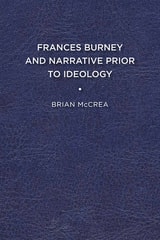
Frances Burney and Narrative Prior to Ideology
Brian McCrea
University of Delaware Press, 2014
Frances Burney and Narrative Prior to Ideology works between Burney’s Journals and Letters and her fiction more thoroughly than any study of her in the past twenty-five years. By doing so, it offers significant reinterpretations of Burney’s four novels: Evelina, Cecilia, Camilla, and The Wanderer. It describes Burney’s eluding the major modern–isms through which critics have tried to read her: Feminism (with its “gendering” of beauty and reversal of gender roles); Capitalism and its Marxist critique (here the details of Burney’s housekeeping become important); Professionalism (as a response to status inconsistency and class conflict); and Ian Watt’s “Formal Realism” (Burney perhaps saved the novel from a sharp decline it suffered in the 1770s, even as she tried to distance herself from the genre).
Burney’s most successful writing appeared before the coining of “ideology.” But her standing “prior to ideology” is not a matter of chronological accident. Rather, she quietly but forcefully resisted shared explanations—domesticity as model for household management, debt as basis for family finance, professional status as a means to social confidence, the novel as the dominant literary genre—that became popular during her long and eventful life.
Frederic Jameson has described Paul de Man, “in private conversation,” claiming, “Marxism . . . has no way of understanding the eighteenth century.” Frances Burney and Narrative Prior to Ideology conjoins Burney’s “eighteenth-centuryness” with her modernity.
Published by University of Delaware Press. Distributed worldwide by Rutgers University Press.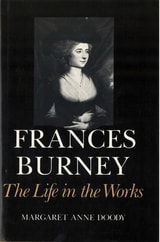
Frances Burney
The Life in the WorksDoody, Margaret A
Rutgers University Press, 1988
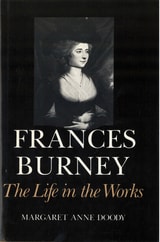
Frances Burney
The Life in the WorksDoody, Margaret A
Rutgers University Press, 1988

Francois Vallé and His World
Upper Louisiana before Lewis and ClarkCarl J. Ekberg
University of Missouri Press, 2002
Winner of the Kemper & Leila Williams Prize in Louisiana History for excellence in historical scholarship for the year 2002, awarded by The Historic New Orleans Collection, The Louisiana Historical Association.

Freedom Seekers
Escaping from Slavery in Restoration LondonSimon P. Newman
University of London Press, 2021
This book brings the history of slavery in England to light, revealing the powerful untold stories of resistance by enslaved workers from Africa, South Asia, and First-Nations America forced to work in London as sailors and dockworkers, wet-nurses and washerwomen. Featuring a series of original case studies on those enslaved people who escaped captivity, this volume provides a rich source of information about slavery in eighteenth-century mainland Britain and the “freedom seekers” therein. Using maps, photographs, newspaper advertisements, and more, the book details escape routes, the networks of slaveholders, and the community of people of color across the London region.
Freedom Seekers demonstrates that not only were enslaved people present in Restoration London but that white Londoners were intimately involved in the construction of the system of racial slavery, a process traditionally regarded as happening in the colonies rather than the British Isles. Freedom Seekers is an utterly unmissable and important book that seeks to delve into Britain’s colonial past.

Freedom and the End of Reason
On the Moral Foundation of Kant's Critical PhilosophyRichard L. Velkley
University of Chicago Press, 1989
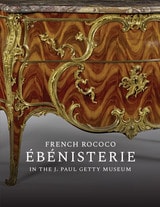
French Rococo Ébénisterie in the J. Paul Getty Museum
Gillian Wilson
J. Paul Getty Trust, The, 2021
The first comprehensive catalogue of the Getty Museum’s significant collection of French Rococo ébénisterie furniture.
This catalogue focuses on French ébénisterie furniture in the Rococo style dating from 1735 to 1760. These splendid objects directly reflect the tastes of the Museum’s founder, J. Paul Getty, who started collecting in this area in 1938 and continued until his death in 1976.
The Museum’s collection is particularly rich in examples created by the most talented cabinet masters then active in Paris, including Bernard van Risenburgh II (after 1696–ca. 1766), Jacques Dubois (1694–1763), and Jean-François Oeben (1721–1763). Working for members of the French royal family and aristocracy, these craftsmen excelled at producing veneered and marquetried pieces of furniture (tables, cabinets, and chests of drawers) fashionable for their lavish surfaces, refined gilt-bronze mounts, and elaborate design. These objects were renowned throughout Europe at a time when Paris was considered the capital of good taste.
The entry on each work comprises both a curatorial section, with description and commentary, and a conservation report, with construction diagrams. An introduction by Anne-Lise Desmas traces the collection’s acquisition history, and two technical essays by Arlen Heginbotham present methodologies and findings on the analysis of gilt-bronze mounts and lacquer.
The free online edition of this open-access publication is available at www.getty.edu/publications/rococo/ and includes zoomable, high-resolution photography. Also available are free PDF, EPUB, and Kindle/MOBI downloads of the book, and JPG downloads of the main catalogue images.
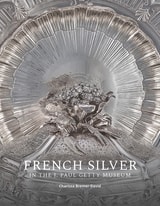
French Silver in the J. Paul Getty Museum
Charissa Bremer-David
J. Paul Getty Trust, The, 2023
The collection of seventeenth- and eighteenth-century French silver at the J. Paul Getty Museum is of exceptional quality and state of preservation. Each piece is remarkable for its beauty, inventive form, skillful execution, illustrious provenance, and the renown of its maker. This volume is the first complete study of these exquisite objects, with more than 250 color photographs bringing into focus extraordinary details such as minuscule makers’ marks, inscriptions, and heraldic armorials.
The publication details the formation of the Museum’s collection of French silver, several pieces of which were selected by J. Paul Getty himself, and discusses the regulations of the historic Parisian guild of gold- and silversmiths that set quality controls and consumer protections. Comprehensive entries catalogue a total of thirty-three pieces with descriptions, provenance, exhibition history, and technical information. The related commentaries shed light on the function of these objects and the roles they played in the daily lives of their prosperous owners. The book also includes maker biographies and a full bibliography.
The free online edition of this open-access publication is available at getty.edu/publications/french-silver/ and includes 360-degree views and zoomable high-resolution photography. Also available are free PDF and EPUB downloads of the book, and JPG downloads of the main catalogue images.

From Androboros to the First Amendment
A History of America's First PlayPeter A. Davis
University of Iowa Press, 2015
Androboros was not just the first of its kind, it was also ahead of its time in many ways, preceding the harsh political satires and farces of the later eighteenth century by some fifty years. Such plays served a small but essential role in promoting political thought among the colonists. Written by anonymous authors and passed from hand to hand, these short, crude, and often bawdy plays and dialogues were rarely acted due to their inflammatory lampoonery. Nevertheless, they provided an opportunity for disgruntled colonists to vent their grievances and promote their ideas to fellow citizens. The farces of the late eighteenth century drove home the meaning and message of the American Revolution.
Equally significant is that Androboros may have influenced a few of the key political discourses published in the 1730s, and these works in turn may well have shaped the future of the American political landscape for the next several decades and even into the modern era. But as a closet drama intended only to be read by close friends and political supporters, this play has languished as a minor footnote in American intellectual history. Scholarly research published to date has been, for the most part, inadequate and occasionally inaccurate. This study remedies that oversight, providing a full analysis as well as an annotated typescript and facsimiles of the original printing.
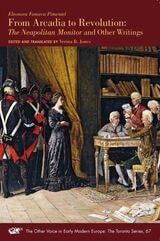
From Arcadia to Revolution
The Neapolitan Monitor and Other WritingsEleonora Fonseca Pimentel
Iter Press, 2019
The Other Voice in Early Modern Europe: The Toronto Series, Volume 67
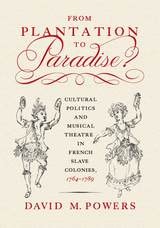
From Plantation to Paradise?
Cultural Politics and Musical Theatre in French Slave Colonies, 1764–1789David M. Powers
Michigan State University Press, 2014

From the Ruins of Enlightenment
Beethoven and Schubert in Their SolitudeRichard Kramer
University of Chicago Press, 2023
Here is Vienna, hosting a congress in 1815 that would redraw national boundaries and reconfigure the European community for a full century. A snapshot captures two of its citizens, each seemingly oblivious to this momentous political environment: Franz Schubert, not yet twenty years old and in the midst of his most prolific year—some 140 songs, four operas, and much else; and Ludwig van Beethoven, struggling through a midlife crisis that would yield the song cycle An die ferne Geliebte, two strikingly original cello sonatas, and the two formidable sonatas for the “Hammerklavier,” opp. 101 and 106. In Richard Kramer’s compelling reading, each seemed to be composing “against”—Beethoven, against the Enlightenment; Schubert, against the looming presence of the older composer even as his own musical imagination took full flight.
From the Ruins of Enlightenment begins in 1815, with the discovery of two unique projects: Schubert’s settings of the poems of Ludwig Hölty in a fragmentary cycle and Beethoven’s engagement with a half dozen poems by Johann Gottfried Herder. From there, Kramer unearths previously undetected resonances and associations, illuminating the two composers in their “lonely and singular journeys” through the “rich solitude of their music.”

From the Womb to the Body Politic
Raising the Nation in Enlightenment RussiaAnna Kuxhausen
University of Wisconsin Press, 2012
Making innovative use of obstetrical manuals, belles lettres, children’s primers, and other primary documents from the era, Anna Kuxhausen draws together many discourses—medical, pedagogical, and political—to show the scope and audacity of new notions about childrearing. Reformers aimed to teach women to care for the bodies of pregnant mothers, infants, and children according to medical standards of the Enlightenment. Kuxhausen reveals both their optimism and their sometimes fatal blind spots in matters of implementation. In examining the implication of women in public, even political, roles as agents of state-building and the civilizing process, From the Womb to the Body Politic offers a nuanced, expanded view of the Enlightenment in Russia and the ways in which Russians imagined their nation while constructing notions of childhood.
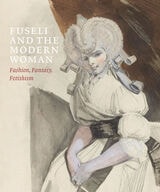
Fuseli and the Modern Woman
Fashion, Fantasy, FetishismEdited by David Solkin
Paul Holberton Publishing, 2022
Best known for his notoriously provocative painting The Nightmare, Anglo-Swiss painter Henry Fuseli (1741–1825) cultivated a reputation for eccentricity, with vividly stylized images of supernatural creatures, muscle-bound heroes, and damsels in distress. While these convinced some viewers of the greatness of his genius, others dismissed him as a charlatan, or as completely mad.
By bringing together more than fifty of his works, this volume offers unprecedented access to see one of the finest draftsmen of the Romantic period at his most innovative and exciting. Visitors to the show and readers of the lavishly illustrated catalog will further be invited to consider how Fuseli’s drawings of women, as products of the turbulent aftermath of the American and French Revolutions, speak to concerns about gender and sexuality that have never been more relevant than they are today.
The exhibition showcases drawings brought together from international collections, including the Kunsthaus Zürich, the Auckland Art Gallery in New Zealand, and other European and North American institutions.