Results by title
35 books match the query 'Industry'
Aesthetics, Industry, and Science
Hermann von Helmholtz and the Berlin Physical SocietyM. Norton Wise
University of Chicago Press, 2018
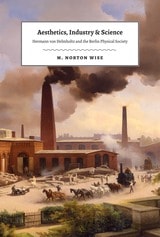
In Aesthetics, Industry, and Science M. Norton Wise answers these questions not simply from a technical perspective of theories and practices but with a broader cultural view of what was happening in Berlin at the time. He emphasizes in particular how rapid industrial development, military modernization, and the neoclassical aesthetics of contemporary art informed the ways in which these young men thought. Wise argues that aesthetic sensibility and material aspiration in this period were intimately linked, and he uses these two themes for a final reappraisal of Helmholtz’s early work. Anyone interested in modern German cultural history, or the history of nineteenth-century German science, will be drawn to this landmark book.

African Animation
History, Culture, and IndustryBoukary Sawadogo
Rutgers University Press, 2027
Against the backdrop of the rising interest in African stories in mainstream media, African Animation looks at a more than century-old animation practice that remains largely unknown. Carefully organized, this book offers a comprehensive treatment that canvases animation from all over the continent, analyzing its history, socio-political contexts, artistic and technological development, visual cultures, and economic market conditions. African animation also contributes to the broader landscape of animation studies: how does our view of the history of animation change when we add an African perspective to the otherwise dominating perspectives of Hollywood, Japanese, and Korean animation? What does animation look and feel like in other parts of the world? African animation has always been there; this book helps us pay attention to it. This is a must-read for those interested in African animation, including artists, industry insiders, and fans.

Alaska Herring History
The Story of Alaska’s Herring Fisheries and Industryby James Mackovjak
University of Alaska Press, 2022
The book is divided into three parts based on the purposes for which herring have been harvested. Part I is a history of the reduction (fertilizer/fish meal/fish oil) and cured (salted) herring industries and the
bait-herring fisheries; part II is a history of the roe-herring fisheries in Southeast Alaska, Prince William Sound, Kodiak Island, lower Cook Inlet, Togiak, and Norton Sound; and part III is a history of the herring spawn-on-kelp industry. Historical and contemporary photos and illustrations—as well as graphs and charts that help summarize the development and, in some cases, the demise of the fisheries—augment this detailed look at the evolution of Alaska's herring fisheries.
Balancing scientific details, historical facts, and personal anecdotes from experts in the field, Alaska Herring History will be of interest to historians, social scientists, biologists, and fishery managers and makes an important contribution to Alaska fisheries literature.
Beauty Shop Politics
African American Women's Activism in the Beauty IndustryTiffany M. Gill
University of Illinois Press, 2010
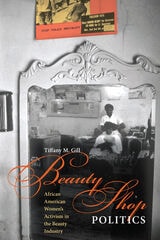
Looking through the lens of black business history, Beauty Shop Politics shows how black beauticians in the Jim Crow era parlayed their economic independence and access to a public community space into platforms for activism. Tiffany M. Gill argues that the beauty industry played a crucial role in the creation of the modern black female identity and that the seemingly frivolous space of a beauty salon actually has stimulated social, political, and economic change.
From the founding of the National Negro Business League in 1900 and onward, African Americans have embraced the entrepreneurial spirit by starting their own businesses, but black women's forays into the business world were overshadowed by those of black men. With a broad scope that encompasses the role of gossip in salons, ethnic beauty products, and the social meanings of African American hair textures, Gill shows how African American beauty entrepreneurs built and sustained a vibrant culture of activism in beauty salons and schools. Enhanced by lucid portrayals of black beauticians and drawing on archival research and oral histories, Beauty Shop Politics conveys the everyday operations and rich culture of black beauty salons as well as their role in building community.

Birth of an Industry
Blackface Minstrelsy and the Rise of American AnimationNicholas Sammond
Duke University Press, 2015

Cattle on a Thousand Hills
A History of the Cattle Industry in ArkansasC.J. Brown
University of Arkansas Press, 1996

Changing Hands
Industry, Evolution, and the Reconfiguration of the Victorian BodyPeter J. Capuano
University of Michigan Press, 2015
Chicago Business and Industry
From Fur Trade to E-CommerceEdited by Janice L. Reiff
University of Chicago Press, 2013
Drawing on the award-winning Encyclopedia of Chicago, Janice L. Reiff has compiled a unique history of work in the Windy City. Beginning with an overview of the city’s commercial development, Chicago Business and Industry considers how key industries shaped—and were shaped by—both the local and global economies. The city’s phenomenal population growth, its proximity to water, and its development of railroads made Chicago one of the most productive markets for lumber and grain throughout the nineteenth century. The region’s once-booming steel industry, on the other hand, suffered a dramatic decline in the second half of the twentieth century, when already weakened demand met with increasing international competition. Chicago Business and Industry chronicles the Chicago region’s changing fortunes from its beginning.
Reiff has compiled and updated essays from the Encyclopedia covering the city’s most historically famous—and infamous—companies, from the Union Stock Yard to Montgomery Ward to the Board of Trade. The book concludes with a historical account of labor types and issues in the city, with attention to such topics as health-care workers, unemployment, and unionization. Today, Groupon and a host of other high-tech firms have led some experts to christen Chicago the Silicon Valley of the Midwest. Reiff’s new introduction takes account of these and other recent trends.
Engaging, accessible, and packed with fascinating facts, Chicago Business and Industry invites readers into the history and diversity of work in the city, helping them understand how Chicago became Chicago.
City of Industry
Genealogies of Power in Southern CaliforniaValle, Victor
Rutgers University Press, 2011
Valle investigated an untapped archive of Industry's built landscape, media coverage, and public records, including sealed FBI reports, to uncover a cascading series of scandals. A kaleidoscopic view of the corruption that resulted when local land owners, media barons, and railroads converged to build the city, this suspenseful narrative explores how new governmental technologies and engineering feats propelled the rationality of privatization using their property-owning servants as tools.
Valle's tale of corporate greed begins with the city's founder James M. Stafford and ends with present day corporate heir, Edward Roski Jr., the nation's biggest industrial developerùco-owner of the L.A. Staples Arena and possible future owner of California's next NFL franchise. Not to be forgotten in Valle's captivating story are Latino working class communities living within Los Angeles's distribution corridors, who suffer wealth disparities and exposure to air pollution as a result of diesel-burning trucks, trains, and container ships that bring global trade to their very doorsteps. They are among the many victims of City of Industry.

Competitiveness Matters
Industry and Economic Performance in the U.S.Candace Howes and Ajit Singh, Editors
University of Michigan Press, 2000

Fair Bananas!
Farmers, Workers, and Consumers Strive to Change an IndustryHenry J. Frundt
University of Arizona Press, 2009
Fair Bananas! is one of the first books to examine the issue of “fair-trade bananas.” Specifically, Henry Frundt analyzes whether a farmer-worker-consumer alliance can collaborate to promote a fair-trade label for bananas—much like those for fair-trade coffee and chocolate—that will appeal to North American shoppers. Researching the issue for more than ten years, Henry Frundt has elicited surprising and nuanced insights from banana workers, Latin American labor officials, company representatives, and fair-trade advocates.
Frundt writes with admirable clarity throughout the book, which he has designed for college students who are being introduced to the subject of international trade and for consumers who are interested in issues of development. Frankly, though, Fair Bananas! will appeal to anyone who wants to know more about bananas, including where they come from and how they get from there to here.
Fifties Television
THE INDUSTRY AND ITS CRITICSWilliam Boddy
University of Illinois Press, 1990

Haywire
Discord in Maine's Logging Woods and the Unraveling of an IndustryAndrew Egan
University of Massachusetts Press, 2022
Logging in the northern forest has been romanticized, with images of log drives, plaid shirts, and bunkhouses in wide circulation. Increasingly dismissed as a quaint, rural pastime, logging remains one of the most dangerous jobs in the United States, with loggers occupying a precarious position amid unstable markets, expanding global competition, and growing labor discord. Examining a time of transition and decline in Maine’s forest economy, Andrew Egan traces pathways for understanding the challenges that have faced Maine’s logging community and, by extension, the state’s forestry sector, from the postwar period through today.
Seeking greater profits, logging companies turned their crews loose at midcentury, creating a workforce of independent contractors who were forced to purchase expensive equipment and compete for contracts with the mills. Drawing on his own experience with the region’s forest products industry, interviews with Maine loggers, media coverage, and court documents, Egan follows the troubled recent history of the industry and its battle for survival.
Industry and the Creative Mind
The Eccentric Writer in American Literature and Entertainment, 1790-1860Sandra Tomc
University of Michigan Press, 2012
Industry and the Creative Mind takes a radically new look at the figure of the eccentric, alienated writer in American literature and entertainment from 1790 to 1860. Traditional scholarship takes for granted that the eccentric writer, modeled by such Romantic beings as Lord Byron and brought to life for American audiences by the gloomy person of Edgar Allan Poe, was a figure of rebellion against the excesses of modern commercial culture and industrial life. By contrast, Industry and the Creative Mind argues that in the United States myths of writerly moodiness, alienation, and irresponsibility predated the development of a commercial arts and entertainment industry and instead of forming a site of rebellion from this industry formed a bedrock for its development. Looking at the careers of a number of early American writers---Joseph Dennie, Nathaniel Parker Willis, Edgar Allan Poe, Fanny Fern, as well as a host of now forgotten souls who peopled the twilight worlds of hack fiction and industrial literature---this book traces the way in which early nineteenth-century American arts and entertainment systems incorporated writerly eccentricity in their "logical" economic workings, placing the mad, rebellious writer at the center of the industry's productivity and success.

Industry, the State, and Public Policy in Mexico
By Dale Story
University of Texas Press, 1986
The industrialization process in Mexico began before that of any other nation in Latin America except Argentina, with the most rapid expansion of new industrial firms occurring in the 1930s and 1940s, and import substitution in capital goods evident as early as the late 1930s. Though Mexico’s trade relations have always been dependent on the United States, successive Mexican presidents in the postwar period attempted to control the penetration of foreign capital into Mexican markets.
In Industry, the State, and Public Policy in Mexico, Dale Story, recognizing the significance of the Mexican industrial sector, analyzes the political and economic role of industrial entrepreneurs in postwar Mexico. He uses two original data sets—industrial production data for 1929–1983 and a survey of the political attitudes of leaders of the two most important industrial organizations in Mexico—to address two major theoretical arguments relating to Latin American development: the meaning of late and dependent development and the nature of the authoritarian state. Story accepts the general relevance of these themes to Mexico but asserts that the country is an important variant of both.
With regard to the authoritarian thesis, the Mexican authoritarian state has demonstrated some crucial distinctions, especially between popular and elite sectors. The incorporation of the popular sector groups has closely fit the characteristics of authoritarianism, but the elite sectors have operated fairly independently of state controls, and the government has employed incentives or inducements to try to win their cooperation.
In short, industrialists have performed important functions, not only in accumulating capital and organizing economic enterprises but also by bringing together the forces of social change. Industrial entrepreneurs have emerged as a major force influencing the politics of growth, and the public policy arena has become a primary focus of attention for industrialists since the end of World War II.

Interchangeable Parts
Acting, Industry, and Technology in US TheaterVictor Holtcamp
University of Michigan Press, 2019
Victor Holtcamp explores the invocations of scientific and industrial rhetoric and philosophy in the founding of the first schools of acting, and echoes of that rhetoric in playwriting, production, and the cinema, as Hollywood in particular embraced this industrially infected model of acting. In their divergent approaches to performance, the major US acting teachers (Lee Strasberg, Stella Adler, and Sanford Meisner) demonstrated strong rhetorical affinities for the language of industry, illustrating the pervasive presence of these industrial roots. The book narrates the story of how actors learned to learn to act, and what that process, for both stage and screen, owed to the interchangeable parts and mass production revolutions.
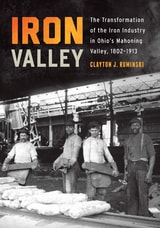
Iron Valley
The Transformation of the Iron Industry in Ohio's Mahoning Valley, 1802–1913Clayton J. Ruminski
The Ohio State University Press, 2017
Youngstown, Ohio, and the surrounding Mahoning Valley supplied the iron that helped transform the United States into an industrial powerhouse in the nineteenth century. The story of the Mahoning Valley’s unorthodox rise from mid-scale iron producer to twentieth-century “Steel Valley” is a tale of innovation, stagnation, and, above all, extreme change. Located halfway between Pittsburgh and Cleveland, the Mahoning Valley became a major supplier of pig iron to America’s biggest industrial regions. For much of the nineteenth century, outside consumers relied on the Valley’s pig iron, but this reliance nurtured a reluctance on the part of Youngstown iron companies to diversify or expand their production.
In Iron Valley: The Transformation of the Iron Industry in Ohio’s Mahoning Valley, 1802–1913, Clayton J. Ruminski argues that Youngstown-area iron manufacturers were content to let others in the industry innovate, and only modernized when market conditions forced them to do so. Desperate to find new markets, some Youngstown iron manufacturers eventually looked toward steel and endured a rapid, but successful, industrial transformation that temporarily kept their old enterprises afloat in a rapidly evolving industry. Richly illustrated with rare photographs of Mahoning Valley ironmasters, mills, furnaces, and workers, Iron Valley sheds light on a previously underrepresented and vital region that built industrial America.

Ivy and Industry
Business and the Making of the American University, 1880-1980Christopher Newfield
Duke University Press, 2003
Newfield views management as neither inherently good nor bad, but rather as a challenge to and tool for negotiating modern life. In Ivy and Industry he integrates business and managerial philosophies from Taylorism through Tom Peters’s “culture of excellence” with the speeches and writings of leading university administrators and federal and state education and science policies. He discusses the financial dependence on industry and government that was established in the university’s early years and the equal influence of liberal arts traditions on faculty and administrators. He describes the arrival of a managerial ethos on campus well before World War II, showing how managerial strategies shaped even fields seemingly isolated from commerce, like literary studies. Demonstrating that business and the humanities have each had a far stronger impact on higher education in the United States than is commonly thought, Ivy and Industry is the dramatic story of how universities have approached their dual mission of expanding the mind of the individual while stimulating economic growth.

Making the Modern
Industry, Art, and Design in AmericaTerry Smith
University of Chicago Press, 1993

Media in the Enlarged Europe
Politics, Policy and IndustryEdited by Alec Charles
Intellect Books, 2009
Looking beyond national and cultural boundaries, Media in the Enlarged Europe focuses on the complexity and instability of the European Union and its relationship with the mass media. Contributors to this volume address the continuing growth and expansion of the European Union, relationships between old and new Europe, and social and political developments in the former communist countries. Media in the Enlarged Europe presents snapshots of media politics, policies, industries, and cultures in the European Union as a whole, while incorporating case studies of the history and current state of mass media in specific nations. This will be an essential volume for students and experts in media studies, international relations, and international studies.

Mining America
The Industry and the Environment, 1800-1980Duane A. Smith
University Press of Colorado, 1994

Mining the Borderlands
Industry, Capital, and the Emergence of Engineers in the Southwest Territories, 1855-1910Sarah E. M. Grossman
University of Nevada Press, 2018
At the dawn of the twentieth century, the US-Mexico border was home to some of the largest and most technologically advanced industrial copper mines. This despite being geographically, culturally, and financially far-removed from traditional urban centers of power. Mining the Borderlands argues that this was only possible because of the emergence of mining engineers—a distinct technocratic class of professionals who connected capital, labor, and expertise.
Mining engineers moved easily between remote mining camps and the upscale parlors of east coast investors. Working as labor managers and technical experts, they were involved in the daily negotiations, which brought private US capital to the southwestern border. The success of the massive capital-intensive mining ventures in the region depended on their ability to construct different networks, serving as intermediaries to groups that rarely coincided.
Grossman argues that this didn’t just lead to bigger and more efficient mines, but served as part of the ongoing project of American territorial and economic expansion. By integrating the history of technical expertise into the history of the transnational mining industry, this in-depth look at borderlands mining explains how American economic hegemony was established in a border region peripheral to the federal governments of both Washington, D.C. and Mexico City.

Misalignment of Exchange Rates
Effects on Trade and IndustryEdited by Richard C. Marston
University of Chicago Press, 1988
Contributors to Misalignment of Exchange Rates address a series of questions about misalignment. Several papers investigate the causes of misalignment and the extent to which observed movements in real exchange rates can be attributed to misalignment. These studies are conducted both empirically, through the experiences of the United States, Great Britain, Japan, and the countries of the European Monetary System, and theoretically, through models of imperfect competition. Attention is then turned to the effects of misalignment, especially on employment and production, and to detailed estimates of the effects of changes in exchange rates on several industries, including the U.S. auto industry. In response to the contention that there is significant "hysteresis" in the adjustment of employment and production to changes in exchange rates, contributors also attempt to determine whether the effects of misalignment can be reversed once exchange rates return to earlier levels. Finally, the issue of how to avoid—or at least control—misalignment through macroeconomic policy is confronted.
Music by Numbers
The Use and Abuse of Statistics in the Music IndustryEdited by Richard Osborne and Dave Laing
Intellect Books, 2021
An edited volume that examines the data and statistics that are key to the music industry.
The music industries are fueled by statistics: sales targets, breakeven points, success ratios, royalty splits, website hits, ticket revenues, listener figures, piracy abuses, and big data. Statistics are of consequence. They influence the music that consumers get to hear, they determine the revenues of music makers, and they shape the policies of governments and legislators. Yet many of these statistics are generated by the music industries themselves, and their accuracy can be questioned. Music by Numbers sets out to explore this shadowy terrain.
This edited collection provides the first in-depth examination of the use and abuse of statistics in the music industry. Written by noted music business scholars and practitioners in the field, the book addresses five key areas in which numbers are employed: sales and awards; music industry policy; live music; music piracy; and digital solutions. The authors address these subjects from a range of perspectives: some of them test the veracity of this data and explore its tactical use by music businesses; others help to generate these numbers by developing surveys and online projects and offering candid observations.
The aim of this collection is to expose the culture and politics of data. Music industry statistics are pervasive, but despite this ubiquity they are underexplored. This book offers a corrective by providing new ways by which to learn music by numbers.

Occupational Mobility in American Business and Industry, 1928-1952
W. Lloyd Warner and James C. Abegglen
University of Minnesota Press, 1955
Occupational Mobility in American Business and Industry, 1928–1952 was first published in 1955. Minnesota Archive Editions uses digital technology to make long-unavailable books once again accessible, and are published unaltered from the original University of Minnesota Press editions.
Is the American occupational system rigid or flexible? How has it changed in the last twenty-five years? What factors help to influence the selection of business leaders? Questions like these are answered in this comprehensive study of occupational mobility, made by two social scientists at the University of Chicago. The study is based on information about 8,000 executives in the largest business firms of America. The rate of movement of men from various occupational backgrounds into positions of business leadership today is compared with that of 1928, as reported in the well-known study of Taussig and Joslyn, American Business Leaders. Warner and Abegglen present their complete research data, many of the findings in tabular form. The research encompasses all kinds of businesses and industries in every part of the country and persons at all levels of top management.

The Dynamics of Business-Government Relations
Industry and Exports, 1893-1921William H. Becker
University of Chicago Press, 1982
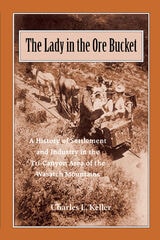
The Lady In The Ore Bucket
A History of Settlement and Industry in the Tri-Canyon Area of the Wasatch MountainsCharles L Keller
University of Utah Press, 2001
These place names, as well as the physcial traces and artifacts that persist in three Wasatch canyons—Mill Creek, Big Cottonwood, and Little Cottonwood—tantalize with what they suggest, but do not tell, about the history of settlement and development in the canyons. Charles Keller has extracted a wealth of information to create The Lady in the Ore Bucket, a faxcinating history of the lumber, mining, and hydropower industries built from the rich natural resources of the canyons. With more than six dozen photographs and maps, the book is alive with details concerning the personalities, politics, pacts, and peregrinations of local leaders from white settlement in 1847 through the early 1900s. It will delight any reader with an interest in the magnificent canyones that open onto the modern Wasatch Front.

The Lofts of SoHo
Gentrification, Art, and Industry in New York, 1950–1980Aaron Shkuda
University of Chicago Press, 2016
American cities entered a new phase when, beginning in the 1950s, artists and developers looked upon a decaying industrial zone in Lower Manhattan and saw, not blight, but opportunity: cheap rents, lax regulation, and wide open spaces. Thus, SoHo was born. From 1960 to 1980, residents transformed the industrial neighborhood into an artist district, creating the conditions under which it evolved into an upper-income, gentrified area. Introducing the idea—still potent in city planning today—that art could be harnessed to drive municipal prosperity, SoHo was the forerunner of gentrified districts in cities nationwide, spawning the notion of the creative class.
In The Lofts of SoHo, Aaron Shkuda studies the transition of the district from industrial space to artists’ enclave to affluent residential area, focusing on the legacy of urban renewal in and around SoHo and the growth of artist-led redevelopment. Shkuda explores conflicts between residents and property owners and analyzes the city’s embrace of the once-illegal loft conversion as an urban development strategy. As Shkuda explains, artists eventually lost control of SoHo’s development, but over several decades they nonetheless forced scholars, policymakers, and the general public to take them seriously as critical actors in the twentieth-century American city.
The Most Powerful Idea in the World
A Story of Steam, Industry, and InventionWilliam Rosen
University of Chicago Press, 2012
This bracing history uses the earth-shaking development of the steam engine to show how the very idea of intellectual property was essential to the entire Industrial Revolution.
Hardly a week passes without some high-profile court case that features intellectual property at its center. But how did the belief that one could own an idea come about? And how did that belief change the way humankind lives and works?
William Rosen, author of Justinian's Flea, seeks to answer these questions and more with The Most Powerful Idea in the World. A lively and passionate study of the engineering and scientific breakthroughs that led to the steam engine, this book argues that the very notion of intellectual property drove not only the invention of the steam engine but also the entire Industrial Revolution: history’s first sustained era of economic improvement. To do so, Rosen conjures up an eccentric cast of characters, including the legal philosophers who enabled most the inventive society in millennia, and the scientists and inventors—Thomas Newcomen, Robert Boyle, and James Watt—who helped to create and perfect the steam engine over the centuries. With wit and wide-ranging curiosity, Rosen explores the power of creativity, capital, and collaboration in the brilliant engineering of the steam engine and how this power source, which fueled factories, ships, and railroads, changed human history.
Deeply informative and never dull, Rosen's account of one of the most important inventions made by humans is a rollicking ride through history, with careful scholarship and fast-paced prose in equal measure.
The Organization of Industry
George J. Stigler
University of Chicago Press, 1983
In part one, Stigler examines the nature of competition and monopoly. In part two he discusses the forces that determine the size structure of industry, including barriers to entry, economics of scale, and mergers. Part three contains articles on a wide range of topics, such as profitability, delivered price systems, block booking, the economics of information, and the kinky oligopoly demand curve and rigid price. Part four offers a discussion of antitrust policy and includes Stigler's recommendations for future policy as well as an examination of the effects of past policies.
"Stigler's writings might well be subtitled 'The Joys of Doing Economics.' He, more than any other contemporary American economist, dispels the gloom surrounding economic theory. It is impossible to confront the subject treated with such humor and verve and come away still believing that economics is the dismal science."—Shirley B. Johnson, American Scholar

The Technology of Drawing
Image and Industry in the Early United StatesElizabeth Bacon Eager
University of Chicago Press, 2026
A richly illustrated study of how technical drawing shaped culture in the early United States.
With The Technology of Drawing, Elizabeth Bacon Eager explores the importance of manual skill and graphic literacy in the emergence of American industry, offering readers a new lens through which to view the visual culture of the early United States. Focused on questions of materiality and process, the book traces the development of drawing as a technology and argues for it as an embodied way of thinking and knowing, revealing the significance of such knowledge in the construction of both scientific and social authority. Through close analysis of materials, including construction drawings, mechanical treatises, cartographic surveys, and patent drawings, many of which have never been published before, Eager presents a history of American art focused on materiality and process through the view of the mechanic rather than the fine artist.
Reaching beyond the traditional boundaries of art historical study to engage objects rarely considered as art, The Technology of Drawing treats the technical image as a site of extraordinary creativity, in which eighteenth- and nineteenth-century Americans across the social spectrum negotiated critical concepts of identity, invention, and authorship with a remarkable degree of material intelligence and visual sophistication.
The Wright Company
From Invention to IndustryEdward J. Roach
Ohio University Press, 2014
Fresh from successful flights before royalty in Europe, and soon after thrilling hundreds of thousands of people by flying around the Statue of Liberty, in the fall of 1909 Wilbur and Orville Wright decided the time was right to begin manufacturing their airplanes for sale. Backed by Wall Street tycoons, including August Belmont, Cornelius Vanderbilt III, and Andrew Freedman, the brothers formed the Wright Company. The Wright Company trained hundreds of early aviators at its flight schools, including Roy Brown, the Canadian pilot credited with shooting down Manfred von Richtofen—the “Red Baron”—during the First World War; and Hap Arnold, the commander of the U.S. Army Air Forces during the Second World War. Pilots with the company’s exhibition department thrilled crowds at events from Winnipeg to Boston, Corpus Christi to Colorado Springs. Cal Rodgers flew a Wright Company airplane in pursuit of the $50,000 Hearst Aviation Prize in 1911.
But all was not well in Dayton, a city that hummed with industry, producing cash registers, railroad cars, and many other products. The brothers found it hard to transition from running their own bicycle business to being corporate executives responsible for other people’s money. Their dogged pursuit of enforcement of their 1906 patent—especially against Glenn Curtiss and his company—helped hold back the development of the U.S. aviation industry. When Orville Wright sold the company in 1915, more than three years after his brother’s death, he was a comfortable man—but his company had built only 120 airplanes at its Dayton factory and Wright Company products were not in the U.S. arsenal as war continued in Europe.
Edward Roach provides a fascinating window into the legendary Wright Company, its place in Dayton, its management struggles, and its effects on early U.S. aviation.

The Wright Company
From Invention to IndustryEdward J. Roach
Ohio University Press, 0
But all was not well in Dayton, a city that hummed with industry, producing cash registers, railroad cars, and many other products. The brothers found it hard to transition from running their own bicycle business to being corporate executives responsible for other people’s money. Their dogged pursuit of enforcement of their 1906 patent — especially against Glenn Curtiss and his company — helped hold back the development of the U.S. aviation industry. When Orville Wright sold the company in 1915, more than three years after his brother’s death, he was a comfortable man — but his company had built only 120 airplanes at its Dayton factory and Wright Company products were not in the U.S. arsenal as war continued in Europe.
Edward Roach provides a fascinating window into the legendary Wright Company, its place in Dayton, its management struggles, and its effects on early U.S. aviation.

West Virginia and the Captains of Industry
John A. Williams
West Virginia University Press, 2003
The first period of the twentieth century - that stretch of years beginning in the 1870s and ending with the United States' entry into World War I - is known as the Gilded Age. This was the era of the "Robber Barons" and the origin of modern America. These were the years in which developments in coal, steam, oil, and gas forged our national infrastructure. West Virginia and the Captains of Industry show how the excesses of the Gilded Age and the latitude our government accorded industrialists of the time created an impact on the fragile economy of our new state that accounts for much of the political and economic landscape of modern West Virginia. Gracefully written and thoroughly researched, West Virginia and the Captains of Industry has become a classic work of West Virginia history since its first publication by the West Virginia University Press in 1975. Anyone interested in the history of our state must read this revised edition; then again, so must anyone interested in the future of West Virginia.
Work Sights
The Visual Culture of Industry in Nineteenth-Century AmericaVanessa Meikle Schulman
University of Massachusetts Press, 2015
Ranging across the fields of art history, visual studies, the history of technology, and American studies, Work Sights captures both the richness of nineteenth-century American visual culture and the extent to which Americans had begun to perceive their country as a modern nation connected by a web of interlocking technological systems.