Results by title
77 books match the query 'Adventurers & Explorers' and 6 start with f

Field Man
Life as a Desert ArchaeologistJulian D. Hayden; Edited by Bill Broyles and Diane E. Boyer
University of Arizona Press, 2012
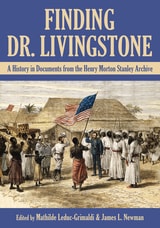
Finding Dr. Livingstone
A History in Documents from the Henry Morton Stanley ArchivesMathilde Leduc-Grimaldi
Ohio University Press, 2020
This eye-opening perspective on Stanley’s expedition reveals new details about the Victorian explorer and his African crew on the brink of the colonial Scramble for Africa.
In 1871, Welsh American journalist Henry M. Stanley traveled to Zanzibar in search of the “missing” Scottish explorer and missionary David Livingstone. A year later, Stanley emerged to announce that he had “found” and met with Livingstone on Lake Tanganyika. His alleged utterance there, “Dr. Livingstone, I presume,” was one of the most famous phrases of the nineteenth century, and Stanley’s book, How I Found Livingstone, became an international bestseller.
In this fascinating volume Mathilde Leduc-Grimaldi and James L. Newman transcribe and annotate the entirety of Stanley’s documentation, making available for the first time in print a broader narrative of Stanley’s journey that includes never-before-seen primary source documents—worker contracts, vernacular plant names, maps, ruminations on life, lines of poetry, bills of lading—all scribbled in his field notebooks.
Finding Dr. Livingstone is a crucial resource for those interested in exploration and colonization in the Victorian era, the scientific knowledge of the time, and the peoples and conditions of Tanzania prior to its colonization by Germany.

Finding Mars
Ned Rozell
University of Alaska Press, 2011

Flowers, Guns, and Money
Joel Roberts Poinsett and the Paradoxes of American PatriotismLindsay Schakenbach Regele
University of Chicago Press, 2023
Joel Roberts Poinsett’s (1779–1851) brand of self-interested patriotism illuminates the paradoxes of the antebellum United States. He was a South Carolina investor and enslaver, a confidant of Andrew Jackson, and a secret agent in South America who fought surreptitiously in Chile’s War for Independence. He was an ambitious Congressman and Secretary of War who oversaw the ignominy of the Trail of Tears and orchestrated America’s longest and costliest war against Native Americans, yet also helped found the Smithsonian. In addition, he was a naturalist, after whom the poinsettia—which he appropriated while he was serving as the first US ambassador to Mexico—is now named.
As Lindsay Schakenbach Regele shows in Flowers, Guns, and Money, Poinsett personified a type of patriotism that emerged following the American Revolution, one in which statesmen served the nation by serving themselves, securing economic prosperity and military security while often prioritizing their own ambitions and financial interests. Whether waging war, opposing states’ rights yet supporting slavery, or pushing for agricultural and infrastructural improvements in his native South Carolina, Poinsett consistently acted in his own self-interest. By examining the man and his actions, Schakenbach Regele reveals an America defined by opportunity and violence, freedom and slavery, and nationalism and self-interest.
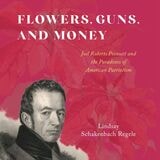
Flowers, Guns, and Money
Joel Roberts Poinsett and the Paradoxes of American PatriotismLindsay Schakenbach Regele
University of Chicago Press, 2023
A fascinating historical account of a largely forgotten statesman, who pioneered a form of patriotism that left an indelible mark on the early United States.
Joel Roberts Poinsett’s (1779–1851) brand of self-interested patriotism illuminates the paradoxes of the antebellum United States. He was a South Carolina investor and enslaver, a confidant of Andrew Jackson, and a secret agent in South America who fought surreptitiously in Chile’s War for Independence. He was an ambitious Congressman and Secretary of War who oversaw the ignominy of the Trail of Tears and orchestrated America’s longest and costliest war against Native Americans, yet also helped found the Smithsonian. In addition, he was a naturalist, after whom the poinsettia—which he appropriated while he was serving as the first US ambassador to Mexico—is now named.
As Lindsay Schakenbach Regele shows in Flowers, Guns, and Money, Poinsett personified a type of patriotism that emerged following the American Revolution, one in which statesmen served the nation by serving themselves, securing economic prosperity and military security while often prioritizing their own ambitions and financial interests. Whether waging war, opposing states’ rights yet supporting slavery, or pushing for agricultural and infrastructural improvements in his native South Carolina, Poinsett consistently acted in his own self-interest. By examining the man and his actions, Schakenbach Regele reveals an America defined by opportunity and violence, freedom and slavery, and nationalism and self-interest.
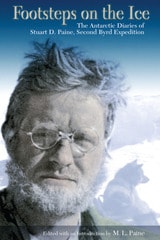
Footsteps on the Ice
The Antarctic Diaries of Stuart D. Paine, Second Byrd ExpeditionStuart D. Paine, Edited & Intro by M. L. Paine
University of Missouri Press, 2007
In 1933 Antarctica was essentially unexplored. Admiral Richard Byrd launched his Second Expedition to chart the southernmost continent, primarily relying on the muscle power of dog teams and their drivers who skied or ran beside the loaded sledges as they traveled. The life-threatening challenges of moving glaciers, invisible crevasses, and horrific storms compounded the difficulties of isolation, darkness, and the unimaginable cold that defined the men’s lives.
Stuart Paine was a dog driver, radio operator, and navigator on the fifty-six-man expedition, the bold and complex venture that is now famous for Byrd’s dramatic rescue from Bolling Advance Weather Base located 115 miles inland. Paine’s diaries represent the only published contemporary account written by a member of the Second Expedition. They reveal a behind-the-scenes look at the contentiousness surrounding the planned winter rescue of Byrd and offer unprecedented insights into the expedition’s internal dynamics.
Equally riveting is Paine’s breathtaking narrative of the fall and summer field operations as the field parties depended on their own resources in the face of interminable uncertainty and peril. Undertaking the longest and most hazardous sledging journey of the expedition, Paine guided the first American party from the edge of the Ross Sea more than seven hundred miles up the Ross Ice Shelf and the massive Thorne (Scott) Glacier to approach the South Pole. He and two other men skied more than fourteen hundred miles in eighty-eight days to explore and map part of Antarctica for the first time.
Footsteps on the Ice reveals the daily struggles, extreme personalities, and the matter-of-fact bravery of early explorers who are now fading into history. Detailing the men’s frustrations, annoyances, and questioning of their leader, Paine’s entries provide rare insight into how Byrd conducted his expeditions. Paine exposes the stresses of living under the snow in Little America during the four-month-long winter night, trapped in dim, crowded huts and black tunnels, while the men uneasily mulled over their leader’s isolation at Advance Base. The fates of Paine’s dogs, which provided some of his most difficult and rewarding experiences, are also described—his relationship with Jack, his lead dog, is an entrancing story in itself.
Featuring previously unpublished photographs and illustrations, Footsteps on the Ice documents the period in Antarctic exploration that bridged the “heroic era” and the modern age of mechanized travel. Depicting almost incomprehensible mental and physical duress and unhesitating courage, Paine’s tale is one of the most compelling stories in polar history, surpassing other accounts with its immediacy and adventure as it captures the majesty and mystery of the untouched Antarctic.