314 books match the query 'African' and 12 start with f

cover of Faith and the Fragility of Justice: Responses to Gender-Based Violence in South Africa

Faith and the Fragility of Justice

Responses to Gender-Based Violence in South Africa

Meredith Whitnah

Rutgers University Press, 2025
South Africa has repeatedly made international headlines because of its high rates of gender-based violence. In the midst of a wide range of responses to the problem, an important voice has been largely absent. Why are the religious groups that had famously protested the racial violence of apartheid faltering in their response to gendered violence in the democracy? Faith and the Fragility of Justice answers this question through a deep dive into the public discourse of three Protestant Christian organizations that had been adamant about a theological mandate to challenge apartheid, but have varied in their responses to gender-based violence in the democracy. The central argument of the book is that the organizations’ theological convictions intersect with their posture toward various social groups to shape their actions. In making this argument, Meredith Whitnah demonstrates that religious beliefs are a central dimension of institutional processes that sustain or challenge social inequality and violence.
[more]
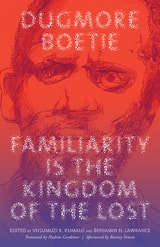
cover of Familiarity Is the Kingdom of the Lost

Familiarity Is the Kingdom of the Lost

Dugmore Boetie

Ohio University Press, 2020
A fast-paced romp through apartheid-era South Africa that exemplifies the creative human capacity to overcome seemingly omnipotent enemies and overwhelming odds. The picaresque hero of this novel, Duggie, is a dispossessed black street kid turned con man. Duggie’s response to being confined to the lowest level of South Africa’s oppressive and humiliating racial hierarchy is to one-up its absurdity with his own glib logic and preposterous schemes. Duggie’s story, as one critic puts it, offers “an encyclopedic catalogue of rip-offs, swindles, and hoaxes” that regularly land him in jail and rely on his white targets’ refusal to admit a black man is capable of outsmarting them. Duggie exploits South Africa’s bureaucratic pass laws and leverages his artificial leg every chance he gets. As “a worthless embarrassment to the authorities and a bad example to the convicts,” Duggie even manages to get himself thrown out of jail. From Duggie’s Depression-era childhood in urban Johannesburg to World War II and the rise of the white supremacist apartheid regime to his final, bitter triumph, Boetie’s narrative celebrates humanity’s relentless drive to survive at any cost. This new edition of Boetie’s out-of-print classic features a recently discovered photograph of the author, an introduction replete with previously unpublished research, numerous annotations, and is accompanied by Lionel Abrahams’ haunting poem, “Soweto Funeral,” composed after attending Boetie’s interment, all of which render the text accessible to a new generation of readers.
[more]
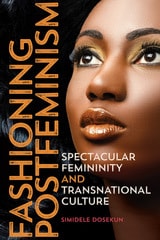
cover of Fashioning Postfeminism: Spectacular Femininity and Transnational Culture

Fashioning Postfeminism

Spectacular Femininity and Transnational Culture

Simidele Dosekun

University of Illinois Press, 2020

Women in Lagos, Nigeria, practice a spectacularly feminine form of black beauty. From cascading hair extensions to immaculate makeup to high heels, their style permeates both day-to-day life and media representations of women not only in a swatch of Africa but across an increasingly globalized world.

Simidele Dosekun's interviews and critical analysis consider the female subjectivities these women are performing and desiring. She finds that the women embody the postfeminist idea that their unapologetically immaculate beauty signals—but also constitutes—feminine power. As empowered global consumers and media citizens, the women deny any need to critique their culture or to take part in feminism's collective political struggle. Throughout, Dosekun unearths evocative details around the practical challenges to attaining their style, examines the gap between how others view these women and how they view themselves, and engages with ideas about postfeminist self-fashioning and subjectivity across cultures and class.

Intellectually provocative and rich with theory, Fashioning Postfeminism reveals why women choose to live, embody, and even suffer for a fascinating performative culture.

[more]
cover of Fela: Life And Times Of An African

Fela

Life And Times Of An African

Michael Veal

Temple University Press, 2000

Musician, political critic, and hedonist, international superstar Fela Anikulapo-Kuti created a sensation throughout his career. In his own country of Nigeria he was simultaneously adulated and loathed, often by the same people at the same time. His outspoken political views and advocacy of marijuana smoking and sexual promiscuity offended many, even as his musical brilliance enthralled them. In his creation of afrobeat, he melded African traditions with African American and Afro-Caribbean influences to revolutionize world music.

Although harassed, beaten, and jailed by Nigerian authorities, he continued his outspoken and derisive criticism of political corruption at home and economic exploitation from abroad. A volatile mixture of personal characteristics -- charisma, musical talent, maverick lifestyle, populist ideology, and persistence in the face of persecution -- made him a legend throughout Africa and the world. Celebrated during the 1970s as a musical innovator and spokesman for the continent's oppressed masses, he enjoyed worldwide celebrity during the 1980s and was recognized in the 1990s as a major pioneer and elder statesman of African music. By the time of his death in 1997 from AIDS-related complications, Fela had become something of a Nigerian institution.

In Africa, the idea of transnational alliance, once thought to be outmoded, has gained new currency. In African America, during a period of increasing social conservatism and ethnic polarization, Africa has re-emerged as a symbol of cultural affirmation. At such an historical moment, Fela's music offers a perspective on race, class, and nation on both sides of the Atlantic. As Professor Veal demonstrates, over three decades Fela synthesized a unique musical language while also clearing -- if only temporarily -- a space for popular political dissent and a type of counter-cultural expression rarely seen in West Africa. In the midst of political turmoil in Africa, as well as renewal of pro-African cultural nationalism throughout the diaspora, Fela's political music functions as a post-colonial art form that uses cross-cultural exchange to voice a unique and powerful African essentialism.
[more]
cover of Folklore in New World Black Fiction: Writing and the Oral Traditional Aesthetics

Folklore in New World Black Fiction

Writing and the Oral Traditional Aesthetics

Chiji Akoma

The Ohio State University Press, 2007

For a while, tracing African roots in the artistic creations of blacks in the New World tended to generate much attention as if to suggest that the New World does not have profound impact on their creative spirit. In addition, few studies have tried to construct an interpretive model through which an array of works by New World writers could be meaningfully explored on the basis of their African Diasporic identity.
 
In Folklore in New World Black Fiction, Chiji Akọma offers an interpretive model for the reading of the African New World novel focusing on folklore, not as an ingredient, but as the basis for the narratives. The works examined do not contain folklore materials; they are folklore, constituted by the intersections of African oral narrative aesthetics, New World sensibility, and the written tradition. Specifically Akọma looks at four African Caribbean and African American novelists, Roy A.K. Heath, Wilson Harris, Toni Morrison, and Jean Toomer.
 
The book seeks to expand the understanding of the forms of folklore as it pertains to black texts. For one, it broadens the dimensions of folklore by looking beyond the oral world of the “simple folk” to the kinds of narrative sophistication associated with writing; it also asserts the importance of performance art in folklore analysis. The study demonstrates the durability of the black aesthetic over artistic forms.
[more]
cover of Folktales of Egypt

Folktales of Egypt

Hasan M. El-Shamy

University of Chicago Press, 1982
A fascinating collection of modern folk tales from Egypt
 
In this book Hasan M. El-Shamy has gathered the first authentic new collection of modern Egyptian folk narratives to appear in nearly a century. El-Shamy's English translations of these orally presented stories not only preserve their spirit, but give Middle Eastern lore the scholarly attention it has long deserved. Ranging from the fantastic to the religious to the philosophical and beyond, these stories offer insights into the folk culture of one of the oldest societies in the world.
 
[more]
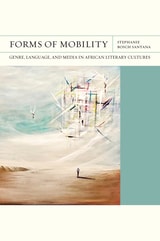
cover of Forms of Mobility: Genre, Language, and Media in African Literary Cultures

Forms of Mobility

Genre, Language, and Media in African Literary Cultures

Stephanie Bosch Santana

Northwestern University Press, 2025

Presents alternative categories of fiction through which to examine how contemporary writers have envisaged Africa’s changing literary terrains

Stephanie Bosch Santana analyzes southern African writers’ experimentations with literary form in periodical print and digital media since the mid-twentieth century in order to offer an alternative account of contemporary African imaginations of mobility. Based on an understudied archive of texts in English and Chichewa/Nyanja from Malawi, South Africa, Zimbabwe, and Zambia, Forms of Mobility: Genre, Language, and Media in African Literary Cultures examines new, noncanonical categories of fiction, including migrant forms, township tales, weekend stories, and digital diaries. These generically, linguistically, and geographically mobile forms map changing ideas of interconnection and belonging. By reading them “in motion,” as they travel across space, time, genre, and language and between publications and platforms, Bosch Santana limns multiple centers of literary influence and relation across southern African and Black diasporas, revealing forms of literary mobility and space making that are occluded by current models of world literature.
[more]
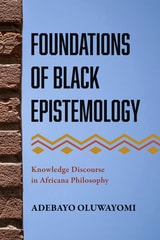
cover of Foundations of Black Epistemology: Knowledge Discourse in Africana Philosophy

Foundations of Black Epistemology

Knowledge Discourse in Africana Philosophy

Adebayo Oluwayomi

Temple University Press, 2025

Foundations of Black Epistemology is Adebayo Oluwayomi’s bold endeavor to delineate Black epistemology as a new sub-disciplinary focus in contemporary Africana or Black philosophy. He engages in a rigorous historical study of Black intellectual history to show how seminal Black thinkers have long been interested in and engaged with questions concerning the phenomenon of human knowledge, and questions around human agency, including practical considerations regarding the social and political value of knowledge.

Foundations of Black Epistemology examines writings by Phillis Wheatley, Frederick Douglass, Ida B. Wells, W.E.B. DuBois, Frantz Fanon, Steve Bantu Biko, Huey P. Newton, and Kathleen Neal Cleaver. Each chapter addresses issues of self-knowledge, self-assertion, Black consciousness, or anticolonialism and its relation to personal and political epistemologies.

Oluwayomi offers innovative perspectives on the formulation, deduction, and interrogation of epistemological themes within Black Africana philosophy. By considering the important epistemological theories and arguments in Black philosophy particularly in the last 150 to 200 years, Foundations of Black Epistemology promises to generate new discussions around this necessary field of Black Africana philosophy.
[more]
cover of Freedom In Our Lifetime: The Collected Writings Of Anton Muziwakhe Lembede

Freedom In Our Lifetime

The Collected Writings Of Anton Muziwakhe Lembede

Anton Muziwakhe Lembede

Ohio University Press, 1996

When a group of young political activists met in 1944 to launch the African National Congress Youth League, it included the nucleus of a remarkable generation of leaders who forged the struggle for freedom and equality in South Africa for the next half century: Nelson Mandela, Oliver Tambo, Walter Sisulu, Jordan Ngubane, Ellen Kuzwayo, Albertina Smith, A. P. Mda, Dan Tloome, and David Bopape. It was Anton Lembede, however whom they chose as their first president.

Lembede, who had just begun practicing law in Johannesburg, was known for his sharp intellect, fiery personality, and unwavering commitment to the struggle at hand. The son of farm laborers from the district of Georgedale, Natal, Lembede had worked tirelessly to put himself through school and college, and then to qualify for the bachelor of laws degree. When he began law practice in 1943, he had also earned the respect of his fellows, not only for his intellectual achievements (which were many), but also for his dedication to the cause of freedom in South Africa. “I am,” he explained, “Africa’s own child.”

His untimely death in 1947 at the age of 33 sent a wave of grief through the Congress Youth, who had looked to him for moral as well as political leadership. With the publication of Freedom In Our Lifetime, the editors acknowledge Lembede’s early contribution to the freedom movement, in particular his passionate and eloquent articulation of the African-centered philosophy he called “Africanism.”

[more]
cover of Freedom as Form: Gavin Jantjes, Anti-Apartheid, and the Transnational Avant-Garde

Freedom as Form

Gavin Jantjes, Anti-Apartheid, and the Transnational Avant-Garde

Allison K. Young

Duke University Press, 2027

In Freedom as Form, Allison K. Young examines the artistic lineage and oeuvre of the South African artist Gavin Jantjes, a prolific printmaker, painter, writer, curator, and activist who fled apartheid to study in Germany and went on to take residence in England and Norway. Known for his portrayals of the global Black struggle for freedom that defy expectations of Black creativity within Eurocentric traditions, Jantjes’s art reflects experiences of apartheid, movement, and transformation. Spanning multiple localities, mediums, and styles, his practice is connected to numerous international milieus and artistic networks, from Cold War-era German art to British Pop, and from South African resistance art to the millennial global turn. Young situates Jantjes’s art across international curatorial and artistic debates, interdisciplinary platforms, and collective actions. In so doing, she models a methodology for a nomadic art history suited to the transnational, exilic experiences of twentieth-century artists whose lives were affected by migration—a methodology inspired by Jantjes’s own dialogic, interdisciplinary, and border-crossing practice that troubles boundaries of genre, style, and nation states.
[more]
cover of From Sleep Unbound

From Sleep Unbound

Andrée Chedid

Ohio University Press, 1983

From Sleep Unbound portrays the life of Samya, an Egyptian woman who is taken at age 15 from her Catholic boarding school and forced into a loveless and humiliating marriage. Eventually sundered from every human attachment, Samya lapses into despair and despondence, and finally an emotionally caused paralysis. But when she shakes off the torpor of sleep, the sleep of avoidance, she awakens to action with the explosive energy of one who has been reborn.
[more]
cover of From War to Genocide: Criminal Politics in Rwanda, 1990–1994

From War to Genocide

Criminal Politics in Rwanda, 1990–1994

André Guichaoua, Translated by Don E. Webster, Foreword by Scott Straus

University of Wisconsin Press, 2017

In April 1994 Rwanda exploded in violence, with political, social, and economic divisions most visible along ethnic lines of the Hutu and Tutsi factions. The ensuing killings resulted in the deaths of as much as 20 percent of Rwanda's population. André Guichaoua, who was present as the genocide began, unfolds a complex story with multiple actors, including three major political parties that each encompassed a spectrum of positions, all reacting to and influencing a rapidly evolving situation. Economic polarities, famine-fueled privation, clientelism, corruption, north-south rivalries, and events in the neighboring nations of Burundi and Uganda all deepened ethnic tensions, allowing extremists to prevail over moderates.

Guichaoua draws on years of meticulous research to describe and analyze this history. He emphasizes that the same virulent controversies that fueled the conflict have often influenced judicial, political, and diplomatic responses to it, reproducing the partisan cleavages between the former belligerents and implicating state actors, international institutions, academics, and the media. Guichaoua insists upon the imperative of absolute intellectual independence in pursuing the truth about some of the gravest human rights violations of the twentieth century.
[more]