Results by title
61 books match the query 'Agribusiness' and 4 start with f

Farm Prices
Myth and RealityWillard W. Cochrane
University of Minnesota Press, 1958
Farm Prices was first published in 1958. Minnesota Archive Editions uses digital technology to make long-unavailable books once again accessible, and are published unaltered from the original University of Minnesota Press editions.
Few domestic questions are so controversial as the farm problem, yet the average city man finds it difficult to understand the basic issues involved. In this book Professor Cochrane describes for the layman the nature and causes of the commercial farm problem and the rural poverty problem and provides the basis for making informed judgments about these problems and their possible solutions. He analyzes the economic and political forces which are at work in the farm economy, explains the organization of modern agriculture, showing the unique structure of farming, and draws a vivid picture of the revolutionary developments which have taken place in agriculture. He discusses behavior patterns of farmers and consumers as they relate to the farm economy, and the role of government in the farm industry and in the lives of farmers.
Farm prices are constantly fluctuating, and out of this price variability emerge such serious and continuing farm problems as variable incomes, low incomes over extended periods, and uncertainty in production planning. In this study Professor Cochrane seeks to get at the root of the trouble by, first, exploring and exposing what he considers a basic fallacy in our present day thinking and approach to the farm problem. This is the widely held myth of an automatically adjusting agriculture, an agriculture that is always out of balance because of an "emergency." This myth, he points out, beclouds the issues involved in the whole farm problem.
The farm price myth splits two ways in the public mind, Mr. Cochrane explains, but these divergent attitudes represent differences only in mechanics, not in principle, and they are equally effective in obscuring the real picture. One segment of the public believes that agriculture, if left alone for a while, would gravitate toward and stabilize at some desirable level and pattern of prices, production, and incomes. The other segment believes that the same result would occur if agriculture were given a temporary, helping hand by the government. Mr. Cochrane shows the fallacies inherent in both of these convictions by presenting an integrated, overall picture of farm price behavior as it really exists. On a basis of this realistic view, he presents the two alternatives or hard policy choices that he believes the American farmer faces today.
Willard W. Cochrane is Professor Emeritus of Agricultural and Applied Economics at the University of Minnesota. He is the author of a number of books, including The City Man's Guide to the Farm Problem and Farm Prices: Myth and Reality. He previously served as an economist with the Food and Agriculture Organization of the United Nations and with the U.S. Department of Agriculture. He is the co-author of Economics of American Agriculture and Economics of Consumption.
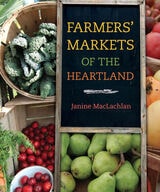
Farmers' Markets of the Heartland
Janine MacLachlan
University of Illinois Press, 2012
A visual feast of the Midwest's homegrown bounty
In this splendidly illustrated book, food writer and self-described farm groupie Janine MacLachlan embarks on a tour of seasonal markets and farmstands throughout the Midwest, sampling local flavors from Michigan, Ohio, Indiana, Illinois, Missouri, Iowa, Minnesota, and Wisconsin. She conducts delicious research as she meets farmers, tastes their food, and explores how their businesses thrive in the face of an industrial food supply. She tells the stories of a pair of farmers growing specialty crops on a few acres of northern Michigan for just a few months out of the year, an Ohio cattle farm that has raised heritage beef since 1820, and a Minnesota farmer who tirelessly champions the Jimmy Nardello sweet Italian frying pepper. Along the way, she savors vibrant red carrots, slurpy peaches, vast quantities of specialty cheeses, and some of the tastiest pie to cross anyone's lips.
Informed by debates about eating local, seasonal crops, organic farming, sanitation, and biodiversity, Farmers' Markets of the Heartland tantalizes with special recipes from farm-friendly chefs and dozens of luscious color photographs that will inspire you to harvest the homegrown flavors in your own neighborhood.
Food for the Few
Neoliberal Globalism and Biotechnology in Latin AmericaEdited by Gerardo Otero
University of Texas Press, 2008
Recent decades have seen tremendous changes in Latin America's agricultural sector, resulting from a broad program of liberalization instigated under pressure from the United States, the IMF, and the World Bank. Tariffs have been lifted, agricultural markets have been opened and privatized, land reform policies have been restricted or eliminated, and the perspective has shifted radically toward exportation rather than toward the goal of feeding local citizens. Examining the impact of these transformations, the contributors to Food for the Few: Neoliberal Globalism and Biotechnology in Latin America paint a somber portrait, describing local peasant farmers who have been made responsible for protecting impossibly vast areas of biodiversity, or are forced to specialize in one genetically modified crop, or who become low-wage workers within a capitalized farm complex. Using dozens of examples such as these, the deleterious consequences are surveyed from the perspectives of experts in diverse fields, including anthropology, economics, geography, political science, and sociology.
From Kathy McAfee's "Exporting Crop Biotechnology: The Myth of Molecular Miracles," to Liz Fitting's "Importing Corn, Exporting Labor: The Neoliberal Corn Regime, GMOs, and the Erosion of Mexican Biodiversity," Food for the Few balances disturbing findings with hopeful assessments of emerging grassroots alternatives. Surveying not only the Latin American conditions that led to bankruptcy for countless farmers but also the North's practices, such as the heavy subsidies implemented to protect North American farmers, these essays represent a comprehensive, keenly informed response to a pivotal global crisis.

Fragrant Frontier
Global Spice Entanglements from the Sino-Vietnamese UplandsEdited by Sarah Turner, Annuska Derks, and Jean-François Rousseau
National University of Singapore Press, 2022