Results by title
32 books match the query 'Others'
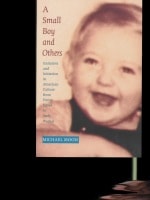
A Small Boy and Others
Imitation and Initiation in American Culture from Henry James to Andy WarholMichael Moon
Duke University Press, 1998
Moon illuminates the careers of James, Warhol, and others by examining the imaginative investments of their protogay childhoods in their work in ways that enable new, more complex cultural readings. He deftly engages notions of initiation and desire not within the traditional framework of “sexual orientation” but through the disorienting effects of imitation. Whether invoking the artist Joseph Cornell’s early fascination with the Great Houdini or turning his attention to James’s self-described “initiation into style” at the age of twelve—when he first encountered the homoerotic imagery in paintings by David, Géricault, and Girodet—Moon reveals how the works of these artists emerge from an engagement that is obsessive to the point of “queerness.”
Rich in historical detail and insistent in its melding of the recent with the remote, the literary with the visual, the popular with the elite, A Small Boy and Others presents a hitherto unimagined tradition of brave and outrageous queer invention. This long-awaited contribution from Moon will be welcomed by all those engaged in literary, cultural, and queer studies.
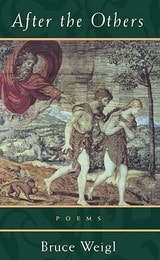
After the Others
PoemsBruce Weigl
Northwestern University Press, 1999
In his twelfth volume of poetry, Bruce Weigl continues his quest for emotional and spiritual enlightenment. Quiet and moving, these poems combine an intimate voice with a searingly direct look at suffering and senseless violence, at human desire and love, and at man's relationship with nature.
An Empire of Others
Creating Ethnographic Knowledge in Imperial Russia and the USSRAlexis Hofmeister
Central European University Press, 2014
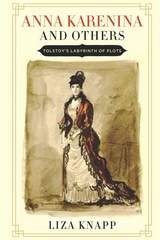
Anna Karenina and Others
Liza Knapp
University of Wisconsin Press, 2018
Knapp provides a series of readings of Anna Karenina that draw on other works that were critical to Tolstoy’s understanding of the interconnectedness of human lives. Among the texts she considers are The Scarlet Letter, a novel of adultery with a divided plot; Middlemarch, a multiplot novel with neighborly love as its ideal; and Blaise Pascal’s Pensées, which fascinated Tolstoy during his own religious crisis. She concludes with a tour-de-force reading of Mrs. Dalloway that shows Virginia Woolf constructing this novel in response to Tolstoy’s treatment of Anna Karenina and others.
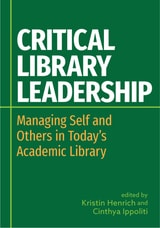
Critical Library Leadership
Managing Self and Others in Today's Academic LibraryKristin Henrich
Assoc of College & Research Libraries, 2024
Critical Library Leadership: Managing Self and Others in Today’s Academic Library provides practical, library-specific, hands-on tools that help us shape our approach to leadership and ourselves as leaders. It gives practical strategies for dealing with stress and addressing feelings of insecurity alongside managing the organization from an equity perspective that places people at the forefront. Each section offers a mixture of theory and research, lived experience, and practice that captures many different techniques you can apply to your own journey and organizational context in both formal and informal ways.
Part I: Leader as Self
Section I: Care, Empathy, and Authenticity
Section II: Career Development
Part II: Leader as Role
Section III: Relationships with Others
Section IV: Management Practices
Critical Library Leadership offers a sense of recognition and of community, new ideas for personal and organizational practice, and a renewed appreciation for the immense amount of affective, emotional, and practical labor that is required of each of us as leaders.
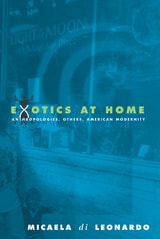
Exotics at Home
Anthropologies, Others, and American ModernityMicaela di Leonardo
University of Chicago Press, 1998
"An impressive work of scholarship that is mordantly witty, passionately argued, and takes no prisoners."—Lesley Gill, News Politics
"[Micaela] di Leonardo eloquently argues for the importance of empirical, interdisciplinary social science in addressing the tragedy that is urban America at the end of the century."—Jonathan Spencer, Times Literary Supplement
"In her quirky new contribution to the American culture brawl, feminist anthropologist Micaela di Leonardo explains how anthropologists, 'technicians of the sacred,' have distorted American popular debate and social life."—Rachel Mattson, Voice Literary Supplement
"At the end of di Leonardo's analyses one is struck by her rare combination of rigor and passion. Simply, [she] is a marvelous iconoclast."—Matthew T. McGuire, Boston Book Review
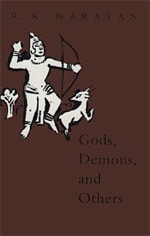
Gods, Demons, and Others
R. K. Narayan llustrated by R. K. Laxman
University of Chicago Press, 1993
"Mr. Narayan gives vitality and an original viewpoint to the most ancient of legends, lacing them with his own blend of satire, pertinent explanation and thoughtful commentary."—Santha Rama Rau, New York Times
"Narayan's narrative style is swift, firm, graceful, and lucid . . . thoroughly knowledgeable, skillful, entertaining. One could hardly hope for more."—Rosanne Klass, Times Literary Supplement
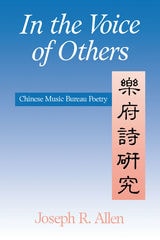
In the Voice of Others
Chinese Music Bureau PoetryJoseph R. Allen
University of Michigan Press, 1992
Knowing the Suffering of Others
Legal Perspectives on Pain and Its MeaningsAustin Sarat
University of Alabama Press, 2014
From fetal imaging to end-of-life decisions, torts to international human rights, domestic violence to torture, and the law of war to victim impact statements, the law is awash in epistemological and ethical problems associated with knowing and imagining suffering. In each of these domains we might ask: How well do legal actors perceive and understand suffering in such varied domains of legal life? What problems of representation and interpretation bedevil efforts to grasp the suffering of others? What historical, political, literary, cultural, and/or theological resources can legal actors and citizens draw on to understand the suffering of others?
In Knowing the Suffering of Others, Austin Sarat presents legal scholarship that explores these questions and puts the problem of suffering at the center of thinking about law. The contributors to this volume do not regard pain and suffering as objective facts of a universe remote from law; rather they examine how both are discursively constructed in and by law. They examine how pain and suffering help construct and give meaning to the law as we know it. The authors attend to the various ways suffering appears in law as well as the different forms of suffering that require the law’s attention.
Throughout this book law is regarded as a domain in which the meanings of pain and suffering are contested, and constituted, as well as an instrument for inflicting suffering or for providing or refusing its relief. It challenges scholars, lawyers, students, and policymakers to ask how various legal actors and audiences understand the suffering of others.
Contributors
Montré D. Carodine / Cathy Caruth / Alan L. Durham / Bryan K.Fair / Steven H. Hobbs / Gregory C. Keating
/ Linda Ross Meyer / Meredith M. Render / Jeannie Suk / John Fabian Witt
Living in the Rock N Roll Mystery
Reading Context, Self, and Others as CluesH. L. Goodall, Jr.
Southern Illinois University Press, 1991
Mystery, rather than “problem,” provides the context that the cultural ethnographer best uses to approach the experience of both the living and the writing of culture. In this work, H. L. Goodall, Jr., continues his discussion of the cultural ethnographer as detective through an investigation of what he calls the “rock n roll mystery.”
Using Bakhtin’s notion of “Carnival,” Goodall positions rock n roll as an important aspect of the American cultural experience using its lyrics and rhythm as a force of resistance to the dominant bureaucratic order. He argues that interpretive ethnography, where sentences use rhythms and emotions along with words to construct a work, parallels rock n roll in its creation of multiple voices struggling for creative and interpretive presence and space in the text. As there is no privileged text in the social life of rock n roll, there is no privileged voice in the writing of interpretive ethnography. It is, instead, a reading and writing method within the field of communication and the field of cultural studies that challenges the “existing wisdom.”
Goodall invites the reader to join him in the role of the detective who confronts, enters, and then participates in the mysteries of living. Through the use of his interpretive method, Goodall is able to move under the skin of experience to disclose the relationship among self, other(s), and context, an understanding only achieved by “going beneath the often cosmetic surfaces of cultural traffic to where symbols mingle with the driven stuff of life.” Because the “stuff of life” is laid out on the pages of this book, Goodall’s text is as compelling as a good novel and in some ways more intimate.

Machiavelli
The Chief Works and Others, 3 volume setAllan Gilbert, ed.
Duke University Press, 0
“A most remarkable achievement.”—Felix Gilbert, Renaissance Quarterly
Machiavelli
The Chief Works and Others, 3 volume setAllan Gilbert, ed.
Duke University Press, 0
“A most remarkable achievement.”—Felix Gilbert, Renaissance Quarterly
Machiavelli
The Chief Works and Others, Vol. IAllan Gilbert, ed.
Duke University Press, 1989
Allan Gilbert is unquestionably the most accurate and reliable translator of Machiavelli into English; the publication of this edition is an altogether happy occasion. Students of the history of political thought owe a particular debt of gratitude to Allan Gilbert.”—Dante Germino, The Journal of Politics
“A most remarkable achievement.”—Felix Gilbert, Renaissance Quarterly
Machiavelli
The Chief Works and Others, Vol. IIAllan Gilbert, ed.
Duke University Press, 1989
Allan Gilbert is unquestionably the most accurate and reliable translator of Machiavelli into English; the publication of this edition is an altogether happy occasion. Students of the history of political thought owe a particular debt of gratitude to Allan Gilbert.”—Dante Germino, The Journal of Politics
“A most remarkable achievement.”—Felix Gilbert, Renaissance Quarterly
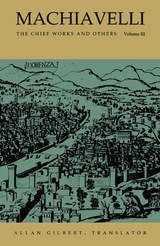
Machiavelli
The Chief Works and Others, Vol. IIIAllan Gilbert, ed.
Duke University Press, 1989
Allan Gilbert is unquestionably the most accurate and reliable translator of Machiavelli into English; the publication of this edition is an altogether happy occasion. Students of the history of political thought owe a particular debt of gratitude to Allan Gilbert.”—Dante Germino, The Journal of Politics
“A most remarkable achievement.”—Felix Gilbert, Renaissance Quarterly
Malinowski, Rivers, Benedict and Others
Essays on Culture and PersonalityEdited by George W. Stocking, Jr.
University of Wisconsin Press, 1988
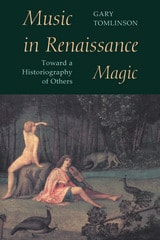
Music in Renaissance Magic
Toward a Historiography of OthersGary Tomlinson
University of Chicago Press, 1994
In Music in Renaissance Magic, Gary Tomlinson describes some of these connections and offers a fresh view of the development of early modern thought in Italy. Raising issues essential to postmodern historiography—issues of cultural distance and our relationship to the others who inhabit our constructions of the past —Tomlinson provides a rich store of ideas for students of early modern culture, for musicologists, and for historians of philosophy, science, and religion.
"A scholarly step toward a goal that many composers have aimed for: to rescue the idea of New Age Music—that music can promote spiritual well-being—from the New Ageists who have reduced it to a level of sonic wallpaper."—Kyle Gann, Village Voice
"An exemplary piece of musical and intellectual history, of interest to all students of the Renaissance as well as musicologists. . . . The author deserves congratulations for introducing this new approach to the study of Renaissance music."—Peter Burke, NOTES
"Gary Tomlinson's Music in Renaissance Magic: Toward a Historiography of Others examines the 'otherness' of magical cosmology. . . . [A] passionate, eloquently melancholy, and important book."—Anne Lake Prescott, Studies in English Literature

Nabokov's Fifth Arc
Nabokov and Others on His Life's WorkEdited by J. E. Rivers and Charles Nicol
University of Texas Press, 1982
In his autobiography Speak, Memory, Vladimir Nabokov compared his life to a spiral, in which “twirl follows twirl, and every synthesis is the thesis of the next series.” The first four arcs of the spiral of Nabokov’s life—his youth in Russia, voluntary exile in Europe, two decades spent in the United States, and the final years of his life in Switzerland—are now followed by a fifth arc, his continuing life in literary history, which this volume both explores and symbolizes.
This is the first collection of essays to examine all five arcs of Nabokov’s creative life through close analyses of representative works. The essays cast new light on works both famous and neglected and place these works against the backgrounds of Nabokov’s career as a whole and modern literature in general. Nabokov analyzes his own artistry in his “Postscript to the Russian Edition of Lolita,” presented here in its first English translation, and in his little-known “Notes to Ada by Vivian Darkbloom,” published now for the first time in America and keyed to the standard U.S. editions of the novel. In addition to a defense of his father’s work by Dmitri Nabokov and a portrait-interview by Alfred Appel, Jr., the volume presents a vast spectrum of critical analyses covering all Nabokov’s major novels and several important short stories. The highly original structure of the book and the fresh and often startling revelations of the essays dramatize as never before the unity and richness of Nabokov’s unique literary achievement.

Nikolai Evreinov & Others
»The Storming of the Winter Palace«Edited by Inke Arns, Sylvia Sasse, and Igor Chubarov
Diaphanes, 2017
Nikolaj Evreinov: “The Storming of the Winter Palace” tells the fascinating story of this production. Taking readers through the relevant history, the authors describe the role of The Storming of the Winter Palace in commemorating Soviet power. With a wealth of illustrations, they also show how photographs of Evreinov’s theatrical storming eventually became historical documents of the October Revolution themselves.
Objects and Others
Essays on Museums and Material CultureEdited by George W. Stocking, Jr.
University of Wisconsin Press, 1988
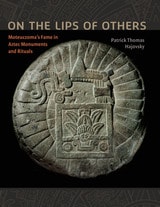
On the Lips of Others
Moteuczoma's Fame in Aztec Monuments and RitualsBy Patrick Thomas Hajovsky
University of Texas Press, 2015
Moteuczoma, the last king who ruled the Aztec Empire, was rarely seen or heard by his subjects, yet his presence was felt throughout the capital city of Tenochtitlan, where his deeds were recorded in hieroglyphic inscriptions on monuments and his command was expressed in highly refined ritual performances. What did Moteuczoma’s “fame” mean in the Aztec world? How was it created and maintained? In this innovative study, Patrick Hajovsky investigates the king’s inscribed and spoken name, showing how it distinguished his aura from those of his constituencies, especially other Aztec nobles, warriors, and merchants, who also vied for their own grandeur and fame. While Tenochtitlan reached its greatest size and complexity under Moteuczoma, the “Great Speaker” innovated upon fame by tying his very name to the Aztec royal office.
As Moteuczoma’s fame transcends Aztec visual and oral culture, Hajovsky brings together a vast body of evidence, including Nahuatl language and poetry, indigenous pictorial manuscripts and written narratives, and archaeological and sculptural artifacts. The kaleidoscopic assortment of sources casts Moteuczoma as a divine king who, while inheriting the fame of past rulers, saw his own reputation become entwined with imperial politics, ideological narratives, and eternal gods. Hajovsky also reflects on posthumous narratives about Moteuczoma, which created a very different sense of his fame as a conquered subject. These contrasting aspects of fame offer important new insights into the politics of personhood and portraiture across Aztec and colonial-period sources.
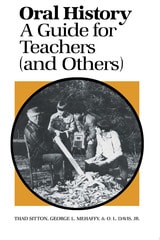
Oral History
A Guide for Teachers (and Others)By Thad Sitton, George L. Mehaffy, and O.L. Davis, Jr.
University of Texas Press, 1983
More than a mode of gathering information about the past, oral history has become an international movement. Historians, folklorists, and other educational and religious groups now recognize the importance of preserving the recollections of people about the past. The recorded memories of famous and common folk alike provide a vital complement to textbook history, bringing the past to life through the stories of those who lived it.
Oral History is designed to introduce teachers, students, and interested individuals to the techniques, problems, and pleasures of collecting oral history. The authors, themselves experienced educators, examine the uses of oral history in the classroom, looking at a wide range of projects that have been attempted and focusing on those that have succeeded best.
Besides suggesting many possible projects, they discuss the necessary hardware and its use: recording equipment and procedures, interview outlines and preliminary research, photography and note-taking in the field, transcription and storage of information, legal forms, and more. For the teacher, the authors offer helpful advice on training students to be sensitive interviewers in both formal and informal situations.
How can oral histories collected in the classroom be put to use? The authors discuss their uses within the curriculum; in projects such as oral history archives, publications such as the popular Foxfire books, and other media productions; and in researching current community problems. Useful appendixes survey a variety of reference tools for the oral historian and describe in detail how a Foxfire-concept magazine may be developed.
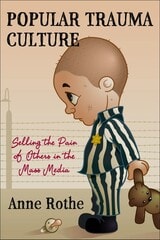
Popular Trauma Culture
Selling the Pain of Others in the Mass MediaRothe, Anne
Rutgers University Press, 2011
In Popular Trauma Culture, Anne Rothe argues that American Holocaust discourse has a particular plot structure—characterized by a melodramatic conflict between good and evil and embodied in the core characters of victim/survivor and perpetrator—and that it provides the paradigm for representing personal experiences of pain and suffering in the mass media. The book begins with an analysis of Holocaust clichés, including its political appropriation, the notion of vicarious victimhood, the so-called victim talk rhetoric, and the infusion of the composite survivor figure with Social Darwinism. Readers then explore the embodiment of popular trauma culture in two core mass media genres: daytime TV talk shows and misery memoirs.
Rothe conveys how victimhood and suffering are cast as trauma kitsch on talk shows like Oprah and as trauma camp on modern-day freak shows like Springer. The discussion also encompasses the first scholarly analysis of misery memoirs, the popular literary genre that has been widely critiqued in journalism as pornographic depictions of extreme violence. Currently considered the largest growth sector in book publishing worldwide, many of these works are also fabricated. And since forgeries reflect the cultural entities that are most revered, the book concludes with an examination of fake misery memoirs.
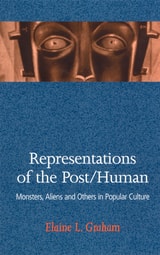
Representations of the Post/Human
Monsters, Aliens, and Others in Popular CultureGraham, Elaine L.
Rutgers University Press, 2002
Microchips. Genetic modification of plants. Cloning. Advances in technology promise to shape our lives more profoundly than ever before. Exciting new discoveries in reproductive, genetic, and information technologies all serve to call into question the immutability of the boundaries between humans, animals, and machines. The category of the “posthuman” reflects the implications of such new technologies on contemporary culture, especially in their capacity to reconfigure the human body and to challenge our most fundamental understandings of human nature.
Elaine L. Graham explores these issues as they are expressed within popular culture and the creative arts. From the myth of Prometheus and the Gothic horror of Frankenstein’s monster to contemporary postmodern science fiction, a gallery of fantastic creatures haunts Western myth, religion, and literature. They serve to connect contemporary debates with enduring concerns about the potential—and the limits—of human creativity.
This book breaks new ground in drawing together a wide range of literature on new technologies and their ethical implications. In her explorations of the monstrous and the cyborg, Graham covers the Jewish legend of the golem, the Human Genome Project, Star Trek: Next Generation, Star Trek: Voyager, Fritz Lang’s Metropolis, Donna Haraway’s cyborg writing, andmany other related topics. This book will interest students in cultural studies, literature, ethics, religion, information technology, and the life sciences.
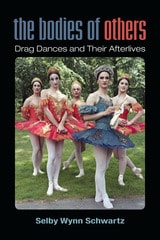
The Bodies of Others
Drag Dances and Their AfterlivesSelby Wynn Schwartz
University of Michigan Press, 2019
The Deliverance of Others
Reading Literature in a Global AgeDavid Palumbo-Liu
Duke University Press, 2012
The influential literary critic David Palumbo-Liu suggests that we can arrive at a sense of responsibility toward others by reconsidering the discourses of sameness that deliver those unlike ourselves to us. Through virtuoso readings of novels by J. M. Coetzee, Nadine Gordimer, Kazuo Ishiguro, and Ruth Ozeki, he shows how notions that would seem to offer some basis for commensurability between ourselves and others—ideas of rationality, the family, the body, and affect—become less stable as they try to accommodate more radical types of otherness. For Palumbo-Liu, the reading of literature is an ethical act, a way of thinking through our relations to others.
The Ecology of Others
Philippe Descola
Prickly Paradigm Press, 2013
Since the end of the nineteenth century, the division between nature and culture has been fundamental to Western thought. In this groundbreaking work, renowned anthropologist Philippe Descola seeks to break down this divide, arguing for a departure from the anthropocentric model and its rigid dualistic conception of nature and culture as distinct phenomena. In its stead, Descola proposes a radical new worldview, in which beings and objects, human and nonhuman, are understood through the complex relationships that they possess with one another.
The One and the Others
Metaphysics, Poetry, and the Antinomies of Plato’s "Parmenides"Andrew Cutrofello
Northwestern University Press, 2026
At the end of Plato’s Parmenides, Parmenides concludes that “whether ‘the One’ is or is not, it and ‘the Others’ both are and are not, and both appear and do not appear, all things in all ways.” Throughout the history of philosophy various attempts have been made to make sense of Plato’s puzzling dialectical exercise. In this ambitious book Andrew Cutrofello shows how Kant and Hegel extended it, how contemporary philosophers, including Graham Priest and Alain Badiou, have reinterpreted it, and how poets such as Dante, Shakespeare, Blake, Wordsworth, and Susan Howe have channeled it. What emerges is an original conception of the history of metaphysics as a series of antinomies, and of metaphysical poetry as a type of antinomianism.
The Soul of the Helper
Seven Stages to Seeing the Sacred within Yourself So You Can See It in OthersHolly K. Oxhandler
Templeton Press, 2025
In their devotion to the well-being of others, caregivers routinely put their own well-being last and can unintentionally burn themselves out physically, emotionally, and spiritually. Their self-neglect, paired alongside a deep desire to help others, has the potential to stir up feelings of anger and resentment, leading to a sense of guilt and shame. They often believe that if they were to grant themselves any rest or grace, they would be at risk of failing in their duty.
In The Soul of the Helper, Dr. Holly K. Oxhandler shows caregivers and fellow helpers a more self-compassionate way to cope with their overwhelming responsibilities and to attend to their own needs, particularly when it comes to their mental health and spiritual journey. She invites them to pause and realize that if they let their personal resources run dry, they cannot possibly care for others as fully as they wish. In fact, their efforts are likely to cause more harm than good.
With a background in spiritually-integrated mental health, Dr. Oxhandler teaches helpers a seven-step process to slow down and reconnect with the stillness within themselves. It is in this space of stillness that Oxhandler guides helpers to reconnect with the “sacred spark” within their soul. By allowing themselves to enter that stillness, caregivers will recognize that they, too, are worthy of care. And with that realization, they will see anew the sacred spark that dwells inside everyone else, especially within those they’re helping.
As a social worker, researcher, and person of faith, Dr. Oxhandler writes in a warm and welcoming style, shares many relatable stories, and widens her scope to include believers of all faiths and spiritual traditions. Her book is for caregivers everywhere who sense the sacred spark within them saying, in effect: “Come to me, all you who are weary and burdened, and I will give you rest.”

Versions of Hollywood Crime Cinema
Studies in Ford, Wilder, Coppola, Scorsese, and OthersCarl Freedman
Intellect Books, 2013
Film, argues Carl Freedman, is an especially fruitful medium for considering questions like these. With Versions of Hollywood Crime Cinema, he offers a series of critical readings spanning several genres. From among the mob movies, Freedman focuses on Francis Ford Coppola’s Godfather trilogy—arguably the foremost work of crime cinema—crafting a convincing argument that the plot’s action is principally driven by the shift from Sicily to America, which marks the shift to a capitalist society. Turning his attention to other genres, Freedman also looks at film noir and Westerns, in addition to films for which crime is significant but not central, from horror movies like Stanley Kubrick’s The Shining to science fiction and social realist films like The Grapes of Wrath. In recent years, television has welcomed innovative works like Boardwalk Empire, The Wire, and The Sopranos, and Freedman discusses how television’s increasingly congenial creative environment has allowed it to turn out productions whose ability to engage with these larger social questions rivals that of films from the height of cinema’s Golden Age.
Weeping in the Playtime of Others
America’s Incarcerated Children. 2nd edition.Written by Kenneth Wooden with a foreword by Kathleen M. Heide
The Ohio State University Press, 2000
Kenneth Wooden’s Weeping in the Playtime of Others—first published in 1976 and an enduring work of investigative journalism and criminology that was nominated for a Pulitzer Prize—exposes the harsh realities faced by children in the American juvenile justice system. Wooden’s extensive research and firsthand accounts highlight the systemic abuse, neglect, and violence that incarcerated youth endure. Investigative reporter Wooden journeyed across thirty states to document brutal conditions in juvenile detention centers and training schools. His work revealed in stark detail how these institutions regularly failed to provide the rehabilitation they promised, perpetuating cycles of violence and criminality, and presented a devastating picture of the detrimental effects on of solitary confinement, physical punishment, and inadequate educational and psychological support.
Wooden’s many case studies include that of a young Charles Manson, illustrating how early institutionalization can presage lifelong criminal behavior. Wooden also critiques the political and economic forces that sustain these abusive systems, calling for comprehensive reforms.
Willa Cather and Others
Jonathan Goldberg
Duke University Press, 2001
The “others” referred to in the title are women, for the most part Cather’s contemporaries, whose artistic projects allow for points of comparison with Cather. They include the Wagnerian diva Olive Fremstad, renowned for her category-defying voice; Blair Niles, an ethnographer and novelist of jazz-age Harlem and the prisons of New Guinea; Laura Gilpin, photographer of the American Southwest; and Pat Barker, whose Regeneration trilogy places World War I writers—and questions of sexuality and gender—at its center. In the process of studying these women and their work, Goldberg forms innovative new insights into a wide range of Cather’s celebrated works, from O Pioneers! and My Ántonia to her later books The Song of the Lark, One of Ours, The Professor’s House, Death Comes for the Archbishop, and Sapphira and the Slave Girl.
By applying his unique talent to the study of Cather’s literary genius, Jonathan Goldberg makes a significant and new contribution to the study of American literature and queer studies.