Results by title
209 books match the query 'Alaska' and 16 start with f

Fantastic Antone Succeeds
Experiences in Educating Children with Fetal Alcohol SyndromeJudith Kleinfeld
University of Alaska Press, 1993
The book consists of separate chapters written in a popular and accessible style by psychologists, teachers, and birth and adoptive parents of alcohol-affected children. Many chapters are personal stories with emotional power. A birth mother, for example, tells of her anguish when she realizes that she has recovered from her own alcoholism but her daughter cannot. This mother describes how she dealt with her grief, how she told her daughter the truth, her daughter's relief at finally understanding what was wrong, and how they both developed ways of overcoming her daughter's learning problems.
Other chapters describe how experienced teachers have learned to organize classrooms where alcohol-affected children can thrive and how therapists have learned to work with parents. One chapter summarizes medical knowledge of FAS/FAE and offers information useful for understanding a child's learning and behavioral problems and devising educational approaches. The book includes lists of important resources, organizations to contact, and descriptions of effective classroom practices for teachers.
Without minimizing the seriousness of FAS/FAE and the first priority prevention, Fantastic Antone Succeeds provides practical tools and strategies that can help alcohol-affected individuals and their families lead happier, more productive lives.
Fierce Climate, Sacred Ground
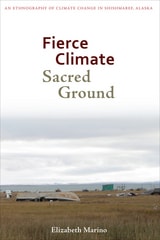
An Ethnography of Climate Change in Shishmaref, AlaskaElizabeth Marino
University of Alaska Press, 2015
Publications from the New York Times to Esquire have covered this disappearing village, yet few have taken the time to truly show the community and the two millennia of traditions at risk. In Fierce Climate, Sacred Ground, Elizabeth Marino brings Shishmaref into sharp focus as a place where people in a close-knit, determined community are confronting the realities of our changing planet every day. She shows how physical dangers challenge lives, while the stress and uncertainty challenge culture and identity. Marino also draws on Shishmaref’s experiences to show how disasters and the outcomes of climate change often fall heaviest on those already burdened with other social risks and often to communities who have contributed least to the problem. Stirring and sobering, Fierce Climate, Sacred Ground proves that the consequences of unchecked climate change are anything but theoretical.
Fifty Years Below Zero
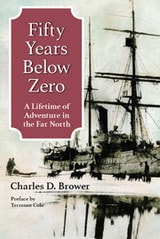
A Lifetime of Adventure in the Far NorthCharles Brower
University of Alaska Press, 1994

Fighter in Velvet Gloves
Alaska Civil Rights Hero Elizabeth PeratrovichAnnie Boochever with Roy Peratrovich Jr.
University of Alaska Press, 2019
In 1945, Peratrovich stood before the Alaska Territorial Legislative Session and gave a powerful speech about her childhood and her experiences being treated as a second-class citizen. Her heartfelt testimony led to the passing of the landmark Alaska Anti-Discrimination Act, America’s first civil rights legislation. Today, Alaska celebrates Elizabeth Peratrovich Day every February 16, and she was honored on the gold one-dollar coin in 2020.
Annie Boochever worked with Elizabeth’s eldest son, Roy Peratrovich Jr., to bring Elizabeth’s story to life in the first book written for young teens on this remarkable Alaska Native woman.

Fighter in Velvet Gloves
Study GuideAnnie Boochever
University of Alaska Press, 2021
Annie Boochever worked with Elizabeth’s eldest son, Roy Peratrovich Jr., to bring Elizabeth’s story to life in the first book written for young teens on this remarkable Alaska Native woman. Written about an Alaska Native civil rights leader, Fighter in Velvet Gloves has been incorporated in school curricula around the country, and won the 2019 Lumen Award for Literary Excellence, in addition to receiving many other national recognitions. This study guide is a custom work designed to help instructors teach the story of Elizabeth Peratrovich to students in grades 6 through 12.
Fighting for the Forty-Ninth Star
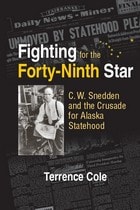
C. W. Snedden and the Crusade for Alaska StatehoodTerrence Cole
University of Alaska Press, 2010
C.W. "Bill" Snedden, the publisher of America's farthest north daily newspaper, the Fairbanks Daily News-Miner, helped lead the battle of the Far North against the Deep South. Working behind the scenes with his protege, a young attorney named Ted Stevens, and a fellow Republican newspaperman, Secretary of Interior Fred Seaton, Snedden's "magnificent obsession" would open the door to development of the oil fields at Prudhoe Bay, inspire establishment of the Arctic Wildlife Range (now the Arctic National Wildlife Refuge), and add the forty-ninth star to the flag.
Fighting for the Forty-Ninth Star is the story of how the publisher of a little newspaper four thousand miles from Washington, D.C., helped convince Congress that Alaskans should be second-class citizens no more.
Finding Mars
Ned Rozell
University of Alaska Press, 2011
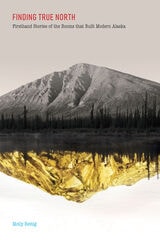
Finding True North
First-Hand Stories of the Booms that Built Modern AlaskaMolly Rettig
University of Alaska Press, 2021
Melting sea ice and rumbling volcanoes. Sled dogs racing through unnamed valleys.
These were the images that came to mind when Molly Rettig moved to Fairbanks, Alaska to work as a reporter at the local newspaper. An avid environmentalist, she couldn’t wait to explore the vast, untamed spaces that had largely been paved over on the east coast. But when her 72-year-old neighbor, Clutch, invites her on a tour of his gold mine—an 800-foot tunnel blasted into the side of his house–she begins to question many of her ideas about Alaska, and about herself.
In Finding True North, Rettig takes us on a gripping journey through Alaska's past that brings alive the state's magnificent country and its quirky, larger-than-life characters. She meets a trapper who harvests all she needs from the land, a bush pilot who taught himself how to fly, and an archaeologist who helped build an oil pipeline through pristine wilderness. While she learns how airplanes, mines, and oil fields have paved the way for newcomers like herself, she also stumbles upon a bigger question: what has this quest for Alaska’s natural resources actually cost, and how much more is at stake?
This is a book about all the ways wild places teach us about ourselves. Rettig writes both playfully and honestly about how one place can be many things to many people—and how all of it can be true.
Finding the Arctic
History and Culture Along a 2,500-Mile Snowmobile Journey from Alaska to Hudson’s BayMatthew Sturm
University of Alaska Press, 2012
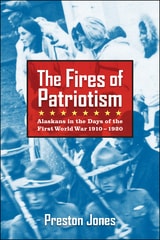
Fires of Patriotism
Alaskans in the Days of the First World War 1910-1920Preston Jones
University of Alaska Press, 2013
The Fires of Patriotism explores Alaska’s wartime experience, bringing to light new stories and new characters from a decade that shook the world. This multifaceted book explores the era through engaging stories and rare photos, offering a fresh perspective on World War I from a marginal land that forged its place in the greater unity of the country.
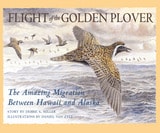
Flight of the Golden Plover
The Amazing Migration Between Hawaii and AlaskaDebbie S. Miller
University of Alaska Press, 2011
The remarkable story of the golden plover’s annual migration, this beautifully illustrated nature title for young readers sees the small but mighty plover embark on a six-thousand-mile flight between the frozen Alaska tundra and gentle grassy slopes of the Hawaiian Islands. Equally at home in his two very different habitats, the once-endangered golden plover has evolved many behaviors and adaptations that make it perfectly well-suited to each of its homes, and this book contains many fascinating facts about them. Readers are also introduced to the plover’s neighbors and friends—from the giant Hawaiian goose, or nene, to the musk ox, grizzly bear, arctic fox, and sandhill crane.

Frigid Embrace
Politics, Economics, and Environment in AlaskaStephen Haycox
Oregon State University Press, 2002
Frontier Romance
Environment, Culture, and Alaska IdentityJudith Kleinfeld
University of Alaska Press, 2012
Frontier in Alaska and the Matanuska Colony
Orlando W. Miller
University of Alaska Press, 2008
During the Great Depression, Franklin D. Roosevelt gave more than two hundred families from some of the poorest areas in Minnesota, Wisconsin, and Michigan the opportunity to start their farms anew in the undeveloped land of Matanuska in Alaska. These transplanted midwesterners soon found themselves in a startling new climate and landscape that presented many unexpected challenges. Available for the first time in paperback, The Frontier in Alaska and the Matanuska Colony examines several case studies of these original families, dispelling many frontier myths and describing the reality of pioneering in Alaska. Despite the many impediments, Orlando W. Miller argues, much of the current agricultural success in Matanuska can be directly credited to the innovative farmers who settled there in the 1930s.
Frozen Fauna of the Mammoth Steppe
The Story of Blue BabeR. Dale Guthrie
University of Chicago Press, 1990
The 36,000-year-old bison mummy, coated with blue mineral crystals, was dubbed "Blue Babe." Guthrie conveys the excitement of its excavation and shows how he made use of evidence from living animals, other Pleistocene mummies, Paleolithic art, and geological data. With photographs and scores of detailed drawings, he takes the reader through the excavation and subsequent detective work, analyzing the animal's carcass and its surroundings, the circumstances of its death, its appearance in life, the landscape it inhabited, and the processes of preservation by freezing. His examination shows that Blue Babe died in early winter, falling prey to lions that inhabited the Arctic during the Pleistocene era.
Guthrie uses information gleaned from his study of Blue Babe to provide a broad picture of bison evolutionary history and ecology, including speculations on the interactions of bison and Ice Age peoples. His description of the Mammoth Steppe as a cold, dry, grassy plain is based on an entirely new way of reading the fossil record.
Fur Farms of Alaska
Two Centuries of History and a Forgotten StampedeSarah Crawford Isto
University of Alaska Press, 2012