Results by title
9 books match the query 'Perfection'
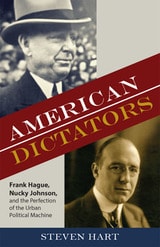
American Dictators
Frank Hague, Nucky Johnson, and the Perfection of the Urban Political MachineHart, Steven
Rutgers University Press, 2013
One man was tongue-tied and awkward around women, in many ways a mama's boy at heart, although his reputation for thuggery was well earned. The other was a playboy, full of easy charm and ready jokes, his appetite for high living a matter of public record. One man tolerated gangsters and bootleggers as long as they paid their dues to his organization. The other was effectively a gangster himself, so crooked that he hosted a national gathering of America's most ruthless killers. One man never drank alcohol. The other, from all evidence, seldom drank anything else.
American Dictators is the dual biography of two of America’s greatest political bosses: Frank Hagueand Enoch “Nucky” Johnson. Packed with compelling information and written in an informal, sometimes humorous style, the book shows Hague and Johnson at the peak of their power and the strength of their political machines during the years of Prohibition and the Great Depression. Steven Hart compares how both men used their influence to benefit and punish the local citizenry, amass huge personal fortunes, and sometimes collaborate to trounce their enemies.
Similar in their ruthlessness, both men were very different in appearance and temperament. Hague, the mayor of Jersey City, intimidated presidents and wielded unchallenged power for three decades. He never drank and was happily married to his wife for decades. He also allowed gangsters to run bootlegging and illegal gambling operations as long as they paid protection money. Johnson, the political boss of Atlantic City, and the inspiration for the hit HBO series Boardwalk Empire, presided over corruption as well, but for a shorter period of time. He was notorious for his decadent lifestyle. Essentially a gangster himself, Johnson hosted the infamous Atlantic City conference that fostered the growth of organized crime.
Both Hague and Johnson shrewdly integrated otherwise disenfranchised groups into their machines and gave them a stake in political power. Yet each failed to adapt to changing demographics and circumstances. In American Dictators, Hart paints a balanced portrait of their accomplishments and their failures.
Conditions Handsome and Unhandsome
The Constitution of Emersonian Perfectionism: The Carus Lectures, 1988Stanley Cavell
University of Chicago Press, 1991
"Cavell's 'readings' of Wittgenstein and Heidegger and Emerson and other thinkers surely deepen our understanding of them, but they do much more: they offer a vision of what life can be and what culture can mean. . . . These profound lectures are a wonderful place to make [Cavell's] acquaintance."—Hilary Putnam
Growing into God
The Fathers of the Church on Christian MaturityJohn Gavin
Catholic University of America Press, 2025

Perfection in Bad Axe
StoriesStories by Craig Bernthal
University of Missouri Press, 2003
You could find out anything at Jim's, and Larry and I liked to be in the know. Information (not gossip) was passed back and forth constantly. Did you hear about the four couples engaged in "wife- swapping" in town? The mechanics and gas pumpers at Jim's could fill you in. Were you interested in the last time the Baptist minister beat his wife? Who your cute French teacher slept with a couple nights ago? Jim's had the answers. The place held another attraction for me: if you were under twenty-one and wanting some liquor for Friday night, Jim's son, Jimmy the Bomb, just out of the Marine Corps, had no problem picking up a bottle or two for you at the liquor store on the east side of town.
Set mainly in the Midwest, these tales are inhabited by ordinary, decent people who, often to their surprise, find joy and meaning under difficult circumstances. Many of the stories depict isolated moments of perfection in a world that routinely forces its imperfections on us. A teenager wrestles with guilt over an accident he caused in “Perfection in Bad Axe.” In “A Knight Pursued,” a young prosecuting attorney confronts on the same day his first autopsy and his wife’s unexpected desire to have a baby. A devout, hardworking business owner is drawn into a lawsuit that threatens his marriage and leads him to question his most deeply felt principles. “Center of Gravity” finds a middle-aged law professor overcome by his chaotic life and searching for a degree of peace. These are the finely developed characters of Bernthal’s stories—people we recognize, but who never seem overly familiar. Interesting, substantial, and utterly engrossing, each one could be just like any one of us, an ordinary Jane or Joe, trying to maintain or find order in a life sometimes filled with disorder.
Perfection in Death
Patrick M. Clark
Catholic University of America Press, 2015

Robert de Cotte and the Perfection of Architecture in Eighteenth-Century France
Robert Neuman
University of Chicago Press, 1994
After describing de Cotte's training and the professional context in which he worked, Neuman offers a thorough survey of de Cotte's output. For each commission, he recreates the actual design process, showing how de Cotte manipulated an accepted vocabulary of architectural forms to meet the patron's specific requirements. De Cotte's own drawings, many reproduced here for the first time, and quotations from a wide variety of contemporary writings vividly supplement the case histories. Beautifully illustrated, Neuman's much-needed book reveals de Cotte as an innovative and strikingly modern architect.
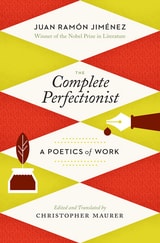
The Complete Perfectionist
A Poetics of WorkJuan Ramón Jiménez
Swan Isle Press, 2011
Few have written more memorably about the work of poetry and the poetics of work than Juan Ramón Jiménez, winner of a Nobel Prize and discerning teacher of an entire generation of Spanish poets. In this series of aphorisms, Jiménez brings together the elements of perfect work, both in writing and in other realms. Among these elements—the wellsprings of any kind of creation—are instinct and inspiration, memory and forgetting, silence and noise, love and regret.
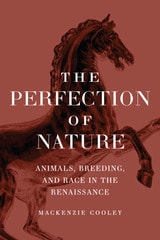
The Perfection of Nature
Animals, Breeding, and Race in the RenaissanceMackenzie Cooley
University of Chicago Press, 2022
The Renaissance is celebrated for the belief that individuals could fashion themselves to greatness, but there is a dark undercurrent to this fêted era of history. The same men and women who offered profound advancements in European understanding of the human condition—and laid the foundations of the Scientific Revolution—were also obsessed with controlling that condition and the wider natural world.
Tracing early modern artisanal practice, Mackenzie Cooley shows how the idea of race and theories of inheritance developed through animal breeding in the shadow of the Spanish Empire. While one strand of the Renaissance celebrated a liberal view of human potential, another limited it by biology, reducing man to beast and prince to stud. “Race,” Cooley explains, first referred to animal stock honed through breeding. To those who invented the concept, race was not inflexible, but the fragile result of reproductive work. As the Spanish empire expanded, the concept of race moved from nonhuman to human animals. Cooley reveals how, as the dangerous idea of controlled reproduction was brought to life again and again, a rich, complex, and ever-shifting language of race and breeding was born.
Adding nuance and historical context to discussions of race and human and animal relations, The Perfection of Nature provides a close reading of undertheorized notions of generation and its discontents in the more-than-human world.
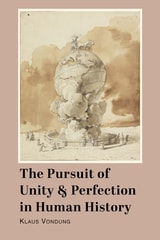
The Pursuit of Unity and Perfection in History
Klaus Vondung
St. Augustine's Press, 2020
Particular focus in following the thread of unity and perfection in human intellectual and practical ambitions ultimately hones in on the combination of religion and politics. Vondung in these essays unpacks the ways in which this continues to fascinate and disturb us, and in his expertise he uses National Socialism to connect this pursuit of unity and perfection to what he calls one of the signature marks of modernity––namely, secular apocalypticism. This claim stands in opposition to Eric Voegelin’s remark that Gnosticism, rather, is “the nature of modernity.” Vondung, who studied and wrote his dissertation under Voegelin, grapples with the contrast of these positions. Vondung is willing to challenge Voegelin, but ultimately his treatment of the latter bears the quality of tribute to this great scholar.
Vondung also explores the points of contact between apocalypticism and Hermetic speculation. Despite the independence of the religious and philosophical doctrines of Hermeticism, there are parallels to be found. Apocalypticism and Hermeticism originated in antiquity and yet each represents a tradition that still holds footing today. Vondung furthermore leads the reader to see the project of salvation found in both even as each operates with a different scope.
This collection of essays centers itself on a perspective of the human pursuit of unity and perfection, directly or indirectly, as objectives of intellectual endeavors, existential ideals, as social or political outcomes, and in the case of National Socialism even as perverse aberrations that led to the Holocaust. Vondung’s particular treatment of Voegelin’s work likewise establishes what the former identifies as a stand-out question of this study: Does the search for order in history show us the unity of the history of humankind?