Results by title
3576 books match the query 'American' and 135 start with f
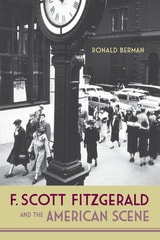
F. Scott Fitzgerald and the American Scene
Ronald Berman
University of Alabama Press, 2017
A study of the philosophical, intellectual, and political influences on the artistic creations of Fitzgerald and key early American modernist writers
F. Scott Fitzgerald and the American Scene continues Ronald Berman’s lifelong study of the philosophical, intellectual, and political influences on the artistic creations of key early American modernist writers. Each chapter in this volume elaborates on a crucial aspect of F. Scott Fitzgerald’s depiction of American society, specifically through the lens of the social sciences that most influenced his writing and thinking.
Berman addresses, among other subjects, Fitzgerald’s use of philosophy, cultural analyses, and sociology—all enriched by the insights of his own experience living an American life. He was especially interested in how life had changed from 1910 to 1920. Many Americans were unable to navigate between the 1920s and their own memories of a very different world before the Great War; especially Daisy Buchanan who evolves from girlhood (as typified in sentimental novels of the time) to wifehood (as actually experienced in the new decade). There is a profound similarity between what happens to Fitzgerald’s characters and what happened to the nation.
Berman revisits classics like The Great Gatsby but also looks carefully at Fitzgerald’s shorter fictions, analyzing a stimulating spectrum of scholars from more contemporary critics like Thomas Piketty to George Santayana, John Maynard Keynes, John Dewey, and Walter Lippmann. This fascinating addition to F. Scott Fitzgerald scholarship, although broad in its content, is accessible to a wide audience. Scholars and students of Fitzgerald and twentieth-century American literature, as well as dedicated Fitzgerald readers, will enjoy Berman’s take on a long-debated and celebrated author.
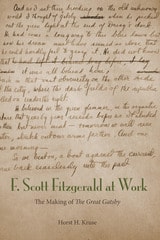
F. Scott Fitzgerald at Work
The Making of "The Great Gatsby"Horst H. Kruse
University of Alabama Press, 2014
The essays in F. Scott Fitzgerald at Work examine fresh facts that illuminate the experiences and source materials upon which Fitzgerald based this quintessentially American masterpiece. They confirm author Horst Kruse’s view that Fitzgerald’s flights of fancy, even at their most spectacular, are firmly grounded in biographical experience as well as in the social, literary, and philosophical circumstances of his era.
In the first essay, Kruse reconstructs the life story of the individual who allegedly inspired the character of Jay Gatsby: Max von Gerlach. Kruse recounts his journeys to various archives and libraries in the United States as well as in Germany to unearth new facts about the genesis of the Gatsby characters. In another journey, readers travel with Kruse to Long Island to explore its physical and moral geography in relation to Fitzgerald, specifically the role of certain elite Long Island families in the advancement of the “science of eugenics” movement. The final two essays take Kruse across the globe to various destinations to consider the broader place of The Great Gatsby in American and international intellectual history.
Replete with fascinating discoveries and insights, F. Scott Fitzgerald at Work both corrects previous assumptions about The Great Gatsby and deepens our appreciation and understanding of Fitzgerald‘s imagination.
F. Scott Fitzgerald in the Twenty-First Century
Jackson R. Bryer
University of Alabama Press, 2003
This thought-provoking collection explores significant new facets of an American author of lasting international stature.
“Edited by three eminent Fitzgerald scholars, this fine book comprises nineteen incisive and provocative essays (most written for this collection) by . . . well-known Fitzgerald critics. The content is as varied as the international origins of its authors.” —Choice
As the author of some of the most compelling short stories ever written, two of the central novels in American literature, and some of the most beautiful prose ever penned, F. Scott Fitzgerald is read and studied all over the world. Sixty-two years after his death, his works—protean, provocative, multilayered, and rich—continue to elicit spirited responses. This collection grew out of the F. Scott Fitzgerald Conference that convened in Princeton at the centennial of this author's birth. Bringing together dozens of the world's leading scholars and commentators, the conference and the book celebrate the ever-growing legacy of Fitzgerald's art.
The subjects of these 19 essays reflect the contributors' wish to shine new light on less-frequently discussed aspects of Fitzgerald's work. Topics include Fitzgerald's Princeton influences and his expression of Catholic romanticism; his treatments of youth culture, the devil, and waste; parallels in the work of Mencken, Cather, and Murakami; and the ways gender, pastoral mode, humor, and the Civil War are variously presented in his work. One illustrated summary examines Fitzgerald's effect on popular culture through his appearance in the comics. Two broad overviews—one on Fitzgerald's career and another on the final developments in the author's style—round out the collection.
The international scope of the contributors to this volume reflects Fitzgerald's worldwide reputation and appeal. With extensive treatments of This Side of Paradise, The Beautiful and Damned, The Last Tycoon, and the Pat Hobby stories, this collection makes an unusual and significant contribution to the field of Fitzgerald studies.
FEMALE TRADITION IN SOUTHERN LITERATURE
Carol S. Manning
University of Illinois Press, 1993
essays reclaim women's traditions which have been neglected by critics who ought to have known
better." -- Kathryn Lee Seidel, author of The Southern Belle in the American Novel
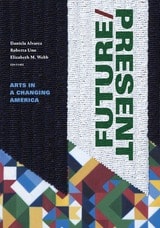
FUTURE/PRESENT
Arts in a Changing AmericaDaniela Alvarez, Roberta Uno, and Elizabeth M. Webb, editors
Duke University Press, 2024
Selected contributors. Dahlak Brathwaite, adrienne maree brown, Jeff Chang, Tameca Cole, Ofelia Esparza, Antoine Hunter, Nobuko Miyamoto, Wendy Red Star, Spel, Jose Antonio Vargas, Carrie Mae Weems, Hinaleimoana Kwai Kong Wong-Kalu
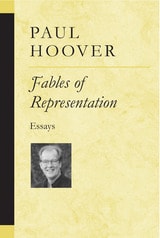
Fables of Representation
EssaysPaul Hoover
University of Michigan Press, 2004
With its title essay, "Fables of Representation," one of the most cogent studies ever written of the New York School of poets (a group that includes the influential poet John Ashbery), this book is required reading for anyone who seeks to understand the poetry and culture of the postmodern period.
Author Paul Hoover's wide-ranging subjects include African-American interdisciplinary studies; the position of poetry in the electronic age; the notion of doubleness in the work of Harryette Mullen and others; the lyricism of the New York School poets; and the role of reality in American poetry. Hoover also introduces two provocative essays sure to generate attention and discussion: "The Postmodern Era: A Final Exam" and "The New Millennium: Fifty Statements on Literature and Culture."
Paul Hoover is the editor of the anthology Postmodern American Poetry and author of nine poetry collections, including Totem and Shadow: New and Selected Poems and Viridian. His poetry has appeared in American Poetry Review, The New Republic, and The Paris Review, among others. He is Poet-in-Residence at Columbia College, Chicago.
Fabulae
Joy Katz
Southern Illinois University Press, 2002
In Fabulae, Joy Katz interrogates the physical world, constructing a sensual and striking autobiography. She turns to the familiarity and strangeness of the female body, its surfaces and inner workings, often, although her subjects range from Thomas Jefferson to an Adam and Eve plagued with obsessive-compulsive disorder to the streets of New York’s diamond district. The poems, by turns funny and philosophical, point to how we suffer from desire: the danger, she writes, is that we might love the world “like heaven and be lost.” But they come back to delight in a flawed world especially the palpable beauty of words, and even the erotic shapes of the letterforms that make them up.
Facing It
AIDS Diaries and the Death of the AuthorRoss Chambers
University of Michigan Press, 2001
"Groundbreaking in its approach and potentially wide in its appeal. . . . The rigor of the ideas, their dramatic nature, and the political drive of the rhetoric all should win Facing It a large readership that could extend far beyond students of narrative or queer theory." --David Bergman, Towson University, editor of Camp Grounds: Style and Homosexuality
Ross Chambers is Distinguished University Professor of French and Comparative Literature, University of Michigan, and author of Room for Maneuver: Reading (the) Oppositional (in) Narrative and Story and Situation: Narrative Seduction and the Power of Fiction.

Facing It
AIDS Diaries and the Death of the AuthorRoss Chambers
University of Michigan Press, 1999
"Groundbreaking in its approach and potentially wide in its appeal. . . . The rigor of the ideas, their dramatic nature, and the political drive of the rhetoric all should win Facing It a large readership that could extend far beyond students of narrative or queer theory." --David Bergman, Towson University, editor of Camp Grounds: Style and Homosexuality
Ross Chambers is Distinguished University Professor of French and Comparative Literature, University of Michigan, and author of Room for Maneuver: Reading (the) Oppositional (in) Narrative and Story and Situation: Narrative Seduction and the Power of Fiction.
Facing Texts
Encounters Between Contemporary Writers and CriticsHeide Ziegler, ed.
Duke University Press, 1988
Faint Praise
The Plight of Book Reviewing in AmericaGail Pool
University of Missouri Press, 2007
For more than two hundred years, book reviewers have influenced American readers, setting our literary agenda by helping us determine not only what we read but also what we think about what we read. And for nearly as long, critics of these critics have lambasted book reviews for their overpraise, hostility, banality, and bias.
Faint Praise takes a hard and long-overdue look at the institution of book reviewing. Gail Pool, herself an accomplished reviewer and review editor, analyzes the inner workings of this troubled trade to show how it works—and why it so often fails to work well. She reveals why bad reviewing happens despite good intentions and how it is that so many intelligent people who love books can say so many unintelligent things on their behalf.
Reviewers have the power to award prestige to authors, give prominence to topics, and shape opinion and taste; yet most readers have little knowledge of why certain books are selected for review, why certain reviewers are selected to review them, and why they so often praise books that aren’t all that good. Pool takes readers behind the scenes to describe how editors choose books for review and assign them to reviewers, and she examines the additional roles played by publishers, authors, and readers. In describing the context of reviewing, she reveals a culture with little interest in literature, much antipathy to criticism, and a decided weakness for praise. In dissecting the language of reviews, Pool demonstrates how it often boils down to unbelievable hype.
Pool explores the multifaceted world of book reviewing today, contrasting traditional methods of reviewing with alternative book coverage, from Amazon.com to Oprah, and suggesting how the more established practices could be revised. She also explores the divide between service journalism practiced by reviewers versus the alleged high art served up by literary critics—and what this fuzzy boundary between reviewing and criticism really means.
This is the first book to analyze the field in depth, weighing the inherent difficulties of reviewing against the unacceptable practices that undermine the very reasons we read—and need—reviews. Faint Praise is a book not just for those who create and review books but also for everyone who loves books. By demystifying this hidden process, Pool helps everyone understand how to read reviews—and better decide what to read.
Fair Copy
Rebecca Hazelton
The Ohio State University Press, 2012
Faith in the Furnace of Doubt
Dana Gioia's Poetics of BeliefJoshua Hren
Catholic University of America Press, 2025
Faithful Passages
American Catholicism in Literary Culture, 1844–1931James Emmett Ryan
University of Wisconsin Press, 2013
Faithful Passages also reveals new dimensions in American religious literary culture by moving beyond the antebellum period to consider how the first important cohort of Catholic writers shaped their message for subsequent generations of readers in the late nineteenth and early twentieth centuries. Perhaps most strikingly, Ryan shows that by the early twentieth century, Roman Catholic themes and traditions in American literature would be advanced in complex ways by mainstream, non-Catholic modernist writers like Kate Chopin and Willa Cather.
Catholic literary culture in the United States took shape in a myriad of ways and at the hands of diverse participants. The process by which Roman Catholic ideas, themes, and moralities were shared and adapted by writers with highly differentiated beliefs, Ryan contends, illuminates a surprising fluidity of religious commitment and expression in early U.S. literary culture.
Falling Brick Kills Local Man
Mark Kraushaar
University of Wisconsin Press, 2009
False Starts
The Rhetoric of Failure and the Making of American ModernismDavid M. Ball
Northwestern University Press, 2014

Fanny Fern
An Independent WomanWarren, Joyce W
Rutgers University Press, 1992
Fantasia for the Man in Blue
Tommye Blount
Four Way Books, 2020
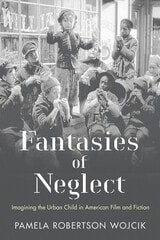
Fantasies of Neglect
Imagining the Urban Child in American Film and FictionPamela Robertson Wojcik
Rutgers University Press, 2016

Far East, Down South
Asians in the American SouthEdited by Raymond A. Mohl, John E. Van Sant, and Chizuru Saeki
University of Alabama Press, 2016
Uncovering the overlooked histories of Asians in the American South.
In sharp contrast to the “melting pot” reputation of the United States, the American South—with its history of slavery, Jim Crow, and the civil rights movement—has been perceived in stark and simplistic demographic terms. In Far East, Down South, editors Raymond A. Mohl, John E. Van Sant, and Chizuru Saeki provide a collection of essential essays that restores and explores an overlooked part of the South’s story—that of Asian immigration to the region.
These essays form a comprehensive overview of key episodes and issues in the history of Asian immigrants to the South. During Reconstruction, southern entrepreneurs experimented with the replacement of slave labor with Chinese workers. As in the West, Chinese laborers played a role in the development of railroads. Japanese farmers also played a more widespread role than is usually believed. Filipino sailors recruited by the US Navy in the early decades of the twentieth century often settled with their families in the vicinity of naval ports such as Corpus Christi, Biloxi, and Pensacola. Internment camps brought Japanese Americans to Arkansas. Marriages between American servicemen and Japanese, Korean, Filipina, Vietnamese, and nationals in other theaters of war created many thousands of blended families in the South. In recent decades, the South is the destination of internal immigration as Asian Americans spread out from immigrant enclaves in West Coast and Northeast urban areas.
Taken together, the book’s essays document numerous fascinating themes: the historic presence of Asians in the South dating back to the mid-nineteenth century; the sources of numerous waves of contemporary Asian immigration to the South; and the steady spread of Asians out from the coastal port cities. Far East, Down South adds a vital new dimension to popular understanding of southern history.
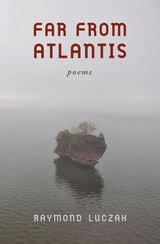
Far from Atlantis
PoemsRaymond Luczak
Gallaudet University Press, 2023
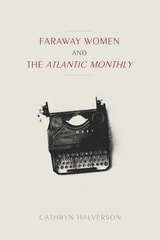
Faraway Women and the "Atlantic Monthly"
Cathryn Halverson
University of Massachusetts Press, 2019
Winner of the 2020 Thomas J. Lyon Award from the Western Literature Association
In the first decades of the twentieth century, famed Atlantic Monthly editor Ellery Sedgwick chose to publish a group of nontraditional writers he later referred to as “Faraway Women,” working-class authors living in the western United States far from his base in Boston. Cathryn Halverson surveys these enormously popular Atlantic contributors, among them a young woman raised in Oregon lumber camps, homesteaders in Wyoming, Idaho, and Alberta, and a world traveler who called Los Angeles and Honolulu home.
Faraway Women and the “Atlantic Monthly” examines gender and power as it charts an archival journey connecting the least remembered writers and readers of the time with one of its most renowned literary figures, Gertrude Stein. It shows how distant friends, patrons, publishers, and readers inspired, fostered, and consumed the innovative life narratives of these unlikely authors, and it also tracks their own strategies for seizing creative outlets and forging new protocols of public expression. Troubling binary categories of east and west, national and regional, and cosmopolitan and local, the book recasts the coordinates of early twentieth-century American literature.
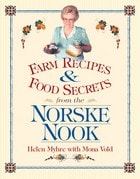
Farm Recipes and Food Secrets from the Norske Nook
Helen Myhre and Mona Vold
University of Wisconsin Press, 2001
When a small-town cafe in Osseo, Wisconsin, was praised for "some of the world’s best pies" in the best-selling guidebook Roadfood, Helen Myhre and the Norske Nook became famous! The same home-cooking tips Helen shared on "Late Night with David Letterman" she now shares with you. From breads to gravies, meats to jellies, and of course, that celebrated sour cream raisin pie, Myhre shows you how to bring a rich, thick slice of Midwest cooking into your kitchen.
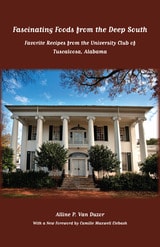
Fascinating Foods from the Deep South
Favorite Recipes from the University Club of Tuscaloosa, AlabamaAlline P. Van Duzor
University of Alabama Press, 2010
250 Recipes from the University of Alabama’s famed University Club in Tuscaloosa
The historic mansion at the corner of University Boulevard and Queen City Avenue in Tuscaloosa, Alabama has been home to the University of Alabama University Club since 1944. In its early years, the Club took shape around the vision and culinary expertise of the formidable Atlantan Alline P. Van Duzor, still remembered in Tuscaloosa for her impeccable and exacting standards. This book reveals her most beloved recipes.
Commissioned in the early 1960s by a New York publisher, this collection of her gastronomic creations sold through more than eight printings, further spreading her reputation.
The more than 250 favorite Southern recipes in this now-classic cookbook are written in Van Duzor’s straight-forward style, using common fresh and store-bought ingredients. This new edition has been augmented by a guide to portions and food brand names, an index to the recipes, and an appendix of past presidents of the University Club Board.
Cookbook collectors, local history buffs, the university community, and happy cooks everywhere will welcome this reissue of a popular cookbook that has won decades of fans.
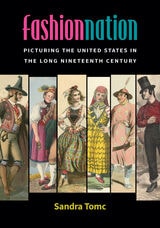
Fashion Nation
Picturing the United States in the Long Nineteenth CenturySandra Tomc
University of Michigan Press, 2021
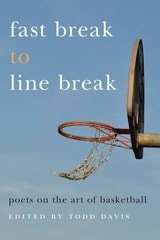
Fast Break to Line Break
Poets on the Art of BasketballTodd Davis
Michigan State University Press, 2012
If baseball is the sport of nostalgic prose, basketball’s movement, myths, and culture are truly at home in verse. In this extraordinary collection of essays, poets meditate on what basketball means to them: how it has changed their perspective on the craft of poetry; how it informs their sense of language, the body, and human connectedness; how their love of the sport made a difference in the creation of their poems and in the lives they live beyond the margins. Walt Whitman saw the origins of poetry as communal, oral myth making. The same could be said of basketball, which is the beating heart of so many neighborhoods and communities in this country and around the world. On the court and on the page, this “poetry in motion” can be a force of change and inspiration, leaving devoted fans wonderstruck.
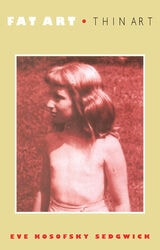
Fat Art, Thin Art
Eve Kosofsky Sedgwick
Duke University Press, 1994
Embodying a decades-long adventure, the poems collected here offer the most accessible and definitive formulations to appear anywhere in Sedgwick’s writing on some characteristic subjects and some new ones: passionate attachments within and across genders; queer childhoods of many kinds; the performativity of a long, unconventional marriage; depressiveness, hilarity, and bliss; grave illness; despised and magnetic bodies and bodily parts. In two long fictional poems, a rich narrative momentum engages readers in the mysterious places—including Victorian novels—where characters, sexualities, and fates are unmade and made. Sedgwick’s poetry opens an unfamiliar, intimate, daring space that steadily refigures not only what a critic may be, but what a poem can do.
Fate News
Norma Cole
Omnidawn, 2018
Fathering the Map
New and Selected Later PoemsRobert Pack
University of Chicago Press, 1993
A selection from his last five books, along with a collection of new poems, Fathering the Map takes us from the personal reflections distilled in the lyrics of Waking to My Name (1980) to the worldly reckonings of Inheritance (1992) and back again. In the dramatic monologues of Faces in a Single Tree (1984), in the narrative of a wayward life from womb to double ending in Clayfield Rejoices, Clayfield Laments (1987), in a cosmic tour conducted by the physicist Heinz Pagels with Before It Vanishes (1990), Pack has fashioned poems of intimate experience, scientific meditations, philosophical wonder, poems that breathe the knowledge of man and woman, young and old, artist and human animal.
Pack's work has won the acclaim of writers, critics, and readers from Robert Penn Warren to Cynthia Ozick to Stephen Jay Gould, who comments that the "precious contacts of science and poetry are now sadly rare, but Bob Pack revitalizes the ancient union with incisive poems that sing with lyricism or bite with insight—but always seem to add wisdom to the scientist's epigram."
"The poet improves his style and spirit as he extends his reach," Howard Nemerov has written, and in his new work Pack reaches back to some of his earliest memories, and so forward to a personal mythology that circles from the primal instant to the present ecological crisis. "Robert Pack's poetry is deeply rooted in his won family life," Richard Wilbur has remarked, "and yet his imagination has always included us all."
And Cynthia Ozick has said of Pack's poetry: "We rejoice as we read."

Faulkner and Hemingway
Biography of a Literary RivalryJoseph Fruscione
The Ohio State University Press, 2012
Faulkner the Storyteller
Blair Labatt
University of Alabama Press, 2006
A study exploring the role of event and plot in William Faulkner’s fiction.
Faulkner the Storyteller addresses the role of event and plot in Faulkner's fiction and the creation of an implied teller behind the tale. Novels like The Sound and the Fury and Absalom, Absalom! are often thought of as canonical modernist texts antagonistic to traditional notions of plot and storytelling. Blair Labatt, however, argues that Faulkner's fiction, regardless of its modernist gestures, is filled and driven by sophisticated manifestations of plot—willed challenges, structural targets, gambits, designs, engagements, and battles—a language of competition and conflict and a syntax of events.
Labatt examines Faulkner's short stories, such as "Mountain Victory," "That Evening Sun," and "Barn Burning," and the architecture of the Snopes Trilogy (The Hamlet, The Town, and The Mansion), and finds that Faulkner's deployment of cause and effect is central to his narratives. Labatt also explores how Faulkner's use of plot creates an implied voice that lends a humorous element to his story's twists and turns that often brackets and encloses the pathos of his characters.

Faulkner's Narrative Poetics
Style as VisionArthur F. Kinney
University of Massachusetts Press, 1978
Faulkner's Revision of Absalom, Absalom!
A Collation of the Manuscript and the Published BookBy Gerald Langford
University of Texas Press, 1971
Faulkner’s Revision of Absalom, Absalom! is a study of the creative process as exemplified in one of the major achievements in twentieth-century fiction. Portions of the original handwritten version of the story are collated, line by line, with corresponding sections of the published version. In an introductory discussion the major changes are analyzed and evaluated.
It is particularly interesting to observe Faulkner revising not only his choice of words and the construction of his sentences but also the central design of the story. Most notably, he changed his mind about having it known from the beginning that Charles Bon was Sutpen’s part-Negro son, and he developed Quentin Compson into the pivotal figure who finally supplies this missing piece of information.
In the process of revision Absalom, Absalom! became a kind of detective story, and the reader is forced to join the quest and participate in the undertaking which is the basic subject of the book—the human attempt to comprehend and deal with the past.
To trace the process of this revision is to experience a sharp focusing of theme and to witness a demonstration of how the meaning of a fictional work can shape its structure and, in turn, stand revealed by what has become the outward sign, or form, of that meaning.
Faulkner's Revision of Sanctuary
A Collation of the Unrevised Galleys and the Published BookBy Gerald Langford
University of Texas Press, 1972
Was Sanctuary really a “cheap idea,” as Faulkner himself called it, a book “deliberately conceived to make money”? The question has teased the reading public since its publication. Many readers have had their worst suspicions about Faulkner’s work confirmed by his statement, but most serious critics have discounted the disparagement, emphasizing instead Faulkner’s further statement that when the galley proofs arrived from his publisher, “I saw that it was so terrible that there were two things to do: tear it up or rewrite it. I thought again, ‘It might sell; maybe 10,000 of them will buy it.’ So I tore the galleys down and rewrote the book.”
Now that two sets of the original galleys are available for inspection, one can see just how Faulkner reworked the novel. In the collation provided here by Gerald Langford, using Faulkner’s own corrected galleys held by the University of Texas at Austin, the reader can reconstruct the first version for himself, noting the cancellations, the additions, and the rewritten passages. As Gerald Langford makes clear in his introductory analysis, neither of Faulkner’s statements is to be trusted. Through revision, Sanctuary became theatrically more effective but thematically less interesting than the original version. Particularly noteworthy is the experimental narrative method of the original version, which foreshadows the method of Absalom, Absalom! as opposed to the straightforward, easily accessible method to which Faulkner turned in the revised Sanctuary and Light in August.
Faulkner’s Marginal Couple
Invisible, Outlaw, and Unspeakable CommunitiesBy John N. Duvall
University of Texas Press, 1990
Is William Faulkner’s fiction built on a fundamental dichotomy of outcast individual versus the healthy agrarian community? The New Critics of the 1930s advanced this view, and it has shaped much Faulkner criticism. However, in Faulkner’s Marginal Couple, John Duvall posits the existence of another possibility, alternative communities formed by “deviant” couples. These couples, who violate “normal” gender roles and behaviors, challenge the either/or view of Faulkner’s world.
The study treats in detail the novels Light in August, The Wild Palms, Sanctuary, Pylon, and Absalom, Absalom!, as well as several of Faulkner’s short stories. In discussing each work, Duvall challenges the traditional view that Faulkner created active men who follow a code of honor and passive women who are close to nature. Instead, he charts the many instances of men who are nurturing and passive and women who are strong and sexually active. These alternative couples undermine a common view of Faulkner as an upholder of Southern patriarchal values, thus countering the argument that Faulkner’s fiction is essentially misogynist.
This new approach, drawing on semiotics, feminism, and Marxism, makes Faulkner more accessible to readers interested in ideological analysis. It also stresses the intertextual connections between Faulkner’s Yoknapatawpha and non-Yoknapatawpha fiction. Perhaps most importantly, it uncovers what the New Criticism concealed, namely, that Faulkner’s fiction traces the full androgynous spectrum of the human condition.
Fear Icons
EssaysKisha Lewellyn Schlegel
The Ohio State University Press, 2018
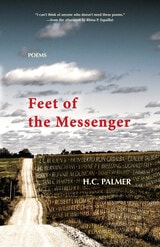
Feet of the Messenger
poemsH. C. Palmer
BkMk Press, 2017
Winner, Kansas Notable Book
Balcones Poetry Prize Finalist
Feet of the Messenger explores H.C. Palmer’s experiences as a medical doctor, especially as an army surgeon in the Vietnam War, and his feelings for and memories of his native Kansas, especially the Flint Hills. Although he has only been writing poetry for ten years, Palmer’s work reflects decades of discovering how the war kept coming back to him, even on the prairie.
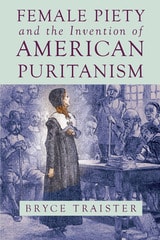
Female Piety and the Invention of American Puritanism
Bryce Traister
The Ohio State University Press, 2016
Uncovering the feminine interiority of New England Protestantism, Female Piety and the Invention of American Puritanism positions itself against prevalent historical arguments about the rise of secularism in the modern West. Traister demonstrates that female spirituality became a principal vehicle through which Puritan identity became both absorbed within and foundational for pre-national secular culture. Engaging broadly with debates about religion and secularization, national origins and transnational unsettlements, and gender and cultural authority, this is a foundational reconsideration both of American Puritanism itself and of “American Puritanism” as it has been understood in relation to secular modernity.
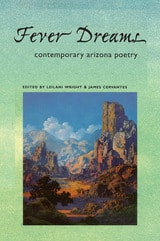
Fever Dreams
Contemporary Arizona PoetryLeilani Wright
University of Arizona Press, 1997
William Aberg
Ai
Jed Allen
Barbara Anderson
Jon Anderson
Michael Bowden
Becky Byrkit
Cordelia Candelaria
James Cervantes
David Chorlton
Jeanne E. Clark
Jane Candia Coleman
Michael Cuddihy
Barbara Cully
Alison Hawthorne Deming
Norman Dubie
Beckian Fritz Goldberg
Catherine Hammond
Rex Lee Jim
Ramson Lomatewama
Rita Magdaleno
Jane Miller
Paul Morris
Sheila Murphy
Rick Noguchi
Steve Orlen
Henry Quintero
Alberto R¡os
William Pitt Root
Jeannine Savard
Richard Shelton
Jim Simmerman
Virginia Chase Sutton
Laura Tohe
Tracy Trefethen
Peter Wild
Leilani Wright
Brian Young
Ofelia Zepeda
Fiction Beyond Secularism
Justin Neuman
Northwestern University Press, 2014
Modernist thinkers once presumed a progressive secularity, with the novel replacing religious texts as society’s moral epics. Yet religion—beginning with the Iranian revolution of 1979, through the collapse of communism, and culminating in the singular rupture of September 11, 2001—has not retreated quietly out of sight.
In Fiction Beyond Secularism, Justin Neuman argues that contemporary novelists who are most commonly identified as antireligious—among them Orhan Pamuk, Salman Rushdie, Ian McEwan, Margaret Atwood, Nadine Gordimer, Haruki Murakami, and J. M. Coetzee—have defied assumptions and have instead written some of the most trenchant critiques of secular ideologies, as well as the most exciting and rigorous inquiries into the legacies of the religious imagination. As a result, many readers (or nonreaders) on either side of the religious divide neglect the insights of works like The Satanic Verses, Disgrace, and Snow. Fiction Beyond Secularism serves as a timely corrective.
Fiction Sets You Free
Literature, Liberty, and Western CultureRussell A. Berman
University of Iowa Press, 2007
In what can only be called a genuine intellectual adventure, Russell Berman raises fundamental questions long ignored by literary scholars: Why does literature command our attention at all? Why would society want to cultivate a sphere of activity devoted to the careful study of literary ?ction? Written as a tonic to what he calls the debilitating cultural relativism of contemporary literary studies, Fiction Sets You Free advances the innovative argument that literature and capitalism, rather than representing merely commercialization, actually belie a long and positive association: literary autonomy is a central part of modern Western culture, thoroughly intertwined with political democracy and free-market capitalism.
Berman particularly challenges the issue of periodization, in which current scholarship emphasizes historical context over the integrity of a literary work and thus neglects the capacity of literature to remain interesting in other times and contexts. By moving from the origins of human language through the development of written alphabets and sacred texts, eventually probing the role of public literature in the creation of community, Berman elegantly and cogently surveys the intellectual landscape of Western societies. By giving us the license to dream and envision other worlds, literature sets us free.
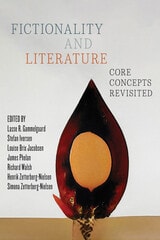
Fictionality and Literature
Core Concepts RevisitedEdited by Lasse R. Gammelgaard, Stefan Iversen, Louise Brix Jacobsen, James Phelan, Richard Walsh, Henrik Zetterberg-Nielsen, and Simona Zetterberg-Nielsen
The Ohio State University Press, 2022
Contributors:
H. Porter Abbott, Catherine Gallagher, Lasse R. Gammelgaard, Stefan Iversen, Louise Brix Jacobsen, Rikke Andersen Kraglund, Susan S. Lanser, Jakob Lothe, Maria Ma¨kela¨, Greta Olson, Sylvie Patron, James Phelan, Richard Walsh, Wendy Veronica Xin, Henrik Zetterberg-Nielsen, Simona Zetterberg-Nielsen

Fieldglass
Catherine Pond
Southern Illinois University Press, 2021
Fraught with obsession, addiction, and unrequited love, Catherine Pond’s Fieldglass immerses us in the speaker’s transition from childhood to adulthood. A queer coming-of-age, this collection is a candid exploration of sexual identity, family dynamics, and friendships that elude easy categorization, offering insight on the ambiguous nature of identity.
Saturated by her surroundings and permeated by the emotional lives of those close to her, the speaker struggles with feelings of displacement, trauma, and separateness. She is perpetually in transit, with long drives, flights, and train rides—moving most often between the city and the foothills of the Adirondack Mountains. As the collection unfolds, the speaker journeys toward adulthood, risking intimacy and attempting to undo her embedded impulses toward silence and absorption.
Reflective, graceful, and understated, Pond’s images accumulate power through restraint and suggestion. Deeply personal and intense, searching and yearning, associative and lyric, Fieldglass is a confessional about growing up, loving hard, and letting go.
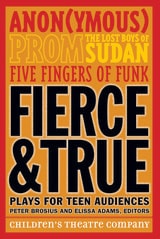
Fierce and True
Plays for Teen AudiencesChildren’s Theatre Children’s Theatre Company
University of Minnesota Press, 2010
In an effort to reach out to and engage these young people, the CTC began to commission and produce plays aimed at a twelve- to eighteen-year-old audience, focusing on the complexities, idiosyncrasies, and epic dilemmas in the lives of young people. Fierce and True collects four of these critically acclaimed plays: Anon(ymous) by Naomi Iizuka, The Lost Boys of Sudan by Lonnie Carter, Five Fingers of Funk by Will Power, and Prom by Whit MacLaughlin and New Paradise Laboratories.
Professional, full-length works not about teens so much as they are written for them. Ambitious, surprising, and complex, these plays speak directly to teens without pandering to them; they engage, challenge, and respect teenage minds. Diverse and utterly unique, these playwrights are bound together by the excellence of their craft and the power of their storytelling. Fierce and True both redefines the field of theater for young people and provides an invaluable resource for theater professionals, educators, and the teens they serve.
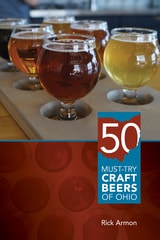
Fifty Must-Try Craft Beers of Ohio
Rick Armon
Ohio University Press, 2017
Every craft beer has a story, and part of the fun is learning where the liquid gold in your glass comes from. In Fifty Must-Try Craft Beers of Ohio, veteran beer writer Rick Armon picks the can’t-miss brews in a roundup that will handily guide everyone from the newest beer aficionado to those with the most seasoned palates. Some are crowd pleasers, some are award winners, some are just plain unusual—the knockout beers included here are a tiny sample of what Ohio has to offer.
In the midst of the ongoing nationwide renaissance in local beer culture, Ohio has become a major center for the creation of quality craft brews, and Armon goes behind the scenes to figure out what accounts for the state’s beer alchemy. He asked the brewers themselves about the great idea or the happy accident that made each beer what it is. The book includes brewer profiles, quintessentially Ohio food pairings (sauerkraut balls and Cincinnati chili!), and more.
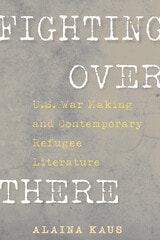
Fighting Over There
U.S. War Making and Contemporary Refugee LiteratureAlaina Kaus
University of Massachusetts Press, 2023
U.S. foreign policy has long been built on a dichotomy of an irreplaceable “here” and an expendable “there.” In his 2003 announcement of the military campaign in Iraq, George W. Bush declared that we would fight in the Middle East so we wouldn’t have to fight “on the streets of our cities.” But what do the millions of people who live over “there” have to say about U.S. interventions and the displacement they provoke?
In this pathbreaking study, Alaina Kaus analyzes literature by and about refugees who fled Southeast Asia, Central America, the Caribbean, North Africa, and the Middle East, in the wake of U.S. military occupation and economic intervention. Narratives by authors such as Lan Cao, Viet Thanh Nguyen, Demetria Martínez, Héctor Tobar, Dave Eggers, Mohsin Hamid, and Riverbend reveal contradictions in the human rights pledges that undergird U.S. foreign policy, which promote freedom while authorizing intervention and displacement, and favor market-based solutions over social justice and racial equality.
Fighting Words
Polemics and Social Change in Literary NaturalismIra Wells
University of Alabama Press, 2013
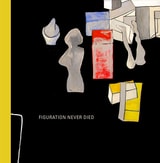
Figuration Never Died
New York Painterly Painting, 1950–1970Karen Wilkin
The Artist Book Foundation, 2020
By 1950, forward-looking New York painting was seen as synonymous with abstraction, especially charged, gestural Abstract Expressionism. But there was also a strong group of dissenters; artists, all born in the 1920s and many of them students of Hans Hofmann, who never lost their enthusiasm for recognizable imagery, without rejecting Abstract Expressionism's love of malleable oil paint. Although most of them began as abstract artists, they all evolved into painters working from observation, using a fluid, urgent touch to translate their perceptions into eloquent, highly individualized visual languages, almost always informed by the hand; that is, unlike the Color Field and Minimalist artists, these artists remained, for the most part, "painterly" painters. In light of their important contributions to twentieth-century American art, The Artist Book Foundation presents the cataloge for the Brattleboro Museum & Art Center's eponymous 2020 exhibition, Figuration Never Died: New York Painterly Painting, 1950–1970.
These rebellious artists include Lois Dodd, Jane Freilicher, Paul Georges, Grace Hartigan, Wolf Kahn, Alex Katz, Albert Kresch, Robert de Niro Sr., Paul Resika, and Anne Tabachnick. The compelling figurative work they made between about 1950 and 1970, in contrast to the prevailing Abstract Expressionism of the time, constitutes a significat chapter in the history of recent American Modernism. Their work not only greatly expands our conception of the story of New York painting, but it also presages and contextualizes today's multiplicity of artistic concepts and processes. Given both the aesthetic diversity of today's New York art world and the dependence of many younger artists on digital media or the appearance of digital media, it seems an appropriate moment to reconsider the work of these daring pioneers, as both precursor and opposition to current norms.
Figures in a Landscape
Gail Mazur
University of Chicago Press, 2011
A new inclusiveness, a heady freedom, grounded in the facts of mortality, inform Gail Mazur’s recent poems, as if making them has served as both a bunker and a promontory, a way to survive, and to be exposed to, the profound underlying subject of this book: a husband’s approaching death. The intimate particulars of a shared life are seen from a great height—and then there’s the underlife of the bunker: endurance, holding on, life as uncompromising reality. This new work, possessed by the unique devil-may-care intensity of someone writing at the end of her nerves, makes Figures in a Landscape feel radiant, visionary, and exhilarating, rather than elegiac. Mazur’s masterly fusion of abstraction with the facts of a life creates a coming to terms with what Yeats called “the aboriginal ice.”
Figures of the World
The Naturalist Novel and Transnational FormChristopher Laing Hill
Northwestern University Press, 2020
The book begins by tracing the history of naturalist fiction from the 1860s into the twentieth century and the reasons it spread around the world. Hill explores the development of three naturalist figures—the degenerate body, the self-liberated woman, and the social milieu—through close readings of fiction from France, Japan, and the United States. Rather than genealogies of European influence or the domination of cultural “peripheries” by the center, novels by Émile Zola, Tayama Katai, Frank Norris, and other writers reveal conspicuous departures from metropolitan models as writers revised naturalist methods to address new social conditions. Hill offers a new approach to studying culture on a large scale for readers interested in literature, the arts, and the history of ideas.