Results by title
69 books match the query 'American Culture' and 5 start with f
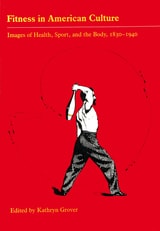
Fitness in American Culture
Images of Health, Sport, and the Body, 1830-1940Kathryn Grover
University of Massachusetts Press, 1989
Following Tradition
Folklore in the Discourse of American CultureSimon J. Bronner
Utah State University Press, 1998
Following Tradition is an expansive examination of the history of tradition—"one of the most common as well as most contested terms in English language usage"—in Americans' thinking and discourse about culture. Tradition in use becomes problematic because of "its multiple meanings and its conceptual softness." As a term and a concept, it has been important in the development of all scholarly fields that study American culture. Folklore, history, American studies, anthropology, cultural studies, and others assign different value and meaning to tradition. It is a frequent point of reference in popular discourse concerning everything from politics to lifestyles to sports and entertainment. Politicians and social advocates appeal to it as prima facie evidence of the worth of their causes. Entertainment and other media mass produce it, or at least a facsimile of it. In a society that frequently seeks to reinvent itself, tradition as a cultural anchor to be reverenced or rejected is an essential, if elusive, concept. Simon Bronner's wide net captures the historical, rhetorical, philosophical, and psychological dimensions of tradition. As he notes, he has written a book "about an American tradition—arguing about it." His elucidation of those arguments makes fascinating and thoughtful reading. An essential text for folklorists, Following Tradition will be a valuable reference as well for historians and anthropologists; students of American studies, popular culture, and cultural studies; and anyone interested in the continuing place of tradition in American culture.

For Zion's Sake
The Judeo-Christian Tradition in American CultureFuad Sha'ban
Pluto Press, 2005
This book explores the role of religion, especially religious extremism, in American culture. In particular, it examines the development of the Judeo-Christian tradition, its impact on America's self-image, and the way it has influenced America's attitude to the Arab World.
The Christian Right has become a very powerful force in American politics. Its basic belief in Christian Zionism has resulted in a steadfast commitment to the establishment of the state of Israel and to its aggressive expansion, and has made Zionism a central part of government policy, for both Republicans and Democrats.
Fuad Sha'ban shows how this is not a new phenomenon: what he terms the 'Vision of Zion' in American life has its roots in literature, the arts and internal politics from colonial times until today. Looking in detail at a wealth of resources, including religious and literary texts, as well as official political statements, he pieces together a subtle account of how America's Puritan roots have fostered a specifically religious political culture that encourages hatred and suspicion of the Muslim World in domestic and foreign policy.
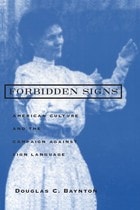
Forbidden Signs
American Culture and the Campaign against Sign LanguageDouglas C. Baynton
University of Chicago Press, 1996
The ensuing debate over sign language invoked such fundamental questions as what distinguished Americans from non-Americans, civilized people from "savages," humans from animals, men from women, the natural from the unnatural, and the normal from the abnormal. An advocate of the return to sign language, Baynton found that although the grounds of the debate have shifted, educators still base decisions on many of the same metaphors and images that led to the misguided efforts to eradicate sign language.
"Baynton's brilliant and detailed history, Forbidden Signs, reminds us that debates over the use of dialects or languages are really the linguistic tip of a mostly submerged argument about power, social control, nationalism, who has the right to speak and who has the right to control modes of speech."—Lennard J. Davis, The Nation
"Forbidden Signs is replete with good things."—Hugh Kenner, New York Times Book Review
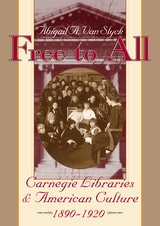
Free to All
Carnegie Libraries & American Culture, 1890-1920Abigail A. Van Slyck
University of Chicago Press, 1996
"The whole story is told here in this book. Carnegie's wishes, the conflicts among local groups, the architecture, development of female librarians. It's a rich and marvelous story, lovingly told."—Alicia Browne, Journal of American Culture
"This well-written and extensively researched work is a welcome addition to the history of architecture, librarianship, and philanthropy."—Joanne Passet, Journal of American History
"Van Slyck's book is a tremendous contribution for its keenness of scholarship and good writing and also for its perceptive look at a familiar but misunderstood icon of the American townscape."—Howard Wight Marshall, Journal of the Society of Architectural Historians
"[Van Slyck's] reading of the cultural coding implicit in the architectural design of the library makes a significant contribution to our understanding of the limitations of the doctrine 'free to all.'"—Virginia Quarterly Review