402 books match the query 'American poetry' and 13 start with f
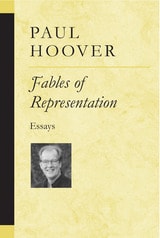
cover of Fables of Representation: Essays

Fables of Representation

Essays

Paul Hoover

University of Michigan Press, 2004

From the acclaimed author of Winter (Mirror) and Rehearsal in Black, Fables of Representation is a powerful collection of essays on the state of contemporary poetry, free from the stultifying theoretical jargon of recent literary history.

With its title essay, "Fables of Representation," one of the most cogent studies ever written of the New York School of poets (a group that includes the influential poet John Ashbery), this book is required reading for anyone who seeks to understand the poetry and culture of the postmodern period.

Author Paul Hoover's wide-ranging subjects include African-American interdisciplinary studies; the position of poetry in the electronic age; the notion of doubleness in the work of Harryette Mullen and others; the lyricism of the New York School poets; and the role of reality in American poetry. Hoover also introduces two provocative essays sure to generate attention and discussion: "The Postmodern Era: A Final Exam" and "The New Millennium: Fifty Statements on Literature and Culture."

Paul Hoover is the editor of the anthology Postmodern American Poetry and author of nine poetry collections, including Totem and Shadow: New and Selected Poems and Viridian. His poetry has appeared in American Poetry Review, The New Republic, and The Paris Review, among others. He is Poet-in-Residence at Columbia College, Chicago.
[more]
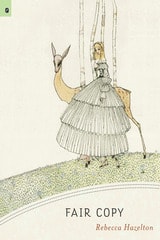
cover of Fair Copy

Fair Copy

Rebecca Hazelton

The Ohio State University Press, 2012
Fair Copy, byRebecca Hazelton, is a meditation on the difficulties of distinguishing the real from the false, the copy from the original. It is in part an exploration of the disparity between our conception of love as either true or false and the messy reality that it can sometimes be both. If “true” love is not to be found, is an approximation a “fair” substitute? These poems repeatedly question the veracity of memory—sometimes toying with the seductiveness of nostalgia while at other times pleading for the real story. Here, the fairy tale and the everyday nervously coexist, the bride is an uneasy molecule, and happiness comes in the form of a pill. Composed of acrostics from lines by Emily Dickinson, the collection retains a direct and recurrent tie to Dickinson’s work, even while Hazelton deftly branches off into new sonic, rhythmic, and conceptual territories.
[more]
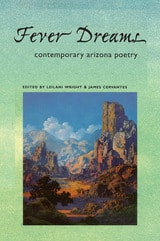
cover of Fever Dreams: Contemporary Arizona Poetry

Fever Dreams

Contemporary Arizona Poetry

Leilani Wright

University of Arizona Press, 1997

Dream worlds, real worlds: this book ushers in an extraordinary collection of new work by nearly forty poets currently living and writing in Arizona. From campuses and coffee houses, prisons and pueblos, classrooms and kitchen tables comes the work of both well-known and emerging writers drawn to the state's blazing days and starry nights in search of place, time, idea, and self.Brief introductions for each poet reveal that socially, geographically, and emotionally, they come from anywhere and everywhere. Here and together, however, their energy and synergy are shaping a literary landscape unlike any other. They write of jazz, serotonin levels and talk shows, homelessness, convenience stores and gunplay, Tiananmen Square and Bosnia. Their poems, like these lines by Alberto Ríos, are as clear as the desert air: "The birds, they make this happen. / In the sky with nothing else to do, a Saturday, / The slow knee-bend of an afternoon, out there. / I have seen them myself / The birds caw down a rain, tease it / To a hard ground of grass and flat and edge."For the anthology, well-known contributors—Ríos, Richard Shelton, Steve Orlen, Alison Deming, and others—were asked to surprise the editors with their ideas for the best less-known artists to include in the volume. Like a kaleidoscope, then, each page brings a shift in tone and color from the one before, from mainstream, "language," and experimental poetry, to that shaped by rural or traditional cultures.In English, Spanish, and Native languages, voices here reach out to those readers whose home—or whose heart—is in Arizona, and to many others who will never travel here. "Each distinct and other," says Forché of the words in Fever Dreams, make of poetry "what it could not be without this place, translating into poetry its timelessness and awe."Contributors:
William Aberg
Ai
Jed Allen
Barbara Anderson
Jon Anderson
Michael Bowden
Becky Byrkit
Cordelia Candelaria
James Cervantes
David Chorlton
Jeanne E. Clark
Jane Candia Coleman
Michael Cuddihy
Barbara Cully
Alison Hawthorne Deming
Norman Dubie
Beckian Fritz Goldberg
Catherine Hammond
Rex Lee Jim
Ramson Lomatewama
Rita Magdaleno
Jane Miller
Paul Morris
Sheila Murphy
Rick Noguchi
Steve Orlen
Henry Quintero
Alberto R¡os
William Pitt Root
Jeannine Savard
Richard Shelton
Jim Simmerman
Virginia Chase Sutton
Laura Tohe
Tracy Trefethen
Peter Wild
Leilani Wright
Brian Young
Ofelia Zepeda
[more]
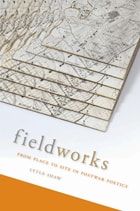
cover of Fieldworks: From Place to Site in Postwar Poetics

Fieldworks

From Place to Site in Postwar Poetics

Lytle Shaw

University of Alabama Press, 2013

Fieldworks offers a historical account of the social, rhetorical, and material attempts to ground art and poetry in the physicality of a site.

Arguing that place-oriented inquiries allowed poets and artists to develop new, experimental models of historiography and ethnography, Lytle Shaw draws out the shifting terms of this practice from World War II to the present through a series of illuminating case studies. Beginning with the alternate national genealogies unearthed by William Carlos Williams in Paterson and Charles Olson in Gloucester, Shaw demonstrates how subsequent poets sought to ground such inquiries in concrete social formations—to in effect live the poetics of place: Gary Snyder in his back-to-the-land familial compound, Kitkitdizze; Amiri Baraka in a black nationalist community in Newark; Robert Creeley and the poets of Bolinas, California, in the capacious “now” of their poet-run town. Turning to the work of Robert Smithson—who called one of his essays an “appendix to Paterson,” and who in turn has exerted a major influence on poets since the 1970s—Shaw then traces the emergence of site-specific art in relation both to the poetics of place and to the larger linguistic turn in the humanities, considering poets including Clark Coolidge, Bernadette Mayer, and Lisa Robertson.

By putting the poetics of place into dialog with site-specificity in art, Shaw demonstrates how poets and artists became experimental explicators not just of concrete locations and their histories, but of the discourses used to interpret sites more broadly. It is this dual sense of fieldwork that organizes Shaw’s groundbreaking history of site-specific poetry.
[more]
cover of Fishing by Obstinate Isles: Modern and Postmodern British Poetry and American Readers

Fishing by Obstinate Isles

Modern and Postmodern British Poetry and American Readers

Keith Tuma

Northwestern University Press, 1998
Fishing by Obstinate Isles explores the relations of recent British and American poetries, challenging American views of a British poetry dominated by antimodernism while discussing the role of rhetorics of national identity on both sides of the Atlantic in the persistence of these views. Devoting its most extensive commentary to a collection of British modernist and postmodernist poets, it attacks the relegation of British poetry to the zones of the quaint, making a compelling case for renewed engagements with fields of British poetry deserving of attention.
[more]
cover of Flourish

Flourish

Dora Malech

Carnegie Mellon University Press, 2020

In Flourish, multiple meanings catch light—as the leaves of growing things might, or the facets of cut gemstones, or a signal mirror flashing in distress. These poems explore themes of thriving, growth, innovation, and survival, while immersing the reader in the pleasures of language itself—the “flourish” of linguistic gesture, play, form, turn, and adornment.
Here, the lens zooms in and out to micro and macro levels, asking us to see the familiar with new eyes. The collection engages with the materials of the worlds we inhabit—natural worlds and those of our own making—and a full spectrum of poetry’s own materials, building worlds of words and illuminating the shadowed terrain of our interior landscapes as well.
[more]
cover of Foremother Love: Phillis Wheatley and Black Feminist Criticism

Foremother Love

Phillis Wheatley and Black Feminist Criticism

Dana Murphy

Duke University Press, 2025
In Foremother Love, Dana Murphy examines the importance of eighteenth-century poet Phillis Wheatley as a foundational figure for Black feminist criticism. Murphy establishes Phillis (as she refers to her) as a writer who wrote in response to and in conversation with other creators as well as a critic who was invested in sharing, explaining, and evaluating her own and others’ work and contexts. Indeed, Phillis played a key role in the development of what Murphy calls “foremother love”—the Black feminist depiction of the love of an unrelated feminist ancestor as a legitimate relation for the practice of inheritance, mourning, liberation, and friendship. Drawing on the work of Barbara Christian, June Jordan, Audre Lorde, Barbara Smith, and others, Murphy shows that Black feminist criticism becomes a transhistorical theorization when read in conjunction with Phillis’s labor and vision. Revealing how Phillis lives on in Black feminist criticism, Murphy contends that foremother love is an ethic of critical care that implores readers to recognize the affective labor of all those working in the field.
[more]
cover of Forms of Expansion: Recent Long Poems by Women

Forms of Expansion

Recent Long Poems by Women

Lynn Keller

University of Chicago Press, 1997

Expanding the boundaries of both genre and gender, contemporary American women are writing long poems in a variety of styles that repossess history, reconceive female subjectivity, and revitalize poetry itself. In the first book devoted to long poems by women, Lynn Keller explores this rich and evolving body of work, offering revealing discussions of the diverse traditions and feminist concerns addressed by poets ranging from Rita Dove and Sharon Doubiago to Judy Grahn, Marilyn Hacker, and Susan Howe.

Arguing that women poets no longer feel intimidated by the traditional associations of long poems with the heroic, public realm or with great artistic ambition, Keller shows how the long poem's openness to sociological, anthropological, and historical material makes it an ideal mode for exploring women's roles in history and culture. In addition, the varied forms of long poems—from sprawling free verse epics to regular sonnet sequences to highly disjunctive experimental collages—make this hybrid genre easily adaptable to diverse visions of feminism and of contemporary poetics.

[more]
cover of Four Quartets: Poetry in the Pandemic

Four Quartets

Poetry in the Pandemic

Edited by Jeffrey Levine and Kristina Marie Darling

Tupelo Press, 2020

In this timely anthology, established and emerging poets bear powerful witness to the COVID-19 pandemic in writing that reels from collective grief and uncertainty. This volume consists of sixteen separate chapbooks, and a collection of pandemic-era photography, which are unified by a shared narrative: public and private experiences of quarantine, and the impulse toward creation during a time of enormous upheaval, injustice, and protest. Each voice brings with it a deeply personal account of this globally historic moment, and in doing so, conveys the urgency of introspection, of isolation, and of revolution. These pieces feature B. A. Van Sise, Jimmy Santiago Baca, Yusef Komunyakaa, Laren McClung, Stephanie Strickland, Mary Jo Bang, Shane McCrae, Ken Chen, J. Mae Barizo, Dora Malech, Jon Davis, Lee Young-Ju, Jae Kim, Rachel Eliza Griffiths, A. Van Jordan, Maggie Queeney, Traci Brimhall, Brynn Saito, Denise Duhamel, and Rick Barot. This is a transcendent and ultimately transformative book of poetry written through the COVID-19 pandemic.
[more]
cover of Franciscan Notes

Franciscan Notes

Alan Williamson

Tupelo Press, 2019
The book begins with deaths: chiefly the poet’s mother’s, but also those of cherished mentors and friends. Poems explore living beyond those deaths and approaching old age, and then do some traveling. Williamson takes a pilgrimage to Japan and India, inspired by his practice of Zen meditation, and placed under the aegis of a saying from the great Rinzai Zen monastery at Daitoku-ji: “If you cannot endure this moment, what can you endure?” A theme then becomes enduring the public moment, with all its griefs and opportunities for growth. The reader is then transported with the poet to Italy. In 2000, Williamson began visiting Tuscany regularly, and eventually became a property owner there. The poems set in Italy dwell on an encounter with old culture, and its potential to encourage both resignation and mysticism, with moods that persist from the tutelary geniuses of two great Italian poets: the nihilistic Leopardi and the tentatively mystical Montale. Gathering around those experiences multiple lore from music, philosophy and science, it becomes an extended meditation on mental suffering, glimpses of the ecstatic, and the double nature of our life, “skull / and beatific face,” with “the immortal recombinants of fire and water.”
[more]
cover of Free Verse: An Essay on Prosody

Free Verse

An Essay on Prosody

Charles O. Hartman

Northwestern University Press, 1996
To make sense of "free verse" in theory of in practice, the study of prosody—the function of rhythm in poetry—must be revised and rethought. In Free Verse: An Essay on Prosody, Charles Hartman develops a theory of prosody that includes the most characteristic form of twentieth-century poetry.
[more]
cover of From Outlaw to Classic: Canons in American Poetry

From Outlaw to Classic

Canons in American Poetry

Alan Golding

University of Wisconsin Press, 1995

From Outlaw to Classic presents a sweeping history of the forces that have shaped, and continue to shape, the American poetry canon. Students, scholars, critics, and poets will welcome this enlightening and impressively documented book.
    Recent writings by critics and theorists on literary canons have dealt almost exclusively with prose; Alan Golding shows that, like all canons, those of American poetry are characterized by conflict. Choosing a series of varied but representative instances, he analyzes battles and contentions among poets, anthologists, poetry magazine editors, and schools of thought in university English departments.  The chapters:
• present a history of American poetry anthologies
• compare competing models of canon-formation, the aesthetic (poet-centered) and the institutional (critic-centered)
• discuss the influence of the New Critics, emphasizing their status as practicing poets, their anti-nationalist reading of American poetry, and the landmark textbook, Understanding Poetry by Cleanth Brooks and Robert Penn Warren
• examine the canonizing effects of an experimental “little magazine,” Origin
• trace how the Language poets address, in both their theory and their method, the canonizing institutions and canonical assumptions of the age.
[more]
cover of Furious Flower: Seeding the Future of African American Poetry

Furious Flower

Seeding the Future of African American Poetry

Edited by Joanne V. Gabbin and Lauren K. Alleyne; Foreword by Rita Dove

Northwestern University Press, 2020

Furious Flower: Seeding the Future of African American Poetry is an anthology of poems by more than one hundred award-winning poets, including Jericho Brown, Justin Philip Reed, and Tracy K. Smith, with themed essays on poetics from celebrated scholars such as Kwame Dawes, Meta DuEwa Jones, and Evie Shockley. The Furious Flower Poetry Center is the nation’s first academic center for Black poetry. In this eponymous collection, editors Joanne V. Gabbin and Lauren K. Alleyne bring together many of the paramount voices in Black poetry and poetics active today, composing an electrifying mosaic of voices, generations, and aesthetics that reveals the Black narrative in the  work of twentieth- and twenty-first-century writers. Intellectually enlightening and powerfully enlivening, Furious Flower explores and celebrates the idea of the Black poetic voice by posing the question, What’s next for Black poetic expression?
[more]