Results by title
664 books match the query 'Ancient & Classical' and 9 start with f
FEELING HISTORY
LUCAN, STOICISM, AND THE POETICS OF PASSIONFrancesca D’Alessandro Behr
The Ohio State University Press, 2007

Fairy Tales from Before Fairy Tales
The Medieval Latin Past of Wonderful LiesJan M. Ziolkowski
University of Michigan Press, 2009
When did fairy tales begin? What qualifies as a fairy tale? Is a true fairy tale oral or literary? Or is a fairy tale determined not by style but by content? To answer these and other questions, Jan M. Ziolkowski not only provides a comprehensive overview of the theoretical debates about fairy tale origins but includes an extensive discussion of the relationship of the fairy tale to both the written and oral sources. Ziolkowski offers interpretations of a sampling of the tales in order to sketch the complex connections that existed in the Middle Ages between oral folktales and their written equivalents, the variety of uses to which the writers applied the stories, and the diverse relationships between the medieval texts and the expressions of the same tales in the "classic" fairy tale collections of the nineteenth century. In so doing, Ziolkowski explores stories that survive in both versions associated with, on the one hand, such standards of the nineteenth-century fairy tale as the Brothers Grimm, Hans Christian Andersen, and Carlo Collodi and, on the other, medieval Latin, demonstrating that the literary fairy tale owes a great debt to the Latin literature of the medieval period.
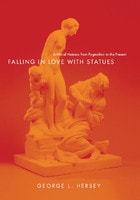
Falling in Love with Statues
Artificial Humans from Pygmalion to the PresentGeorge L. Hersey
University of Chicago Press, 2009
Hersey’s history of statue love begins in Cyprus, home of the legendary sculptor Pygmalion, who famously grew enamored of his own creation. Examining the island’s prehistoric images of Aphrodite—the love goddess who brought Pygmalion’s sculpture to life—Hersey traces the origins of statue love back to the Cypriot followers who adored her terra-cotta likenesses. He goes on to explore ideas about human replicas in the works of Empedocles, Aristotle, Lucretius, and Ovid, whose definitive account of the Pygmalion myth introduced the notion that statues have the potential to induce physical responses in their viewers. Finding avatars of Ovid’s living image in everything from pagan idols and early Christian statuary to eighteenth-century painting to modern action figures and marionettes, Hersey concludes by investigating the concern that these automata will eventually replace humans.
In the process, he narrates a powerful history of artificial life at a moment when—with the development of robot soldiers, ever more sophisticated genetic engineering, and a continually expanding digital universe—it seems more real than ever.
Fama and Fiction in Vergil's Aeneid
Antonia Syson
The Ohio State University Press, 2013
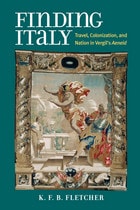
Finding Italy
Travel, Nation, and Colonization in Vergil's AeneidK. F. B. Fletcher
University of Michigan Press, 2014
Finding Italy explores the journey of the Romans’ ancestor Aeneas and his fellow Trojans from their old home, Troy, to their new country, Italy, narrated in Vergil’s epic poem Aeneid. K. F. B. Fletcher argues that a main narrative theme is patriotism, specifically the problem of how one comes to love one’s new country. The various directions Aeneas receives throughout the first half of the poem are meant to create this love, explaining both to Aeneas and to Vergil’s readers how they should respond to the new, unified Italy synonymous with Rome. These directions come from the gods, or from people close to Aeneas who have divine connections, and they all serve to instill an emotional connection to the land, creating a mental image of Italy that tells him far more about his destination than merely its location, and ultimately making him fall in love with Italy enough to fight for it soon after his arrival. The poem thus dramatizes the birth of nationalism, as Italy is only a concept to Aeneas throughout his trip; these directions do not describe Italy as it is at the time of Aeneas’ journey, but as an ideal to be realized by Aeneas and his descendants, reaching its final, perfect form under Augustus Caesar.
Finding Italy provides a very detailed reading of the directions Aeneas receives by situating them within their relevant contexts: ancient geography, Greek colonization narratives, prophecy, and ancient views of wandering. Vergil draws on all of these concepts to craft instructions that create in Aeneas an attachment to Italy before he ever arrives, a process that dramatizes a key emotional problem in the late first century BCE in the wake of the Social and Civil Wars: how to balance the love of one's modest birthplace with the love of Rome, the larger city that now encompasses it.
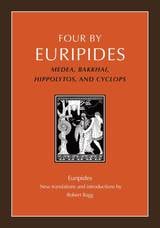
Four by Euripides
Medea, Bakkhai, Hippolytos, and CyclopsRobert Bagg
University of Massachusetts Press, 2019

From Abortion to Pederasty
Addressing Difficult Topics in the Classics ClassroomEdited by Nancy Sorkin Rabinowitz and Fiona McHardy
The Ohio State University Press, 2014
From Abortion to Pederasty: Addressing Difficult Topics in the Classics Classroom, edited by Nancy Sorkin Rabinowitz and Fiona McHardy, is committed to the proposition that it is important to continue to teach texts that raise these issues, not to avoid them. In this volume, classicists and ancient historians from around the world address how to teach such topics as rape, pederasty, and slavery in the classics classroom. The contributors present the concrete ways in which they themselves have approached such issues in their course planning and in their responses to students’ needs.
A main objective of From Abortion to Pederasty is to combat arguments, from both the left and the right, that the classics are elitist and irrelevant. Indeed, they are so relevant, and so challenging, as to be painful at times. Another objective is to show how Greco-Roman culture and history can provide a way into a discussion that might have been difficult or even traumatic in other settings. Thus it will provide teaching tools for dealing with uncomfortable topics in the classroom, including homophobia and racism.
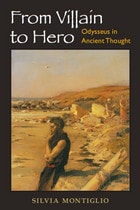
From Villain to Hero
Odysseus in Ancient ThoughtSilvia Montiglio
University of Michigan Press, 2011
Praise for Silvia Montiglio
"[A] brilliant and important book. . . . "
---Journal of Religion, on Silence in the Land of Logos
"[A]n invigorating reevaluation of both the ancient symbolic landscape and our preconceptions of it."
---American Journal of Philology, on Wandering in Ancient Greek Culture
Best known for his adventures during his homeward journey as narrated in Homer's Odyssey, Odysseus remained a major figure and a source of inspiration in later literature, from Greek tragedy to Dante's Inferno to Joyce's Ulysses. Less commonly known, but equally interesting, are Odysseus' "wanderings" in ancient philosophy: Odysseus becomes a model of wisdom for Socrates and his followers, Cynics and Stoics, as well as for later Platonic thinkers. From Villain to Hero: Odysseus in Ancient Thought follows these wanderings in the world of ancient Greek and Roman philosophy, retracing the steps that led the cunning hero of Homeric epic and the villain of Attic tragedy to become a paradigm of the wise man.
From Villain to Hero explores the reception of Odysseus in philosophy, a subject that so far has been treated only in tangential or limited ways. Diverging from previous studies, Montiglio outlines the philosophers' Odysseus across the spectrum, from the Socratics to the Middle Platonists. By the early centuries CE, Odysseus' credentials as a wise man are firmly established, and the start of Odysseus' rehabilitation by philosophers challenges current perceptions of him as a villain. More than merely a study in ancient philosophy, From Villain to Hero seeks to understand the articulations between philosophical readings of Odysseus and nonphilosophical ones, with an eye to the larger cultural contexts of both. While this book is the work of a classicist, it will also be of interest to students of philosophy, comparative literature, and reception studies.
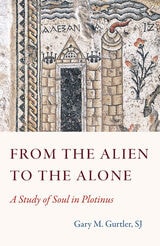
From the Alien to the Alone
A Study of Soul in PlotinusGary M. Gurtler, SJ
Catholic University of America Press, 2022