Results by title
299 books match the query 'Arizona' and 10 start with f

Fear Falls Away
and Other Essays from Hard and Rocky PlacesJanice Emily Bowers
University of Arizona Press, 1997
Faced with the prospect of moving to another place, Bowers finds herself thinking about the familiar world in new and unfamiliar ways. Through her eyes, too, we see how an interest in nature and the outdoors developed from early childhood and how simple curiosity has led her to the most surprising discoveries. At odd and unexpected moments, her work also seems to bring new insights into herself and her life as a writer, a wife, and a mother. These pages promise a new adventure at every turn in the trail. For sheer terror, there's a climb up the face of Baboquivari, for laughs, there's the great bagworm caper, and for some quiet truths, there are themes of gain and loss, of connection and reconcilliation. Crunching through winter snow or sweating under summer sun, we know we're in the hands of an experienced guide. And we know we couldn't ask for a better companion.

Fever Dreams
Contemporary Arizona PoetryLeilani Wright
University of Arizona Press, 1997
William Aberg
Ai
Jed Allen
Barbara Anderson
Jon Anderson
Michael Bowden
Becky Byrkit
Cordelia Candelaria
James Cervantes
David Chorlton
Jeanne E. Clark
Jane Candia Coleman
Michael Cuddihy
Barbara Cully
Alison Hawthorne Deming
Norman Dubie
Beckian Fritz Goldberg
Catherine Hammond
Rex Lee Jim
Ramson Lomatewama
Rita Magdaleno
Jane Miller
Paul Morris
Sheila Murphy
Rick Noguchi
Steve Orlen
Henry Quintero
Alberto R¡os
William Pitt Root
Jeannine Savard
Richard Shelton
Jim Simmerman
Virginia Chase Sutton
Laura Tohe
Tracy Trefethen
Peter Wild
Leilani Wright
Brian Young
Ofelia Zepeda

Folk Mammalogy of the Northern Pimans
Amadeo M. Rea
University of Arizona Press, 1998
Rea describes the relationship of the River Pima, Tohono O'odham (Papago), Pima Bajo, and Mountain Pima to the furred creatures of their environment: how they are named and classified, hunted, prepared for consumption, and incorporated into myth. He also identifies associations between mammals and Piman notions of illness by establishing correlations between the geographical distribution of mammals and ideas regarding which animals do or do not cause staying sickness. This information reveals how historical and ecological factors can directly influence the belief systems of a people. At the heart of the book are detailed species accounts that relate Piman knowledge of the bats, rabbits, rodents, carnivores, and hoofed mammals in their world, encompassing creatures ranging from deer mouse to mule deer, cottontail to cougar.
Rea has been careful to emphasize folk knowledge in these accounts by letting the Pimans tell their own stories about mammals, as related in transcribed conversations. This wide-reaching study encompasses an area from the Rio Yaqui to the Gila River and the Gulf of California to the Sierra Madre Occidental and incorporates knowledge that goes back three centuries. Folk Mammalogy of the Northern Pimans preserves that knowledge for scholars and Pimans alike and invites all interested readers to see natural history through another people's eyes.

Foragers and Farmers of the Northern Kayenta Region
Excavations along the Navajo Mountain RoadPhil Geib
University of Utah Press, 2011
Foragers and Farmers of the Northern Kayenta Region presents the results of a major archaeological excavation project on Navajo tribal land in the Four Corners area and integrates this new information with existing knowledge of the archaeology of the northern Kayenta region. The excavation of thirty-three sites provides a cross section of prehistory from which Navajo Nation archaeologists retrieved a wealth of information about subsistence, settlement, architecture, and other aspects of past lifeways. The project’s most important contributions involve the Basketmaker and Archaic periods, and include a large number of radiocarbon dates on high-quality samples. Dating back to the early Archaic period (ca. 7000 BC) and ranging forward through the Basketmaker components to the Puebloan period, this volume is a powerful record of ancient peoples and their cultures. Detailed supplementary data will be available on the University of Utah Press Web site upon publication of this summary volume.
Volume 2: Archaic Site Descriptions
Volume 3: Basketmaker Site Descriptions
Volume 4: Puebloan Site Descriptions
Volume 5: Analyses and Interpretation
Appendix Volume

Forging Arizona
A History of the Peralta Land Grant and Racial Identity in the WestAnita Huizar-Hernández
Rutgers University Press, 2019

Forging the Copper Collar
Arizona's Labor-Management War of 1901–1921James W. Byrkit
University of Arizona Press, 1982
Just after dawn, two thousand armed vigilantes took to the streets of this remote Arizona mining town to round up members and sympathizers of the radical Industrial Workers of the World. Before the morning was over, nearly twelve hundred alleged Wobblies had been herded onto waiting boxcars. By day's end, they had been hauled off to New Mexico.
While the Bisbee Deportation was the most notorious of many vigilante actions of its day, it was more than the climax of a labor-management war—it was the point at which Arizona donned the copper collar. That such an event could occur, James Byrkit contends, was not attributable so much to the marshaling of public sentiment against the I.W.W. as to the outright manipulation of the state's political and social climate by Eastern business interests.
In Forging the Copper Collar, Byrkit paints a vivid picture of Arizona in the early part of this century. He demonstrates how isolated mining communities were no more than mercantilistic colonies controlled by Eastern power, and how that power wielded control over all the Arizona's affairs—holding back unionism, creating a self-serving tax structure, and summarily expelling dissidents.
Because the years have obscured this incident and its background, the writing of Copper Collar involved extensive research and verification of facts. The result is a book that captures not only the turbulence of an era, but also the political heritage of a state.

Friars, Soldiers, and Reformers
Hispanic Arizona and the Sonora Mission Frontier, 1767–1856John L. Kessell
University of Arizona Press, 1976
Kessell provides exciting accounts of the explorations of Francisco Garcés, de Anza's expeditions, and the Yuma massacre. Drawing from widely scattered archival materials, he vividly describes the epic struggle between Bishop Reyes and Father President Barbastro, the missionary scandals of 1815–18, and the bloody victory of Mexican civilian volunteers over Apaches in Arivaipa Canyon in 1832. Numerous missionaries, presidials, and bureaucrats—nameless in histories until now—emerge as living, swearing, praying, individuals.
This authoritative chronicle offers an engrossing picture of the continually threatened mission frontier. Reformers championing civil rights for mission Indians time and again challenged the friars' "tight-fisted paternalistic control" over their wards. Expansionists repeatedly saw their plans dashed by Indian raids, uncooperative military officials, or lack of financial support.
Frairs, Soldiers, and Reformers brings into sharp focus the long, blurry period between Jesuit Sonora and Territorial Arizona.

Frog Mountain Blues
Charles Bowden; Photographs by Jack W. Dykinga
University of Arizona Press, 1994

Frog Mountain Blues
Charles Bowden; Photographs by Jack Dykinga; Foreword by Alison Hawthorne Deming
University of Arizona Press, 2018
When it was first published in 1987, Frog Mountain Blues documented the creeping sprawl of new development up the Catalinas’ foothills. Today, that development is fully visible, but Charles Bowden’s prescience of the urgency to preserve and protect a sacred recreational space remains as vivid as ever. Accompanied by Jack W. Dykinga’s photographs from the original work, this book continues to convey the natural beauty of the Catalinas and warns readers that this unique wilderness could easily be lost.
As Alison Hawthorne Deming writes in the new foreword, “Frog Mountain Blues continues to be an important book for learning to read this place through the eyes of experience and history, and Bowden remains a sobering voice for facing our failures in protecting what we love in this time of global destruction, for taking seriously the power of language to set ourselves right again with the enormous task of living with purpose and presence and care on the land.”
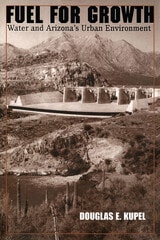
Fuel for Growth
Water and Arizona's Urban EnvironmentDouglas E. Kupel
University of Arizona Press, 2003
Fuel for Growth describes and interprets the history of water resource development and its relationship to urban development in Arizona's three signature cities: Phoenix, Tucson, and Flagstaff. These three urban areas could hardly be more different: a growth-oriented metropolis, an environmentally conscious city with deep cultural roots, and an outdoor-friendly mountain town. Despite these differences, their community leaders and public officials have taken similar approaches to developing water resources with varying degrees of success and acceptance.
Douglas Kupel has created a new vision of water history based on the Arizona experience. He challenges many of the traditional assumptions of environmental history by revealing that the West's aridity has had relatively little impact on the development of municipal water infrastructure in these cities. While urban growth in the West is often characterized as the product of an elite group of water leaders, the development of Arizona's cities is shown to reflect the broad aspirations of all their citizens.
The book traces water development from the era of private water service to municipal ownership of water utilities and examines the impact of the post-World War II boom and subsequent expansion. Taking in the Salt River Project, the Central Arizona Project, and the Groundwater Management Act of 1980, Kupel explores the ongoing struggle between growth and environmentalism. He advocates public policy measures that can sustain a water future for the state.
As the urban West enters a new century of water management, Arizona's progress will increasingly be tied to that of its ever-expanding cities. Fuel for Growth documents an earlier era of urban water use and provides important recommendations for the future path of water development in the West's key population centers.