Results by title
54 books match the query 'Aviation' and 5 start with f
Fatal Words
Communication Clashes and Aircraft CrashesSteven Cushing
University of Chicago Press, 1994
In Fatal Words, Steven Cushing explains how miscommunication has led to dozens of aircraft disasters, and he proposes innovative solutions for preventing them. He examines ambiguities in language when aviation jargon and colloquial English are mixed, when a word is used that has different meanings, and when different words are used that sound alike. To remedy these problems, Cushing proposes a visual communication system and a computerized voice mechanism to help clear up confusing language.
Fatal Words is an accessible explanation of some of the most notorious aircraft tragedies of our time, and it will appeal to scholars in communications, linguistics, and cognitive science, to aviation experts, and to general readers.
Fiat G.91
Arno Landewers
Amsterdam University Press, 2023
It was in production for nineteen years. 756 aircraft were completed, including the prototypes and pre-production models. The assembly lines were finally closed in 1977. The Fiat G.91 enjoyed a long service life that extended over 35 years. It was widely used by Portugal in the Portuguese Colonial War in Africa.
Fiscal Aspects of Aviation Management
Robert W. Kaps
Southern Illinois University Press, 2000
Although introductions to courses in finance exist for a variety of fields, Robert W. Kaps provides the first text to address the subject from an aviation viewpoint. Relying on his vast experience—twenty-plus years in the airline industry and more than thirty years in aviation—Kaps seeks not only to prepare students for careers in the aviation field but also to evoke in these students an excitement about the business. Specifically, he shows students how airlines, airports, and aviation are financed. Each chapter contains examples and illustrations and ends with suggested readings and references.
Following his discussion of financial management and accounting procedures, Kaps turns to financial management and sources of financial information. Here he discusses types of business organizations, corporate goals, business ethics, maximizing share price, and sources of financial information.
Kaps also covers debt markets, financial statements, air transport sector revenue generation, and air transport operating cost management, including cost administration and labor costs, fuel, and landing fees and rentals. He describes in depth air transport yield management systems and airport financing, including revenues, ownership, operations, revenue generation, funding, allocation of Air Improvement Program funds, bonds, and passenger facility charges.
Kaps concludes with a discussion of the preparation of a business plan, which includes advice about starting and running a business. He also provides two typical business plan outlines. While the elements of fiscal management in aviation follow generally accepted accounting principles, many nuances are germane only to the airline industry. Kaps provides a basic understanding of the principles that are applicable throughout the airline industry.
Fokker C.X
Edwin Hoogschagen
Amsterdam University Press, 2023
The C.X is a little-known member of the Dutch Fokker stable. Just like the D.XXI this biplane served in the air forces of two little neutral countries on the eve of World War II. Both fought gallantly in a war of David versus Goliath proportions, and the complete operational history of the type spans a total of 25 years. In retrospect, the C.X was the last fighting biplane type built by Fokker and the company's last pre-war military type to survive.
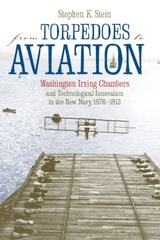
From Torpedoes to Aviation
Washington Irving Chambers & Technological Innovation in the New Navy 1876 to 1913Stephen K. Stein
University of Alabama Press, 2007
The central figure in the modernization of the U.S. Navy.
The career of Washington Irving Chambers spans a formative period in the development of the United States Navy: He entered the Naval Academy in the doldrum years of obsolete, often rotting ships, and left after he had helped like-minded officers convince Congress and the public of the need to adopt a new naval strategy built around a fleet of technologically advanced battleships. He also laid the groundwork for naval aviation and the important role it would play in the modern navy.
This work covers Chambers’s early naval career, his work at the new Office of Naval Intelligence, his participation in the Greeley Relief Expedition, and a survey for the projected isthmian canal through Nicaragua, before becoming the key advocate for naval modernization. As such, Chambers worked as a pioneering torpedo designer, supervised construction of the Maine, modernized the New York Navy Yard, and became a member of the first permanent faculty at the Naval War College.
During his long career, Chambers not only designed torpedoes, but also several warships, including a prototype Dreadnought-style battleship and a host of small devices that ranged from torpedo guidance systems to the first catapult for launching airplanes from ships. At the close of his career, Chambers purchased the navy’s first aircraft and founded its air arm. Working with Glenn Curtiss, Chambers guided a coalition of aviation enthusiasts and pioneers who popularized naval aviation and demonstrated its capabilities. Chambers arranged the first take-off and landing of an airplane from a ship and other demonstrations of naval aviation. Combined with his tireless advocacy for modernization, these contributions secured a place in naval and aviation history for the innovator.