Results by title
128 books match the query 'Buildings, structures, etc' and 4 start with f
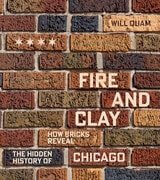
Fire and Clay
How Bricks Reveal the Hidden History of ChicagoWill Quam
University of Chicago Press, 2026
A remarkable exploration of Chicago’s architectural history through the humble brick.
By the late 1920s, at its peak of brick making and consumption, Chicago was making over a billion bricks a year for its buildings and importing almost another billion nicer face bricks for their front facades. Throughout Chicago’s history, brick dramatically transformed from a simple fireproof building material into an integral piece of architectural design. And no one knows the hidden details and stories of this fascinating history like Chicago’s foremost brick aficionado, Will Quam.
In Fire and Clay, Quam takes us on journeys to experience the beauty and mystery of Chicago’s buildings. He also explores how developers, architects, and masons followed changing fashions as they designed and built the city, creating connections across disparate neighborhoods. The red bricks that make up Lincoln Park mansions, for example, are the same as those found on Pullman row homes and Pilsen workers’ cottages, just as Rogers Park’s colorful bricks can also be found far across the city in South Shore. Known for his popular walking tours, Quam has built his life around the appreciation, study, and evangelizing of this most humble building block’s many wonders. Here, he pours all his knowledge into the first book of its kind, beautifully illustrated with more than one hundred of his own full-color photographs.
More than just an investigation into brick, Fire and Clay gives readers a fresh lens through which to explore the city anew and find clear connections across its different neighborhoods. By the end of this lively tour through Chicago’s history, readers will never look at a brick building the same way again.
[more]
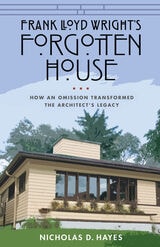
Frank Lloyd Wright's Forgotten House
How an Omission Transformed the Architect's LegacyNicholas D. Hayes
University of Wisconsin Press, 2021
While the grandiosity of Fallingwater and elegance of Taliesin are recognized universally, Frank Lloyd Wright’s first foray into affordable housing is frequently overlooked. Although Wright began work on his American System-Built Homes (ASBH, 1911–17) with great energy, the project fell apart following wartime shortages and disputes between the architect and his developer. While continuing to advocate for the design of affordable small homes, Wright never spoke publicly of ASBH. As a result, the heritage of many Wright-designed homes was forgotten.
When Nicholas and Angela Hayes became stewards of the unassuming Elizabeth Murphy House near Milwaukee, they began to unearth evidence that ultimately revealed a one-hundred-year-old fiasco fueled by competing ambitions and conflicting visions of America. The couple’s forensic pursuit of the truth untangled the ways Wright’s ASBH experiment led to the architect’s most productive, creative period. Frank Lloyd Wright’s Forgotten House includes a wealth of drawings and photographs, many of which have never been previously published. Historians, architecture buffs, and Wrightophiles alike will be fascinated by this untold history that fills a crucial gap in the architect’s oeuvre.
When Nicholas and Angela Hayes became stewards of the unassuming Elizabeth Murphy House near Milwaukee, they began to unearth evidence that ultimately revealed a one-hundred-year-old fiasco fueled by competing ambitions and conflicting visions of America. The couple’s forensic pursuit of the truth untangled the ways Wright’s ASBH experiment led to the architect’s most productive, creative period. Frank Lloyd Wright’s Forgotten House includes a wealth of drawings and photographs, many of which have never been previously published. Historians, architecture buffs, and Wrightophiles alike will be fascinated by this untold history that fills a crucial gap in the architect’s oeuvre.
[more]
Frank Lloyd Wright's Larkin Building
Myth and FactJack Quinan
University of Chicago Press, 2006
Frank Lloyd Wright’s Larkin Building has become an icon of modern architecture. And the fact that it was demolished only forty-six years after its 1904 completion makes Jack Quinan’s study of the building—which housed a Buffalo, New York, soap company—all the more valuable.
Quinan’s history draws on engineering documents, personal accounts of the building, and other papers he acquired from the family of Darwin D. Martin, a Larkin executive who proposed commissioning Wright to design the company’s offices. With access to these rare sources, Quinan reveals how a young Wright landed the commission and traces the evolution of his cutting-edge plans. Quinan then takes Wright studies to a new level, examining the Larkin Building as a structure at the center of economic and personal relationships.
Illustrated with more than one hundred photographs, floor plans, maps, and diagrams, Frank Lloyd Wright’s Larkin Building provides a concise but complete record of how the building was conceived, built, evaluated, and finally demolished in what has been called a tragic loss for American architecture.
[more]
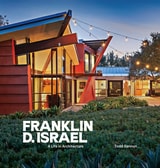
Franklin D. Israel
A Life in ArchitectureTodd Gannon
J. Paul Getty Trust, The, 2024
This book examines the life and legacy of Franklin D. Israel, an influential member of the Los Angeles school of architects.
Acclaimed Los Angeles architect Franklin D. Israel (1945–1996) created innovative residential projects and office interiors that made him one of the most talked-about designers of his generation. In this vivid account, architectural historian Todd Gannon draws on archival resources, analyses of Israel’s buildings, and recent interviews with the architect’s colleagues, clients, and contemporaries, including Frank Gehry, Thom Mayne, and Robert A. M. Stern. Gannon traces Israel’s development from his early years and career on the East Coast to his formative world travels and residence at the American Academy in Rome. The author guides readers through the Los Angeles architectural context, Israel’s influential teaching at UCLA, his dalliance with Hollywood, and the personal motivations behind his architecture and design work—all aspects of an influential career that was cut short by his death from AIDS-related complications at the age of fifty.
Franklin D. Israel is a compelling work of architectural history and biography, chronicling one gay man’s engagement with the largely heteronormative world of American architectural culture. It explores the achievement of this central figure in the still largely unstudied history of late twentieth-century avant-garde Los Angeles architecture.
[more]