Results by title
63 books match the query 'Cases' and 2 start with f
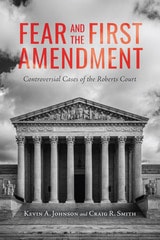
Fear and the First Amendment
Controversial Cases of the Roberts CourtKevin A. Johnson and Craig R. Smith
University of Alabama Press, 2024
DISTINGUISHED PUBLICATION AWARD FOR THE NATIONAL COMMUNICATION ASSOCIATION'S COMMUNICATION AND LAW DIVISION
The First Amendment: protected by law, threatened by fear in the Roberts Supreme Court.
In Fear and the First Amendment: Controversial Cases of the Roberts Court, Kevin A. Johnson and Craig R. Smith offer a deeply considered examination of the ways fear figures in First Amendment questions. Bringing together literature on theories of fear in rhetorical and philosophical traditions, Johnson and Smith focus on the rulings from the Roberts Court, which form a pivotal era of dramatic precedents. Each chapter analyzes one or more First Amendment cases and a variety of related fears—whether evidentiary or not—that pertain to a given case.
These cases include Morse v. Frederick, which takes up the competing fears of school administrators’ loss of authority and students’ loss of free speech rights. The authors touch on corporate funding of elections in Citizens United v. Federal Elections Commission, from the fear of corporate influence on electoral politics to corporate fears of alienating their consumers by backing political candidates. They explore religious freedom and fears of homosexuality in Christian Legal Society v. Martinez. Similarly, in Snyder v. Phelps, the authors delve further into fears of God, death, emotional distress, failing as a parent, and losing one’s reputation. Next, they investigate parents’ anxieties about violence in video games in Brown v. Entertainment Merchants Association. Finally, Johnson and Smith examine the role of fear in indecent, obscene, and graphic communication in three cases: FCC v. Fox Television Stations, Ashcroft v. American Civil Liberties Union, and United States v. Stevens.
Together these cases reveal fear to be an endemic factor in the rhetoric of First Amendment cases. This fascinating and original work will appeal to current legal practitioners and students of law, rhetoric, philosophy, and the First Amendment.
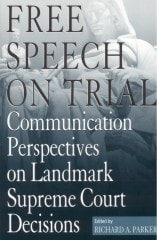
Free Speech On Trial
Communication Perspectives on Landmark Supreme Court DecisionsEdited by Richard A. Parker
University of Alabama Press, 2008
Describes landmark free speech decisions of the Supreme Court while highlighting the issues of language, rhetoric, and communication that underlie them.
At the intersection of communication and First Amendment law reside two significant questions: What is the speech we ought to protect, and why should we protect it? The 20 scholars of legal communication whose essays are gathered in this volume propose various answers to these questions, but their essays share an abiding concern with a constitutional guarantee of free speech and its symbiotic relationship with communication practices.
Free Speech on Trial fills a gap between textbooks that summarize First Amendment law and books that analyze case law and legal theory. These essays explore questions regarding the significance of unregulated speech in a marketplace of goods and ideas, the limits of offensive language and obscenity as expression, the power of symbols, and consequences of restraint prior to publication versus the subsequent punishment of sources. As one example, Craig Smith cites Buckley vs. Valeo to examine how the context of corruption in the 1974 elections shaped the Court's view of the constitutionality of campaign contributions and expenditures.
Collectively, the essays in this volume suggest that the life of free speech law is communication. The contributors reveal how the Court's free speech opinions constitute discursive performances that fashion, deconstruct, and reformulate the contours and parameters of the Constitution’s guarantee of free expression and that, ultimately, reconstitute our government, our culture, and our society.