Results by title
159 books match the query 'Change' and 7 start with f

FEASTS OF HONOR
RITUAL AND CHANGE IN THE TORAJA HIGHLANDToby Alice Volkman
University of Illinois Press, 1985

Fair Bananas!
Farmers, Workers, and Consumers Strive to Change an IndustryHenry J. Frundt
University of Arizona Press, 2009
Fair Bananas! is one of the first books to examine the issue of “fair-trade bananas.” Specifically, Henry Frundt analyzes whether a farmer-worker-consumer alliance can collaborate to promote a fair-trade label for bananas—much like those for fair-trade coffee and chocolate—that will appeal to North American shoppers. Researching the issue for more than ten years, Henry Frundt has elicited surprising and nuanced insights from banana workers, Latin American labor officials, company representatives, and fair-trade advocates.
Frundt writes with admirable clarity throughout the book, which he has designed for college students who are being introduced to the subject of international trade and for consumers who are interested in issues of development. Frankly, though, Fair Bananas! will appeal to anyone who wants to know more about bananas, including where they come from and how they get from there to here.
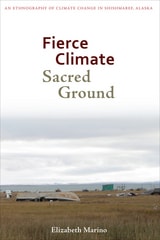
Fierce Climate, Sacred Ground
An Ethnography of Climate Change in Shishmaref, AlaskaElizabeth Marino
University of Alaska Press, 2015
Publications from the New York Times to Esquire have covered this disappearing village, yet few have taken the time to truly show the community and the two millennia of traditions at risk. In Fierce Climate, Sacred Ground, Elizabeth Marino brings Shishmaref into sharp focus as a place where people in a close-knit, determined community are confronting the realities of our changing planet every day. She shows how physical dangers challenge lives, while the stress and uncertainty challenge culture and identity. Marino also draws on Shishmaref’s experiences to show how disasters and the outcomes of climate change often fall heaviest on those already burdened with other social risks and often to communities who have contributed least to the problem. Stirring and sobering, Fierce Climate, Sacred Ground proves that the consequences of unchecked climate change are anything but theoretical.
Fifty Years of Change on the U.S.-Mexico Border
Growth, Development, and Quality of LifeBy Joan B. Anderson and James Gerber
University of Texas Press, 2007
Winner, Book Award, Associaton for Borderland Studies, 2008
The U.S. and Mexican border regions have experienced rapid demographic and economic growth over the last fifty years. In this analysis, Joan Anderson and James Gerber offer a new perspective on the changes and tensions pulling at the border from both sides through a discussion of cross-border economic issues and thorough analytical research that examines not only the dramatic demographic and economic growth of the region, but also shifts in living standards, the changing political climate, and environmental pressures, as well as how these affect the lives of people in the border region.
Creating what they term a Border Human Development Index, the authors rank the quality of life for every U.S. county and Mexican municipio that touches the 2,000-mile border. Using data from six U.S. and Mexican censuses, the book adeptly illustrates disparities in various aspects of economic development between the two countries over the last six decades.
Anderson and Gerber make the material accessible and compelling by drawing an evocative picture of how similar the communities on either side of the border are culturally, yet how divided they are economically. The authors bring a heightened level of insight to border issues not just for academics but also for general readers. The book will be of particular value to individuals interested in how the border between the two countries shapes the debates on quality of life, industrial growth, immigration, cross-border integration, and economic and social development.

Fighting Back in Appalachia
Traditions of Resistance and Changeedited by Stephen L. Fisher
Temple University Press, 1993
Contributors: Bill Allen, Mary K. Anglin, Fran Ansley, Alan Banks, Dwight Billings, Mary Beth Bingman, Sherry Cable, Guy and Candie Carawan, Richard A. Couto, Stephen William Foster, John M. Glen, Hal Hamilton, Bennett M. Judkins, Don Manning-Miller, Ellen Ryan, Jim Sessions, Joe Szakos, Karen Tice, Chris Weiss, and the editor.
Folk Religion in Japan
Continuity and ChangeIchiro Hori
University of Chicago Press, 1968
Folk religion, transmitted by the common people from generation to generation, has greatly conditioned the political, economic, and cultural development of Japan and continues to satisfy the emotional and religious needs of the people. Hori examines the organic relationship between the Japanese social structure—the family kinship system, village and community organizations—and folk religion. A glossary with Japanese characters is included in the index.
From Revolution to War
State Relations in a World of ChangePatrick J. Conge
University of Michigan Press, 2000