Results by title
80 books match the query 'Clergy' and 7 start with f
Faith in the City
Preaching Radical Social Change in DetroitAngela D. Dillard
University of Michigan Press, 2009
“The dynamics of Black Theology were at the center of the ‘Long New Negro Renaissance,’ triggered by mass migrations to industrial hubs like Detroit. Finally, this crucial subject has found its match in the brilliant scholarship of Angela Dillard. No one has done a better job of tracing those religious roots through the civil rights–black power era than Professor Dillard.”
—Komozi Woodard, Professor of History, Public Policy & Africana Studies at Sarah Lawrence College and author of A Nation within a Nation: Amiri Baraka (LeRoi Jones) and Black Power Politics
“Angela Dillard recovers the long-submerged links between the black religious and political lefts in postwar Detroit. . . . Faith in the City is an essential contribution to the growing literature on the struggle for racial equality in the North.”
—Thomas J. Sugrue, University of Pennsylvania, author of The Origins of the Urban Crisis: Race and Inequality in Postwar Detroit
Spanning more than three decades and organized around the biographies of Reverends Charles A. Hill and Albert B. Cleage Jr., Faith in the City is a major new exploration of how the worlds of politics and faith merged for many of Detroit’s African Americans—a convergence that provided the community with a powerful new voice and identity. While other religions have mixed politics and creed, Faith in the City shows how this fusion was and continues to be particularly vital to African American clergy and the Black freedom struggle.
Activists in cities such as Detroit sustained a record of progressive politics over the course of three decades. Angela Dillard reveals this generational link and describes what the activism of the 1960s owed to that of the 1930s. The labor movement, for example, provided Detroit’s Black activists, both inside and outside the unions, with organizational power and experience virtually unmatched by any other African American urban community.
Angela D. Dillard is Associate Professor of Afroamerican and African Studies at the University of Michigan. She specializes in American and African American intellectual history, religious studies, critical race theory, and the history of political ideologies and social movements in the United States.
Father Groppi
Marching for Civil RightsStuart Stotts
Wisconsin Historical Society Press, 2013
Father Groppi Marched to Change Milwaukee
"Father Groppi: Marching for Civil Rights" tells the story of Father James Groppi, a Catholic priest from Milwaukee, Wis., who stood up for civil rights in the 1960s and 1970s.
This important new addition to the Badger Biographies series for young readers also tells about a turbulent time in Wisconsin history and sheds light on the civil rights movement and its place in the North.
Growing up on the south side of Milwaukee as the son of Italian immigrants, young James Groppi learned early on what it felt like to be made fun of just because of who you are, and he learned to respect people from other races and ethnic groups. Later, while studying to become a priest, he saw the discrimination African Americans faced. It made him angry, and he vowed to do whatever he could to fight racism.
Father Groppi marched with Dr. Martin Luther King Jr. and other leaders of the civil rights movement. But he knew there was work to be done in his own city. In Milwaukee, he teamed up with the NAACP and other organizations, protesting discrimination and segregation wherever they saw it. It wasn't always easy, and Father Groppi and the other civil rights workers faced great challenges.
First Founders
American Puritans and Puritanism in an Atlantic WorldFrancis J. Bremer
University of New Hampshire Press, 2012
This is a truly fascinating look at the Puritans with keenly drawn portraits and the insight that only a lifetime of scholarship can achieve. It should become the standard introduction to the field. Written in the mold of Joseph Ellis’s Founding Brothers and Gordon Wood’s Revolutionary Characters, the book will appeal to general readers, students, and scholars alike.
Following Father Chiniquy
Immigration, Religious Schism, and Social Change in Nineteenth-Century IllinoisCaroline B. Brettell
Southern Illinois University Press, 2015
Winner, ISHS Certificate of Excellence, 2016
In the late 1850s and early 1860s, the attention of the Catholic and Protestant religious communities around the world focused on a few small settlements of French Canadian immigrants in northeastern Illinois. Soon after arriving in their new home, a large number of these immigrants, led by Father Charles Chiniquy, the charismatic Catholic priest who had brought them there, converted to Protestantism. In this anthropological history, Caroline B. Brettell explores how Father Chiniquy took on both the sacred and the secular authority of the Catholic Church to engineer the religious schism and how the legacy of this rift affected the lives of the immigrants and their descendants for generations. This intriguing study of a nineteenth-century migration of French Canadians to the American Midwest offers an innovative perspective on the immigrant experience in America.
Brettell chronicles how Chiniquy came to lead approximately one thousand French Canadian families to St. Anne, Illinois, in the early 1850s and how his conflict with the Catholic hierarchy over the ownership and administration of church property, delivery of the mass in French instead of Latin, and access to the Bible by laymen led to his excommunication. Drawing on the concept of social drama—a situation of intensely lived conflict that emerges within social groups—Brettell explains the religious schism in terms of larger ethnic and religious disagreements that were happening elsewhere in the United States and in Canada. Brettell also explores legal disputes, analyzes the reemergence of Catholicism in St. Anne in the first decade of the twentieth century, addresses the legacy of Chiniquy in both the United States and Quebec, and closely examines the French Canadian immigrant communities, focusing on the differences between the people who converted to Protestantism and those who remained Catholic.
Occurring when nativism was pervasive and the anti-immigrant Know-Nothing Party was at its height, Chiniquy’s religious schism offers an opportunity to examine a range of important historical and anthropological issues, including immigration, ethnicity, and religion; changes in household and family structure; the ways social identities are constructed and reconstructed through time; and the significance of charismatic leadership in processes of social and religious change. Through its multidisciplinary approach, Brettell’s enlightening study provides a pioneering assessment of larger national tensions and social processes, some of which are still evident in modern immigration to the United States.

Fragments of a World
William of Auvergne and His Medieval LifeLesley Smith
University of Chicago Press, 2023
Today, William of Auvergne (1180?–1249) is remembered for his scholarship about the afterlife as well as the so-called Trial of the Talmud. But the medieval bishop of Paris also left behind nearly 600 sermons delivered to all manner of people—from the royal court to the poorest in his care. In Fragments of a World, Lesley Smith uses these sermons to paint a vivid picture of this extraordinary cleric, his parishioners, and their bustling world. The first modern biography of the influential teacher, bishop, and theologian, Fragments of a World casts a new image of William of Auvergne for our times—deeply attuned to both the spiritual and material needs of an ever-changing populace in the medieval city.
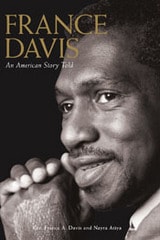
France Davis
An American Story ToldDavis, France
University of Utah Press, 2007
As I was coming up, it was painful to me not to have been given my own nickname. It made me feel different, or rather that I was being treated differently from other family members. I wondered why everybody else was spoken to in terms of their identity, their character, their behavior, and I was simply identified by the 'tag,' my given name. But then, when I read in a book that France meant free, I began to think of it as imbuing me with a sense of flight, of movement. Ultimately, I came to believe my name spoke for itself and that I did not need any other.'—from the book
Imbued with rich detail of family life in a rural community, as well as a system of values at a time of transition in American history, this is the life story of France Davis, the dynamic pastor of the Calvary Baptist Church in Salt Lake City. It is an engaging story of courage and vision that describes coming of age in the segregation-era South, of dreaming, enduring with honor, and living at the forefront of major issues within the United States.
Recorded and skillfully written by Nayra Atiya, France Davis: An American Story Told, is an oral history, ethnography, memoir, perhaps even a life-enhancing sermon delivered with the strong voice of a preacher. The gathered strands of a life lived with conviction and grace will appeal to a broad spectrum of readers from the curious to those seeking inspiration.
Winner of the Utah Book Award in Nonfiction.
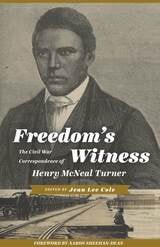
Freedom's Witness
The Civil War Correspondence of Henry McNeal TurnerJean Lee Cole
West Virginia University Press, 2013